STATISTICS
IN
NURSING
Prepared By
Monika Devi NR
M.Sc.Nursing
GMCH Jammu
DEFINITION
• Statistics is the science of making effective use of
numerical data which is related to collection, analysis
and interpretation of data.
• Statistics is the study of how to collect, organizes,
analyze, and Interpret data.
2
Monika Devi NR M.Sc.Nursing
Importance
• Statistics plays a vitally important role in the research.
• It help to answer important research questions and field in
study.
• Helps you understand how to apply statistical method
• Important to understand what tools are suitable for a
particular research study.
• Statistics enables to understand specified statistical
concepts and procedures.
3
Monika Devi NR M.Sc.Nursing
TYPES OF STATISTICS
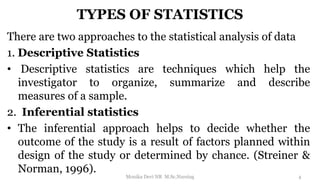
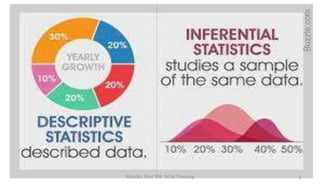
There are two approaches to the statistical analysis of data
1. Descriptive Statistics
• Descriptive statistics are techniques which help the
investigator to organize, summarize and describe
measures of a sample.
2. Inferential statistics
• The inferential approach helps to decide whether the
outcome of the study is a result of factors planned within
design of the study or determined by chance. (Streiner &
Norman, 1996).
4
Monika Devi NR M.Sc.Nursing
5
Monika Devi NR M.Sc.Nursing
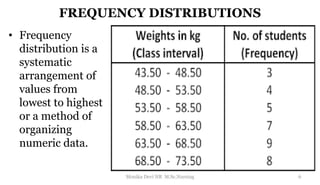
FREQUENCY DISTRIBUTIONS
• Frequency
distribution is a
systematic
arrangement of
values from
lowest to highest
or a method of
organizing
numeric data.
6
Monika Devi NR M.Sc.Nursing
PRESENTATION OF DATA & SHAPES
1. Tabular presentation
2. Diagrammatic Presentation
3. Graphical Presentation
7
Monika Devi NR M.Sc.Nursing
.
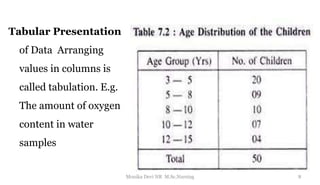
Tabular Presentation
of Data Arranging
values in columns is
called tabulation. E.g.
The amount of oxygen
content in water
samples
8
Monika Devi NR M.Sc.Nursing
.
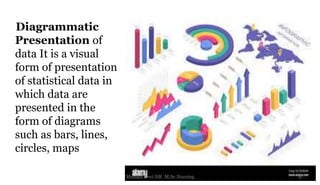
Diagrammatic
Presentation of
data It is a visual
form of presentation
of statistical data in
which data are
presented in the
form of diagrams
such as bars, lines,
circles, maps
9
Monika Devi NR M.Sc.Nursing
Common Types
• Line Diagram
• Pie diagram
• Bar diagram
• C.Line diagram
10
Monika Devi NR M.Sc.Nursing
SHAPES OF FREQUENCY DISTRIBUTION
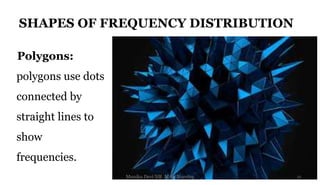
Polygons:
polygons use dots
connected by
straight lines to
show
frequencies.
11
Monika Devi NR M.Sc.Nursing
.
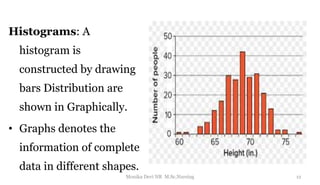
Histograms: A
histogram is
constructed by drawing
bars Distribution are
shown in Graphically.
• Graphs denotes the
information of complete
data in different shapes.
12
Monika Devi NR M.Sc.Nursing
Cont…
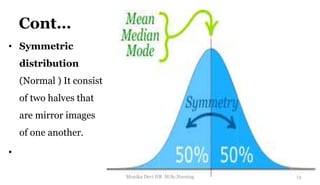
• Symmetric
distribution
(Normal ) It consist
of two halves that
are mirror images
of one another.
•
13
Monika Devi NR M.Sc.Nursing
.
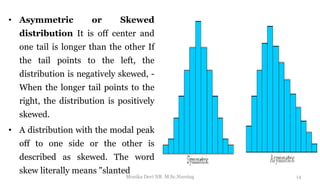
• Asymmetric or Skewed
distribution It is off center and
one tail is longer than the other If
the tail points to the left, the
distribution is negatively skewed, -
When the longer tail points to the
right, the distribution is positively
skewed.
• A distribution with the modal peak
off to one side or the other is
described as skewed. The word
skew literally means "slanted
14
Monika Devi NR M.Sc.Nursing
Conti..
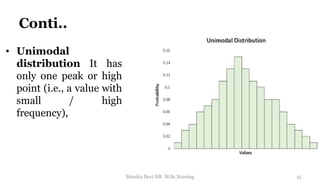
• Unimodal
distribution It has
only one peak or high
point (i.e., a value with
small / high
frequency),
15
Monika Devi NR M.Sc.Nursing
.
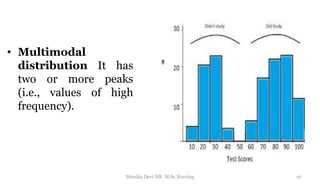
• Multimodal
distribution It has
two or more peaks
(i.e., values of high
frequency).
16
Monika Devi NR M.Sc.Nursing
STATISTICS & DATA ANALYSIS
1. Measures of central
tendency
2. Mean
3. Mode
4. Median
5. Measures of variability
6. Range
7. Standard deviation
8. Correlation
9. Inferential statistics
10. T- test
11. Chi square test
12. ANOVA
17
Monika Devi NR M.Sc.Nursing
CENTRAL TENDENCY
• It is a statistical measure that identifies a single score as
representative for an entire distribution or group.
1. Mean
2. Mode
3. Median
18
Monika Devi NR M.Sc.Nursing
Levels of Measure Used
• Interval level variables – Mean
• Nominal variables – Mode
• Ordinal variables - Median Measures of Central
Tendency
19
Monika Devi NR M.Sc.Nursing
Cont…
• Relationship between mean, median, and mode
is determined by the shape of the distribution
CENTRAL TENDENCY AND THE SHAPE OF THE
DISTRIBUTION
20
Monika Devi NR M.Sc.Nursing
Range
• It is the difference between the lowest and highest number in the
set.
• Range = Xhighest – Xlowest
• E.g: SAT scores of students at two nursing schools.
• Both distributions have a mean of 500, but the score patterns
are different. School A has a wide range of scores, with some
below 300 and some above 700. This school has many students
who performed among the best also many students who scored
well below average. In school B, there are few students at either
extreme.
21
Monika Devi NR M.Sc.Nursing
STANDARD DEVIATION
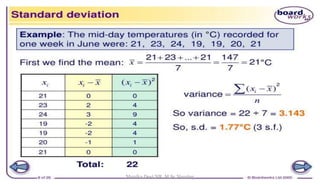
• Standard deviation is the most common measure of variability.
• It is used the mean as a reference point and approximates the
average distance of each score from the mean.
• A deviation (x) is the difference between an individual score
and the mean
• VARIANCE:- The variance is simply the value of the standard
deviation before a square root has been taken
22
Monika Devi NR M.Sc.Nursing
23
Monika Devi NR M.Sc.Nursing
CORRELATION
• Correlation is a measure of association between two
variables.
• Correlations can be graphed on scatter plot or scatter
diagram.
• Scatter plot: It involves making a rectangular coordinate
graph with the two variables laid out at right angles.
• plot (dots) are shown to help identify subjects.
24
Monika Devi NR M.Sc.Nursing
CORRELATION COEFFICIENT
(PEARSON’S – R)
Correlation coefficients can be computed with
two variables measured on either the ordinal,
interval, or ratio scale Pearson’s Calculation…..
25
Monika Devi NR M.Sc.Nursing
INFERENTIAL STATISTICS
• Inferential statistics is a statistical method used to infer result s
of sample (statistic) to population (parameter).
• It is a process of inductive reasoning based on the mathematical
theory of probability - (Fowler, J., Jarvis, P. -2002).
• Component of inferential statistics.
– Hypothesis testing
– Estimation
26
Monika Devi NR M.Sc.Nursing
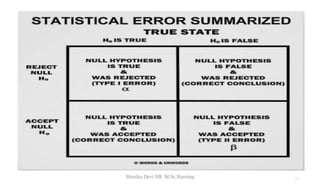
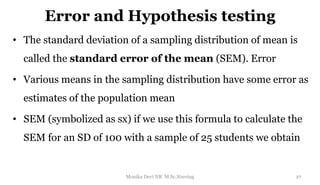
Error and Hypothesis testing
• The standard deviation of a sampling distribution of mean is
called the standard error of the mean (SEM). Error
• Various means in the sampling distribution have some error as
estimates of the population mean
• SEM (symbolized as sx) if we use this formula to calculate the
SEM for an SD of 100 with a sample of 25 students we obtain
27
Monika Devi NR M.Sc.Nursing
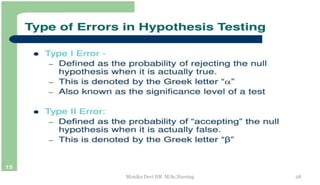
28
Monika Devi NR M.Sc.Nursing
29
Monika Devi NR M.Sc.Nursing
30
Monika Devi NR M.Sc.Nursing
ESTIMATION
It is used to estimate a single parameter, like a mean. Estimation
can take in to two forms.
Forms:
• Point estimation : Point estimation involves calculating a
single statistic to estimate the population parameter. Point
estimates convey no information about accuracy
• Interval estimation : it indicates a range of values within
which the parameter has a specified probability of lying
31
Monika Devi NR M.Sc.Nursing
STATISTICAL TESTS
There are two types of inferential statistics
1. Parametric
2. Non-parametric Tests
Parametric Tests A parametric test is one which specifies
certain conditions about the parameter of the population
from which a sample is taken. E.g t-test, and F-test
(ANOVA).
Non-parametric tests (Distribution-free Statistics) A non-
parametric test is one does not specify any conditions about
the parameter of the population from which the population is
drawn. These tests are called. E.g Chi-squire test.
32
Monika Devi NR M.Sc.Nursing
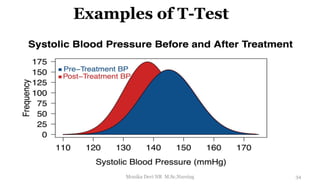
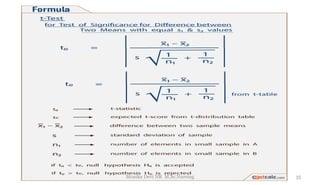
T- TEST
• It is used to testing the differences in group S of
mean.
• T-test can be used when there are two
independent groups (e.G., Experimental versus
control, male versus female), degree of freedom
(df)
• Degree of freedom (df) is describes the number of
events or observations that are free to vary.
• Formula t-test degrees of freedom (df)
33
Monika Devi NR M.Sc.Nursing
Examples of T-Test
34
Monika Devi NR M.Sc.Nursing
.
35
Monika Devi NR M.Sc.Nursing
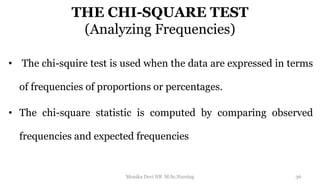
THE CHI-SQUARE TEST
(Analyzing Frequencies)
• The chi-squire test is used when the data are expressed in terms
of frequencies of proportions or percentages.
• The chi-square statistic is computed by comparing observed
frequencies and expected frequencies
36
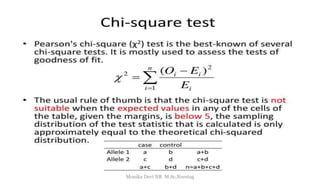
Monika Devi NR M.Sc.Nursing
37
Monika Devi NR M.Sc.Nursing
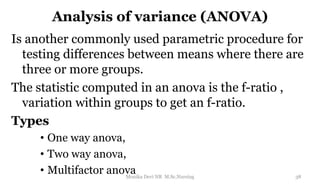
Analysis of variance (ANOVA)
Is another commonly used parametric procedure for
testing differences between means where there are
three or more groups.
The statistic computed in an anova is the f-ratio ,
variation within groups to get an f-ratio.
Types
• One way anova,
• Two way anova,
• Multifactor anova 38
Monika Devi NR M.Sc.Nursing
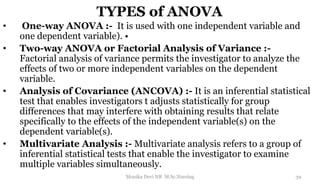
TYPES of ANOVA
• One-way ANOVA :- It is used with one independent variable and
one dependent variable). •
• Two-way ANOVA or Factorial Analysis of Variance :-
Factorial analysis of variance permits the investigator to analyze the
effects of two or more independent variables on the dependent
variable.
• Analysis of Covariance (ANCOVA) :- It is an inferential statistical
test that enables investigators t adjusts statistically for group
differences that may interfere with obtaining results that relate
specifically to the effects of the independent variable(s) on the
dependent variable(s).
• Multivariate Analysis :- Multivariate analysis refers to a group of
inferential statistical tests that enable the investigator to examine
multiple variables simultaneously.
39
Monika Devi NR M.Sc.Nursing
Thank You
40
Monika Devi NR M.Sc.Nursing

Statstics in nursing

  • 1.
  • 2.
    DEFINITION • Statistics isthe science of making effective use of numerical data which is related to collection, analysis and interpretation of data. • Statistics is the study of how to collect, organizes, analyze, and Interpret data. 2 Monika Devi NR M.Sc.Nursing
  • 3.
    Importance • Statistics playsa vitally important role in the research. • It help to answer important research questions and field in study. • Helps you understand how to apply statistical method • Important to understand what tools are suitable for a particular research study. • Statistics enables to understand specified statistical concepts and procedures. 3 Monika Devi NR M.Sc.Nursing
  • 4.
    TYPES OF STATISTICS Thereare two approaches to the statistical analysis of data 1. Descriptive Statistics • Descriptive statistics are techniques which help the investigator to organize, summarize and describe measures of a sample. 2. Inferential statistics • The inferential approach helps to decide whether the outcome of the study is a result of factors planned within design of the study or determined by chance. (Streiner & Norman, 1996). 4 Monika Devi NR M.Sc.Nursing
  • 5.
    5 Monika Devi NRM.Sc.Nursing
  • 6.
    FREQUENCY DISTRIBUTIONS • Frequency distributionis a systematic arrangement of values from lowest to highest or a method of organizing numeric data. 6 Monika Devi NR M.Sc.Nursing
  • 7.
    PRESENTATION OF DATA& SHAPES 1. Tabular presentation 2. Diagrammatic Presentation 3. Graphical Presentation 7 Monika Devi NR M.Sc.Nursing
  • 8.
    . Tabular Presentation of DataArranging values in columns is called tabulation. E.g. The amount of oxygen content in water samples 8 Monika Devi NR M.Sc.Nursing
  • 9.
    . Diagrammatic Presentation of data Itis a visual form of presentation of statistical data in which data are presented in the form of diagrams such as bars, lines, circles, maps 9 Monika Devi NR M.Sc.Nursing
  • 10.
    Common Types • LineDiagram • Pie diagram • Bar diagram • C.Line diagram 10 Monika Devi NR M.Sc.Nursing
  • 11.
    SHAPES OF FREQUENCYDISTRIBUTION Polygons: polygons use dots connected by straight lines to show frequencies. 11 Monika Devi NR M.Sc.Nursing
  • 12.
    . Histograms: A histogram is constructedby drawing bars Distribution are shown in Graphically. • Graphs denotes the information of complete data in different shapes. 12 Monika Devi NR M.Sc.Nursing
  • 13.
    Cont… • Symmetric distribution (Normal )It consist of two halves that are mirror images of one another. • 13 Monika Devi NR M.Sc.Nursing
  • 14.
    . • Asymmetric orSkewed distribution It is off center and one tail is longer than the other If the tail points to the left, the distribution is negatively skewed, - When the longer tail points to the right, the distribution is positively skewed. • A distribution with the modal peak off to one side or the other is described as skewed. The word skew literally means "slanted 14 Monika Devi NR M.Sc.Nursing
  • 15.
    Conti.. • Unimodal distribution Ithas only one peak or high point (i.e., a value with small / high frequency), 15 Monika Devi NR M.Sc.Nursing
  • 16.
    . • Multimodal distribution Ithas two or more peaks (i.e., values of high frequency). 16 Monika Devi NR M.Sc.Nursing
  • 17.
    STATISTICS & DATAANALYSIS 1. Measures of central tendency 2. Mean 3. Mode 4. Median 5. Measures of variability 6. Range 7. Standard deviation 8. Correlation 9. Inferential statistics 10. T- test 11. Chi square test 12. ANOVA 17 Monika Devi NR M.Sc.Nursing
  • 18.
    CENTRAL TENDENCY • Itis a statistical measure that identifies a single score as representative for an entire distribution or group. 1. Mean 2. Mode 3. Median 18 Monika Devi NR M.Sc.Nursing
  • 19.
    Levels of MeasureUsed • Interval level variables – Mean • Nominal variables – Mode • Ordinal variables - Median Measures of Central Tendency 19 Monika Devi NR M.Sc.Nursing
  • 20.
    Cont… • Relationship betweenmean, median, and mode is determined by the shape of the distribution CENTRAL TENDENCY AND THE SHAPE OF THE DISTRIBUTION 20 Monika Devi NR M.Sc.Nursing
  • 21.
    Range • It isthe difference between the lowest and highest number in the set. • Range = Xhighest – Xlowest • E.g: SAT scores of students at two nursing schools. • Both distributions have a mean of 500, but the score patterns are different. School A has a wide range of scores, with some below 300 and some above 700. This school has many students who performed among the best also many students who scored well below average. In school B, there are few students at either extreme. 21 Monika Devi NR M.Sc.Nursing
  • 22.
    STANDARD DEVIATION • Standarddeviation is the most common measure of variability. • It is used the mean as a reference point and approximates the average distance of each score from the mean. • A deviation (x) is the difference between an individual score and the mean • VARIANCE:- The variance is simply the value of the standard deviation before a square root has been taken 22 Monika Devi NR M.Sc.Nursing
  • 23.
    23 Monika Devi NRM.Sc.Nursing
  • 24.
    CORRELATION • Correlation isa measure of association between two variables. • Correlations can be graphed on scatter plot or scatter diagram. • Scatter plot: It involves making a rectangular coordinate graph with the two variables laid out at right angles. • plot (dots) are shown to help identify subjects. 24 Monika Devi NR M.Sc.Nursing
  • 25.
    CORRELATION COEFFICIENT (PEARSON’S –R) Correlation coefficients can be computed with two variables measured on either the ordinal, interval, or ratio scale Pearson’s Calculation….. 25 Monika Devi NR M.Sc.Nursing
  • 26.
    INFERENTIAL STATISTICS • Inferentialstatistics is a statistical method used to infer result s of sample (statistic) to population (parameter). • It is a process of inductive reasoning based on the mathematical theory of probability - (Fowler, J., Jarvis, P. -2002). • Component of inferential statistics. – Hypothesis testing – Estimation 26 Monika Devi NR M.Sc.Nursing
  • 27.
    Error and Hypothesistesting • The standard deviation of a sampling distribution of mean is called the standard error of the mean (SEM). Error • Various means in the sampling distribution have some error as estimates of the population mean • SEM (symbolized as sx) if we use this formula to calculate the SEM for an SD of 100 with a sample of 25 students we obtain 27 Monika Devi NR M.Sc.Nursing
  • 28.
    28 Monika Devi NRM.Sc.Nursing
  • 29.
    29 Monika Devi NRM.Sc.Nursing
  • 30.
    30 Monika Devi NRM.Sc.Nursing
  • 31.
    ESTIMATION It is usedto estimate a single parameter, like a mean. Estimation can take in to two forms. Forms: • Point estimation : Point estimation involves calculating a single statistic to estimate the population parameter. Point estimates convey no information about accuracy • Interval estimation : it indicates a range of values within which the parameter has a specified probability of lying 31 Monika Devi NR M.Sc.Nursing
  • 32.
    STATISTICAL TESTS There aretwo types of inferential statistics 1. Parametric 2. Non-parametric Tests Parametric Tests A parametric test is one which specifies certain conditions about the parameter of the population from which a sample is taken. E.g t-test, and F-test (ANOVA). Non-parametric tests (Distribution-free Statistics) A non- parametric test is one does not specify any conditions about the parameter of the population from which the population is drawn. These tests are called. E.g Chi-squire test. 32 Monika Devi NR M.Sc.Nursing
  • 33.
    T- TEST • Itis used to testing the differences in group S of mean. • T-test can be used when there are two independent groups (e.G., Experimental versus control, male versus female), degree of freedom (df) • Degree of freedom (df) is describes the number of events or observations that are free to vary. • Formula t-test degrees of freedom (df) 33 Monika Devi NR M.Sc.Nursing
  • 34.
    Examples of T-Test 34 MonikaDevi NR M.Sc.Nursing
  • 35.
    . 35 Monika Devi NRM.Sc.Nursing
  • 36.
    THE CHI-SQUARE TEST (AnalyzingFrequencies) • The chi-squire test is used when the data are expressed in terms of frequencies of proportions or percentages. • The chi-square statistic is computed by comparing observed frequencies and expected frequencies 36 Monika Devi NR M.Sc.Nursing
  • 37.
    37 Monika Devi NRM.Sc.Nursing
  • 38.
    Analysis of variance(ANOVA) Is another commonly used parametric procedure for testing differences between means where there are three or more groups. The statistic computed in an anova is the f-ratio , variation within groups to get an f-ratio. Types • One way anova, • Two way anova, • Multifactor anova 38 Monika Devi NR M.Sc.Nursing
  • 39.
    TYPES of ANOVA •One-way ANOVA :- It is used with one independent variable and one dependent variable). • • Two-way ANOVA or Factorial Analysis of Variance :- Factorial analysis of variance permits the investigator to analyze the effects of two or more independent variables on the dependent variable. • Analysis of Covariance (ANCOVA) :- It is an inferential statistical test that enables investigators t adjusts statistically for group differences that may interfere with obtaining results that relate specifically to the effects of the independent variable(s) on the dependent variable(s). • Multivariate Analysis :- Multivariate analysis refers to a group of inferential statistical tests that enable the investigator to examine multiple variables simultaneously. 39 Monika Devi NR M.Sc.Nursing
  • 40.
    Thank You 40 Monika DeviNR M.Sc.Nursing