Projectiles Freefall And
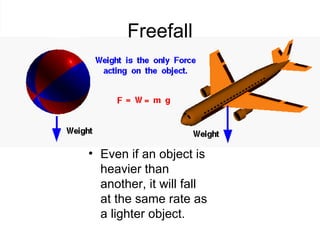
Freefall Even if an object is heavier than another, it will fall at the same rate as a lighter object.
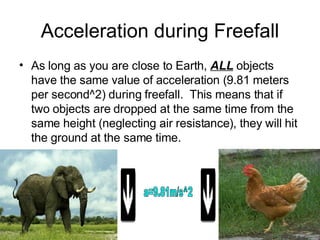
Acceleration during Freefall As long as you are close to Earth,  ALL  objects have the same value of acceleration (9.81 meters per second^2) during freefall.  This means that if two objects are dropped at the same time from the same height (neglecting air resistance), they will hit the ground at the same time. a=9.81m/s^2
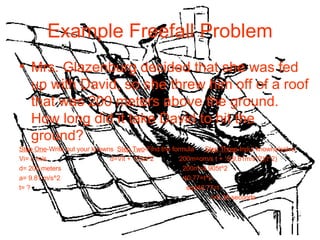
Example Freefall Problem Mrs. Glazenburg decided that she was fed up with David, so she threw him off of a roof that was 200 meters above the ground.  How long did it take David to hit the ground? Step One -Write out your knowns  Step Two -Find the formula  Step Three -Input knowns/solve Vi= o m/s  d=Vit + 1/2at^2  200m=om/s t + ½(9.81m/s^2)(t^2) d= 200 meters  200m=4.905t^2 a= 9.81 m/s^2  40.77=t^2 t= ?  sqrt40.77=t t=6.39 seconds
Real life Applications Freefall applies to many occurrences in life: If an object falls vertically downward in a vacuum tube Moon Orbiting around the Earth Projectile Examples in Life: -In Sports: Tiger Woods’s golf ball flying through the air. Brett Favre’s Pass thrown down field. Pedro Martinez’s Pitch. -In Life: A bullet being shot. An arrow fired.
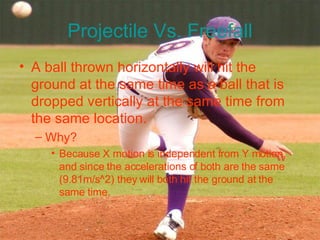
Projectile Vs. Freefall A ball thrown horizontally will hit the ground at the same time as a ball that is dropped vertically at the same time from the same location. Why? Because X motion is independent from Y motion, and since the accelerations of both are the same (9.81m/s^2) they will both hit the ground at the same time.
X-Axis and Y-Axis  in Projectile Problems In Projectile problems, the y-axis and x-axis are independent of each other because they have different motions, therefore should be treated separately.  To insure this is accounted for, one should make a table with the x-axis coefficients on one side and the y-axis coefficients on the other side.

Free Fall & Projectiles 3

  • 1.
  • 2.
    Freefall Even ifan object is heavier than another, it will fall at the same rate as a lighter object.
  • 3.
    Acceleration during FreefallAs long as you are close to Earth, ALL objects have the same value of acceleration (9.81 meters per second^2) during freefall. This means that if two objects are dropped at the same time from the same height (neglecting air resistance), they will hit the ground at the same time. a=9.81m/s^2
  • 4.
    Example Freefall ProblemMrs. Glazenburg decided that she was fed up with David, so she threw him off of a roof that was 200 meters above the ground. How long did it take David to hit the ground? Step One -Write out your knowns Step Two -Find the formula Step Three -Input knowns/solve Vi= o m/s d=Vit + 1/2at^2 200m=om/s t + ½(9.81m/s^2)(t^2) d= 200 meters 200m=4.905t^2 a= 9.81 m/s^2 40.77=t^2 t= ? sqrt40.77=t t=6.39 seconds
  • 5.
    Real life ApplicationsFreefall applies to many occurrences in life: If an object falls vertically downward in a vacuum tube Moon Orbiting around the Earth Projectile Examples in Life: -In Sports: Tiger Woods’s golf ball flying through the air. Brett Favre’s Pass thrown down field. Pedro Martinez’s Pitch. -In Life: A bullet being shot. An arrow fired.
  • 6.
    Projectile Vs. FreefallA ball thrown horizontally will hit the ground at the same time as a ball that is dropped vertically at the same time from the same location. Why? Because X motion is independent from Y motion, and since the accelerations of both are the same (9.81m/s^2) they will both hit the ground at the same time.
  • 7.
    X-Axis and Y-Axis in Projectile Problems In Projectile problems, the y-axis and x-axis are independent of each other because they have different motions, therefore should be treated separately. To insure this is accounted for, one should make a table with the x-axis coefficients on one side and the y-axis coefficients on the other side.