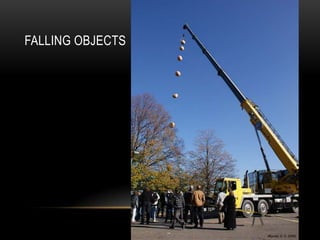
Falling Objects
What is physics exactly? 	The branch of science concerned with the nature and properties of matter and energy.The study of the physical worldIncludes mechanics, heat, light and other radiation, sound, electricity, magnetism, and the structure of atoms
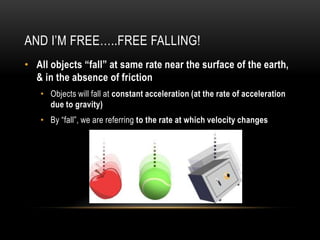
All objects “fall” at same rate near the surface of the earth, & in the absence of frictionObjects will fall at constant acceleration (at the rate of acceleration due to gravity)By “fall”, we are referring to the rate at which velocity changesAnd I’m free…..free falling!
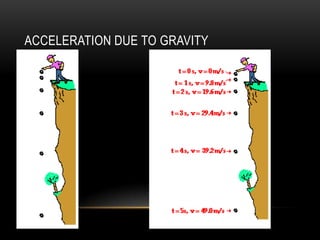
SI units: ay = g = -9.81 m/s2The velocity of an object changes 9.81 m/s every second. English units: ay = g =  -32.2 ft/s2The velocity of an object changes 32.2 m/s every second. Acceleration due to gravity
Acceleration due to gravity
It NEVER ceases to existIt ALWAYS works DOWNIt is NEVER zeroAcceleration due to gravity
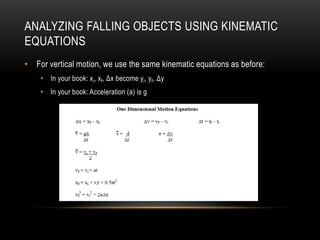
For vertical motion, we use the same kinematic equations as before:  In your book: xi, xf, Δx become yi, yf, ΔyIn your book: Acceleration (a) is gAnalyzing falling objects using kinematic equations
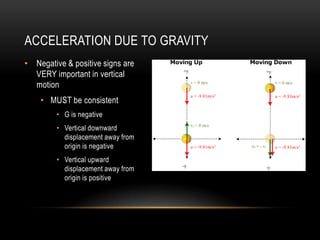
Negative & positive signs are VERY important in vertical motionMUST be consistentG is negativeVertical downward displacement away from origin is negativeVertical upward displacement away from origin is positiveAcceleration due to gravity
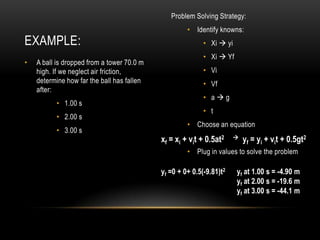
A ball is dropped from a tower 70.0 m high. If we neglect air friction, determine how far the ball has fallen after:1.00 s2.00 s3.00 sProblem Solving Strategy:Identify knowns:Xi  yiXi  YfViVfa  g tChoose an equationPlug in values to solve the problem  Example: xf = xi + vit + 0.5at2     yf= yi+ vit + 0.5gt2yf =0 + 0+ 0.5(-9.81)t2yf at 1.00 s = -4.90 myf at 2.00 s = -19.6 myf at 3.00 s = -44.1 m

Free fall motion-part 1

  • 1.
  • 2.
    What is physicsexactly? The branch of science concerned with the nature and properties of matter and energy.The study of the physical worldIncludes mechanics, heat, light and other radiation, sound, electricity, magnetism, and the structure of atoms
  • 3.
    All objects “fall”at same rate near the surface of the earth, & in the absence of frictionObjects will fall at constant acceleration (at the rate of acceleration due to gravity)By “fall”, we are referring to the rate at which velocity changesAnd I’m free…..free falling!
  • 4.
    SI units: ay= g = -9.81 m/s2The velocity of an object changes 9.81 m/s every second. English units: ay = g = -32.2 ft/s2The velocity of an object changes 32.2 m/s every second. Acceleration due to gravity
  • 5.
  • 6.
    It NEVER ceasesto existIt ALWAYS works DOWNIt is NEVER zeroAcceleration due to gravity
  • 7.
    For vertical motion,we use the same kinematic equations as before: In your book: xi, xf, Δx become yi, yf, ΔyIn your book: Acceleration (a) is gAnalyzing falling objects using kinematic equations
  • 8.
    Negative & positivesigns are VERY important in vertical motionMUST be consistentG is negativeVertical downward displacement away from origin is negativeVertical upward displacement away from origin is positiveAcceleration due to gravity
  • 9.
    A ball isdropped from a tower 70.0 m high. If we neglect air friction, determine how far the ball has fallen after:1.00 s2.00 s3.00 sProblem Solving Strategy:Identify knowns:Xi  yiXi  YfViVfa  g tChoose an equationPlug in values to solve the problem Example: xf = xi + vit + 0.5at2  yf= yi+ vit + 0.5gt2yf =0 + 0+ 0.5(-9.81)t2yf at 1.00 s = -4.90 myf at 2.00 s = -19.6 myf at 3.00 s = -44.1 m