Uniform Circular Motion
What is UCM?
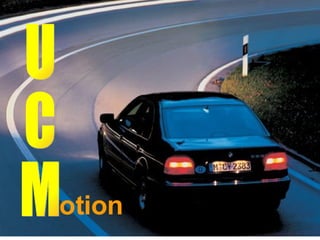
U C M niform
U C M niform  same  speed
U C M ircular
U C M otion
Centripetal Force
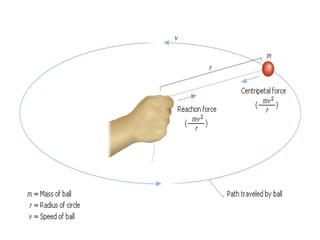
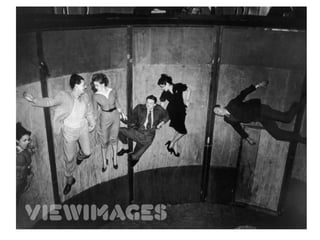
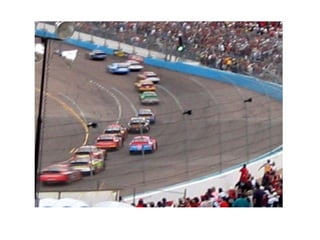
Centripetal Force F net  making object move in UCM
 
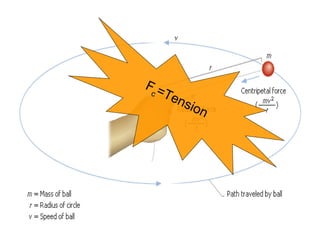
F c =Tension
 
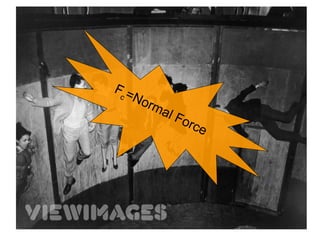
F c =Normal Force
 
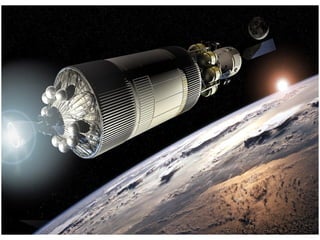
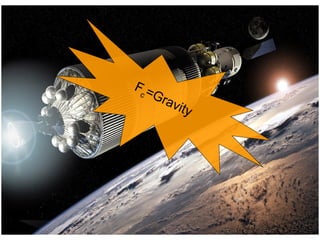
F c =Gravity
 
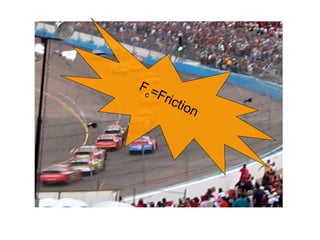
F c =Friction
An object in UCM is accelerating
An object in UCM is accelerating always
An object in UCM is accelerating toward the center of the circle always
How to Solve a UCM Problem
Write out the knowns
Identify force(s) causing the object to move in UCM
An Example of How to Solve a UCM Problem
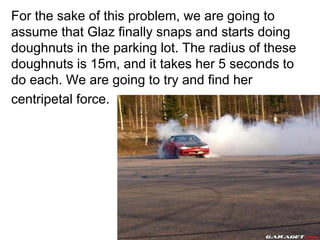
For the sake of this problem, we are going to assume that Glaz finally snaps and starts doing doughnuts in the parking lot. The radius of these doughnuts is 15m, and it takes her 5 seconds to do each. We are going to try and find her centripetal force.
You can tell this is a physics problem since the situation it presents is impossible; we all know Glaz snapped YEARS ago.
Oh, and we also won’t be taking into account silly little things like friction.
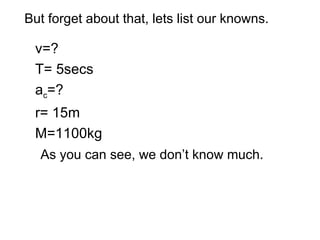
But forget about that, lets list our knowns. v=? T= 5secs  a c =? r= 15m M=1100kg  As you can see, we don’t know much.
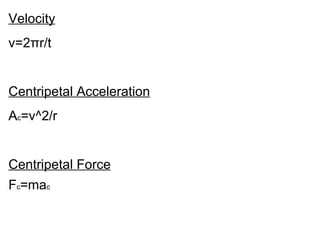
In order to solve this problem we’re going to have to use three equations.
Velocity v=2πr/t Centripetal Acceleration A c =v^2/r Centripetal Force F c =ma c
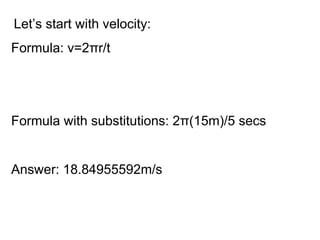
Let’s start with velocity: Formula: v=2πr/t Formula with substitutions: 2π(15m)/5 secs Answer: 18.84955592m/s
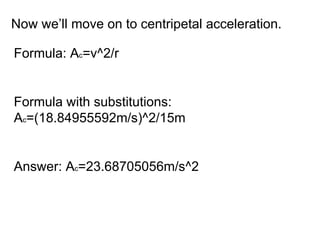
Now we’ll move on to centripetal acceleration. Formula: A c =v^2/r Formula with substitutions: A c =(18.84955592m/s)^2/15m Answer: A c =23.68705056m/s^2
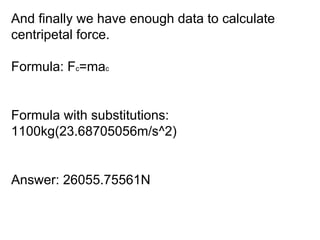
And finally we have enough data to calculate centripetal force. Formula: F c =ma c Formula with substitutions: 1100kg(23.68705056m/s^2) Answer: 26055.75561N
So as you can clearly see, UCM equations are quick, easy, and (generally) painless to do!

UCM 4