KS3 Physics

7K Forces and
their Effects
1 of 27
20

© Boardworks Ltd 2004
2006
Contents

7K Forces and their Effects
Feel the force
Friction
Forces in water
Weight and mass
Summary activities
1 of 27
20
2

© Boardworks Ltd 2004
2006
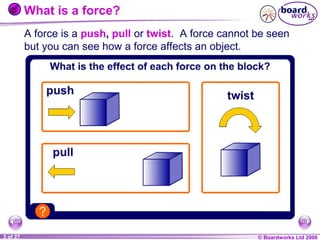
What is a force?
A force is a push, pull or twist. A force cannot be seen
but you can see how a force affects an object.

1 of 27
20
3

© Boardworks Ltd 2004
2006
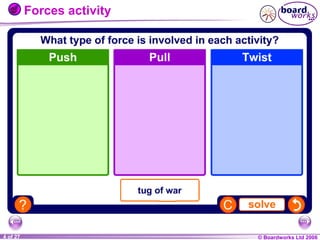
Forces activity

1 of 27
20
4

© Boardworks Ltd 2004
2006
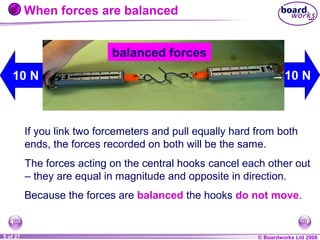
When forces are balanced
balanced forces
10 N

10 N

If you link two forcemeters and pull equally hard from both
ends, the forces recorded on both will be the same.
The forces acting on the central hooks cancel each other out
– they are equal in magnitude and opposite in direction.
Because the forces are balanced the hooks do not move.

1 of 27
20
5

© Boardworks Ltd 2004
2006
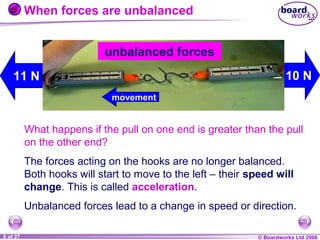
When forces are unbalanced
unbalanced forces
10 N

11 N
movement

What happens if the pull on one end is greater than the pull
on the other end?
The forces acting on the hooks are no longer balanced.
Both hooks will start to move to the left – their speed will
change. This is called acceleration.
Unbalanced forces lead to a change in speed or direction.
1 of 27
20
6

© Boardworks Ltd 2004
2006
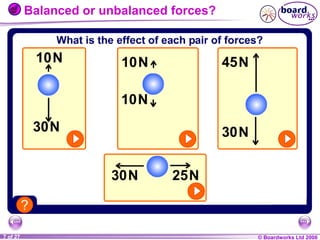
Balanced or unbalanced forces?

1 of 27
20
7

© Boardworks Ltd 2004
2006
Contents

7K Forces and their Effects
Feel the force
Friction
Forces in water
Weight and mass
Summary activities
1 of 27
20
8

© Boardworks Ltd 2004
2006
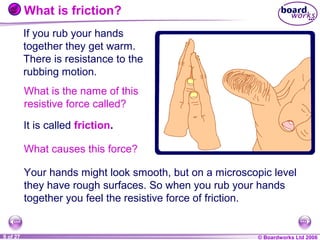
What is friction?
If you rub your hands
together they get warm.
There is resistance to the
rubbing motion.
What is the name of this
resistive force called?
It is called friction.
What causes this force?
Your hands might look smooth, but on a microscopic level
they have rough surfaces. So when you rub your hands
together you feel the resistive force of friction.

1 of 27
20
9

© Boardworks Ltd 2004
2006
More about friction
Friction always tries to slow moving objects down.
We say it opposes motion.
Friction is created whenever two touching objects or
surfaces move past each other.
Friction also occurs when things move through air.
This is called air resistance or drag.
There is a maximum value for the frictional force
which depends on:
 the force pushing the two surfaces together;


1 of 20
10 of 27

the state of the surfaces in contact.

© Boardworks Ltd 2004
2006
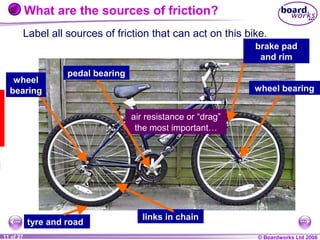
What are the sources of friction?
Label all sources of friction that can act on this bike.
brake pad
and rim
wheel
bearing

pedal bearing
wheel bearing
air resistanceProbably
One more? or “drag”
the most important…

tyre and road
1 of 20
11 of 27

links in chain
© Boardworks Ltd 2004
2006
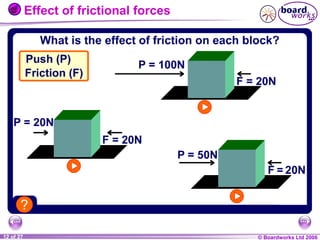
Effect of frictional forces

1 of 20
12 of 27

© Boardworks Ltd 2004
2006
Contents

7K Forces and their Effects
Feel the force
Friction
Forces in water
Weight and mass
Summary activities
1 of 20
13 of 27

© Boardworks Ltd 2004
2006
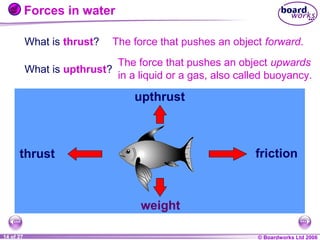
Forces in water
What is thrust?
What is upthrust?

The force that pushes an object forward.
The force that pushes an object upwards
in a liquid or a gas, also called buoyancy.

upthrust

friction

thrust

weight
1 of 20
14 of 27

© Boardworks Ltd 2004
2006
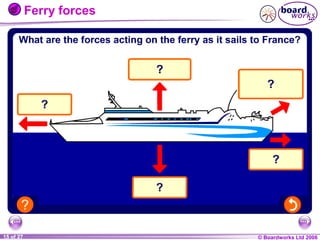
Ferry forces

1 of 20
15 of 27

© Boardworks Ltd 2004
2006
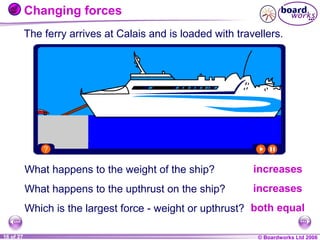
Changing forces
The ferry arrives at Calais and is loaded with travellers.

What happens to the weight of the ship?

increases

What happens to the upthrust on the ship?

increases

Which is the largest force - weight or upthrust? both equal
1 of 20
16 of 27

© Boardworks Ltd 2004
2006
Contents

7K Forces and their Effects
Feel the force
Friction
Forces in water
Weight and mass
Summary activities
1 of 20
17 of 27

© Boardworks Ltd 2004
2006
What are mass and weight?
Mass and weight are not the same!
Mass is the amount of matter in an object and is
measured in kilograms. Mass is not a force.
Mass will have the same value anywhere in the Universe,
including outer space.
Weight is a force and is caused by the pull of gravity
acting on a mass. Like other forces, weight is measured
in newtons and has both magnitude and direction.
Weight has different values depending on where you are
in the Universe.

1 of 20
18 of 27

© Boardworks Ltd 2004
2006
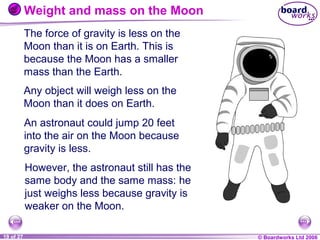
Weight and mass on the Moon
The force of gravity is less on the
Moon than it is on Earth. This is
because the Moon has a smaller
mass than the Earth.
Any object will weigh less on the
Moon than it does on Earth.
An astronaut could jump 20 feet
into the air on the Moon because
gravity is less.
However, the astronaut still has the
same body and the same mass: he
just weighs less because gravity is
weaker on the Moon.
1 of 20
19 of 27

© Boardworks Ltd 2004
2006
Talking about weight and mass
A scientist should never say:
“She weighs 50 kilograms,”
but should always say:
“She has a mass of 50 kilograms”.
Alternatively, the scientist could say:
“The gravitational force acting on her mass
is about 500 newtons”.
This is the same as saying:
“Her weight is about 500 newtons”.

1 of 20
20 of 27

© Boardworks Ltd 2004
2006
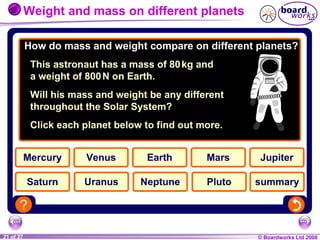
Weight and mass on different planets

1 of 20
21 of 27

© Boardworks Ltd 2004
2006
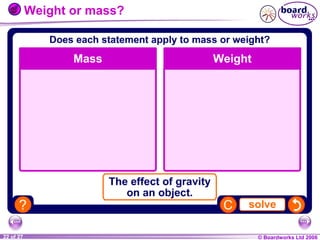
Weight or mass?

1 of 20
22 of 27

© Boardworks Ltd 2004
2006
Contents

7K Forces and their Effects
Feel the force
Friction
Forces in water
Weight and mass
Summary activities
1 of 20
23 of 27

© Boardworks Ltd 2004
2006
Glossary
air resistance – A frictional force that acts against an
object moving through air.

force – A push or a pull, measured in newtons (N).
friction – A force that occurs between two surfaces
rubbing against each other.

gravity – The force of attraction between two objects.
mass – The amount of matter that an object is made of,
measured in kilograms (kg).

thrust – A force that pushes an object forwards.
upthrust – A force that pushes an object upwards.
weight – The force caused by gravity acting on an object,
measured in newtons (N).

1 of 20
24 of 27

© Boardworks Ltd 2004
2006
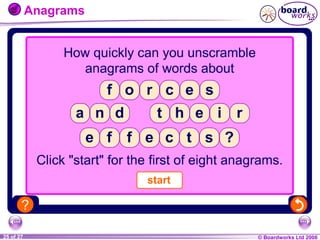
Anagrams

1 of 20
25 of 27

© Boardworks Ltd 2004
2006
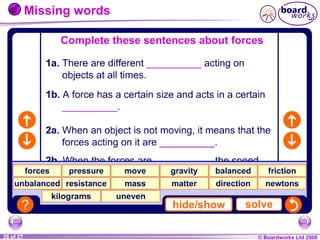
Missing words

1 of 20
26 of 27

© Boardworks Ltd 2004
2006
Multiple-choice quiz

1 of 20
27 of 27

© Boardworks Ltd 2004
2006

7 k forces and their effects (boardworks)

  • 1.
    KS3 Physics 7K Forcesand their Effects 1 of 27 20 © Boardworks Ltd 2004 2006
  • 2.
    Contents 7K Forces andtheir Effects Feel the force Friction Forces in water Weight and mass Summary activities 1 of 27 20 2 © Boardworks Ltd 2004 2006
  • 3.
    What is aforce? A force is a push, pull or twist. A force cannot be seen but you can see how a force affects an object. 1 of 27 20 3 © Boardworks Ltd 2004 2006
  • 4.
    Forces activity 1 of27 20 4 © Boardworks Ltd 2004 2006
  • 5.
    When forces arebalanced balanced forces 10 N 10 N If you link two forcemeters and pull equally hard from both ends, the forces recorded on both will be the same. The forces acting on the central hooks cancel each other out – they are equal in magnitude and opposite in direction. Because the forces are balanced the hooks do not move. 1 of 27 20 5 © Boardworks Ltd 2004 2006
  • 6.
    When forces areunbalanced unbalanced forces 10 N 11 N movement What happens if the pull on one end is greater than the pull on the other end? The forces acting on the hooks are no longer balanced. Both hooks will start to move to the left – their speed will change. This is called acceleration. Unbalanced forces lead to a change in speed or direction. 1 of 27 20 6 © Boardworks Ltd 2004 2006
  • 7.
    Balanced or unbalancedforces? 1 of 27 20 7 © Boardworks Ltd 2004 2006
  • 8.
    Contents 7K Forces andtheir Effects Feel the force Friction Forces in water Weight and mass Summary activities 1 of 27 20 8 © Boardworks Ltd 2004 2006
  • 9.
    What is friction? Ifyou rub your hands together they get warm. There is resistance to the rubbing motion. What is the name of this resistive force called? It is called friction. What causes this force? Your hands might look smooth, but on a microscopic level they have rough surfaces. So when you rub your hands together you feel the resistive force of friction. 1 of 27 20 9 © Boardworks Ltd 2004 2006
  • 10.
    More about friction Frictionalways tries to slow moving objects down. We say it opposes motion. Friction is created whenever two touching objects or surfaces move past each other. Friction also occurs when things move through air. This is called air resistance or drag. There is a maximum value for the frictional force which depends on:  the force pushing the two surfaces together;  1 of 20 10 of 27 the state of the surfaces in contact. © Boardworks Ltd 2004 2006
  • 11.
    What are thesources of friction? Label all sources of friction that can act on this bike. brake pad and rim wheel bearing pedal bearing wheel bearing air resistanceProbably One more? or “drag” the most important… tyre and road 1 of 20 11 of 27 links in chain © Boardworks Ltd 2004 2006
  • 12.
    Effect of frictionalforces 1 of 20 12 of 27 © Boardworks Ltd 2004 2006
  • 13.
    Contents 7K Forces andtheir Effects Feel the force Friction Forces in water Weight and mass Summary activities 1 of 20 13 of 27 © Boardworks Ltd 2004 2006
  • 14.
    Forces in water Whatis thrust? What is upthrust? The force that pushes an object forward. The force that pushes an object upwards in a liquid or a gas, also called buoyancy. upthrust friction thrust weight 1 of 20 14 of 27 © Boardworks Ltd 2004 2006
  • 15.
    Ferry forces 1 of20 15 of 27 © Boardworks Ltd 2004 2006
  • 16.
    Changing forces The ferryarrives at Calais and is loaded with travellers. What happens to the weight of the ship? increases What happens to the upthrust on the ship? increases Which is the largest force - weight or upthrust? both equal 1 of 20 16 of 27 © Boardworks Ltd 2004 2006
  • 17.
    Contents 7K Forces andtheir Effects Feel the force Friction Forces in water Weight and mass Summary activities 1 of 20 17 of 27 © Boardworks Ltd 2004 2006
  • 18.
    What are massand weight? Mass and weight are not the same! Mass is the amount of matter in an object and is measured in kilograms. Mass is not a force. Mass will have the same value anywhere in the Universe, including outer space. Weight is a force and is caused by the pull of gravity acting on a mass. Like other forces, weight is measured in newtons and has both magnitude and direction. Weight has different values depending on where you are in the Universe. 1 of 20 18 of 27 © Boardworks Ltd 2004 2006
  • 19.
    Weight and masson the Moon The force of gravity is less on the Moon than it is on Earth. This is because the Moon has a smaller mass than the Earth. Any object will weigh less on the Moon than it does on Earth. An astronaut could jump 20 feet into the air on the Moon because gravity is less. However, the astronaut still has the same body and the same mass: he just weighs less because gravity is weaker on the Moon. 1 of 20 19 of 27 © Boardworks Ltd 2004 2006
  • 20.
    Talking about weightand mass A scientist should never say: “She weighs 50 kilograms,” but should always say: “She has a mass of 50 kilograms”. Alternatively, the scientist could say: “The gravitational force acting on her mass is about 500 newtons”. This is the same as saying: “Her weight is about 500 newtons”. 1 of 20 20 of 27 © Boardworks Ltd 2004 2006
  • 21.
    Weight and masson different planets 1 of 20 21 of 27 © Boardworks Ltd 2004 2006
  • 22.
    Weight or mass? 1of 20 22 of 27 © Boardworks Ltd 2004 2006
  • 23.
    Contents 7K Forces andtheir Effects Feel the force Friction Forces in water Weight and mass Summary activities 1 of 20 23 of 27 © Boardworks Ltd 2004 2006
  • 24.
    Glossary air resistance –A frictional force that acts against an object moving through air. force – A push or a pull, measured in newtons (N). friction – A force that occurs between two surfaces rubbing against each other. gravity – The force of attraction between two objects. mass – The amount of matter that an object is made of, measured in kilograms (kg). thrust – A force that pushes an object forwards. upthrust – A force that pushes an object upwards. weight – The force caused by gravity acting on an object, measured in newtons (N). 1 of 20 24 of 27 © Boardworks Ltd 2004 2006
  • 25.
    Anagrams 1 of 20 25of 27 © Boardworks Ltd 2004 2006
  • 26.
    Missing words 1 of20 26 of 27 © Boardworks Ltd 2004 2006
  • 27.
    Multiple-choice quiz 1 of20 27 of 27 © Boardworks Ltd 2004 2006