VECTORS & SCALARS
Common Definitions Scalar: A physical quantity that is a single number. Ex: Distance, speed, energy Vector: A physical quantity that possesses both magnitude and direction. Ex: Displacement, velocity, acceleration.
Scalar One: Speed Speed is the measure of how fast an entity is going. Rate at which distance is covered.
Scalar One: Speed Instantaneous Speed The speed at any instant. Taking the speed at a random time when someone is driving. Average Speed Average of all instantaneous speeds. (Distance traveled)/(Time of travel) is the equation.
Vector One: Velocity Velocity is a vector – it has magnitude & direction. Velocity can be measured by using a speedometer in combination with something that indicates the instantaneous direction of travel.
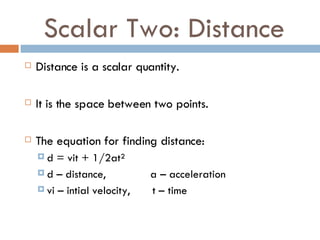
Scalar Two: Distance Distance is a scalar quantity. It is the space between two points. The equation for finding distance: d = vit + 1/2at² d – distance,  a – acceleration  vi – intial velocity,  t – time
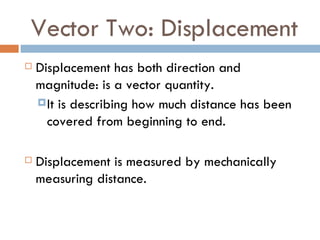
Vector Two: Displacement Displacement has both direction and magnitude: is a vector quantity.  It is describing how much distance has been covered from beginning to end. Displacement is measured by mechanically measuring distance.
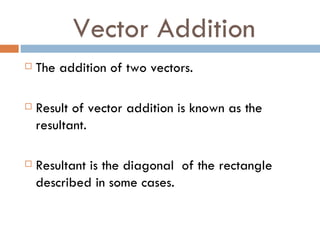
Vector Addition The addition of two vectors. Result of vector addition is known as the resultant. Resultant is the diagonal  of the rectangle described in some cases.
Triangle Method Basically done using the pythagorean theorem. a²+b²=c², using each side of equation. Ex: two vectors, each 3m. 3²+3²=c² 3√2 is the resultant. Answers can be radical.
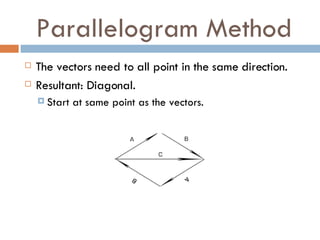
Parallelogram Method The vectors need to all point in the same direction. Resultant: Diagonal. Start at same point as the vectors.
End.

Vectors & Scalars 2

  • 1.
  • 2.
    Common Definitions Scalar:A physical quantity that is a single number. Ex: Distance, speed, energy Vector: A physical quantity that possesses both magnitude and direction. Ex: Displacement, velocity, acceleration.
  • 3.
    Scalar One: SpeedSpeed is the measure of how fast an entity is going. Rate at which distance is covered.
  • 4.
    Scalar One: SpeedInstantaneous Speed The speed at any instant. Taking the speed at a random time when someone is driving. Average Speed Average of all instantaneous speeds. (Distance traveled)/(Time of travel) is the equation.
  • 5.
    Vector One: VelocityVelocity is a vector – it has magnitude & direction. Velocity can be measured by using a speedometer in combination with something that indicates the instantaneous direction of travel.
  • 6.
    Scalar Two: DistanceDistance is a scalar quantity. It is the space between two points. The equation for finding distance: d = vit + 1/2at² d – distance, a – acceleration vi – intial velocity, t – time
  • 7.
    Vector Two: DisplacementDisplacement has both direction and magnitude: is a vector quantity. It is describing how much distance has been covered from beginning to end. Displacement is measured by mechanically measuring distance.
  • 8.
    Vector Addition Theaddition of two vectors. Result of vector addition is known as the resultant. Resultant is the diagonal of the rectangle described in some cases.
  • 9.
    Triangle Method Basicallydone using the pythagorean theorem. a²+b²=c², using each side of equation. Ex: two vectors, each 3m. 3²+3²=c² 3√2 is the resultant. Answers can be radical.
  • 10.
    Parallelogram Method Thevectors need to all point in the same direction. Resultant: Diagonal. Start at same point as the vectors.
  • 11.