ADD YOUR NAME
Add your text.Add your text
Add your title
FREE FALL
Discuss the concept of free fall as an example of
uniformly accelerated motion and derive the relevant
formulas for such motion.
1
2
OBJECTIVES:
Solve problems involving freely falling bodies, addressing
the misconception that heavier objects fall faster than
lighter ones, and reinforcing the understanding that all
objects fall at the same rate in the absence of air
resistance.
What is
FREE
Which will fall
faster?
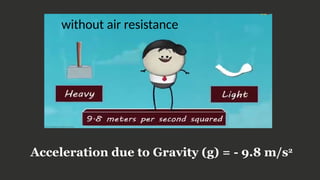
Acceleration due to Gravity (g) = - 9.8 m/s2
without air resistance
Free fall is any motion of a
body where gravity is the
only force acting upon it.
This means no air resistance
or other forces are involved.
Free Fall
A feather and a coin
accelerate equally
when there is no air
around them
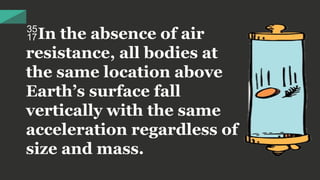
In the absence of air
resistance, all bodies at
the same location above
Earth’s surface fall
vertically with the same
acceleration regardless of
size and mass.
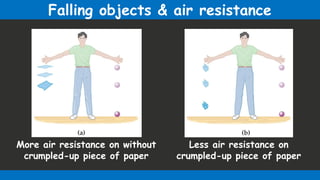
Falling objects & air resistance
More air resistance on without
crumpled-up piece of paper
Less air resistance on
crumpled-up piece of paper
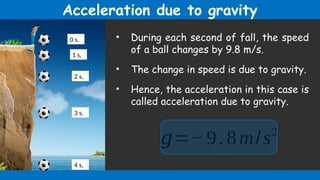
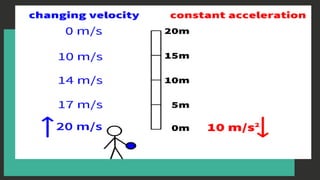
Acceleration due to gravity
0 s,
1 s,
2 s,
3 s,
4 s,
• During each second of fall, the speed
of a ball changes by 9.8 m/s.
• The change in speed is due to gravity.
• Hence, the acceleration in this case is
called acceleration due to gravity.
𝑔=−9.8m/s2
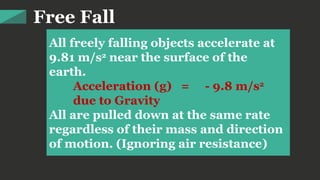
All freely falling objects accelerate at
9.81 m/s2
near the surface of the
earth.
Acceleration (g) = - 9.8 m/s2
due to Gravity
All are pulled down at the same rate
regardless of their mass and direction
of motion. (Ignoring air resistance)
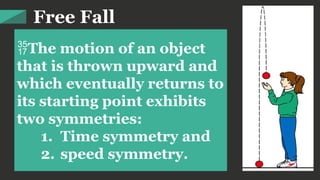
Free Fall
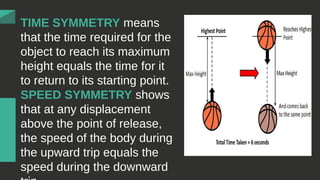
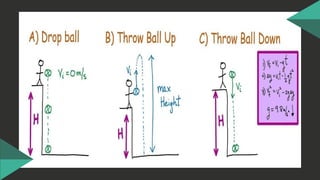
The motion of an object
that is thrown upward and
which eventually returns to
its starting point exhibits
two symmetries:
1. Time symmetry and
2. speed symmetry.
Free Fall
TIME SYMMETRY means
that the time required for the
object to reach its maximum
height equals the time for it
to return to its starting point.
SPEED SYMMETRY shows
that at any displacement
above the point of release,
the speed of the body during
the upward trip equals the
speed during the downward
UNIFORMLY
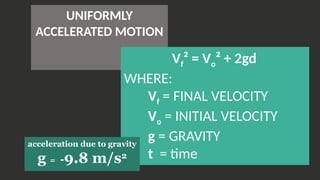
ACCELERATED MOTION
Vf² = Vo² + 2gd
WHERE:
Vf = FINAL VELOCITY
Vo = INITIAL VELOCITY
g = GRAVITY
t = time
acceleration due to gravity
g = -9.8 m/s2
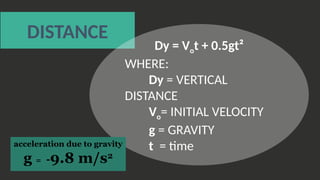
DISTANCE
Dy = Vot + 0.5gt²
WHERE:
Dy = VERTICAL
DISTANCE
Vo= INITIAL VELOCITY
g = GRAVITY
t = time
acceleration due to gravity
g = -9.8 m/s2
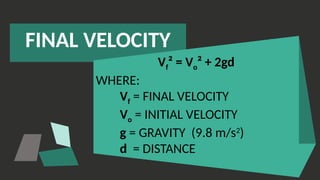
FINAL VELOCITY
Vf² = Vo² + 2gd
WHERE:
Vf = FINAL VELOCITY
Vo = INITIAL VELOCITY
g = GRAVITY (9.8 m/s2
)
d = DISTANCE
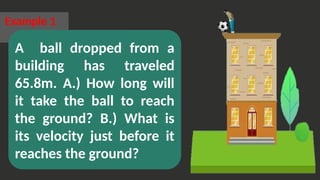
Example 1
A ball dropped from a
building has traveled
65.8m. A.) How long will
it take the ball to reach
the ground? B.) What is
its velocity just before it
reaches the ground?
૛(
૟૞.࢓ૡ
ૢ.ૡ࢓/࢙૛
)
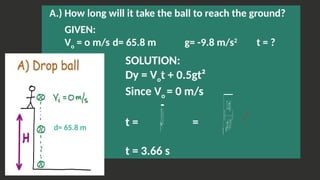
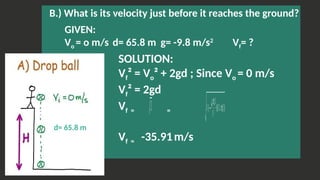
GIVEN:
Vo = o m/s d= 65.8 m g= -9.8 m/s2
t = ?
d= 65.8 m
SOLUTION:
Dy = Vot + 0.5gt²
Since Vo = 0 m/s
t = =
t = 3.66 s
2݀/݃
A.) How long will it take the ball to reach the ground?
GIVEN:
Vo = o m/s d= 65.8 m g= -9.8 m/s2
Vf= ?
d= 65.8 m
SOLUTION:
Vf² = Vo² + 2gd ; Since Vo = 0 m/s
Vf² = 2gd
Vf = =
Vf = -35.91m/s
B.) What is its velocity just before it reaches the ground?
૛ࢊࢍ ૛(−
ૢ. ࢓
ૡ
࢙૛
)(૟૞. ࢓
ૡ )
Example 2
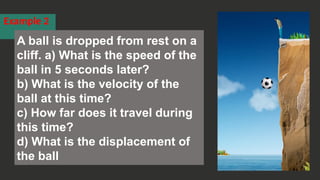
A ball is dropped from rest on a
cliff. a) What is the speed of the
ball in 5 seconds later?
b) What is the velocity of the
ball at this time?
c) How far does it travel during
this time?
d) What is the displacement of
the ball
Example 3
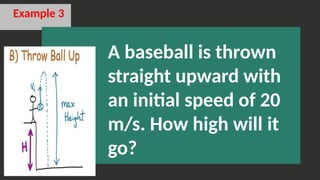
A baseball is thrown
straight upward with
an initial speed of 20
m/s. How high will it
go?
Example 3
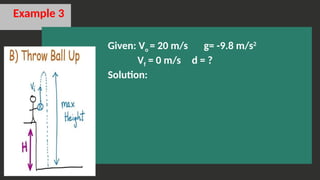
Given: Vo = 20 m/s g= -9.8 m/s2
Vf = 0 m/s d = ?
Solution:
Example 4
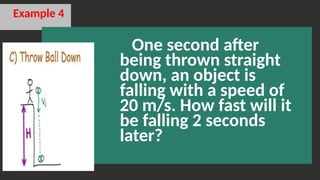
One second after
being thrown straight
down, an object is
falling with a speed of
20 m/s. How fast will it
be falling 2 seconds
later?
Example 4
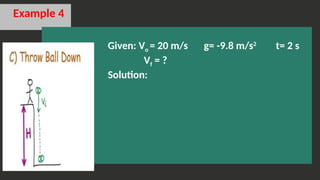
Given: Vo = 20 m/s g= -9.8 m/s2
t= 2 s
Vf = ?
Solution:
THANK YOU!
"The future belongs to those who believe
in the beauty of their dreams."
– Eleanor Roosevelt

FREE FALL PHYSICS 1: What is FREE FALL??

  • 1.
    ADD YOUR NAME Addyour text.Add your text Add your title FREE FALL
  • 2.
    Discuss the conceptof free fall as an example of uniformly accelerated motion and derive the relevant formulas for such motion. 1 2 OBJECTIVES: Solve problems involving freely falling bodies, addressing the misconception that heavier objects fall faster than lighter ones, and reinforcing the understanding that all objects fall at the same rate in the absence of air resistance.
  • 3.
  • 4.
  • 5.
    Acceleration due toGravity (g) = - 9.8 m/s2 without air resistance
  • 6.
    Free fall isany motion of a body where gravity is the only force acting upon it. This means no air resistance or other forces are involved.
  • 7.
    Free Fall A featherand a coin accelerate equally when there is no air around them
  • 8.
    In the absenceof air resistance, all bodies at the same location above Earth’s surface fall vertically with the same acceleration regardless of size and mass.
  • 9.
    Falling objects &air resistance More air resistance on without crumpled-up piece of paper Less air resistance on crumpled-up piece of paper
  • 10.
    Acceleration due togravity 0 s, 1 s, 2 s, 3 s, 4 s, • During each second of fall, the speed of a ball changes by 9.8 m/s. • The change in speed is due to gravity. • Hence, the acceleration in this case is called acceleration due to gravity. 𝑔=−9.8m/s2
  • 11.
    All freely fallingobjects accelerate at 9.81 m/s2 near the surface of the earth. Acceleration (g) = - 9.8 m/s2 due to Gravity All are pulled down at the same rate regardless of their mass and direction of motion. (Ignoring air resistance) Free Fall
  • 12.
    The motion ofan object that is thrown upward and which eventually returns to its starting point exhibits two symmetries: 1. Time symmetry and 2. speed symmetry. Free Fall
  • 13.
    TIME SYMMETRY means thatthe time required for the object to reach its maximum height equals the time for it to return to its starting point. SPEED SYMMETRY shows that at any displacement above the point of release, the speed of the body during the upward trip equals the speed during the downward
  • 15.
    UNIFORMLY ACCELERATED MOTION Vf² =Vo² + 2gd WHERE: Vf = FINAL VELOCITY Vo = INITIAL VELOCITY g = GRAVITY t = time acceleration due to gravity g = -9.8 m/s2
  • 16.
    DISTANCE Dy = Vot+ 0.5gt² WHERE: Dy = VERTICAL DISTANCE Vo= INITIAL VELOCITY g = GRAVITY t = time acceleration due to gravity g = -9.8 m/s2
  • 17.
    FINAL VELOCITY Vf² =Vo² + 2gd WHERE: Vf = FINAL VELOCITY Vo = INITIAL VELOCITY g = GRAVITY (9.8 m/s2 ) d = DISTANCE
  • 19.
    Example 1 A balldropped from a building has traveled 65.8m. A.) How long will it take the ball to reach the ground? B.) What is its velocity just before it reaches the ground?
  • 20.
    ૛( ૟૞.࢓ૡ ૢ.ૡ࢓/࢙૛ ) GIVEN: Vo = om/s d= 65.8 m g= -9.8 m/s2 t = ? d= 65.8 m SOLUTION: Dy = Vot + 0.5gt² Since Vo = 0 m/s t = = t = 3.66 s 2݀/݃ A.) How long will it take the ball to reach the ground?
  • 21.
    GIVEN: Vo = om/s d= 65.8 m g= -9.8 m/s2 Vf= ? d= 65.8 m SOLUTION: Vf² = Vo² + 2gd ; Since Vo = 0 m/s Vf² = 2gd Vf = = Vf = -35.91m/s B.) What is its velocity just before it reaches the ground? ૛ࢊࢍ ૛(− ૢ. ࢓ ૡ ࢙૛ )(૟૞. ࢓ ૡ )
  • 22.
    Example 2 A ballis dropped from rest on a cliff. a) What is the speed of the ball in 5 seconds later? b) What is the velocity of the ball at this time? c) How far does it travel during this time? d) What is the displacement of the ball
  • 23.
    Example 3 A baseballis thrown straight upward with an initial speed of 20 m/s. How high will it go?
  • 24.
    Example 3 Given: Vo= 20 m/s g= -9.8 m/s2 Vf = 0 m/s d = ? Solution:
  • 25.
    Example 4 One secondafter being thrown straight down, an object is falling with a speed of 20 m/s. How fast will it be falling 2 seconds later?
  • 26.
    Example 4 Given: Vo= 20 m/s g= -9.8 m/s2 t= 2 s Vf = ? Solution:
  • 27.
    THANK YOU! "The futurebelongs to those who believe in the beauty of their dreams." – Eleanor Roosevelt

Editor's Notes

  • #1 封面标题特殊字体为百度简综艺.可以自行下载使用或改为微软雅黑.