Exploring Free Fall… Sir Isaac Newton was one of the revolutionary genius’s who discovered and experimented with the laws of motion.  Often heard in today’s culture, Newton was accredited with noticing the pattern of motion of an apple falling from a tree, and onto the ground.  A simple everyday fruit, or a promising example of what was to be found about gravity and physics as a whole?  After many experiments, Newton realized that  gravity was the force which was making the apple fall from the tree to the Ground.
The 101 on Gravity… Sure everybody has heard of gravity at one time or another, but what is gravity?  Well gravity is the force of attraction by which any objects tend to fall toward to the center of Earth.  Haven’t you ever heard the expression “the gravity of a situation”?  That simply means the seriousness or the weight of the problem.  Gravity causes us humans to stay down on Earth’s surface and increase our weight.  The force of gravity is 9.81 meters per second (squared).  This stays true to whether you are talking about the force of gravity on a mouse or an elephant.
 
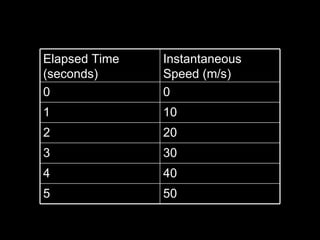
A Common Question… So let’s say that you drop a rock out of an air balloon.  Will the speed of the falling rock remain at 9.81 m/s^2 the entire trip down, or will it increase?  Well think about it; if you caught a rock that was dropped 2 meters above your head, you could do it with ease, however if you were to catch a rock dropped from 200 meters above you head, I’m pretty sure it would hurt your hand thanks to the speed of the falling rock.  This obviously shows that the speed of the rock does increase as it travels a farther distance.
50 5 40 4 30 3 20 2 10 1 0 0 Instantaneous Speed (m/s) Elapsed Time (seconds)
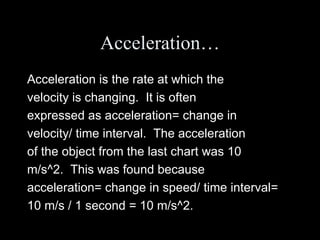
Acceleration… Acceleration is the rate at which the velocity is changing.  It is often expressed as acceleration= change in velocity/ time interval.  The acceleration of the object from the last chart was 10 m/s^2.  This was found because acceleration= change in speed/ time interval= 10 m/s / 1 second = 10 m/s^2.
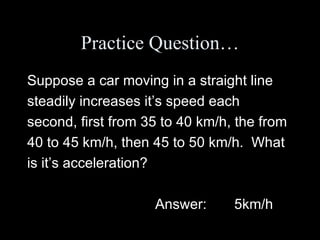
Practice Question… Suppose a car moving in a straight line steadily increases it’s speed each second, first from 35 to 40 km/h, the from 40 to 45 km/h, then 45 to 50 km/h.  What is it’s acceleration? Answer:  5km/h
So What Does That Mean? This car is traveling at 60 miles per hour.  Sure if they are on a highway it mean they are probably going about the speed limit; but what does it REALLY mean?  It means that if that person travels for one hour they go exactly 60 miles.  Sure that’s really easy, but many people think of speed and acceleration as one, but they are not.  If that same person traveled for two hours they would go 120 miles but their speed would stay the same.
Projectiles… A projectile is any object that moves Through the air or through space, acted on only by gravity and any air resistance if there is any.
Horizontal and Vertical Components… When you roll a ball freely along a level surface, it moves at a constant velocity. This is the same for the projectile. When no horizontal force acts on the projectile, the horizontal velocity remains constant.  If you drop a ball from a ledge there is a force due to gravity. A projectile accelerates downward and its vertical component of velocity changes with time.
Vectors Showing Both Horizontal and Vertical Components… The horizontal component is always the same and only the vertical component changes. At the top of the path the vertical component shrinks to zero so the velocity there is the same as the horizontal component in that case. Everywhere else the magnitude of velocity is greater.
Examples… Cannonball shot from a cannon Stone thrown in the air Ball rolling off the edge of a table
 
Upward Launched Projectiles… When a ball is thrown or a cannonball is fired, it follows an upward launched projectile. Gravity causes the ball to follow a curved path until it finally hits the ground. If gravity were not there the ball would follow in a straight line instead.
 
Air Resistance… If air resistance isn’t there, a projectile will rise to its maximum height in the same time it takes to fall from that height to the ground. this happens because of the constant effect of gravity. The deceleration due to gravity going up is the same as acceleration due to gravity.

Free Fall & Projectiles 1

  • 1.
    Exploring Free Fall…Sir Isaac Newton was one of the revolutionary genius’s who discovered and experimented with the laws of motion. Often heard in today’s culture, Newton was accredited with noticing the pattern of motion of an apple falling from a tree, and onto the ground. A simple everyday fruit, or a promising example of what was to be found about gravity and physics as a whole? After many experiments, Newton realized that gravity was the force which was making the apple fall from the tree to the Ground.
  • 2.
    The 101 onGravity… Sure everybody has heard of gravity at one time or another, but what is gravity? Well gravity is the force of attraction by which any objects tend to fall toward to the center of Earth. Haven’t you ever heard the expression “the gravity of a situation”? That simply means the seriousness or the weight of the problem. Gravity causes us humans to stay down on Earth’s surface and increase our weight. The force of gravity is 9.81 meters per second (squared). This stays true to whether you are talking about the force of gravity on a mouse or an elephant.
  • 3.
  • 4.
    A Common Question…So let’s say that you drop a rock out of an air balloon. Will the speed of the falling rock remain at 9.81 m/s^2 the entire trip down, or will it increase? Well think about it; if you caught a rock that was dropped 2 meters above your head, you could do it with ease, however if you were to catch a rock dropped from 200 meters above you head, I’m pretty sure it would hurt your hand thanks to the speed of the falling rock. This obviously shows that the speed of the rock does increase as it travels a farther distance.
  • 5.
    50 5 404 30 3 20 2 10 1 0 0 Instantaneous Speed (m/s) Elapsed Time (seconds)
  • 6.
    Acceleration… Acceleration isthe rate at which the velocity is changing. It is often expressed as acceleration= change in velocity/ time interval. The acceleration of the object from the last chart was 10 m/s^2. This was found because acceleration= change in speed/ time interval= 10 m/s / 1 second = 10 m/s^2.
  • 7.
    Practice Question… Supposea car moving in a straight line steadily increases it’s speed each second, first from 35 to 40 km/h, the from 40 to 45 km/h, then 45 to 50 km/h. What is it’s acceleration? Answer: 5km/h
  • 8.
    So What DoesThat Mean? This car is traveling at 60 miles per hour. Sure if they are on a highway it mean they are probably going about the speed limit; but what does it REALLY mean? It means that if that person travels for one hour they go exactly 60 miles. Sure that’s really easy, but many people think of speed and acceleration as one, but they are not. If that same person traveled for two hours they would go 120 miles but their speed would stay the same.
  • 9.
    Projectiles… A projectileis any object that moves Through the air or through space, acted on only by gravity and any air resistance if there is any.
  • 10.
    Horizontal and VerticalComponents… When you roll a ball freely along a level surface, it moves at a constant velocity. This is the same for the projectile. When no horizontal force acts on the projectile, the horizontal velocity remains constant. If you drop a ball from a ledge there is a force due to gravity. A projectile accelerates downward and its vertical component of velocity changes with time.
  • 11.
    Vectors Showing BothHorizontal and Vertical Components… The horizontal component is always the same and only the vertical component changes. At the top of the path the vertical component shrinks to zero so the velocity there is the same as the horizontal component in that case. Everywhere else the magnitude of velocity is greater.
  • 12.
    Examples… Cannonball shotfrom a cannon Stone thrown in the air Ball rolling off the edge of a table
  • 13.
  • 14.
    Upward Launched Projectiles…When a ball is thrown or a cannonball is fired, it follows an upward launched projectile. Gravity causes the ball to follow a curved path until it finally hits the ground. If gravity were not there the ball would follow in a straight line instead.
  • 15.
  • 16.
    Air Resistance… Ifair resistance isn’t there, a projectile will rise to its maximum height in the same time it takes to fall from that height to the ground. this happens because of the constant effect of gravity. The deceleration due to gravity going up is the same as acceleration due to gravity.