Work
Chapter 5.1
What is work?
• You work on math problems.
• You go to work.
• Making a sandwich is work.
• Taking out the trash is too much
  work.
• Doing your homework is work.

• What machines help us work?
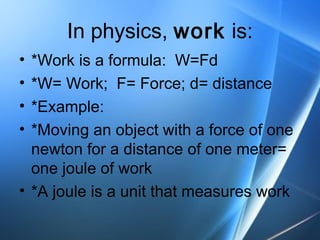
In physics, work is:
• *Work is a formula: W=Fd
• *W= Work; F= Force; d= distance
• *Example:
• *Moving an object with a force of one
  newton for a distance of one meter=
  one joule of work
• *A joule is a unit that measures work
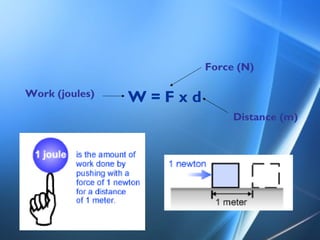
Force (N)

Work (joules)   W=Fxd
                             Distance (m)
Brainstorm using a circle map:


1. In the Center write: Work
2. In the circle write types of simple machines
3. In the frame of reference write down what
   work these machines do
Input and Output
• *Input = how much force you put
  into doing work
• *Output = how much work was
  done
• *The work output can never
  exceed the work input!
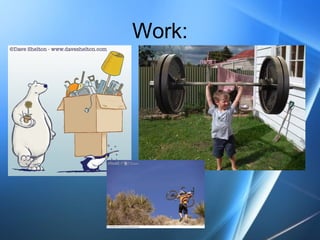
Work:
Efficiency
• *Efficiency is the fraction of
  incoming energy that goes into a
  process.
Examples: Fuel mileage,
  appliances and energy efficiency
*Efficiency
• What does it mean to be efficient?

• *In a very efficient machine, all or
  most of the work input becomes work
  output
• In other words…if five joules of work
  was used to lift a box, the box would
  move the equivalent of five joules
  output- nothing was wasted.
What about friction?
• *In the real world- Work Output is
  always less than work input.
  – WHY?


• *Forces like friction use up some of
  the input work
  – Example: wheel turning on an axle can
    get very hot…when the wheel gets hot
    some of that input work is being
    converted to heat.
Friction
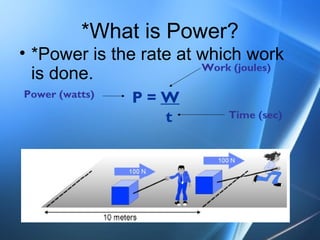
*What is Power?
• *Power is the rate at which work
                        Work (joules)
  is done.
Power (watts)   P=W
                  t          Time (sec)
Power:
Power Demo


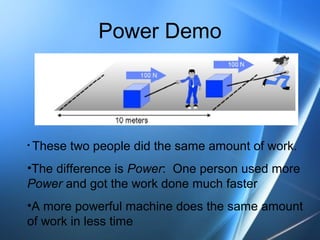
• These   two people did the same amount of work.
•The difference is Power: One person used more
Power and got the work done much faster
•A more powerful machine does the same amount
of work in less time
Review:
• Work = Force x distance
Your Turn…
• On your paper:
 – Look through Chapter 5, Section 1
     Pg 85-90
 – Add more information from this
   section into your notes.
   (at least six items)
Practice:
• Skill Sheet 5-A
     Example:
• How much work is done on a 10 N block
  that is lifted 5 meters off the ground by a
  pulley?
     Work = F x d
     W = 10N x 5 meters = 50 newton- meters OR 50
      joules

     Remember: newton-meters = joules
Work
• Work = Force x Distance

• Work is only done when
  something is moved a distance in
  the direction of the force.

Physical Science: Work

  • 1.
  • 2.
    What is work? •You work on math problems. • You go to work. • Making a sandwich is work. • Taking out the trash is too much work. • Doing your homework is work. • What machines help us work?
  • 3.
    In physics, workis: • *Work is a formula: W=Fd • *W= Work; F= Force; d= distance • *Example: • *Moving an object with a force of one newton for a distance of one meter= one joule of work • *A joule is a unit that measures work
  • 4.
    Force (N) Work (joules) W=Fxd Distance (m)
  • 5.
    Brainstorm using acircle map: 1. In the Center write: Work 2. In the circle write types of simple machines 3. In the frame of reference write down what work these machines do
  • 6.
    Input and Output •*Input = how much force you put into doing work • *Output = how much work was done • *The work output can never exceed the work input!
  • 7.
  • 9.
    Efficiency • *Efficiency isthe fraction of incoming energy that goes into a process. Examples: Fuel mileage, appliances and energy efficiency
  • 10.
    *Efficiency • What doesit mean to be efficient? • *In a very efficient machine, all or most of the work input becomes work output • In other words…if five joules of work was used to lift a box, the box would move the equivalent of five joules output- nothing was wasted.
  • 11.
    What about friction? •*In the real world- Work Output is always less than work input. – WHY? • *Forces like friction use up some of the input work – Example: wheel turning on an axle can get very hot…when the wheel gets hot some of that input work is being converted to heat.
  • 12.
  • 13.
    *What is Power? •*Power is the rate at which work Work (joules) is done. Power (watts) P=W t Time (sec)
  • 14.
  • 16.
    Power Demo • These two people did the same amount of work. •The difference is Power: One person used more Power and got the work done much faster •A more powerful machine does the same amount of work in less time
  • 17.
    Review: • Work =Force x distance
  • 18.
    Your Turn… • Onyour paper: – Look through Chapter 5, Section 1 Pg 85-90 – Add more information from this section into your notes. (at least six items)
  • 19.
    Practice: • Skill Sheet5-A Example: • How much work is done on a 10 N block that is lifted 5 meters off the ground by a pulley? Work = F x d W = 10N x 5 meters = 50 newton- meters OR 50 joules Remember: newton-meters = joules
  • 20.
    Work • Work =Force x Distance • Work is only done when something is moved a distance in the direction of the force.