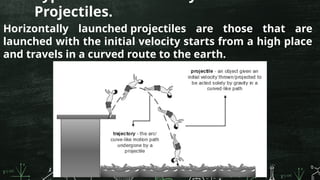
rojectile motion involves an object launched into the air, experiencing constant acceleration due to gravity (uniformly accelerated motion) in the vertical direction, while moving horizontally with constant velocity.
Contents of thistemplate
In this lesson, you will study the definition of
projectile, which differs from Projectile
motion. You will also learn how to explain
how a projectile moves horizontally and
vertically. Finally, you can explain how a
projectile moves horizontally and vertically.
4.
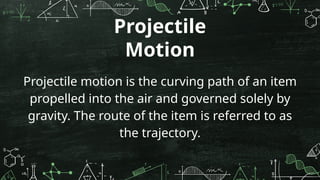
Projectile motion isthe curving path of an item
propelled into the air and governed solely by
gravity. The route of the item is referred to as
the trajectory.
Projectile
Motion
5.
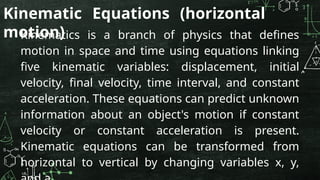
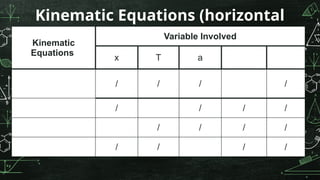
Kinematic Equations (horizontal
motion)
Kinematicsis a branch of physics that defines
motion in space and time using equations linking
five kinematic variables: displacement, initial
velocity, final velocity, time interval, and constant
acceleration. These equations can predict unknown
information about an object's motion if constant
velocity or constant acceleration is present.
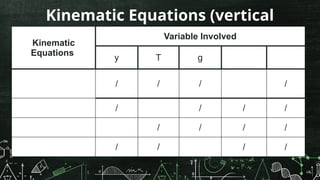
Kinematic equations can be transformed from
horizontal to vertical by changing variables x, y,
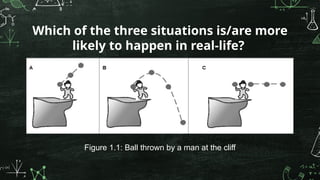
Figure 1.1: Ballthrown by a man at the cliff
Which of the three situations is/are more
likely to happen in real-life?
9.
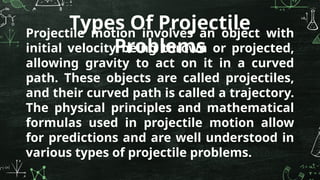
Projectile motion involvesan object with
initial velocity being thrown or projected,
allowing gravity to act on it in a curved
path. These objects are called projectiles,
and their curved path is called a trajectory.
The physical principles and mathematical
formulas used in projectile motion allow
for predictions and are well understood in
various types of projectile problems.
Types Of Projectile
Problems
Projectiles
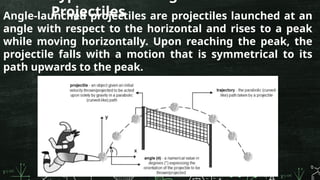
Angle-launched projectiles areprojectiles launched at an
angle with respect to the horizontal and rises to a peak
while moving horizontally. Upon reaching the peak, the
projectile falls with a motion that is symmetrical to its
path upwards to the peak.
12.
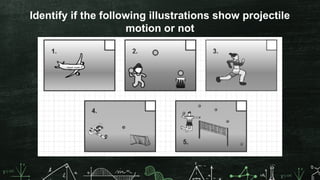
Identify if thefollowing illustrations show projectile
motion or not
13.
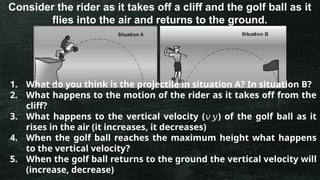
Consider the rideras it takes off a cliff and the golf ball as it
flies into the air and returns to the ground.
1. What do you think is the projectile in situation A? In situation B?
2. What happens to the motion of the rider as it takes off from the
cliff?
3. What happens to the vertical velocity ( ) of the golf ball as it
𝑣𝑦
rises in the air (it increases, it decreases)
4. When the golf ball reaches the maximum height what happens
to the vertical velocity?
5. When the golf ball returns to the ground the vertical velocity will
(increase, decrease)
14.
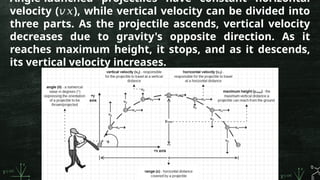
Angle-launched projectiles haveconstant horizontal
velocity ( ), while vertical velocity can be divided into
𝑣𝑥
three parts. As the projectile ascends, vertical velocity
decreases due to gravity's opposite direction. As it
reaches maximum height, it stops, and as it descends,
its vertical velocity increases.
In symbols;
- a= (vf - vi) / t
where:
- a = acceleration expressed in meter per second squared (m/s²)
- t = time expressed in second(s)
- vf = final velocity expressed in meter per second (m/s)
- vi = initial velocity expressed in meter per second (m/s)
In actual life, an object does not always travel at a steady
speed. Acceleration occurs when an object's velocity rises
or decreases or its direction of motion changes.
Acceleration refers to the rate at which velocity varies. It is
a vector quantity that possesses both magnitude and
direction.
17.
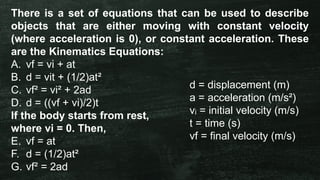
There is aset of equations that can be used to describe
objects that are either moving with constant velocity
(where acceleration is 0), or constant acceleration. These
are the Kinematics Equations:
A. vf = vi + at
B. d = vit + (1/2)at²
C. vf² = vi² + 2ad
D. d = ((vf + vi)/2)t
If the body starts from rest,
where vi = 0. Then,
E. vf = at
F. d = (1/2)at²
G. vf² = 2ad
d = displacement (m)
a = acceleration (m/s²)
v = initial velocity (m/s)
ᵢ
t = time (s)
vf = final velocity (m/s)
18.
Sample Problem 1:Starting from rest, a motorcycle has an average
acceleration of 5 m/s² for 20 seconds until it reaches the school. How
far has it traveled during this time?
A. Identify the given: [Illustration of a motorcycle at the starting
point and another at the school, with the distance between them
labeled as "d = ?"]
B. Select the appropriate equation: Acceleration, time, and initial
velocity are given, and displacement is unknown. We are going to
use equation F since it started from rest so vᵢ = 0.
t = 20 s
a = 5 m/s²
v = 0 (from rest)
ᵢ
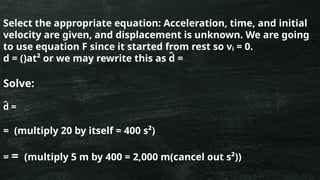
19.
Select the appropriateequation: Acceleration, time, and initial
velocity are given, and displacement is unknown. We are going
to use equation F since it started from rest so vᵢ = 0.
d = ()at² or we may rewrite this as d
̂ =
Solve:
d
̂ =
= (multiply 20 by itself = 400 s²)
= = (multiply 5 m by 400 = 2,000 m(cancel out s²))
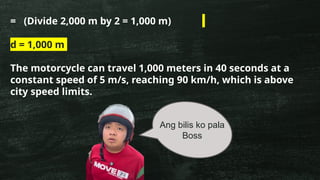
20.
= (Divide 2,000m by 2 = 1,000 m)
d = 1,000 m
The motorcycle can travel 1,000 meters in 40 seconds at a
constant speed of 5 m/s, reaching 90 km/h, which is above
city speed limits.
Ang bilis ko pala
Boss
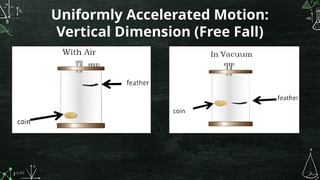
21.
Uniformly Accelerated Motion:
VerticalDimension (Free Fall)
Free fall refers to the motion of an object where gravity acts
as the only force, and air resistance and friction are
ignored. This is an example of uniformly accelerated motion
in the vertical direction, where the speed of the falling body
increases uniformly. Galileo's experiments showed that
both heavy and light objects fall at the same rate in the
absence of air resistance, with the presence of air causing a
slower fall.
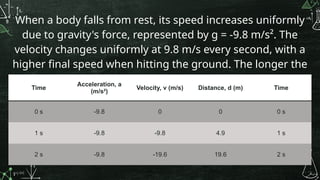
When a bodyfalls from rest, its speed increases uniformly
due to gravity's force, represented by g = -9.8 m/s². The
velocity changes uniformly at 9.8 m/s every second, with a
higher final speed when hitting the ground. The longer the
fall time, the greater the speed.
Time
Acceleration, a
(m/s²)
Velocity, v (m/s) Distance, d (m) Time
0 s -9.8 0 0 0 s
1 s -9.8 -9.8 4.9 1 s
2 s -9.8 -19.6 19.6 2 s
24.
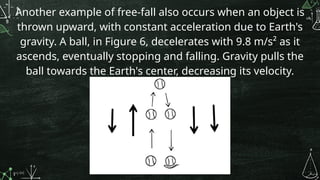
Another example offree-fall also occurs when an object is
thrown upward, with constant acceleration due to Earth's
gravity. A ball, in Figure 6, decelerates with 9.8 m/s² as it
ascends, eventually stopping and falling. Gravity pulls the
ball towards the Earth's center, decreasing its velocity.
25.
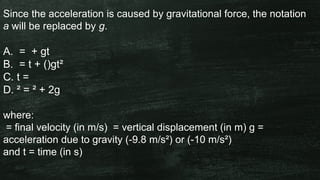
Since the accelerationis caused by gravitational force, the notation
a will be replaced by g.
A. = + gt
B. = t + ()gt²
C. t =
D. ² = ² + 2g
where:
= final velocity (in m/s) = vertical displacement (in m) g =
acceleration due to gravity (-9.8 m/s²) or (-10 m/s²)
and t = time (in s)
26.
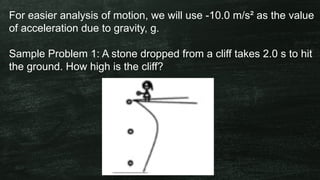
For easier analysisof motion, we will use -10.0 m/s² as the value
of acceleration due to gravity, g.
Sample Problem 1: A stone dropped from a cliff takes 2.0 s to hit
the ground. How high is the cliff?
27.
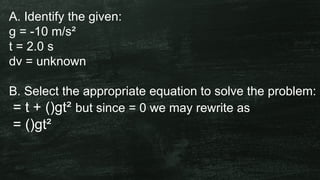
A. Identify thegiven:
g = -10 m/s²
t = 2.0 s
dv = unknown
B. Select the appropriate equation to solve the problem:
= t + ()gt² but since = 0 we may rewrite as
= ()gt²
28.
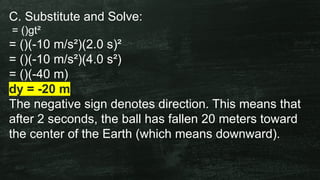
C. Substitute andSolve:
= ()gt²
= ()(-10 m/s²)(2.0 s)²
= ()(-10 m/s²)(4.0 s²)
= ()(-40 m)
dy = -20 m
The negative sign denotes direction. This means that
after 2 seconds, the ball has fallen 20 meters toward
the center of the Earth (which means downward).
29.
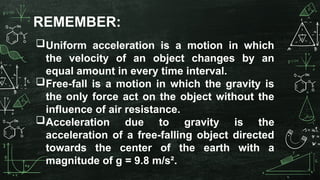
Uniform acceleration isa motion in which
the velocity of an object changes by an
equal amount in every time interval.
Free-fall is a motion in which the gravity is
the only force act on the object without the
influence of air resistance.
Acceleration due to gravity is the
acceleration of a free-falling object directed
towards the center of the earth with a
magnitude of g = 9.8 m/s².
REMEMBER:


![Sample Problem 1: Starting from rest, a motorcycle has an average
acceleration of 5 m/s² for 20 seconds until it reaches the school. How
far has it traveled during this time?
A. Identify the given: [Illustration of a motorcycle at the starting
point and another at the school, with the distance between them
labeled as "d = ?"]
B. Select the appropriate equation: Acceleration, time, and initial
velocity are given, and displacement is unknown. We are going to
use equation F since it started from rest so vᵢ = 0.
t = 20 s
a = 5 m/s²
v = 0 (from rest)
ᵢ](https://image.slidesharecdn.com/projectilesuniformacceleration-250326192450-cac20dab/85/Projectiles-and-Uniform-Acceleration-pptx-18-320.jpg)



![谷歌留痕技术 [ 𝙩𝙤𝙥 𝟮𝟯𝟯. 𝙘 𝙤𝙢 ]](https://cdn.slidesharecdn.com/ss_thumbnails/top233-260130174328-3833018c-thumbnail.jpg?width=640&height=640&fit=bounds)


