Scalar Quantities Describes magnitude Does not depend on direction Is not changed by the coordinate system
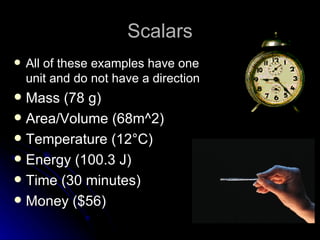
Scalars All of these examples have one unit and do not have a direction Mass (78 g) Area/Volume (68m^2) Temperature (12°C) Energy (100.3 J) Time (30 minutes) Money ($56)
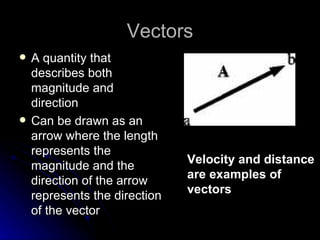
Vectors A quantity that describes both magnitude and direction Can be drawn as an arrow where the length represents the magnitude and the direction of the arrow represents the direction of the vector Velocity and distance are examples of vectors
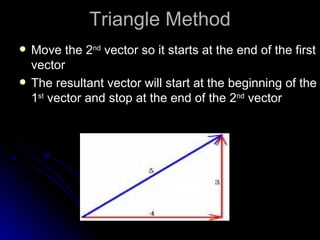
Triangle Method Move the 2 nd  vector so it starts at the end of the first vector The resultant vector will start at the beginning of the 1 st  vector and stop at the end of the 2 nd  vector
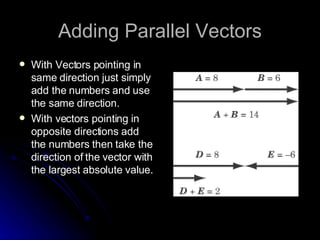
Adding Parallel Vectors With Vectors pointing in same direction just simply add the numbers and use the same direction. With vectors pointing in opposite directions add the numbers then take the direction of the vector with the largest absolute value.
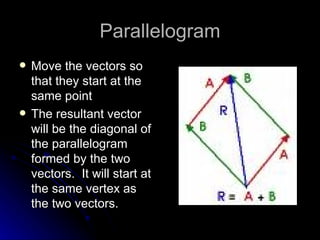
Parallelogram Move the vectors so that they start at the same point The resultant vector will be the diagonal of the parallelogram formed by the two vectors.  It will start at the same vertex as the two vectors.
Speed vs. Velocity Speed describes the rate of change in distance Velocity describes a rate of change in displacement
Displacement vs. Distance Displacement is a vector that describes the change in position if the object from starting to ending point. Distance is a scalar which describes “how much ground” the object has covered during motion.

Vectors Scalars 1

  • 1.
    Scalar Quantities Describesmagnitude Does not depend on direction Is not changed by the coordinate system
  • 2.
    Scalars All ofthese examples have one unit and do not have a direction Mass (78 g) Area/Volume (68m^2) Temperature (12°C) Energy (100.3 J) Time (30 minutes) Money ($56)
  • 3.
    Vectors A quantitythat describes both magnitude and direction Can be drawn as an arrow where the length represents the magnitude and the direction of the arrow represents the direction of the vector Velocity and distance are examples of vectors
  • 4.
    Triangle Method Movethe 2 nd vector so it starts at the end of the first vector The resultant vector will start at the beginning of the 1 st vector and stop at the end of the 2 nd vector
  • 5.
    Adding Parallel VectorsWith Vectors pointing in same direction just simply add the numbers and use the same direction. With vectors pointing in opposite directions add the numbers then take the direction of the vector with the largest absolute value.
  • 6.
    Parallelogram Move thevectors so that they start at the same point The resultant vector will be the diagonal of the parallelogram formed by the two vectors. It will start at the same vertex as the two vectors.
  • 7.
    Speed vs. VelocitySpeed describes the rate of change in distance Velocity describes a rate of change in displacement
  • 8.
    Displacement vs. DistanceDisplacement is a vector that describes the change in position if the object from starting to ending point. Distance is a scalar which describes “how much ground” the object has covered during motion.