2-6:  Projectile motion Recognize  examples of projectile motion. Describe  the path of a projectile as a parabola. Resolve  vectors into their components and apply the kinematic equations to solve problems involving projectile motion.
Projectiles All projectiles follow parabolic trajectories. When you throw a football, it follows a parabola. In this class, horizontal velocity will remain constant.  In the real world, air resistance slows the velocity. Air particles collide with object slowing the object.
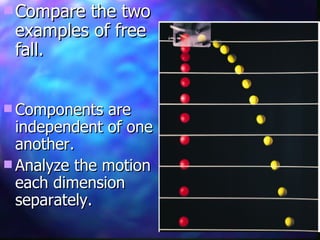
Compare the two examples of free fall.   Components are independent of one another. Analyze the motion each dimension separately.
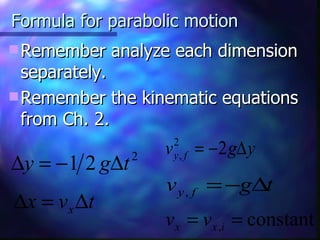
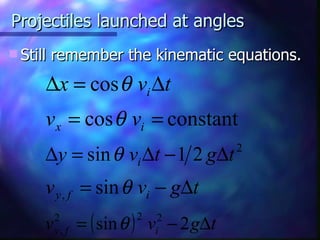
Formula for parabolic motion Remember analyze each dimension separately. Remember the kinematic equations from Ch. 2.
A movie director is shooting a scene that involves dropping a stunt dummy out of an airplane and into a swimming pool. The plane is 10.0 m above the ground, traveling at a velocity of 22.5 m/s in the positive  x  direction. The director wants to know where in the plane’s path the dummy should be dropped so that it will land in the pool.
Projectiles launched at angles Still remember the kinematic equations.
A zookeeper finds an escaped monkey hanging from a light pole. Aiming her tranquilizer gun at the monkey, the zookeeper kneels 10.0 m from the light pole. The monkey tries to trick the zookeeper by dropping a banana, then continues to hold onto the light pole. At the moment the monkey releases the banana, the zookeeper shoots. If the tranquilizer dart travels at 50.0 m/s, will the dart hit the monkey or the banana?
2-6: Summary Neglecting air resistance, a projectile has a constant horizontal velocity and constant downward free-fall acceleration. In the absence of air resistance, projectiles follow a parabolic path.

2-6 Projectile Motion

  • 1.
    2-6: Projectilemotion Recognize examples of projectile motion. Describe the path of a projectile as a parabola. Resolve vectors into their components and apply the kinematic equations to solve problems involving projectile motion.
  • 2.
    Projectiles All projectilesfollow parabolic trajectories. When you throw a football, it follows a parabola. In this class, horizontal velocity will remain constant. In the real world, air resistance slows the velocity. Air particles collide with object slowing the object.
  • 3.
    Compare the twoexamples of free fall. Components are independent of one another. Analyze the motion each dimension separately.
  • 4.
    Formula for parabolicmotion Remember analyze each dimension separately. Remember the kinematic equations from Ch. 2.
  • 5.
    A movie directoris shooting a scene that involves dropping a stunt dummy out of an airplane and into a swimming pool. The plane is 10.0 m above the ground, traveling at a velocity of 22.5 m/s in the positive x direction. The director wants to know where in the plane’s path the dummy should be dropped so that it will land in the pool.
  • 6.
    Projectiles launched atangles Still remember the kinematic equations.
  • 7.
    A zookeeper findsan escaped monkey hanging from a light pole. Aiming her tranquilizer gun at the monkey, the zookeeper kneels 10.0 m from the light pole. The monkey tries to trick the zookeeper by dropping a banana, then continues to hold onto the light pole. At the moment the monkey releases the banana, the zookeeper shoots. If the tranquilizer dart travels at 50.0 m/s, will the dart hit the monkey or the banana?
  • 8.
    2-6: Summary Neglectingair resistance, a projectile has a constant horizontal velocity and constant downward free-fall acceleration. In the absence of air resistance, projectiles follow a parabolic path.

Editor's Notes