Linear Momentum and Impulse By: Qusay Alfaori Supervisor: Marc Reif
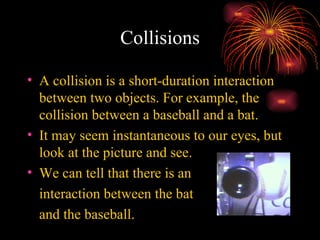
Collisions A collision is a short-duration interaction between two objects. For example, the collision between a baseball and a bat. It may seem instantaneous to our eyes, but look at the picture and see. We can tell that there is an  interaction between the bat  and the baseball.
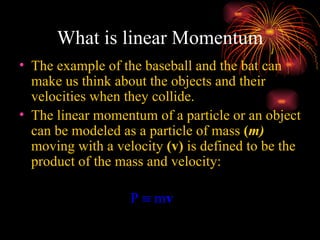
What is linear Momentum The example of the baseball and the bat can make us think about the objects and their velocities when they collide. The linear momentum of a particle or an object can be modeled as a particle of mass  ( m)  moving with a velocity  (v)  is defined to be the product of the mass and velocity:
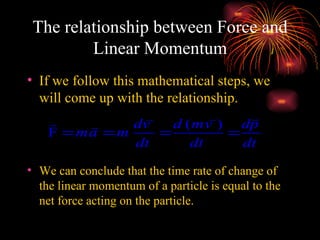
The relationship between Force and Linear Momentum If we follow this mathematical steps, we will come up with the relationship.   We can conclude that the time rate of change of the linear momentum of a particle is equal to the net force acting on the particle.
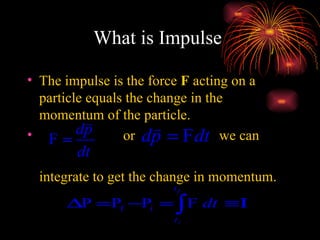
What is Impulse  The impulse is the force  F  acting on a particle equals the change in the momentum of the particle. or we can  integrate to get the change in momentum.
Conservation of Momentum Two types of collisions: Elastic and Inelastic.  Elastic collision: the total kinetic energy (as well as the total momentum) of the system is the same before and after the collision. Inelastic collision: the total kinetic energy is not the same before and after the collision ( even though the momentum of the system is conserved).  Two types of inelastic collision: stick together after collision, and do not stick together after collision but some energy is lost.
Conservation of Momentum Momentum of the system is conserved in all collisions, but Kinetic energy of the system is conserved only in elastic collisions.
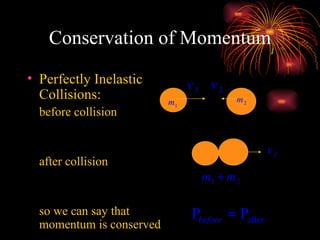
Conservation of Momentum Perfectly Inelastic Collisions:   before collision after collision so we can say that momentum is conserved
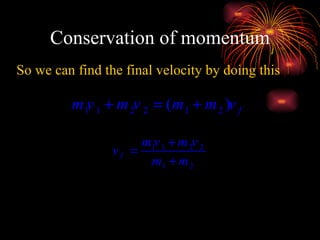
Conservation of momentum So we can find the final velocity by doing this
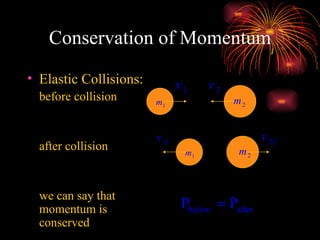
Conservation of Momentum Elastic Collisions: before collision after collision we can say that momentum is conserved
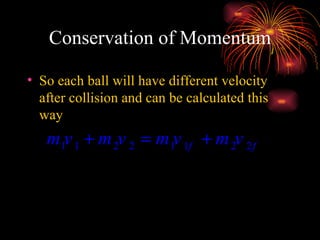
Conservation of Momentum So each ball will have different velocity after collision and can be calculated this way
Sources Physics by Randall D. Knight www.google.com/images

Momentum And Impulse

  • 1.
    Linear Momentum andImpulse By: Qusay Alfaori Supervisor: Marc Reif
  • 2.
    Collisions A collisionis a short-duration interaction between two objects. For example, the collision between a baseball and a bat. It may seem instantaneous to our eyes, but look at the picture and see. We can tell that there is an interaction between the bat and the baseball.
  • 3.
    What is linearMomentum The example of the baseball and the bat can make us think about the objects and their velocities when they collide. The linear momentum of a particle or an object can be modeled as a particle of mass ( m) moving with a velocity (v) is defined to be the product of the mass and velocity:
  • 4.
    The relationship betweenForce and Linear Momentum If we follow this mathematical steps, we will come up with the relationship. We can conclude that the time rate of change of the linear momentum of a particle is equal to the net force acting on the particle.
  • 5.
    What is Impulse The impulse is the force F acting on a particle equals the change in the momentum of the particle. or we can integrate to get the change in momentum.
  • 6.
    Conservation of MomentumTwo types of collisions: Elastic and Inelastic. Elastic collision: the total kinetic energy (as well as the total momentum) of the system is the same before and after the collision. Inelastic collision: the total kinetic energy is not the same before and after the collision ( even though the momentum of the system is conserved). Two types of inelastic collision: stick together after collision, and do not stick together after collision but some energy is lost.
  • 7.
    Conservation of MomentumMomentum of the system is conserved in all collisions, but Kinetic energy of the system is conserved only in elastic collisions.
  • 8.
    Conservation of MomentumPerfectly Inelastic Collisions: before collision after collision so we can say that momentum is conserved
  • 9.
    Conservation of momentumSo we can find the final velocity by doing this
  • 10.
    Conservation of MomentumElastic Collisions: before collision after collision we can say that momentum is conserved
  • 11.
    Conservation of MomentumSo each ball will have different velocity after collision and can be calculated this way
  • 12.
    Sources Physics byRandall D. Knight www.google.com/images