Law of Conservation of Mechanical Energy
What is energy?
Energy (E) is … ability to do work a scalar measurement  measured in Joules
There are two main types of energy: Potential Kinetic
Kinetic Energy: Energy of Motion
Facts About Kinetic Energy anything with velocity has KE It is directly proportional to mass and velocity Equation:
Potential Energy There are two kinds of potential energy…
Gravitational Potential Energy due to an object’s position in Earth’s (or another planet’s) gravitational field.
Basically, if you have height, you have Gravitational Potential Energy
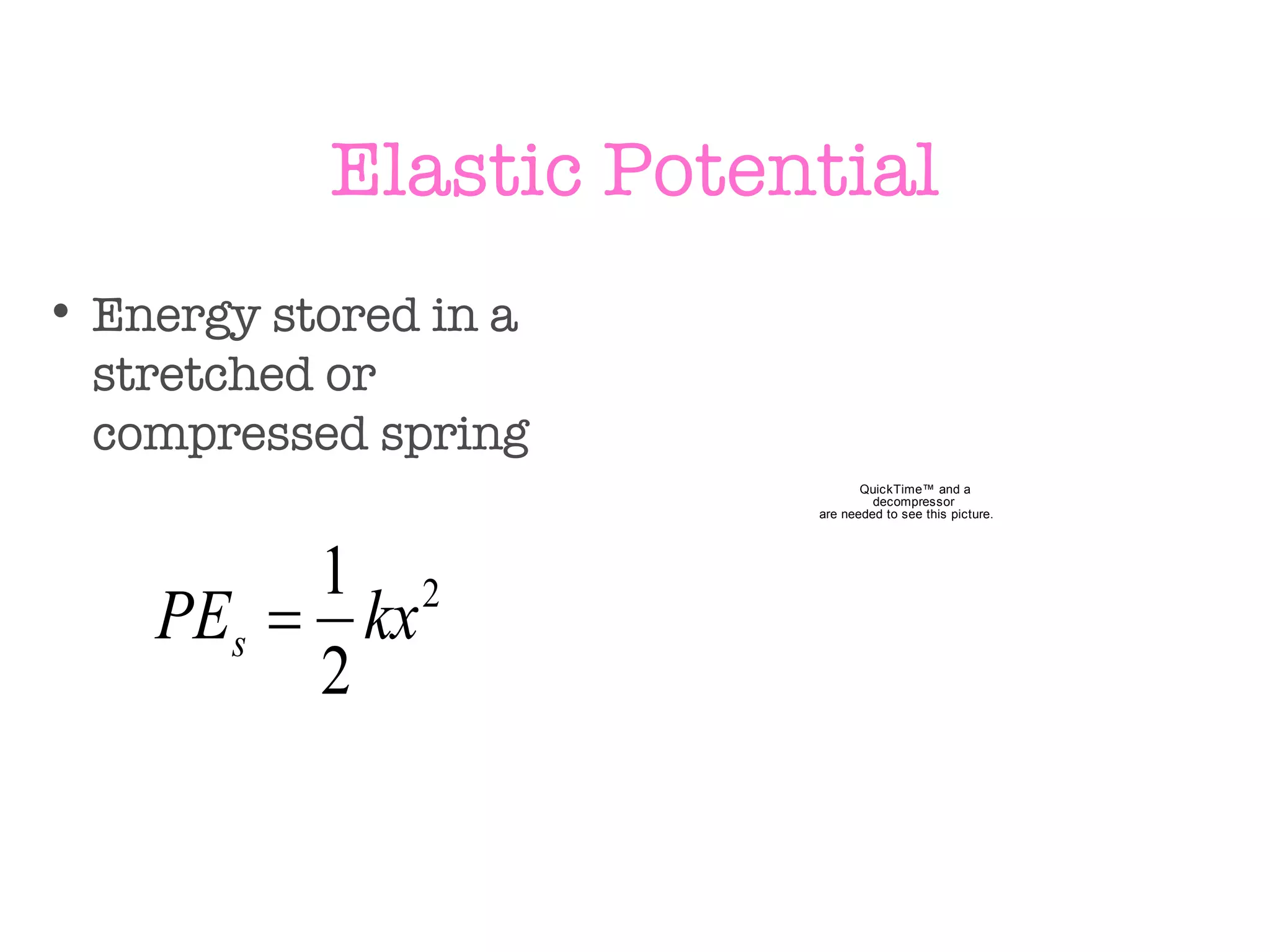
Elastic Potential Energy stored in a stretched or compressed spring
Total Mechanical Energy Potential Energy and Kinetic Energy
Law of Conservation of Energy
In other words, energy cannot be created or destroyed… Unless work was done on the system, the total energy of the system does not change.
… it can, however, be converted between different types. For example, PE can be transferred to KE!
Work is being done against friction and gravity. input energy (chemical energy) > output energy (thermal energy)  energy is lost to friction
If there is no gain in internal energy and no work done against friction, Q=0
The body transfers the chemical energy which is released as kinetic energy of the ball. The input of energy is chemical energy from the ice cream. But the  total  energy remains the same! Example:
Energy  Transfers
Roller    Coasters Good examples of energy transfers
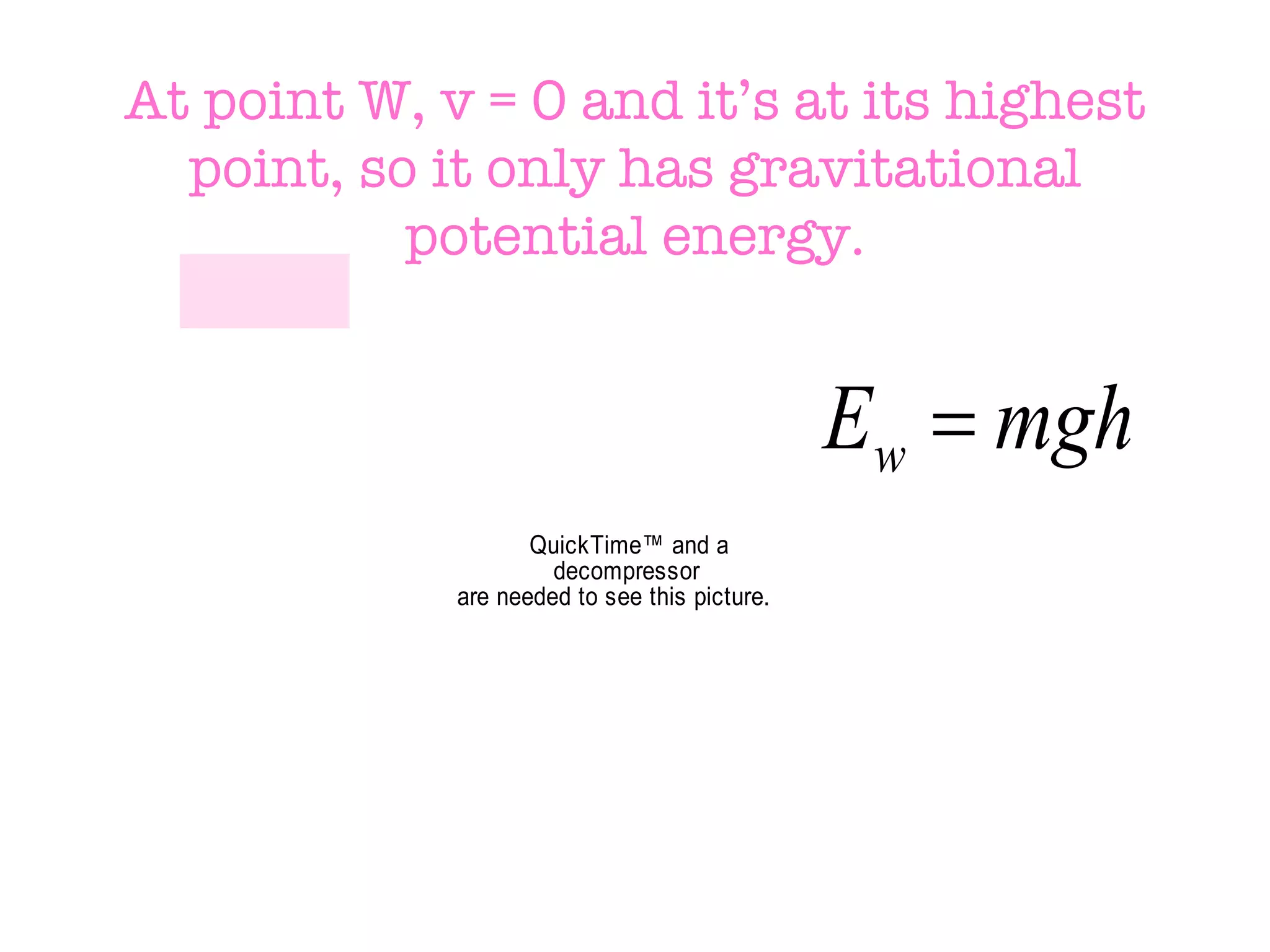
At point W, v = 0 and it’s at its highest point, so it only has gravitational potential energy.
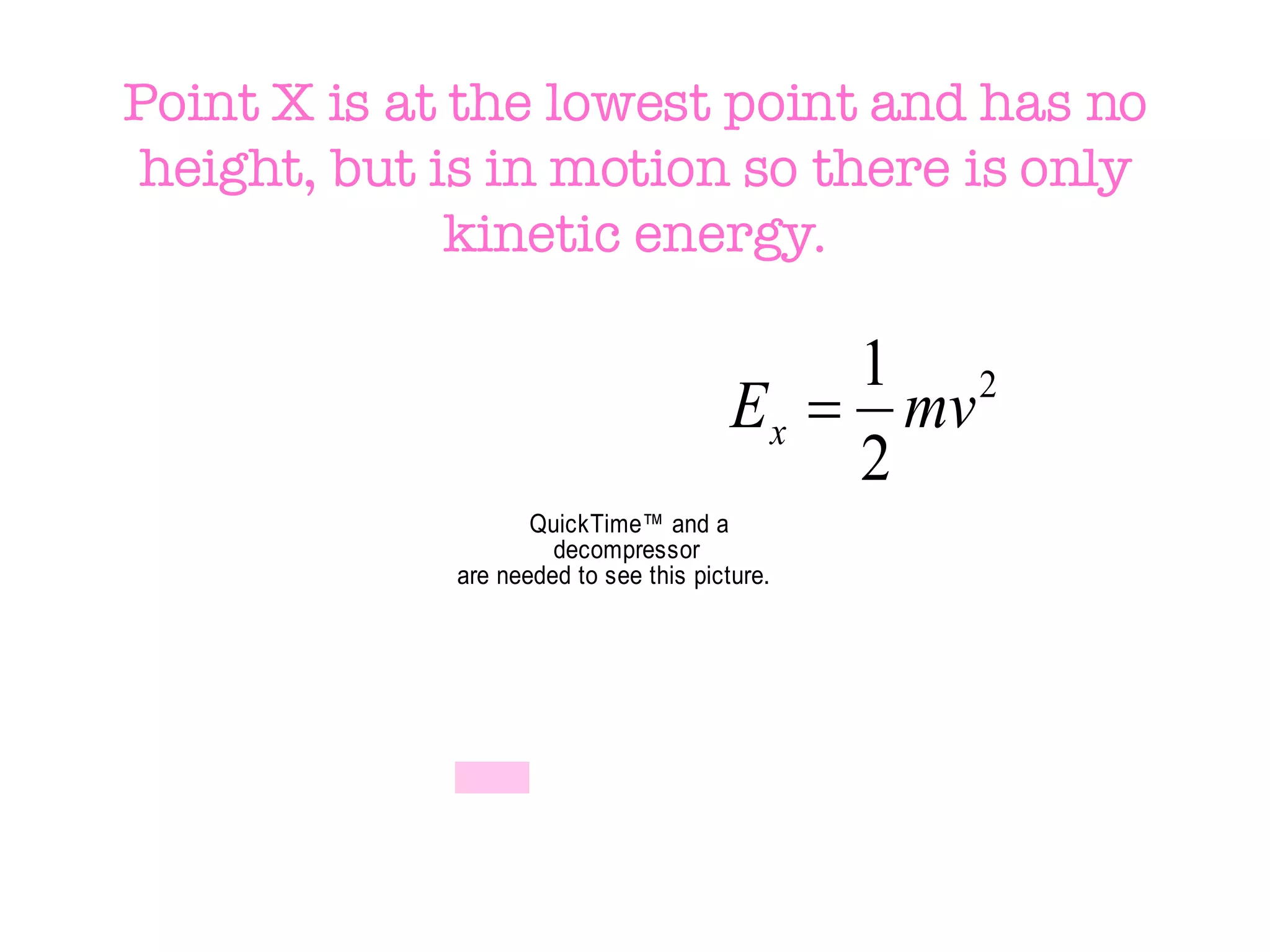
Point X is at the lowest point and has no height, but is in motion so there is only kinetic energy.
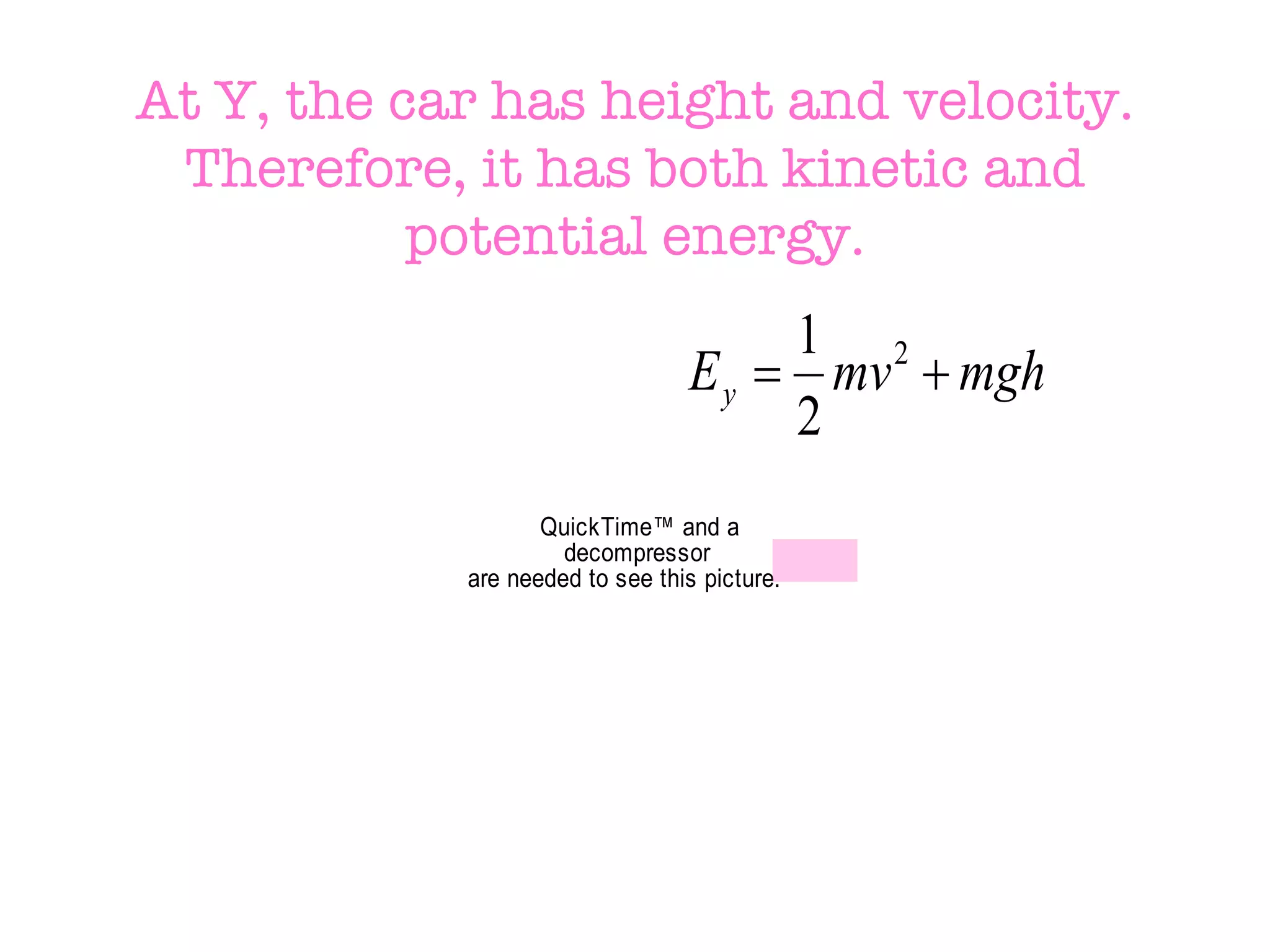
At Y, the car has height and velocity. Therefore, it has both kinetic and potential energy.
Even though the energy is changing from potential to kinetic, the total energy is always the same.
Pendulums Another good example of an energy transfer
Maximum PE: Points 1 and 3 This is where the pendulum has its greatest height.
Maximum KE:  Point 2 This is where the pendulum has its maximum velocity.
From 1 to 2: KE increases, PE decreases From 2 to 3: KE decreases, PE increases
Springs!
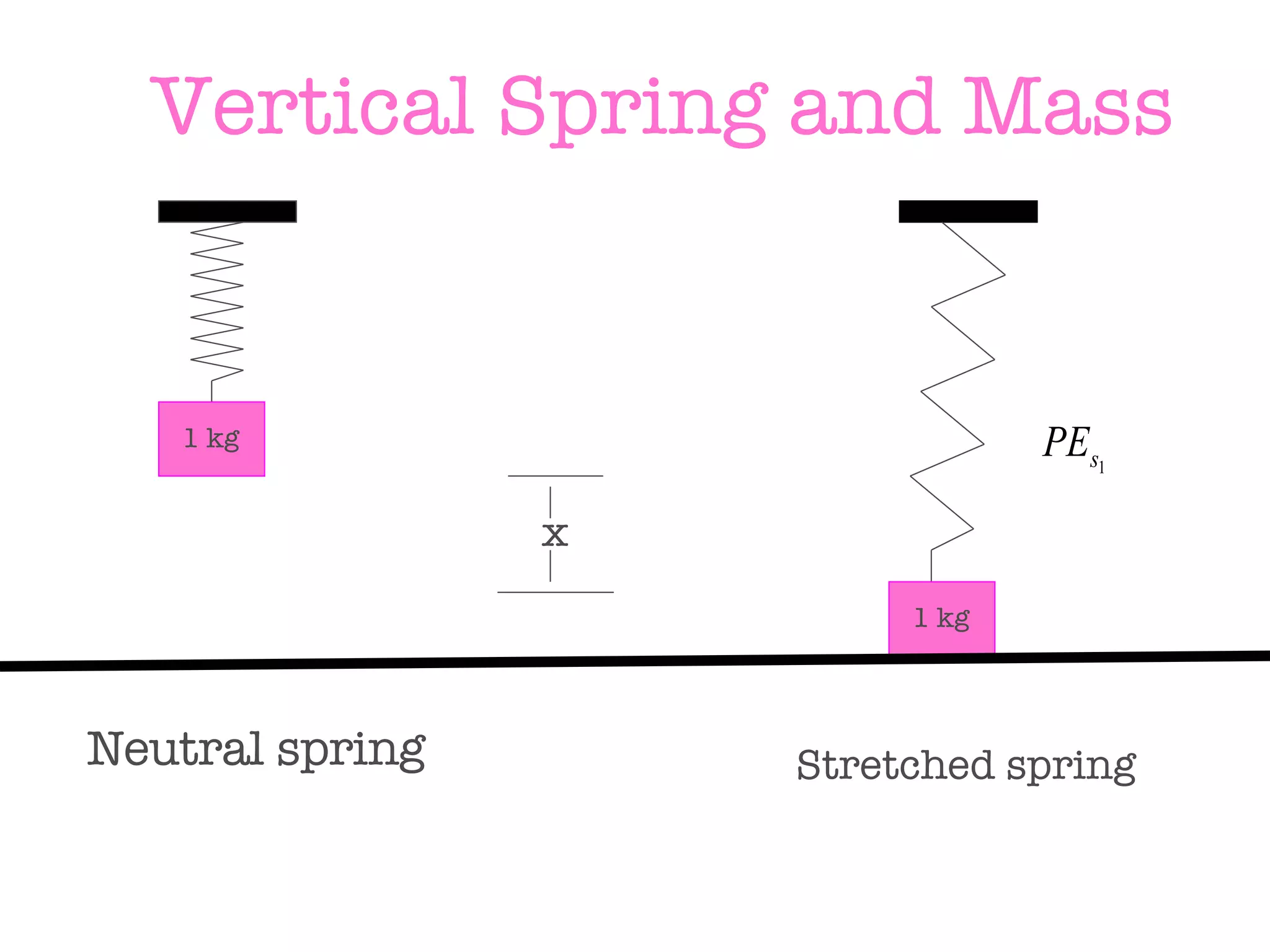
Neutral spring 1 kg Vertical Spring and Mass 1 kg x Stretched spring
Vertical Spring and Mass 1 kg Has velocity --> KE Has height --> PE g The PE s  is converted to PE g  and KE
Vertical Spring and Mass 1 kg PE g 2  + PE s 2 Compressed spring --> PEs Has height --> PEg
PE g 2  > PE g 1 1 kg 1 kg KE +PE g 1 PE g 2   + PE s 2 A. B. A has more height --> more PE g
PE s 1  > PE s 2 1 kg PE g 2  + PE s 2 1 kg PE s 1 A. B. Total energy is always the same --> A has only PE s     B has PE g  and PE s
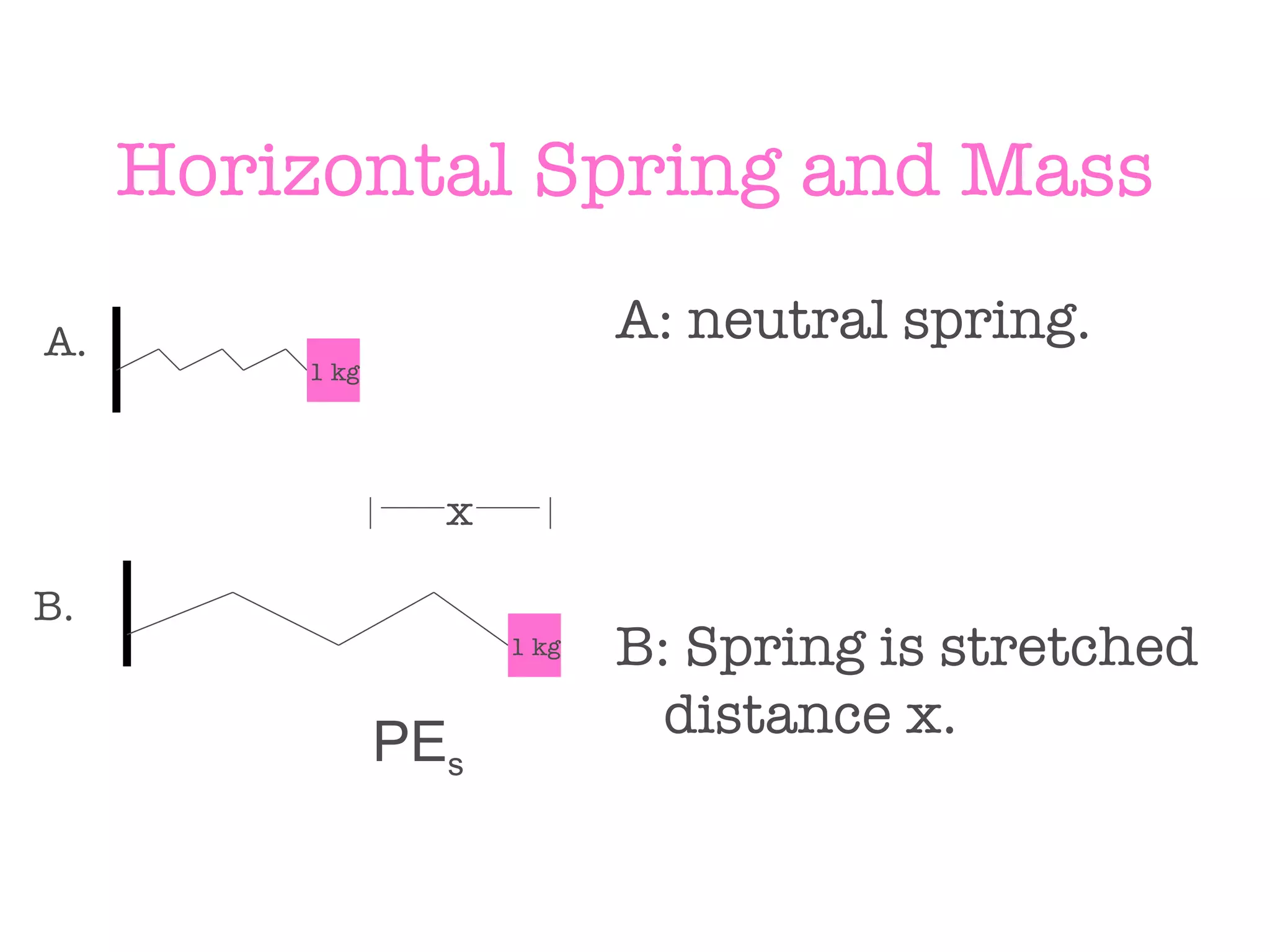
Horizontal Spring and Mass A: neutral spring. B: Spring is stretched distance x. 1 kg 1 kg x A. B. PE s
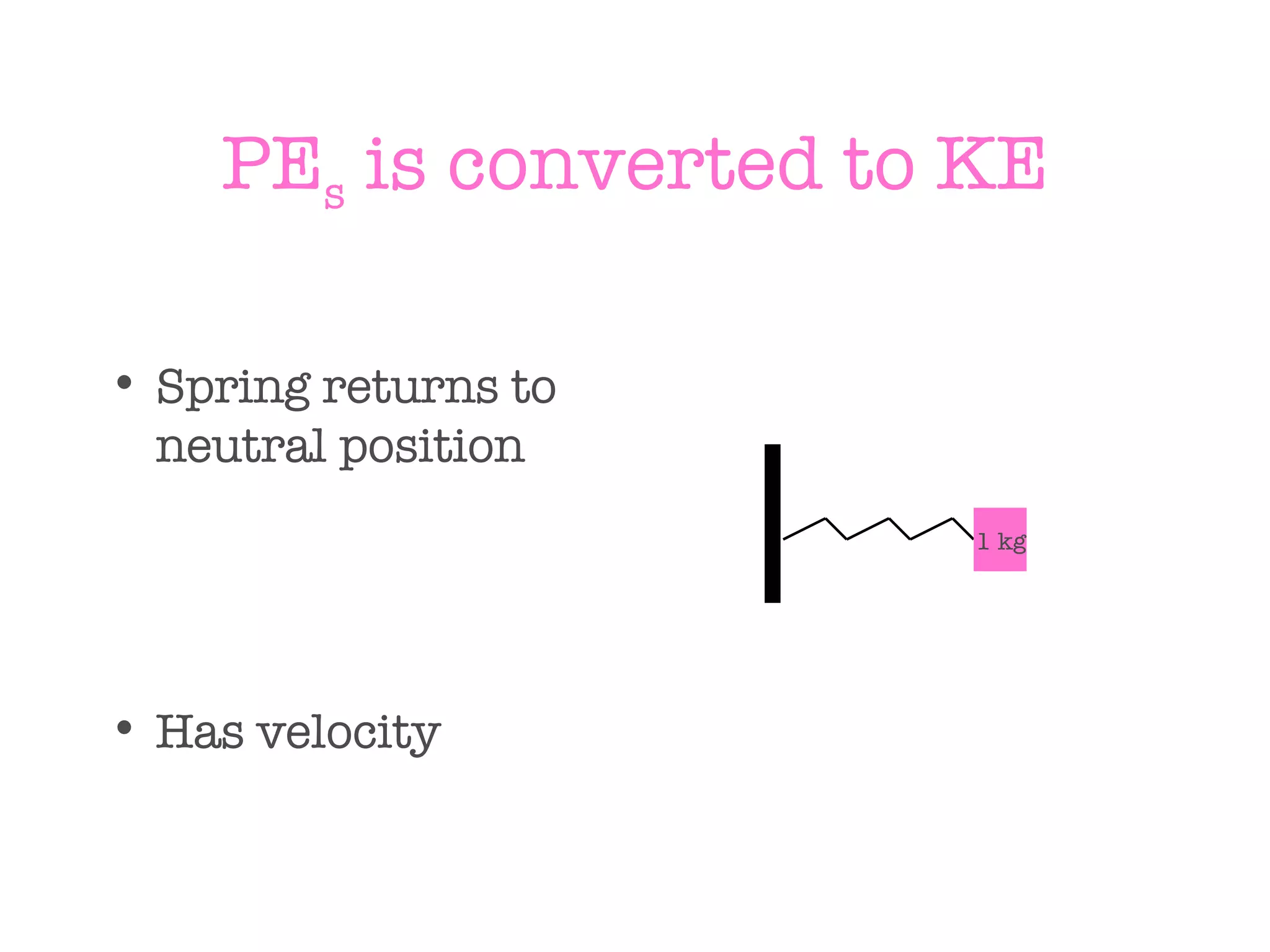
PE s  is converted to KE Spring returns to neutral position Has velocity 1 kg
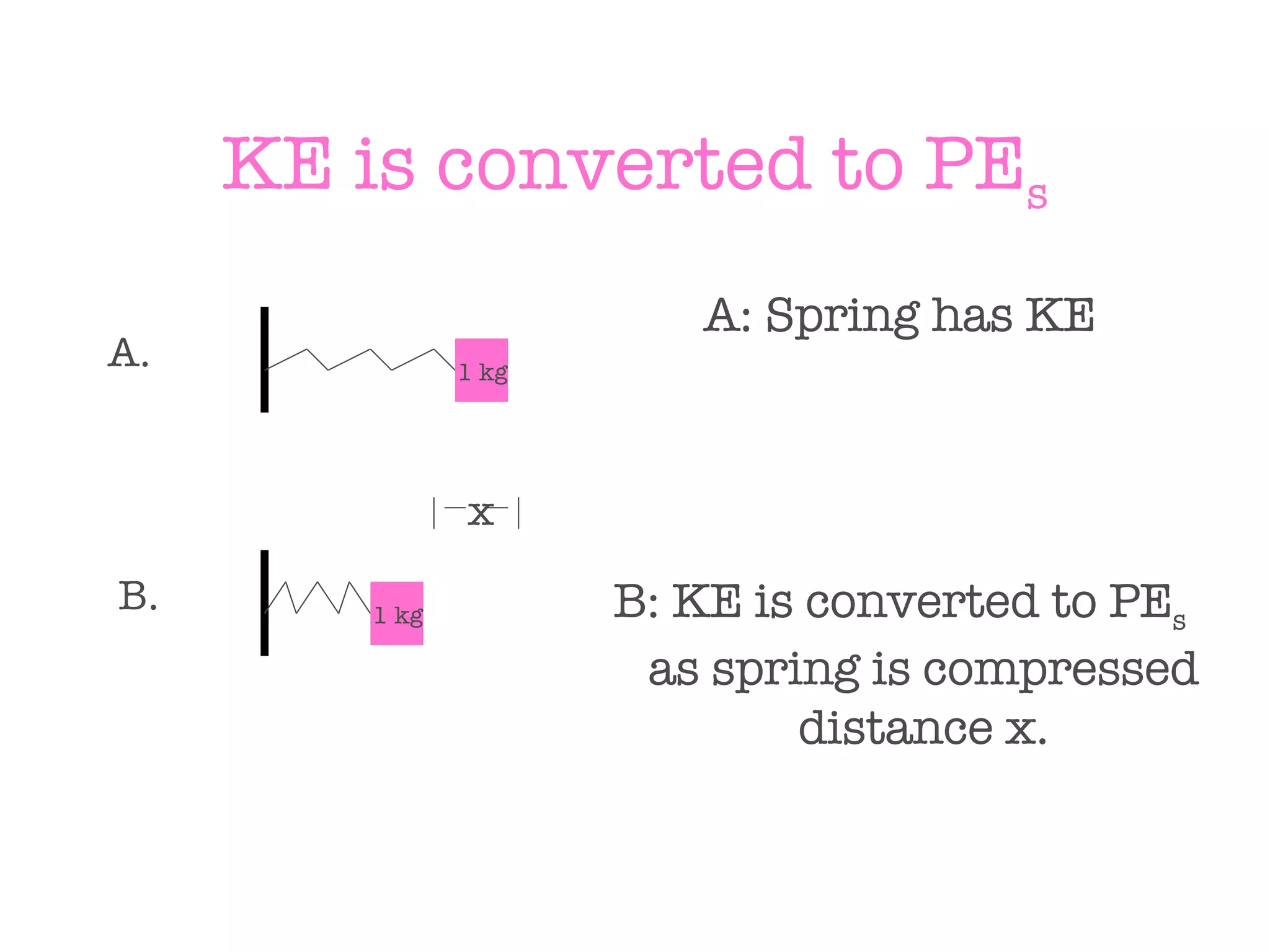
KE is converted to PE s A: Spring has KE B: KE is converted to PE s  as spring is compressed distance x. 1 kg 1 kg x A. B.
How to Solve Energy Problems
A roller coaster, is pulled up to point  A  where it and its screaming occupants are released from rest. Assuming no friction, calculate the speed at points  B ,  C  and  D . ( h a  = 35 m,  h d  = 12 m,  h c  = 22 m) Problem:
We will find the velocity at point C and show you step by step how to find it. At the end of the presentation, you can solve for the other points in the problem and check your answers with ours.
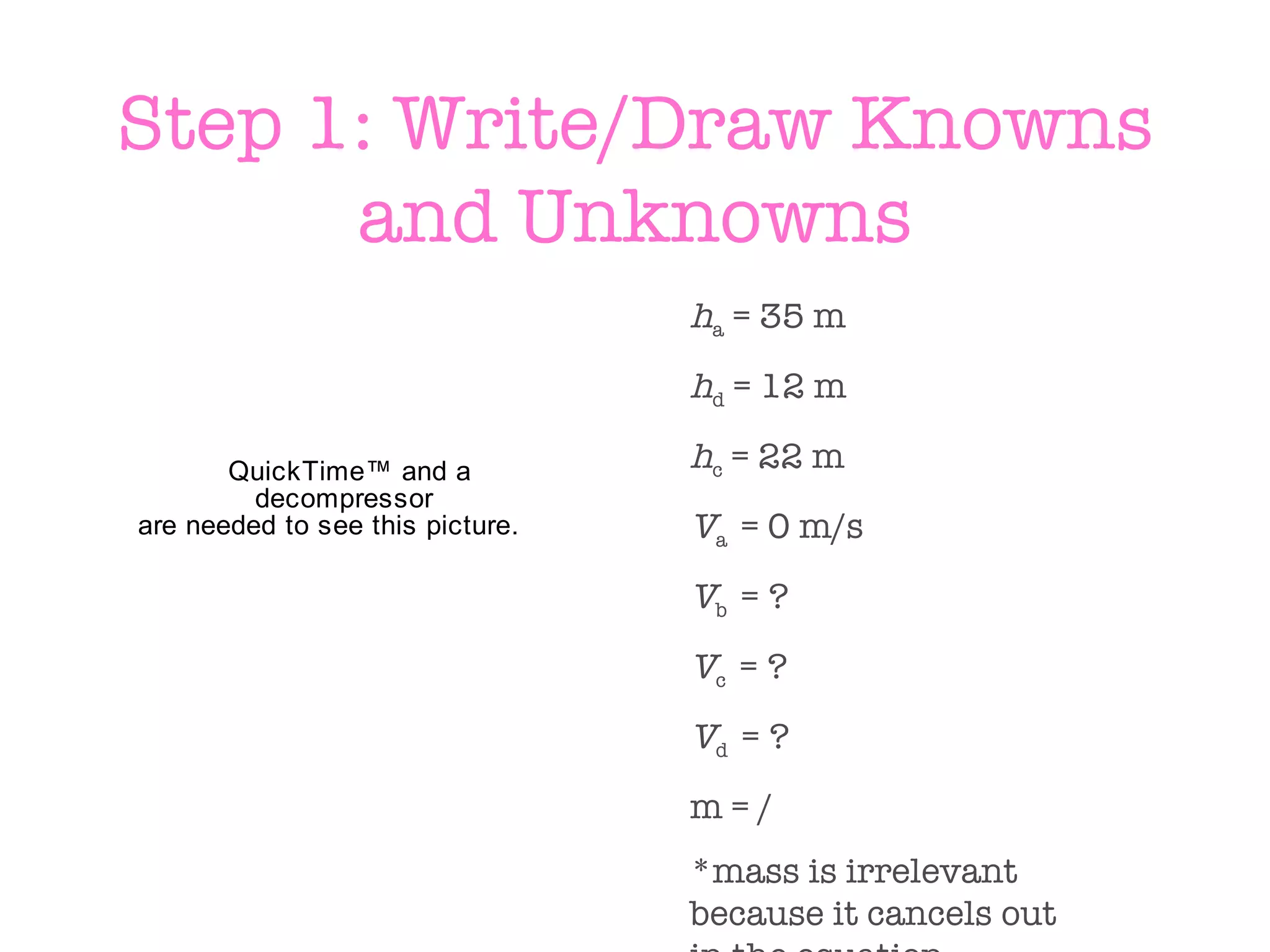
Step 1: Write/Draw Knowns and Unknowns h a  = 35 m h d  = 12 m h c  = 22 m V a  = 0 m/s V b  = ? V c  = ? V d  = ? m = / *mass is irrelevant because it cancels out in the equation
Step 2: Identify Types of Energy A: PE, because it is at rest and at its highest point C: PE, because it has height and KE because it has velocity
Step 3: Select Proper Equations
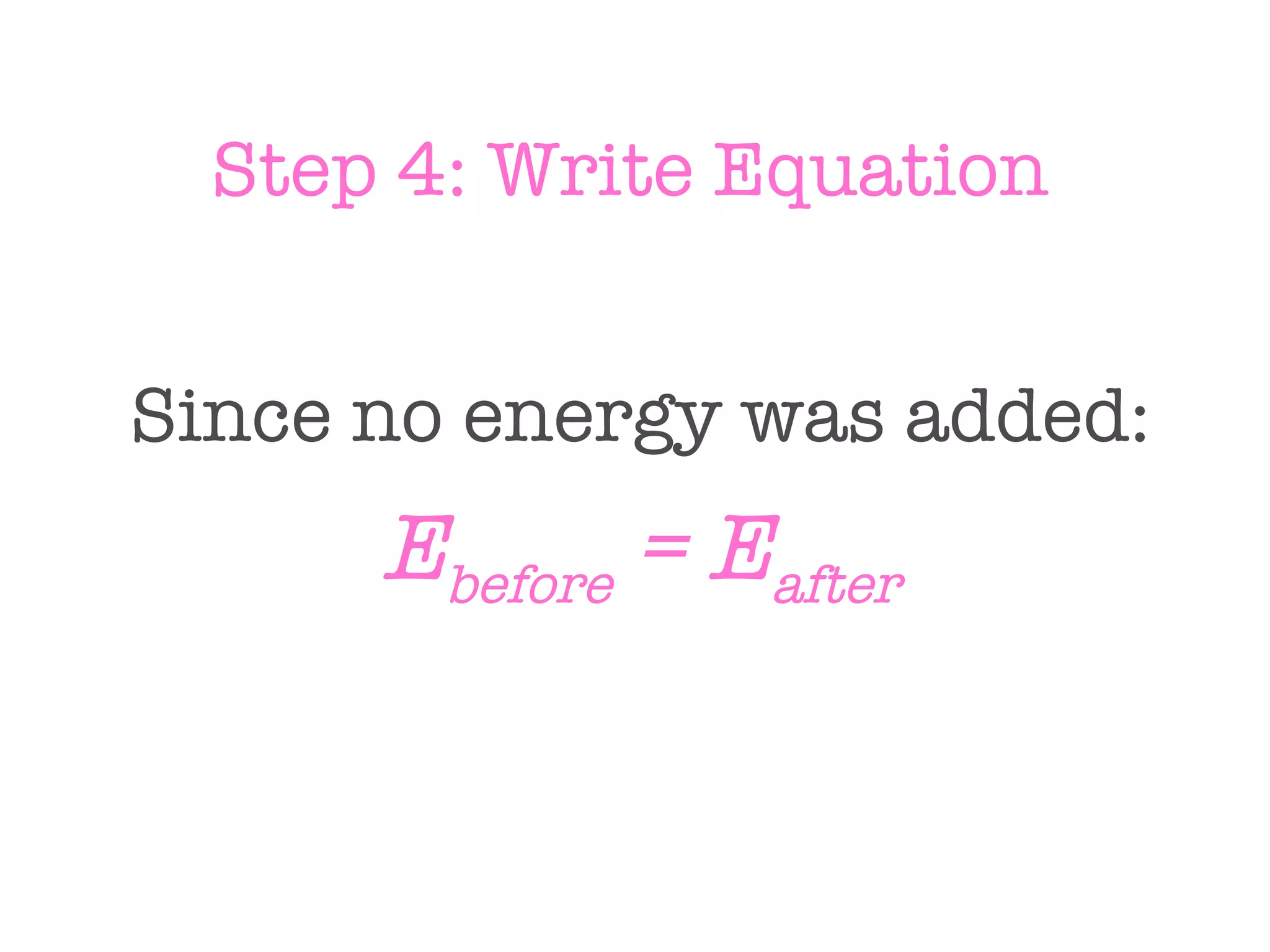
Step 4: Write Equation Since no energy was added:   E before  = E after
Step 4: Write Equation E a  = E c
Remember the masses cancel out!
Step 5: Substitute and Solve
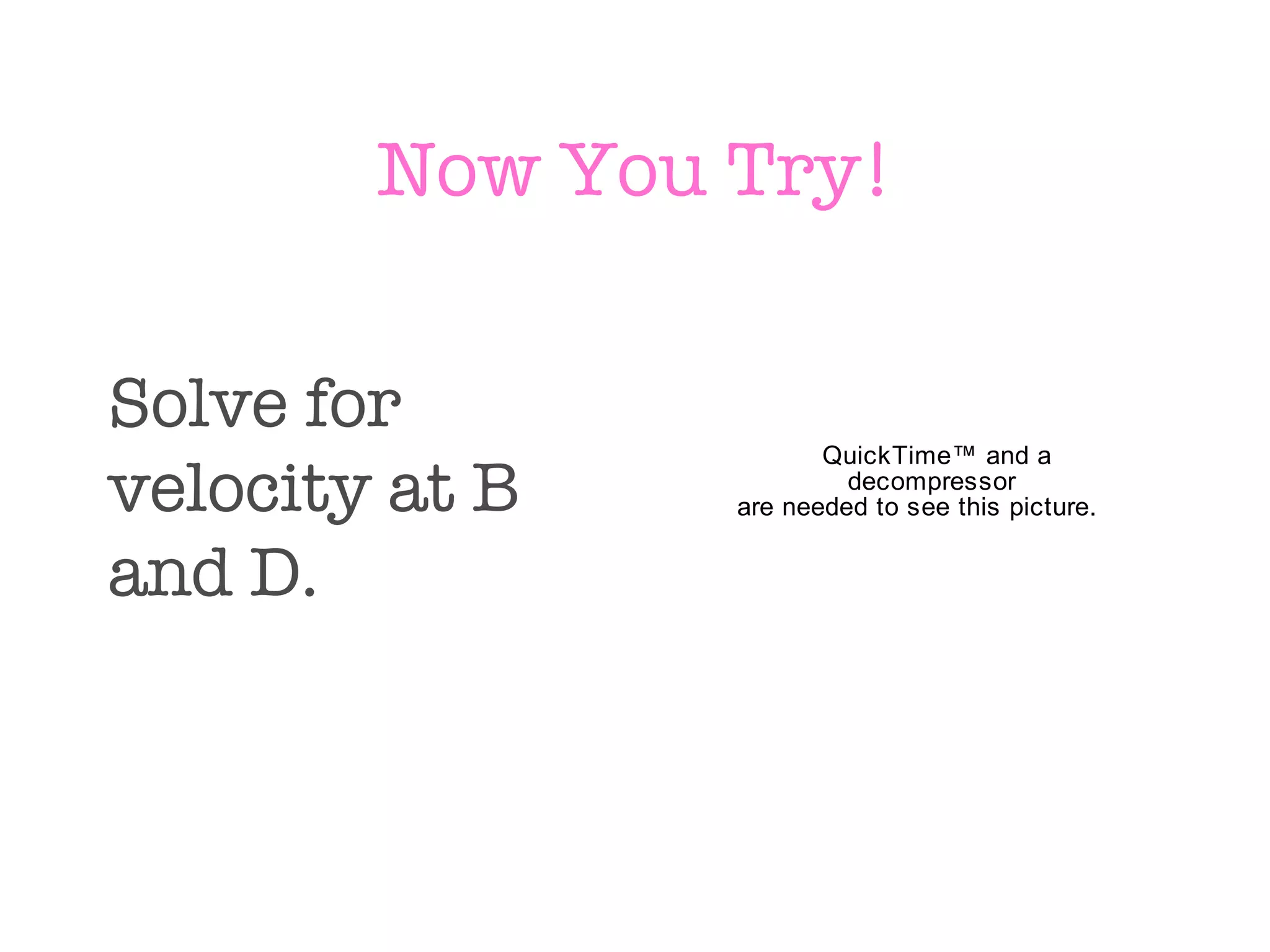
Now You Try! Solve for velocity at B and D.
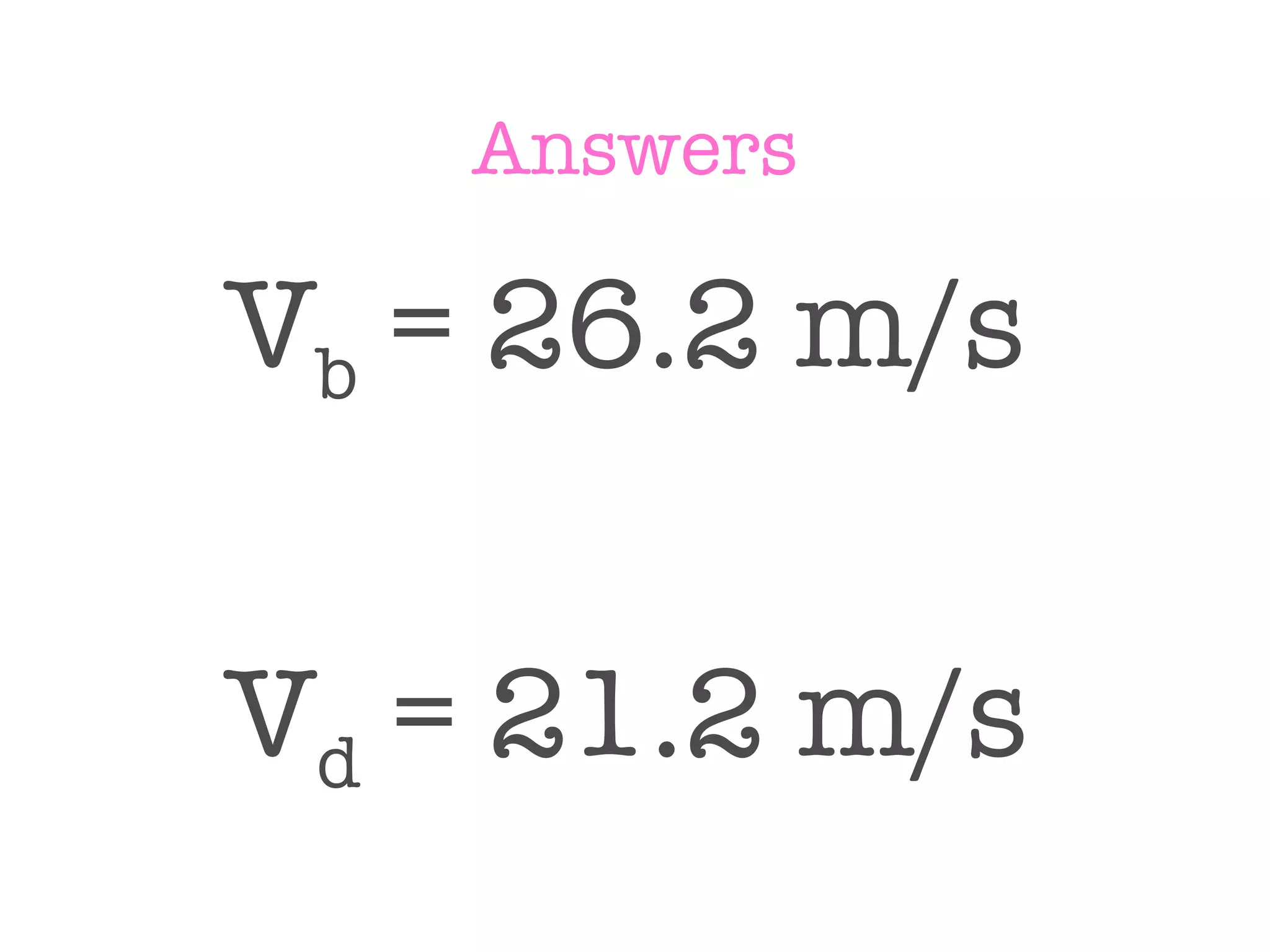
Answers V b  = 26.2 m/s V d   = 21.2 m/s

Energy 1

  • 1.
    Law of Conservationof Mechanical Energy
  • 2.
  • 3.
    Energy (E) is… ability to do work a scalar measurement measured in Joules
  • 4.
    There are twomain types of energy: Potential Kinetic
  • 5.
  • 6.
    Facts About KineticEnergy anything with velocity has KE It is directly proportional to mass and velocity Equation:
  • 7.
    Potential Energy Thereare two kinds of potential energy…
  • 8.
    Gravitational Potential Energydue to an object’s position in Earth’s (or another planet’s) gravitational field.
  • 9.
    Basically, if youhave height, you have Gravitational Potential Energy
  • 10.
    Elastic Potential Energystored in a stretched or compressed spring
  • 11.
    Total Mechanical EnergyPotential Energy and Kinetic Energy
  • 12.
  • 13.
    In other words,energy cannot be created or destroyed… Unless work was done on the system, the total energy of the system does not change.
  • 14.
    … it can,however, be converted between different types. For example, PE can be transferred to KE!
  • 15.
    Work is beingdone against friction and gravity. input energy (chemical energy) > output energy (thermal energy) energy is lost to friction
  • 16.
    If there isno gain in internal energy and no work done against friction, Q=0
  • 17.
    The body transfersthe chemical energy which is released as kinetic energy of the ball. The input of energy is chemical energy from the ice cream. But the total energy remains the same! Example:
  • 18.
  • 19.
    Roller Coasters Good examples of energy transfers
  • 20.
    At point W,v = 0 and it’s at its highest point, so it only has gravitational potential energy.
  • 21.
    Point X isat the lowest point and has no height, but is in motion so there is only kinetic energy.
  • 22.
    At Y, thecar has height and velocity. Therefore, it has both kinetic and potential energy.
  • 23.
    Even though theenergy is changing from potential to kinetic, the total energy is always the same.
  • 24.
    Pendulums Another goodexample of an energy transfer
  • 25.
    Maximum PE: Points1 and 3 This is where the pendulum has its greatest height.
  • 26.
    Maximum KE: Point 2 This is where the pendulum has its maximum velocity.
  • 27.
    From 1 to2: KE increases, PE decreases From 2 to 3: KE decreases, PE increases
  • 28.
  • 29.
    Neutral spring 1kg Vertical Spring and Mass 1 kg x Stretched spring
  • 30.
    Vertical Spring andMass 1 kg Has velocity --> KE Has height --> PE g The PE s is converted to PE g and KE
  • 31.
    Vertical Spring andMass 1 kg PE g 2 + PE s 2 Compressed spring --> PEs Has height --> PEg
  • 32.
    PE g 2 > PE g 1 1 kg 1 kg KE +PE g 1 PE g 2 + PE s 2 A. B. A has more height --> more PE g
  • 33.
    PE s 1 > PE s 2 1 kg PE g 2 + PE s 2 1 kg PE s 1 A. B. Total energy is always the same --> A has only PE s B has PE g and PE s
  • 34.
    Horizontal Spring andMass A: neutral spring. B: Spring is stretched distance x. 1 kg 1 kg x A. B. PE s
  • 35.
    PE s is converted to KE Spring returns to neutral position Has velocity 1 kg
  • 36.
    KE is convertedto PE s A: Spring has KE B: KE is converted to PE s as spring is compressed distance x. 1 kg 1 kg x A. B.
  • 37.
    How to SolveEnergy Problems
  • 38.
    A roller coaster,is pulled up to point A where it and its screaming occupants are released from rest. Assuming no friction, calculate the speed at points B , C and D . ( h a = 35 m, h d = 12 m, h c = 22 m) Problem:
  • 39.
    We will findthe velocity at point C and show you step by step how to find it. At the end of the presentation, you can solve for the other points in the problem and check your answers with ours.
  • 40.
    Step 1: Write/DrawKnowns and Unknowns h a = 35 m h d = 12 m h c = 22 m V a = 0 m/s V b = ? V c = ? V d = ? m = / *mass is irrelevant because it cancels out in the equation
  • 41.
    Step 2: IdentifyTypes of Energy A: PE, because it is at rest and at its highest point C: PE, because it has height and KE because it has velocity
  • 42.
    Step 3: SelectProper Equations
  • 43.
    Step 4: WriteEquation Since no energy was added: E before = E after
  • 44.
    Step 4: WriteEquation E a = E c
  • 45.
  • 46.
  • 47.
    Now You Try!Solve for velocity at B and D.
  • 48.
    Answers V b = 26.2 m/s V d = 21.2 m/s