-PRATIKSHA PATIL
1
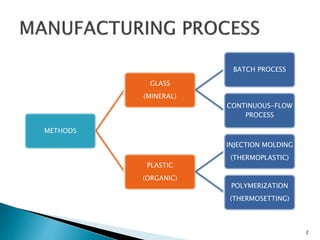
METHODS
GLASS
(MINERAL)
BATCH PROCESS
CONTINUOUS-FLOW
PROCESS
PLASTIC
(ORGANIC)
INJECTION MOLDING
(THERMOPLASTIC)
POLYMERIZATION
(THERMOSETTING)
2
 Often called as “supercooled” liquid
 Raw Materials
◦ Quartz sand (provides silica)
◦ Soda aka sodium carbonate (added as flux to assist
melting)
◦ Lime aka carbon oxide (added to increase chemical
stability & to decrease solubility of glass in water)
3
 Prime ingredients
◦ For Crown glass
 Silica
 Soda or potash
 Lime
◦ For Flint glass
 Silica
 Lead oxide
4
 It is used only for the production of relatively
small quantities of glass
 Special types of glass such as high-index
glass and many varieties of colored glass.
5
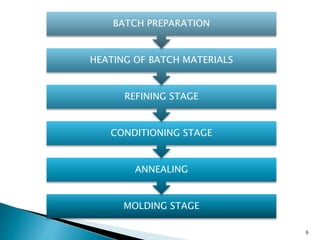
MOLDING STAGE
ANNEALING
CONDITIONING STAGE
REFINING STAGE
HEATING OF BATCH MATERIALS
BATCH PREPARATION
6
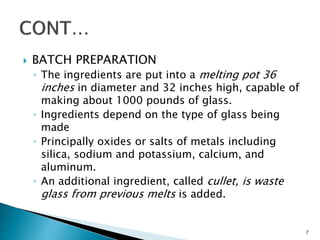
 BATCH PREPARATION
◦ The ingredients are put into a melting pot 36
inches in diameter and 32 inches high, capable of
making about 1000 pounds of glass.
◦ Ingredients depend on the type of glass being
made
◦ Principally oxides or salts of metals including
silica, sodium and potassium, calcium, and
aluminum.
◦ An additional ingredient, called cullet, is waste
glass from previous melts is added.
7
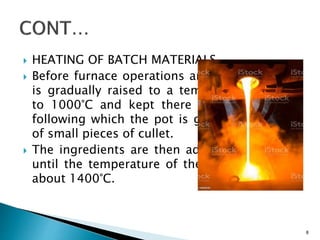
 HEATING OF BATCH MATERIALS
 Before furnace operations are begun, the pot
is gradually raised to a temperature of 800°
to 1000°C and kept there for 3 to 5 days,
following which the pot is glazed by the use
of small pieces of cullet.
 The ingredients are then added, at intervals,
until the temperature of the pot is raised to
about 1400°C.
8
 REFINING STAGE
 During the melting process, the batch is full
of bubbles of escaping gas
 The escaping of the gas is known as fining
 Toward the end of the melting and fining
process (which requires several hours), scum,
stones, and other materials rise to the top of
the batch and are skimmed off.
9
 CONDITIONING STAGE
 After completion of the melting, fining, and
stirring processes, the molten glass has the
consistency of heavy syrup.
 Then the molten glass is cooled to a
temperature of 1200°C making it more
homogenous for molding
10
 ANNEALING
 When cooled to a temperature of 1200°C, it is
poured and rolled into sheets of various
thicknesses, and each sheet of glass is placed
in a heated annealing oven where it is
gradually cooled to room temperature.
11
 MOLDING STAGE
 After annealing, the glass is cut into small
pieces, is reheated, and is then either pressed
or molded into rough blanks.
 After inspection, the rough blanks are
blocked on grinding shells and the first
surface is ground and polished to the desired
curvature.
 The blanks are then reblocked, and ground
and polished on the second side.
12
13
14
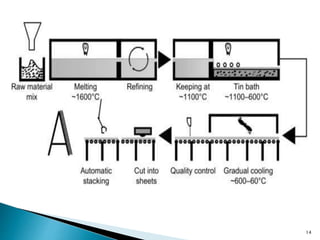
 An automated method
 Used for making large quantities of a
particular type of glass.
 This process differs from the batch process in
that the molten glass is not poured into
sheets but is extruded, by means of a
continuous process, and pressed into molds,
making the rough blanks.
15
 Also known as resin/ hard resin
 Raw Materials
◦ Organic ingredients
◦ Inorganic materials
 carbon, hydrogen, oxygen, nitrogen, chlorine, and
sulfur.
◦ Some come directly from plant and animal sources
such as wood and cotton (cellulose) and milk
(casein).
◦ More commonly, are derivatives of fossil-formed
products including oil, coal, and natural gas.
16
THERMOPLASTIC THERMOSETTING
 Soften when heated
 can be remolded
 Usually supplied in
pellet, granular, or
sheet form.
 Less dimensionally
stable(2-D)
 withstand less heat
without deformation.
 Eg. Polycarbonate
 once hardened cannot
be softened, even at
high temperatures
 usually supplied in
liquid monomer form
and cast in molds.
 molecules forms a 3-D,
cross-linked, lattice
pattern
 good dimensional
stability
 Eg. CR-39
17
 Thermoplastic materials have their molecules
arranged in long chains
 They are usually supplied in pellet, granular,
or sheet form.
 The material softens when heated and can be
stretched, pressed, or molded into complex
shapes with no appreciable change in its
chemical structure.
 When cooled, the material hardens and
shrinks, having the same configuration as the
mold in which it was heated.
18
 Since no chemical change transpires, the
softening and hardening cycle may be
repeated indefinitely.
 Thermoplastic materials are generally less
dimensionally stable than thermosetting
materials and they can withstand less heat
without deformation.
 Other ex. acrylates, cellulose acetate and
cellulose nitrate, polystyrene, the nylons, and
the vinyls
19
20
 Thermosetting materials are usually supplied
in liquid monomer form and cast in molds.
 Plasticizers, filters, dyes, binding modifiers,
other monomers, and catalysts may be added
to the basic chemical compound and then
material is heated. After which polymerization
occurs.
 The molecules form a threedimensional,
cross-linked, lattice pattern rather than the
two-dimensional pattern of the thermoplastic
material.
21
 This process transforms a liquid monomer
first into a syrup and then into a gel, and
finally into a solid.
 The relationship between the time and
temperature required in the hardening
process is known as the curing cycle.
 Once hardened, the material cannot be
softened (even at high temperature).
 If the thermosetting materials are subjected
to a high temperature, the material
decomposes without melting or substantially
softening.
22
 https://www.sciencedirect.com/topics/engin
eering/glass-batch
 https://www.sciencedirect.com/topics/engin
eering/float-glass-process
 Injection molding video
https://youtu.be/AwWlmBka1Gs
 Clinical Optics- Troy.E.Fannin-chapter 1
23
24

Lens manufacturing

  • 1.
  • 2.
  • 3.
     Often calledas “supercooled” liquid  Raw Materials ◦ Quartz sand (provides silica) ◦ Soda aka sodium carbonate (added as flux to assist melting) ◦ Lime aka carbon oxide (added to increase chemical stability & to decrease solubility of glass in water) 3
  • 4.
     Prime ingredients ◦For Crown glass  Silica  Soda or potash  Lime ◦ For Flint glass  Silica  Lead oxide 4
  • 5.
     It isused only for the production of relatively small quantities of glass  Special types of glass such as high-index glass and many varieties of colored glass. 5
  • 6.
    MOLDING STAGE ANNEALING CONDITIONING STAGE REFININGSTAGE HEATING OF BATCH MATERIALS BATCH PREPARATION 6
  • 7.
     BATCH PREPARATION ◦The ingredients are put into a melting pot 36 inches in diameter and 32 inches high, capable of making about 1000 pounds of glass. ◦ Ingredients depend on the type of glass being made ◦ Principally oxides or salts of metals including silica, sodium and potassium, calcium, and aluminum. ◦ An additional ingredient, called cullet, is waste glass from previous melts is added. 7
  • 8.
     HEATING OFBATCH MATERIALS  Before furnace operations are begun, the pot is gradually raised to a temperature of 800° to 1000°C and kept there for 3 to 5 days, following which the pot is glazed by the use of small pieces of cullet.  The ingredients are then added, at intervals, until the temperature of the pot is raised to about 1400°C. 8
  • 9.
     REFINING STAGE During the melting process, the batch is full of bubbles of escaping gas  The escaping of the gas is known as fining  Toward the end of the melting and fining process (which requires several hours), scum, stones, and other materials rise to the top of the batch and are skimmed off. 9
  • 10.
     CONDITIONING STAGE After completion of the melting, fining, and stirring processes, the molten glass has the consistency of heavy syrup.  Then the molten glass is cooled to a temperature of 1200°C making it more homogenous for molding 10
  • 11.
     ANNEALING  Whencooled to a temperature of 1200°C, it is poured and rolled into sheets of various thicknesses, and each sheet of glass is placed in a heated annealing oven where it is gradually cooled to room temperature. 11
  • 12.
     MOLDING STAGE After annealing, the glass is cut into small pieces, is reheated, and is then either pressed or molded into rough blanks.  After inspection, the rough blanks are blocked on grinding shells and the first surface is ground and polished to the desired curvature.  The blanks are then reblocked, and ground and polished on the second side. 12
  • 13.
  • 14.
  • 15.
     An automatedmethod  Used for making large quantities of a particular type of glass.  This process differs from the batch process in that the molten glass is not poured into sheets but is extruded, by means of a continuous process, and pressed into molds, making the rough blanks. 15
  • 16.
     Also knownas resin/ hard resin  Raw Materials ◦ Organic ingredients ◦ Inorganic materials  carbon, hydrogen, oxygen, nitrogen, chlorine, and sulfur. ◦ Some come directly from plant and animal sources such as wood and cotton (cellulose) and milk (casein). ◦ More commonly, are derivatives of fossil-formed products including oil, coal, and natural gas. 16
  • 17.
    THERMOPLASTIC THERMOSETTING  Softenwhen heated  can be remolded  Usually supplied in pellet, granular, or sheet form.  Less dimensionally stable(2-D)  withstand less heat without deformation.  Eg. Polycarbonate  once hardened cannot be softened, even at high temperatures  usually supplied in liquid monomer form and cast in molds.  molecules forms a 3-D, cross-linked, lattice pattern  good dimensional stability  Eg. CR-39 17
  • 18.
     Thermoplastic materialshave their molecules arranged in long chains  They are usually supplied in pellet, granular, or sheet form.  The material softens when heated and can be stretched, pressed, or molded into complex shapes with no appreciable change in its chemical structure.  When cooled, the material hardens and shrinks, having the same configuration as the mold in which it was heated. 18
  • 19.
     Since nochemical change transpires, the softening and hardening cycle may be repeated indefinitely.  Thermoplastic materials are generally less dimensionally stable than thermosetting materials and they can withstand less heat without deformation.  Other ex. acrylates, cellulose acetate and cellulose nitrate, polystyrene, the nylons, and the vinyls 19
  • 20.
  • 21.
     Thermosetting materialsare usually supplied in liquid monomer form and cast in molds.  Plasticizers, filters, dyes, binding modifiers, other monomers, and catalysts may be added to the basic chemical compound and then material is heated. After which polymerization occurs.  The molecules form a threedimensional, cross-linked, lattice pattern rather than the two-dimensional pattern of the thermoplastic material. 21
  • 22.
     This processtransforms a liquid monomer first into a syrup and then into a gel, and finally into a solid.  The relationship between the time and temperature required in the hardening process is known as the curing cycle.  Once hardened, the material cannot be softened (even at high temperature).  If the thermosetting materials are subjected to a high temperature, the material decomposes without melting or substantially softening. 22
  • 23.
     https://www.sciencedirect.com/topics/engin eering/glass-batch  https://www.sciencedirect.com/topics/engin eering/float-glass-process Injection molding video https://youtu.be/AwWlmBka1Gs  Clinical Optics- Troy.E.Fannin-chapter 1 23
  • 24.