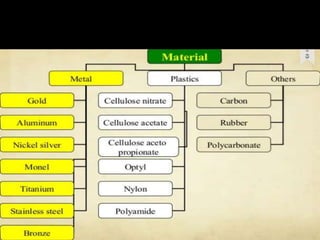
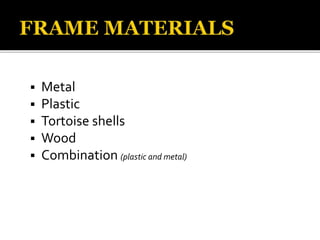
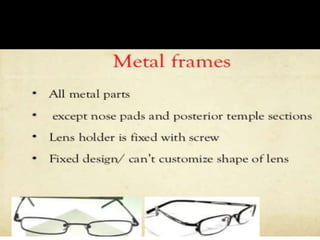
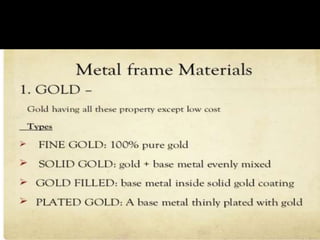
 Metal
 Plastic
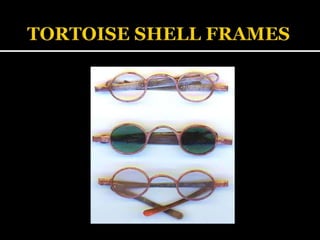
 Tortoise shells
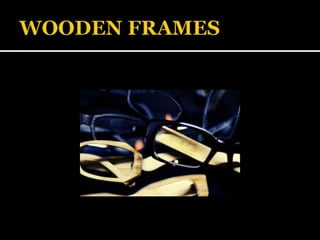
 Wood
 Combination (plastic and metal)
 Stain resistant.
 Durable.
 Light weight.
 Paintable.
 Strong & rigid.
 Does not corrodes.
 Does not solders or welds well, so parts made
from it are to be joined together with screws
or rivets.
Another name for nickel silver is German
silver.
Nickel silver contain more than 50%
copper, 25% nickel and the rest zinc. . .No
Silver.
copper gives the material its pliability, zinc
adds strength and nickel gives the alloy a
whitish appearance.
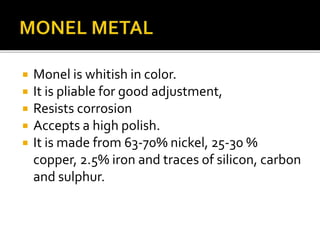
 Monel is whitish in color.
 It is pliable for good adjustment,
 Resists corrosion
 Accepts a high polish.
 It is made from 63-70% nickel, 25-30 %
copper, 2.5% iron and traces of silicon, carbon
and sulphur.
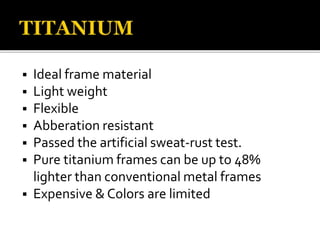
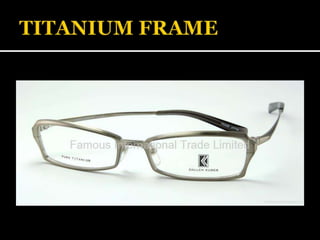
 Ideal frame material
 Light weight
 Flexible
 Abberation resistant
 Passed the artificial sweat-rust test.
 Pure titanium frames can be up to 48%
lighter than conventional metal frames
 Expensive & Colors are limited
 Durable.
 When made very thin, they are
Flexible, that’s why most suited for making
temples.
 Strong.
 Non magnetic
 Resistant to oxidation/corrosion.
 Endless color range
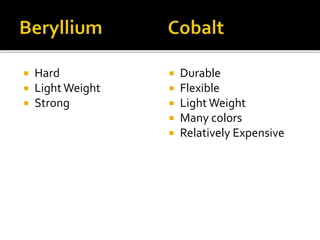
 Hard
 Light Weight
 Strong
 Durable
 Flexible
 Light Weight
 Many colors
 Relatively Expensive
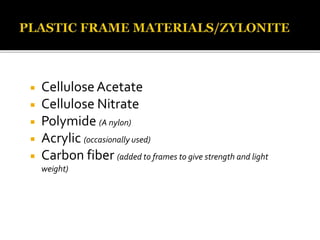
 CelluloseAcetate
 Cellulose Nitrate
 Polymide (A nylon)
 Acrylic (occasionally used)
 Carbon fiber (added to frames to give strength and light
weight)
 The basis cellulose acetate material is extracted
from cotton or wood pulp and then further
processed into sheets from which frame parts are
drawn.
 It is most commonly used material.
 Can be produced faster than other plastic frames.
 Is more colorfast and easy to polish.
 Least material allergies reported if coated
properly.
 Acetate is heavier compared to newer plastics.
Acetate goes white and brittle with age.
 Tougher than Cellulose Acetate.
 Thinner frames.
 Harder surface, so easy to polish.
 Better dimensional stability.
 Inflammable if brought to a sufficiently high temperature,
(because of the danger posed by the flamablility, cellulose
nitrate have been banned by the US Food and drug
administration (FDA) and is no longer used for spectacle
frame).
 Because these zylonite frames were the only plastic
frames commonly used for a period of time, plastic frames
were known as zyl frames. An spite of zylonite
disappearing from the market, the “Zyl” nick name for
plastic lens remains.
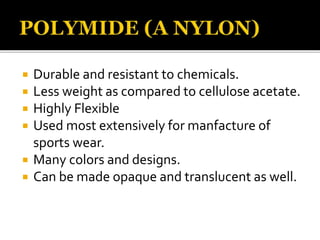
 Durable and resistant to chemicals.
 Less weight as compared to cellulose acetate.
 Highly Flexible
 Used most extensively for manfacture of
sports wear.
 Many colors and designs.
 Can be made opaque and translucent as well.
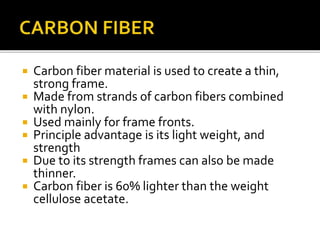
 Carbon fiber material is used to create a thin,
strong frame.
 Made from strands of carbon fibers combined
with nylon.
 Used mainly for frame fronts.
 Principle advantage is its light weight, and
strength
 Due to its strength frames can also be made
thinner.
 Carbon fiber is 60% lighter than the weight
cellulose acetate.
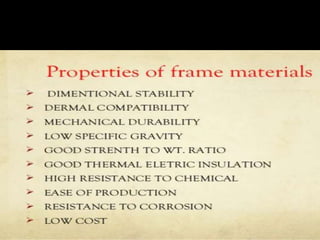
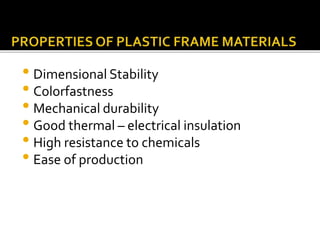
• Dimensional Stability
• Colorfastness
• Mechanical durability
• Good thermal – electrical insulation
• High resistance to chemicals
• Ease of production
 Nylon cord frame, some times called string
mounted frames or nylon supras, hold the
lenses in place by means of a nylon cord that
fits around the edge of lens.
 This give the glasses the appearance of being
rimless.
 Usually the top of the lens fitted into the upper
rim of the frames.The rest of the length has a
small groove cut into an otherwise flat edge.
NYLON CORD FRAMES OR NYLON SUPRAS
 Numont mountings hold the lenses in place
only at their nasal edge.
 Lenses are attached at the bridge area and
the temples are attached to a metal arm that
extends along the posterior surface
temporarily.Thus there is only one point of
attachment.

Spectacle frame materials

  • 5.
     Metal  Plastic Tortoise shells  Wood  Combination (plastic and metal)
  • 8.
     Stain resistant. Durable.  Light weight.  Paintable.  Strong & rigid.  Does not corrodes.  Does not solders or welds well, so parts made from it are to be joined together with screws or rivets.
  • 9.
    Another name fornickel silver is German silver. Nickel silver contain more than 50% copper, 25% nickel and the rest zinc. . .No Silver. copper gives the material its pliability, zinc adds strength and nickel gives the alloy a whitish appearance.
  • 10.
     Monel iswhitish in color.  It is pliable for good adjustment,  Resists corrosion  Accepts a high polish.  It is made from 63-70% nickel, 25-30 % copper, 2.5% iron and traces of silicon, carbon and sulphur.
  • 11.
     Ideal framematerial  Light weight  Flexible  Abberation resistant  Passed the artificial sweat-rust test.  Pure titanium frames can be up to 48% lighter than conventional metal frames  Expensive & Colors are limited
  • 13.
     Durable.  Whenmade very thin, they are Flexible, that’s why most suited for making temples.  Strong.  Non magnetic  Resistant to oxidation/corrosion.  Endless color range
  • 14.
     Hard  LightWeight  Strong  Durable  Flexible  Light Weight  Many colors  Relatively Expensive
  • 16.
     CelluloseAcetate  CelluloseNitrate  Polymide (A nylon)  Acrylic (occasionally used)  Carbon fiber (added to frames to give strength and light weight)
  • 17.
     The basiscellulose acetate material is extracted from cotton or wood pulp and then further processed into sheets from which frame parts are drawn.  It is most commonly used material.  Can be produced faster than other plastic frames.  Is more colorfast and easy to polish.  Least material allergies reported if coated properly.  Acetate is heavier compared to newer plastics. Acetate goes white and brittle with age.
  • 18.
     Tougher thanCellulose Acetate.  Thinner frames.  Harder surface, so easy to polish.  Better dimensional stability.  Inflammable if brought to a sufficiently high temperature, (because of the danger posed by the flamablility, cellulose nitrate have been banned by the US Food and drug administration (FDA) and is no longer used for spectacle frame).  Because these zylonite frames were the only plastic frames commonly used for a period of time, plastic frames were known as zyl frames. An spite of zylonite disappearing from the market, the “Zyl” nick name for plastic lens remains.
  • 20.
     Durable andresistant to chemicals.  Less weight as compared to cellulose acetate.  Highly Flexible  Used most extensively for manfacture of sports wear.  Many colors and designs.  Can be made opaque and translucent as well.
  • 21.
     Carbon fibermaterial is used to create a thin, strong frame.  Made from strands of carbon fibers combined with nylon.  Used mainly for frame fronts.  Principle advantage is its light weight, and strength  Due to its strength frames can also be made thinner.  Carbon fiber is 60% lighter than the weight cellulose acetate.
  • 23.
    • Dimensional Stability •Colorfastness • Mechanical durability • Good thermal – electrical insulation • High resistance to chemicals • Ease of production
  • 26.
     Nylon cordframe, some times called string mounted frames or nylon supras, hold the lenses in place by means of a nylon cord that fits around the edge of lens.  This give the glasses the appearance of being rimless.  Usually the top of the lens fitted into the upper rim of the frames.The rest of the length has a small groove cut into an otherwise flat edge. NYLON CORD FRAMES OR NYLON SUPRAS
  • 27.
     Numont mountingshold the lenses in place only at their nasal edge.  Lenses are attached at the bridge area and the temples are attached to a metal arm that extends along the posterior surface temporarily.Thus there is only one point of attachment.