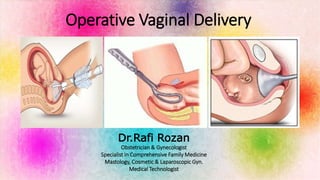

Operative Vaginal Delivery
Dr.Rafi Rozan
Obstetrician & Gynecologist
Specialist in Comprehensive Family Medicine
Mastology, Cosmetic & Laparoscopic Gyn.
Medical Technologist
Forceps
Operative Vaginal Delivery
Vacuum
Odon
Dr.Rozan
INTRODUCTION
The era of modern operative obstetrics began
with the invention of the forceps by Peter
Chamberlen of England. Subsequently, over
the years the ability to use forceps separated
the obstetricians from the midwives. The use
of forceps reached its acme in the United
States as a result of the influence of DeLee,
who in 1920 taught the importance of
prophylactic forceps and episiotomy to protect
against maternal and fetal injury.
Dr.Rozan
In 1968 in New York City, 29.7% of births were forceps assisted,
but by 1978 the incidence was down to 12.2%.
At the same time, in the United States, cesarean birth rates rose from
5.5% in 1970 to 15.2% in 1978 and now is as high as 20–25%.
2015 – 3.1% OVD
0.56 Forceps
2.58% vacuum
Dr.Rozan
Types of Episiotomy
J Shape
Lateral
8 o Clock
MedioLateral
Median
Dr.Rozan
The Bony Pelvis
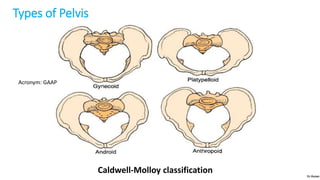
Types of Pelvis
Caldwell-Molloy classification
Acronym: GAAP
Dr.Rozan
Rhombus of MichaelisPelvimetry External
Dr.Rozan
Pelvimetry External
External Conjugate
of Baudelocque
Biischial Spines
Diameter
Suprapubic
Angle
Dr.Rozan
The Bony Pelvis
Dr.Rozan
The Bony Pelvis
Ischial Spines
OC = DC - 1.5
Dr.Rozan
Fetal Station
Hodge Planes
DeLee Planes ACOG Planes
Dr.Rozan
Fetal Head
Metopic Suture
Coronal
Suture
Sagital
Suture
Lambdoid
Suture
Anterior Fontanel
Mastoid
Fontanel
Posterior
Fontanel
Sphenoid
Fontanel
Dr.Rozan
Fetal Head
Dr.Rozan
Regions of the Fetal Head
Dr.Rozan
Dr.Rozan
Cephalic Position Variations
Dr.Rozan
Classification & Criteria for Types of Forceps Deliveries
Low Forceps
Outlet Forceps
Mid Forceps
• Scalp is visible at the introitus without separating the labia
• Fetal skull has reached the pelvic floor
• Fetal head is at or on perineum
• Sagittal suture is in anteroposterior diameter or right or
left occiput anterior or posterior position
• Rotation does not exceed 45 degrees
• Leading point of the fetal skull is at station +2 cm or
more and not on the pelvic floor
• Without rotation: Rotation is 45 degrees or less (right or
left occiput anterior to occiput anterior, or right or left
occiput posterior to occiput posterior)
• With rotation: Rotation is greater than 45 degrees
• Station is above +2 cm but head is engaged
Dr.Rozan
Indications for Operative Vaginal Delivery
Nulliparous: 3 Hours
• Suspicion of immediate or potential fetal compromise
• Shortening of the second stage of labor for maternal benefit
• Prolonged second stage of labor
Multiparous: 2 Hours
Epidural Anesthesia: 1 extra hour with RFT
Acute Placental Abruption
ValSalva Maneuver is Contraindicated
Cardiac Abnormalities
Neurological Disorder
Muscular Disease
Cystic Lung Disease
Dr.Rozan
Contraindications
• Extreme fetal prematurity
• Fetal demineralizing disease (osteogenesis imperfect)
• Fetal bleeding diathesis ( fetal hemophilia, neonatal alloimmune
thrombocytopenia).
• Unengaged head
• Unknown fetal position.
• Brow or face presentation.
• Suspected fetal-pelvic disproportion.
Relative contraindications to use of vacuum devices, but not forceps,
include gestational age <34 weeks
Dr.Rozan
Prerequisites for Operative Vaginal Delivery
• Cervix fully dilated and retracted
• Membranes ruptured
• Engagement of the fetal head
• Position, Presentation, Station, Ortientation and any Asynclitism must be know
• Fetal weight estimation performed
• Adequate anesthesia
• Clinical Pelvimetry (Adequate pelvis to fetal size)
• Maternal bladder has been emptied
• Patient Consents to Procedure
• Willingness to abandon trial of operative vaginal delivery and back-up plan in
place in case of failure to deliver
• This is an operative procedure, and it should be accorded the same respect and
care for aseptic technique as any other operative procedure. Dr.Rozan
ANATOMY OF THE FORCEPS
Handle
Finger Guide
Lock
Shank
Blades
Cephalic Curve
Pelvic Curve
Heel
Toe
Fenestration
Window
Dr.Rozan
Some Types of Forceps
Simpson forceps (1848) are the most commonly used among the types of
forceps and has an elongated cephalic curve. These are used when there is
substantial molding of the fetal head.
Dr.Rozan
Elliot forceps (1860) are similar to Simpson forceps but with an
adjustable pin in the end of the handles which can be drawn out as a
means of regulating the lateral pressure on the handles when the
instrument is positioned for use. They are used most often when there
is minimal moulding.
Dr.Rozan
Kielland forceps (1915, Norwegian) are distinguished by an extremely
small pelvic curve and a sliding lock. The most common forceps used
for rotation. The sliding lock is helpful in asynclitic Kielland forceps lack
traction because they have almost no pelvic curve
Dr.Rozan
Wrigley's forceps are used in low or outlet delivery and in cesarean
section delivery where manual traction is proving difficult. The short
length results in a lower chance of uterine rupture.
Dr.Rozan
Piper's forceps have a perineal curve to allow application to the after-
coming head in breech delivery.
Dr.Rozan
Dr.Rozan
ANATOMY OF THE FORCEPS
French lock English lock
German lock Sliding Lock
Pivot lock
Dr.Rozan
Technique of forceps application
The forceps must be applied so they fit
the head accurately. They should lie
evenly against the sides of the head,
reaching from the parietal bones to and
beyond the malar eminences covering
symmetrically the spaces between the
orbits and the ears.
Parietal – Malar
Ideal application
Dr.Rozan
-With the criteria for forceps application met, the forceps can be applied.
-The operator stands before the perineum with the forceps articulated and
oriented to the position of the fetus' head. Holding the forceps articulated
prevents confusion due to the crossing of the shanks.
-For the left occipitoanterior (LOA) or direct OA positions, the left blade
(posterior) is applied first.
-The operator places his or her back to the maternal right thigh and holds the
handle between the fingers, as in holding a pencil.
-The shank is held perpendicular to the floor, the middle and index fingers are
inserted into the vagina, and the thumb is applied to the heel of the blade.
- The force necessary to insert the blade is exerted by the pressure of the
thumb.
- The left hand guides the handle in a wide arc until the blade is in place. This
blade is then held in place by an assistant.
Technique of forceps application
Dr.Rozan
-The right blade is then inserted in a similar manner, with the
operator's back to the patient's left thigh.
-This blade is inserted more anteriorly in the vagina to avoid rotating
the head further to the left.
- Any adjustments to ensure a cephalic application should generally be
made with the right blade.
Technique of forceps application
Dr.Rozan
Madame Lachapelle Maneuver
Dr.Rozan
Once the blades are applied, the accuracy of placement should be evaluated.
Technique of forceps application
1. Lock articulation of the Forceps. Do not close the Handle
2. Ocipital Fontanel 1 finger beneath above the shank of the forceps
3. The shanks are perpendicular to the Sagital suture
4. One or less fingertip space at the heel of the blade
5. No maternal tissue has been grasped
Dr.Rozan
The Pull …
Technique of forceps application
Pajot Saxtorph Maneuver
Bill axis traction handle
Scanzoni Maneuver
OP
Dr.Rozan
Maternal Effort + Uterine Contraction + Devise Pull
Ritgen maneuver
Is used to control delivery of the fetal
head. It involves applying upward
pressure from the coccygeal region to
extend the head during actual delivery,
thereby protecting the musculature of
the perineum.
Modified Ritgen Maneuver
Dr.Rozan
Dr.Rozan
Dr.Rozan
Name: Jorge Odón
Country: Argentina
Occupation: Car Mechanic
Dr.Rozan
Dr.Rozan
Odón's idea to
Odón Device
Dr.Rozan
Odón
Device
Dr.Rozan
Odón
Device
Dr.Rozan
Odón
Device
Dr.Rozan
Odón
Device
Dr.Rozan
1. ACOG PB 154
2. Uptodate OVD
3. Williams Obstetrics 24 Ed
4. Martin JA, Hamilton BE, Osterman MJ, et al. Births: Final Data for 2015.
Natl Vital Stat Rep 2017; 66:1.
5. Committee on Practice Bulletins—Obstetrics. ACOG Practice Bulletin No.
154 Summary: Operative Vaginal Delivery. Obstet Gynecol 2015; 126:1118.
6. Palatnik A, Grobman WA, Hellendag MG, et al. Predictors of Failed
Operative Vaginal Delivery in a Contemporary Obstetric Cohort. Obstet
Gynecol 2016; 127:501.
7. American College of Obstetricians and Gynecologists, Society for Maternal-
Fetal Medicine. Obstetric care consensus no. 1: safe prevention of the
primary cesarean delivery. Obstet Gynecol 2014; 123:693.
Referenc
es
Dr.Rozan
Dr.Rozan

Operative Vaginal Delivery (Dr.Rozan)

  • 1.
    Operative Vaginal Delivery Dr.RafiRozan Obstetrician & Gynecologist Specialist in Comprehensive Family Medicine Mastology, Cosmetic & Laparoscopic Gyn. Medical Technologist
  • 2.
  • 3.
    INTRODUCTION The era ofmodern operative obstetrics began with the invention of the forceps by Peter Chamberlen of England. Subsequently, over the years the ability to use forceps separated the obstetricians from the midwives. The use of forceps reached its acme in the United States as a result of the influence of DeLee, who in 1920 taught the importance of prophylactic forceps and episiotomy to protect against maternal and fetal injury. Dr.Rozan
  • 4.
    In 1968 inNew York City, 29.7% of births were forceps assisted, but by 1978 the incidence was down to 12.2%. At the same time, in the United States, cesarean birth rates rose from 5.5% in 1970 to 15.2% in 1978 and now is as high as 20–25%. 2015 – 3.1% OVD 0.56 Forceps 2.58% vacuum Dr.Rozan
  • 5.
    Types of Episiotomy JShape Lateral 8 o Clock MedioLateral Median Dr.Rozan
  • 6.
  • 7.
    Types of Pelvis Caldwell-Molloyclassification Acronym: GAAP Dr.Rozan
  • 8.
  • 9.
    Pelvimetry External External Conjugate ofBaudelocque Biischial Spines Diameter Suprapubic Angle Dr.Rozan
  • 10.
  • 11.
    The Bony Pelvis IschialSpines OC = DC - 1.5 Dr.Rozan
  • 12.
    Fetal Station Hodge Planes DeLeePlanes ACOG Planes Dr.Rozan
  • 13.
    Fetal Head Metopic Suture Coronal Suture Sagital Suture Lambdoid Suture AnteriorFontanel Mastoid Fontanel Posterior Fontanel Sphenoid Fontanel Dr.Rozan
  • 14.
  • 15.
    Regions of theFetal Head Dr.Rozan
  • 16.
  • 17.
  • 18.
    Classification & Criteriafor Types of Forceps Deliveries Low Forceps Outlet Forceps Mid Forceps • Scalp is visible at the introitus without separating the labia • Fetal skull has reached the pelvic floor • Fetal head is at or on perineum • Sagittal suture is in anteroposterior diameter or right or left occiput anterior or posterior position • Rotation does not exceed 45 degrees • Leading point of the fetal skull is at station +2 cm or more and not on the pelvic floor • Without rotation: Rotation is 45 degrees or less (right or left occiput anterior to occiput anterior, or right or left occiput posterior to occiput posterior) • With rotation: Rotation is greater than 45 degrees • Station is above +2 cm but head is engaged Dr.Rozan
  • 19.
    Indications for OperativeVaginal Delivery Nulliparous: 3 Hours • Suspicion of immediate or potential fetal compromise • Shortening of the second stage of labor for maternal benefit • Prolonged second stage of labor Multiparous: 2 Hours Epidural Anesthesia: 1 extra hour with RFT Acute Placental Abruption ValSalva Maneuver is Contraindicated Cardiac Abnormalities Neurological Disorder Muscular Disease Cystic Lung Disease Dr.Rozan
  • 20.
    Contraindications • Extreme fetalprematurity • Fetal demineralizing disease (osteogenesis imperfect) • Fetal bleeding diathesis ( fetal hemophilia, neonatal alloimmune thrombocytopenia). • Unengaged head • Unknown fetal position. • Brow or face presentation. • Suspected fetal-pelvic disproportion. Relative contraindications to use of vacuum devices, but not forceps, include gestational age <34 weeks Dr.Rozan
  • 21.
    Prerequisites for OperativeVaginal Delivery • Cervix fully dilated and retracted • Membranes ruptured • Engagement of the fetal head • Position, Presentation, Station, Ortientation and any Asynclitism must be know • Fetal weight estimation performed • Adequate anesthesia • Clinical Pelvimetry (Adequate pelvis to fetal size) • Maternal bladder has been emptied • Patient Consents to Procedure • Willingness to abandon trial of operative vaginal delivery and back-up plan in place in case of failure to deliver • This is an operative procedure, and it should be accorded the same respect and care for aseptic technique as any other operative procedure. Dr.Rozan
  • 22.
    ANATOMY OF THEFORCEPS Handle Finger Guide Lock Shank Blades Cephalic Curve Pelvic Curve Heel Toe Fenestration Window Dr.Rozan
  • 23.
    Some Types ofForceps Simpson forceps (1848) are the most commonly used among the types of forceps and has an elongated cephalic curve. These are used when there is substantial molding of the fetal head. Dr.Rozan
  • 24.
    Elliot forceps (1860)are similar to Simpson forceps but with an adjustable pin in the end of the handles which can be drawn out as a means of regulating the lateral pressure on the handles when the instrument is positioned for use. They are used most often when there is minimal moulding. Dr.Rozan
  • 25.
    Kielland forceps (1915,Norwegian) are distinguished by an extremely small pelvic curve and a sliding lock. The most common forceps used for rotation. The sliding lock is helpful in asynclitic Kielland forceps lack traction because they have almost no pelvic curve Dr.Rozan
  • 26.
    Wrigley's forceps areused in low or outlet delivery and in cesarean section delivery where manual traction is proving difficult. The short length results in a lower chance of uterine rupture. Dr.Rozan
  • 27.
    Piper's forceps havea perineal curve to allow application to the after- coming head in breech delivery. Dr.Rozan
  • 28.
  • 29.
    ANATOMY OF THEFORCEPS French lock English lock German lock Sliding Lock Pivot lock Dr.Rozan
  • 30.
    Technique of forcepsapplication The forceps must be applied so they fit the head accurately. They should lie evenly against the sides of the head, reaching from the parietal bones to and beyond the malar eminences covering symmetrically the spaces between the orbits and the ears. Parietal – Malar Ideal application Dr.Rozan
  • 31.
    -With the criteriafor forceps application met, the forceps can be applied. -The operator stands before the perineum with the forceps articulated and oriented to the position of the fetus' head. Holding the forceps articulated prevents confusion due to the crossing of the shanks. -For the left occipitoanterior (LOA) or direct OA positions, the left blade (posterior) is applied first. -The operator places his or her back to the maternal right thigh and holds the handle between the fingers, as in holding a pencil. -The shank is held perpendicular to the floor, the middle and index fingers are inserted into the vagina, and the thumb is applied to the heel of the blade. - The force necessary to insert the blade is exerted by the pressure of the thumb. - The left hand guides the handle in a wide arc until the blade is in place. This blade is then held in place by an assistant. Technique of forceps application Dr.Rozan
  • 32.
    -The right bladeis then inserted in a similar manner, with the operator's back to the patient's left thigh. -This blade is inserted more anteriorly in the vagina to avoid rotating the head further to the left. - Any adjustments to ensure a cephalic application should generally be made with the right blade. Technique of forceps application Dr.Rozan
  • 33.
  • 34.
    Once the bladesare applied, the accuracy of placement should be evaluated. Technique of forceps application 1. Lock articulation of the Forceps. Do not close the Handle 2. Ocipital Fontanel 1 finger beneath above the shank of the forceps 3. The shanks are perpendicular to the Sagital suture 4. One or less fingertip space at the heel of the blade 5. No maternal tissue has been grasped Dr.Rozan
  • 35.
    The Pull … Techniqueof forceps application Pajot Saxtorph Maneuver Bill axis traction handle Scanzoni Maneuver OP Dr.Rozan Maternal Effort + Uterine Contraction + Devise Pull
  • 36.
    Ritgen maneuver Is usedto control delivery of the fetal head. It involves applying upward pressure from the coccygeal region to extend the head during actual delivery, thereby protecting the musculature of the perineum. Modified Ritgen Maneuver Dr.Rozan
  • 37.
  • 38.
  • 39.
    Name: Jorge Odón Country:Argentina Occupation: Car Mechanic Dr.Rozan
  • 40.
  • 41.
    Odón's idea to OdónDevice Dr.Rozan
  • 42.
  • 43.
  • 44.
  • 45.
  • 46.
    1. ACOG PB154 2. Uptodate OVD 3. Williams Obstetrics 24 Ed 4. Martin JA, Hamilton BE, Osterman MJ, et al. Births: Final Data for 2015. Natl Vital Stat Rep 2017; 66:1. 5. Committee on Practice Bulletins—Obstetrics. ACOG Practice Bulletin No. 154 Summary: Operative Vaginal Delivery. Obstet Gynecol 2015; 126:1118. 6. Palatnik A, Grobman WA, Hellendag MG, et al. Predictors of Failed Operative Vaginal Delivery in a Contemporary Obstetric Cohort. Obstet Gynecol 2016; 127:501. 7. American College of Obstetricians and Gynecologists, Society for Maternal- Fetal Medicine. Obstetric care consensus no. 1: safe prevention of the primary cesarean delivery. Obstet Gynecol 2014; 123:693. Referenc es Dr.Rozan
  • 47.

Editor's Notes

  • #4 The history of obstetrical forceps is long and, often, colorful. Sanskrit writings from approximately 1500 BC contain evidence of single and paired instruments; Egyptian, Greek, Roman, and Persian writings and pictures refer to forceps that were originally used for extraction following fetal demise to save the mother’s life DeLee's teaching was the impetus for the dramatic increase in the number of forceps deliveries performed in the United States from the 1930s through the 1950s. DeLee's has many contribution to the era of modern obstetric.. Namely the fetal station.
  • #5 However, due to the provocative studies by Friedman and colleagues and the increasing tendency for an adverse obstetric outcome to result in a malpractice suit, obstetric forceps delivery rates have fallen in the United States. OVD remains an important part of modern obstetrics and its knowledge and application is vital in every labor setting so that we can decrease CS and save a life if the needs arise.
  • #7 Knowing to do a Good Obstetric Explorartion is the Gold Key AP diameter = 11.5 to 12cm Oblique = 12.5 , Transverse = 13 cm, Inlet, mid, outlet and low
  • #9 The Rhombus of Michaelis, also known as the Michaelis-Raute or the quadrilateral of Michaelis, it is a rhombus-shaped contour that is sometimes visible on the lower back. The Rhombus of Michaelis is named after Gustav Adolf Michaelis, a 19th-century German obstetrician. 4 sides and angles
  • #10 Baudelocque, martin or Budin Pelvimeters. Bispinal = 24cm Distance between iliac crest= 28cm Distance between trocanters (Bitrocanter Diameter)= 32cm
  • #13 The concept of fetal station was initially described by DeLee in 1924 as the level of the presenting fetal part in the birth canal in relation to the ischial spines. Later, in 1988, ACOG first reported on a station classification system wherein the pelvis above and below the ischial spines is divided into fifths. These divisions are represented in centimeters; if the leading part of the fetus descends at a level between the spines, the station is designated as 0. Below the ischial spines, the presenting fetal part passes stations +1, +2, +3, +4, and +5 to delivery.
  • #14 Fontanels and sutures allows for molding of the fetal hear as it passes through the birth canal. In OVD it allows us to identify the Fetal Orientation thus being able to adequately and correctly place the Forceps.
  • #16 The regions of the fetal skull have been designated to aid in the description of the presenting Part felt at vaginal examination during labor.
  • #17 The sagittal suture is parallel to the transverse diameter of the pelvis- symmetricly (Selhiem Law). 2 unequal ovoid will align on there greater diameter axis reasons why the fetal head orients sideways to the transverse diameter of the Pelvis When the fetal head engages with some degree of tilt to the shoulder it results in asynclitism. Anterior asynclitism, in which the anterior part presents, is called Nägele obliquity. Posterior asynclitism, Litzman obliquity Bitemporal asynclitism, Roederer obliquity
  • #19 The American College of Obstetricians and Gynecologists' classification system for forceps deliveries is based on station and extent of rotation
  • #20 To reduce the rate of CS for failure to progress in the second stage, ACOG & SMFM recommend allowing 3H of pushing for nulliparous women and 2H of pushing for multiparous women before diagnosing arrest of labor, when maternal and fetal conditions permit. They did not provide specific criteria for the upper limit of the 2nd stage. Many obstetric providers allow an extra hour of pushing for women with epidural anesthesia when there is reassuring fetal testing. Use of forceps or vacuum is appropriate when expeditious delivery is indicated because of fetal compromise or probably imminent fetal compromise (eg, acute abruption)
  • #21 Instrumental delivery is contraindicated if the clinician or patient believes that the risk to mother or fetus is unacceptable. Examples include, but are not limited to
  • #31 Parietal Malar placement is important because It avoids over flexion or over extension of the fetal Head and as such preventing Maternal and fetal complications.
  • #32 Applying the left blade first has the advantage of not needing to cross the shanks in order to lock the forceps
  • #36 An alternative method of traction is to use a Bill axis traction handle and pull in the direction of the pointer. In exerting traction, it is well to keep in mind the bell-shaped curve of a uterine contraction as seen on a fetal monitor. The traction force should gradually increase, reaching its acme at about 30–40 seconds and then gradually relaxing. For the resident being taught, it is instructive to actually count off the seconds out loud so that they can appreciate the time involved. Between tractions, the handles are unlocked to relieve pressure on the fetus' head. Experts suggest 3 pulls are enough but its depends on the operator The OVD should be abandoned if no success in 15-20 minutes. When the baby he is crowned then Restrictive Episiotmy is done if indicated and the blades are removed starting with the Right one.
  • #38 Vacuum Assisted Delivery
  • #39 Forceps Assisted Delivery
  • #40 Argentinean Jorge Odón is a car mechanic by trade, and a tinkerer by nature. Recently, Odón watched a video about an easy method for removing a cork stuck in a wine bottle. And in the middle of the night it dawned on him that the same "trick" could be used during childbirth to help a baby that is stuck in the birth canal. Odón's children were fortunately born without complications, but his aunt suffered nerve damage during childbirth, so Odón was familiar with the potential complications. In an interview with the New York Times  Odón explained that after seeing the wine bottle trick, it dawned on him that this could be used during childbirth.
  • #41 Worldwide, more than 13 million births each year face serious complications, and every day about 800 women die from preventable causes related to pregnancy and childbirth (about 300,000 annually). The use of forceps and other mechanical devices can aid significantly in the extraction of the fetus during second stage of labor.
  • #42 With the help of his wife, he constructed a prototype using his daughter's baby doll, a glass jar and a fabric bag. In time, and with several revisions of his design, Odón's idea — the Odón Device — won the endorsement of the World Health Organization (WHO), big-time donors, and a medical technology company that wants to develop it for production.
  • #43 Using the Odón Device, a lubricated plastic sleeve is slipped around the baby's head and inflated until it forms a grip. Doctors then pull on the bag until the baby emerges. According to Dr. Margaret Chan, director general of WHO, the Odón Device has the potential to save babies in poor countries, and reduce the number of emergency cesareans in rich ones. "The Odón Device, developed by WHO and now undergoing clinical trials, offers a low-cost simplified way to deliver babies, and protect mothers, when labour is prolonged. It promises to transfer life-saving capacity to rural health posts, which almost never have the facilities and staff to perform a C-section. If approved, the Odón Device will be the first simple new tool for assisted delivery since forceps and vacuum extractors were introduced centuries ago," Chan said in a speech to the 65th World Health Assembly.
  • #44 The Odon delivery is done in 5 Steps.