MALPOSITION
Mrs. U SREEVIDYA Msc.
NURSING,
Associate Professor,
Apollo college of nursing,
CHITTOOR
MALPOSITION
“ Malposition refers to any
position of the vertex other than the
flexed occipito-anterior one.”
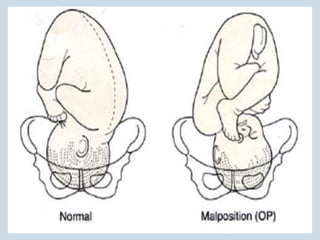
OCCIPITO POSTERIOR POSITION
“In a vertex presentation where
the occiput is placed posteriorly over
the sacroiliac joint, sacrum called
occipito-posterior postion.”
Malposition
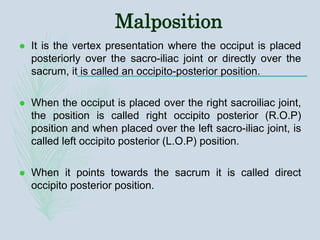
 It is the vertex presentation where the occiput is placed
posteriorly over the sacro-iliac joint or directly over the
sacrum, it is called an occipito-posterior position.
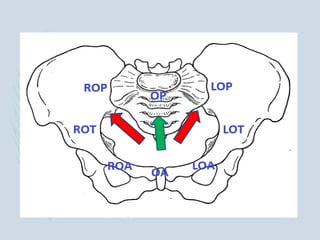
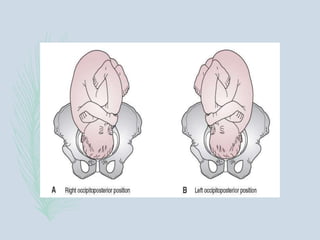
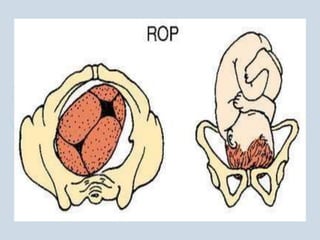
 When the occiput is placed over the right sacroiliac joint,
the position is called right occipito posterior (R.O.P)
position and when placed over the left sacro-iliac joint, is
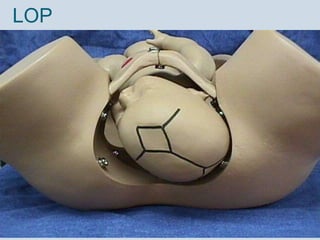
called left occipito posterior (L.O.P) position.
 When it points towards the sacrum it is called direct
occipito posterior position.
Types
 Right occipitoposterior
 Left occipitoposterior
 Direct occipitoposterior
LOP
Incidence
 At onset of labour 10% of vertex presentations
are occipitoposterior
 2/3rd of occipitoposterior presentations at delivery
are result if malrotation of occipitoanterior
position
 80% of occipitoposterior presentations rotate
to occipitoanterior during labour
 Among occipitoposterior positions incidence of
ROP is 5 times LOP
 Occipito-posterior position is an abnormal position of
the vertex rather than an abnormal presentation.
 Occurs in approximately 10% of labours.
 A persistent occipito-posterior position results from a
failure of internal rotation prior to birth.
 Occurs in 5% of the births.
Causes
 The direct cause is often unknown. But the following are
the responsible factors:
 Shape of the pelvic inlet: associated with either an
anthropoid or android pelvis.
 Fetal factors: Marked deflexion of fetal head.
 Uterine factors: Abnormal uterine contraction
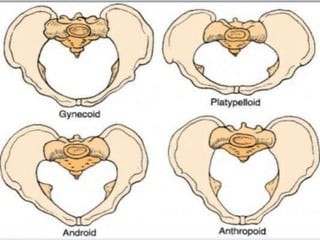
 Shape of the pelvic inlet
More than 50 % cases are associated
with the ANTHROPOID OR ANDROID
PELVIS
The wide occiput can comfortably be
placed in the wider posterior segment
of the pelvis
 FETAL FACTORS
Marked deflexion of the fetal head
Causes of deflexion:-
1. High pelvic inclination
2. Anterior attachment of placenta
3. Primary brachy cephaly
4. Pelvic tumors
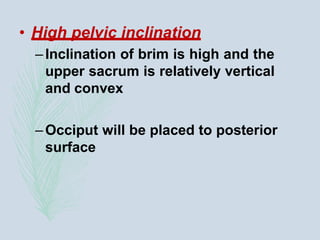
• High pelvic inclination
–Inclination of brim is high and the
upper sacrum is relatively vertical
and convex
–Occiput will be placed to posterior
surface
• Anterior attachment of placenta
– Well flexed attitude but convexity of
maternal and fetal spine is opposite,
which leads to deflexion of fetal head
and thus the occiput with occupy the
posterior part
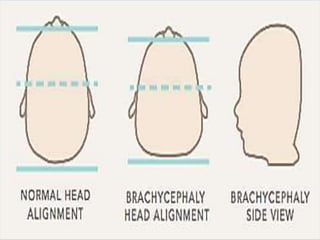
• Primary brachycephaly
(flatened area at back of the
skull)
– Diminishes the effectivemovement
of flexion
 Uterine factor
Abnormal uterine contraction which
may be cause or effect, lead to
persistent deflexion and occipito
posterior postion
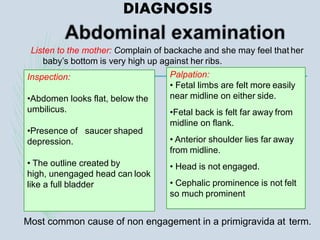
Listen to the mother: Complain of backache and she may feel that her
baby’s bottom is very high up against her ribs.
Palpation:
• Fetal limbs are felt more easily
near midline on either side.
•Fetal back is felt far away from
midline on flank.
• Anterior shoulder lies far away
from midline.
• Head is not engaged.
• Cephalic prominence is not felt
so much prominent
Inspection:
•Abdomen looks flat, below the
umbilicus.
•Presence of saucer shaped
depression.
• The outline created by
high, unengaged head can look
like a full bladder
Most common cause of non engagement in a primigravida at term.
DIAGNOSIS
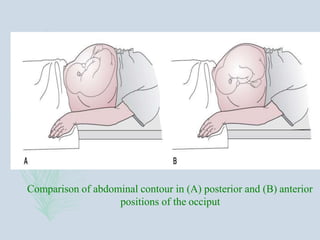
Comparison of abdominal contour in (A) posterior and (B) anterior
positions of the occiput
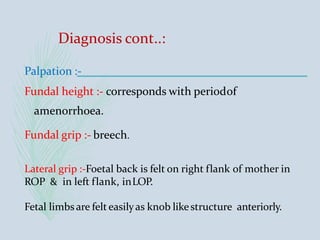
Diagnosis cont..:
Palpation :-
Fundal height :- corresponds with periodof
amenorrhoea.
Fundal grip :- breech.
Lateral grip :-Foetal back is felt on right flank of mother in
ROP & in left flank, inLOP.
Fetal limbs are felteasilyas knob likestructure anteriorly.
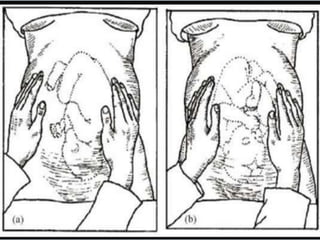
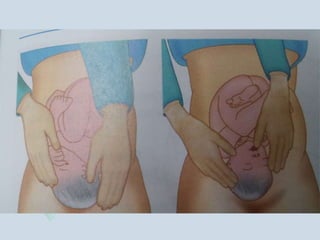
Pelvic grip :-
• Head is notengaged.
• Cephalic prominance (sinciput) is not felt so
prominent as found in well flexed occipito–
anterior.
• In directoccipito – posterior the small sinciput is
confused with breech.
Examination cont.. …
 In late labour, the diagnosis is often difficult because of
caput formation.
 In such cases, the ear is to be located and the unfolded
pinna points towards the occiput.
Auscultation
•The fetal back is not well
flexed so chest is thrust
forward, therefore the fetal
heart can be heard in the
midline.
•Heart rate may be heard
more easily at the flank on the
same side as the back.
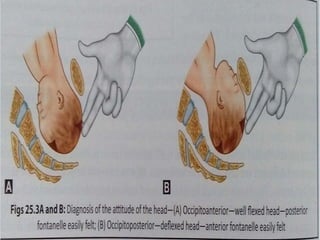
Vaginal examination
• Elongated bag of membranes
•Sagittal suture occupies any of
the oblique diameters of pelvis.
•Posterior fontanelle is felt
near the sacro-iliac joint
•Anterior fontanelle is felt more
easily
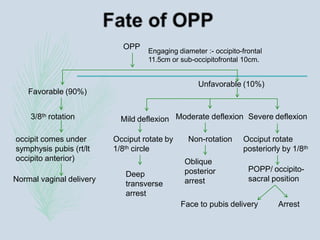
OPP
Engaging diameter :- occipito-frontal
11.5cm or sub-occipitofrontal 10cm.
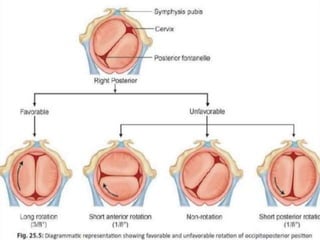
Favorable (90%)
Unfavorable (10%)
3/8th rotation
occipit comes under
symphysis pubis (rt/lt
occipito anterior)
Normal vaginal delivery
Mild deflexion Moderate deflexion Severe deflexion
Occiput rotate by
1/8th circle
Deep
transverse
arrest
Non-rotation
Oblique
posterior
arrest
Occiput rotate
posteriorly by 1/8th
POPP/ occipito-
sacral position
Face to pubis delivery Arrest
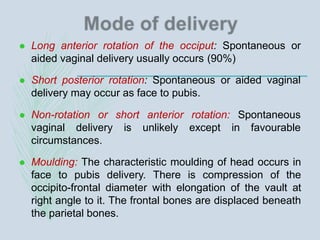
 Long anterior rotation of the occiput: Spontaneous or
aided vaginal delivery usually occurs (90%)
 Short posterior rotation: Spontaneous or aided vaginal
delivery may occur as face to pubis.
 Non-rotation or short anterior rotation: Spontaneous
vaginal delivery is unlikely except in favourable
circumstances.
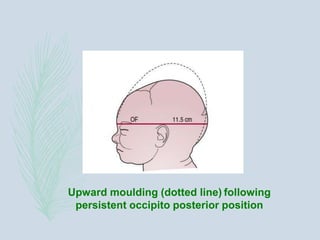
 Moulding: The characteristic moulding of head occurs in
face to pubis delivery. There is compression of the
occipito-frontal diameter with elongation of the vault at
right angle to it. The frontal bones are displaced beneath
the parietal bones.
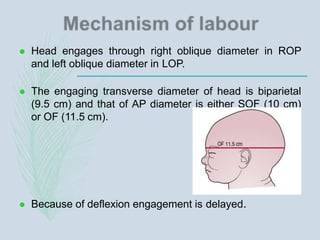
 Head engages through right oblique diameter in ROP
and left oblique diameter in LOP.
 The engaging transverse diameter of head is biparietal
(9.5 cm) and that of AP diameter is either SOF (10 cm)
or OF (11.5 cm).
 Because of deflexion engagement is delayed.
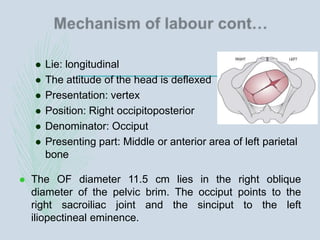
 Lie: longitudinal
 The attitude of the head is deflexed
 Presentation: vertex
 Position: Right occipitoposterior
 Denominator: Occiput
 Presenting part: Middle or anterior area of left parietal
bone
 The OF diameter 11.5 cm lies in the right oblique
diameter of the pelvic brim. The occiput points to the
right sacroiliac joint and the sinciput to the left
iliopectineal eminence.
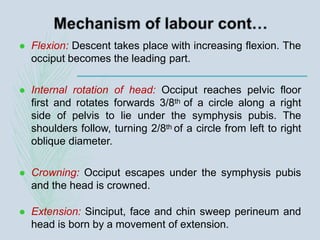
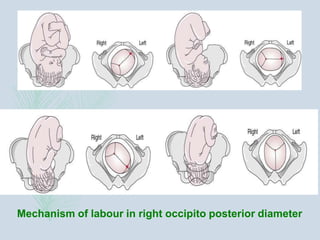
 Flexion: Descent takes place with increasing flexion. The
occiput becomes the leading part.
 Internal rotation of head: Occiput reaches pelvic floor
first and rotates forwards 3/8th of a circle along a right
side of pelvis to lie under the symphysis pubis. The
shoulders follow, turning 2/8th of a circle from left to right
oblique diameter.
 Crowning: Occiput escapes under the symphysis pubis
and the head is crowned.
 Extension: Sinciput, face and chin sweep perineum and
head is born by a movement of extension.
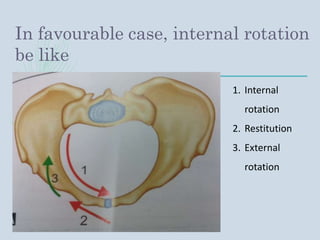
In favourable case, internal rotation
be like
1. Internal
rotation
2. Restitution
3. External
rotation
 Restitution: Occiput turns 1/8th of circle to the right.
 Internal rotation of shoulders: Shoulders enter the pelvis
in right oblique diameter; anterior shoulder reaches
pelvic floor first and rotates forwards 1/8th of circle to lie
under the symphysis pubis.
 External rotation of head: Occiput turns a further 1/8 of a
circle to the right.
 Lateral flexion: Anterior shoulder escapes under the
symphysis pubis, posterior shoulder sweeps perineum
and body is born by a movement of lateral flexion.
Mechanism of labour in right occipito posterior diameter
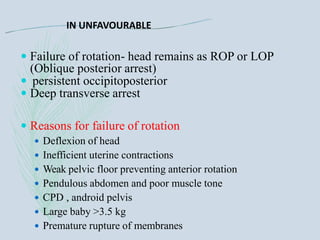
IN UNFAVOURABLE
 Failure of rotation- head remains as ROP or LOP
(Oblique posterior arrest)
 persistent occipitoposterior
 Deep transverse arrest
 Reasons for failure of rotation
 Deflexion of head
 Inefficient uterine contractions
 Weak pelvic floor preventing anterior rotation
 Pendulous abdomen and poor muscle tone
 CPD , android pelvis
 Large baby >3.5 kg
 Premature rupture of membranes
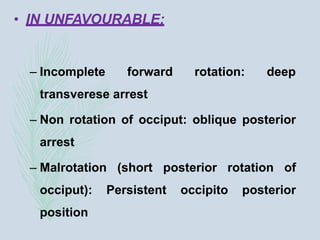
• IN UNFAVOURABLE:
– Incomplete forward rotation: deep
transverese arrest
– Non rotation of occiput: oblique posterior
arrest
– Malrotation (short posterior rotation of
occiput): Persistent occipito posterior
position
 Incomplete forward rotation –occiput rotates 1/8th
of circle. saggital suture comes to lie in bispinous
diameter results in Deep transverse arrest. It
occurs in mild deflexion of head.
 Nonrotation –both sinciput & occiput reaches
pelvic floor at same time & sagital suture lies in
oblique diameter results in Oblique posterior
arrest. It occurs in moderate deflexion of head.
Malrotation - the sinciput touches pelvic floor
first resulting in anterior rotation of sinciput
1/8th of circle putting occiput to sacral hollow
called Persistent Occipito -posterior Position of
vertex. It occurs in extreme deflexion. Also
called occipito -sacral position.
 It is an abnormal mechanism of the occipito posterior position where
there is malrotation of the occiput posteriorly towards the sacral
hollow.
 Delivery may occur spontaneously as face to pubis but arrest may
occur in this position and is called occipito sacral arrest
 Cause: Failure of flexion
 In favourable circumstances, spontaneous delivery occurs as face to
pubis.
 Descent of head occurs until roof of nose hinges under symphysis
pubis. Delivery of brow, vertex, occiput lastly face is born by
extension. Restitution, external rotation & delivery of trunk occurs
normally.
PERSISTENT OCCIPITO POSTERIOR POSITION
 Further descent occurs until the root of nose hinges
under symphysis pubis.
 Flexion occurs —releasing successively the brow, vertex
and occiput out of the stretched perineum and then the
face is born by extension.
 Restitution: Head moves 1/8th of circle in opposite
direction of internal rotation thus turning the face to look
towards the mother’s left thigh in ROP and right thigh in
LOP.
 External rotation: Occiput further rotates to the same
direction of restitution to 1/8th of a circle placing finally
face looking directly towards the left thigh in ROP and
the right thigh in LOP.
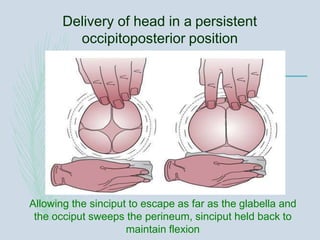
Delivery of head in a persistent
occipitoposterior position
Allowing the sinciput to escape as far as the glabella and
the occiput sweeps the perineum, sinciput held back to
maintain flexion
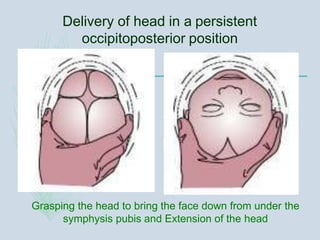
Delivery of head in a persistent
occipitoposterior position
Grasping the head to bring the face down from under the
symphysis pubis and Extension of the head
Upward moulding (dotted line) following
persistent occipito posterior position
 The head is deep into the cavity, the sagittal suture is
placed in the transverse bipsinous diameter and there is
no prognosis in descent of the head even after ½ -1 hour
following full dilatation of cervix.
 May be end result of incomplete anterior rotation of the
oblique OPP, or it may be due to non rotation of the
commonly primary occipito transverse position of normal
mechanism of labour.
Causes:
 Faulty pelvic architecture
 Prominent ischial spine,
 Flat sacrum and convergent side walls,
 Deflexion of head,
 Weak uterine contraction,
 Laxity of the pelvic floor muscles.
Diagnosis
 Head is engaged
 Sagittal suture lies in transverse bispinous diameter,
 Anterior fontanelle is palpable,
 Faulty pelvic architecture may be detected.
Management:
 Vaginal delivery is found safe.
 Ventouse
 Manual rotation and application of forceps
 Forceps rotation and delivery with Keilland in hands
of an expert.
 Vaginal delivery is not safe: caesarean section.
 Craniotomy in dead fetus.
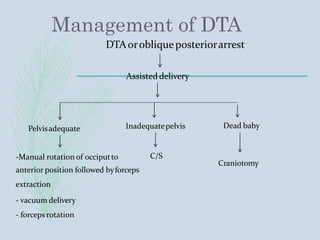
Management of DTA
DTAorobliqueposteriorarrest
Assisteddelivery
Pelvisadequate Inadequatepelvis
-Manual rotation of occiputto
anterior position followed byforceps
extraction
- vacuum delivery
- forceps rotation
Dead baby
Craniotomy
C/S
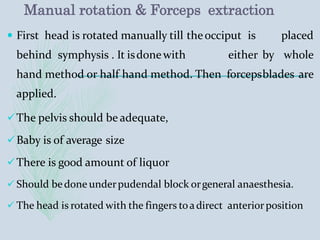
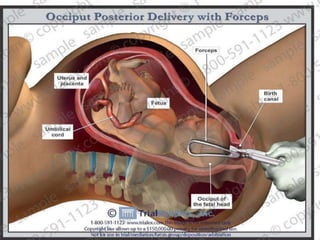
Manual rotation & Forceps extraction
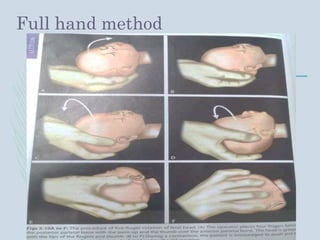
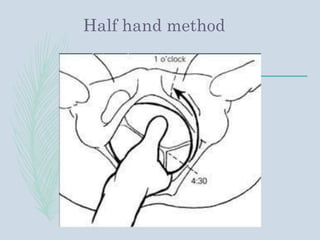
 First head is rotated manually till theocciput is placed
behind symphysis . It isdonewith either by whole
hand method or half hand method. Then forcepsblades are
applied.
The pelvis should be adequate,
Baby is of average size
There is good amount of liquor
 Should bedone underpudendal block orgeneral anaesthesia.
 The head is rotated with the fingers toadirect anteriorposition
Full hand method
Half hand method
 The shoulder girdle of the fetus should be rotated
at the same time as the head by pressure through
the abdominal wall by externalhand.
 After rotation completed an obstetric forceps are
applied to complete thedelivery.
Difficultiesare-
Failure togrip head adequatelydue to lack of space.
Failure to dislodge head from impactedposition
Inadequate anaesthesia
Wrong caseselection
Complications-
Accidental slippage of head
Prolapse of cord
Forceps rotation&extraction
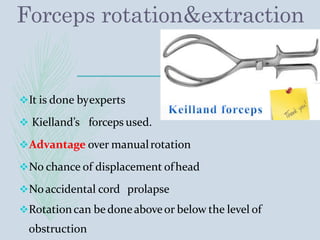
It is done byexperts
 Kielland’s forceps used.
Advantage over manualrotation
No chance of displacement ofhead
Noaccidental cord prolapse
Rotationcan bedoneaboveor below the level of
obstruction
Caeserean section-if there is midpelvic contraction,It
is much safer thanrotation
Craniotomy- it is done in caseof dead baby
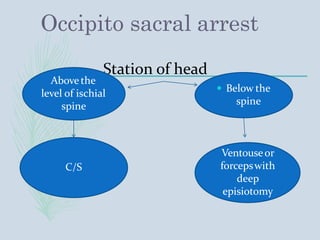
Occipito sacral arrest
 Below the
spine
Station of head
Abovethe
level of ischial
spine
C/S
Ventouseor
forcepswith
deep
episiotomy
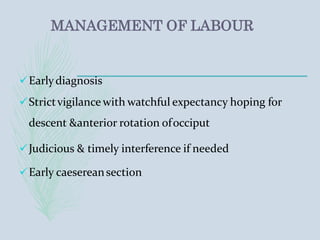
MANAGEMENT OF LABOUR
Earlydiagnosis
Strictvigilance with watchful expectancy hoping for
descent &anterior rotation ofocciput
Judicious & timely interference if needed
Early caesereansection
First stage: In uncomplicated cases, the labour is allowed
to proceed in a manner similar to normal labour.
 Intravenous infusion is started.
 Progress of labour is judged
 Weak pain, persistence of deflexion and nonrotation of
the occiput are the triad too often coexistent. In such
situation, oxytocin infusion is started for augmentation of
labour.
 Indication of caesarean section: arrest of labour,
incoordinate uterine action, fetal distress.
Management of the first stage of labour:
The 1st stage is managed as in a normalcase.
Nothing can be done to correct the Malposition or to
influence the rotation of the head at this stage.
A partogram is done to monitorthe :
1.Uterine contraction (frequency, duration and
strength).
2.Fetalheart.
3.Dilatation of thecervix.
If progressive cervical dilatation does not occur
augmentation with an oxytocin drip may be tried.
If still no progress obtained in a few hours
caesarian section (C/S) isperformed.
Also if there is fetal distress C/S isdone
Second stage: In majority anterior rotation of the occiput is
completed and the delivery is either spontaneous or can be
accomplished by low forceps or ventouse.
 In minority: watchful expectancy for anterior rotation of the
occiput and descent of the head.
 In occipito-sacral position, spontaneous delivery of face to
pubis may occur.
Third stage:
 Tendency of PPH can be prevented by prophylactic IV
ergometrine 0.25 mg with the delivery of anterior shoulder.
 Following vaginal delivery meticulous inspection of the
cervix and lower genital tract should be made to detect any
injury.
First stage of labour
 Continuous support
 Provide physical support: Back massage and other comfort
measures and suggest changes of posture and position.
 Prevent the mother from being dehydrated or ketotic.
 Oxytocin infusion
 Change in position and the use of breathing techniques or
inhalational analgesia to enhance relaxation.
 Suggest the women the alternative method of pain relief.
Second stage of labour
 Confirm full dilatation of cervix by vaginal examination. If the
head is not visible at the onset of second stage of labour
encourage the women to remain in upright position.
 Closely monitor the maternal and fetal conditions throughout
the second stage.
 The length of second stage is generally increased when the
occiput is posterior and there is increased likelihood of
operative delivery.
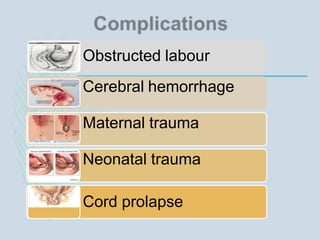
Obstructed labour
Cerebral hemorrhage
Maternal trauma
Neonatal trauma
Cord prolapse
1. Fraser DM, Cooper MA. Myles Textbook for
Midwives.15th edition. Philadelphia:Churchill livingstone
elsevier;2009
2. Dutta DC. Textbook of obstetrics. 6th edition.
Calcutta:New central book agency;2004
3. Pillitteri A. Maternal and child health nursing. Care of
the childbearing and childrearing family. Sixth edition.
Philadelphia; Lippincott Williams & Wilkins: 2010.
4. Cunningham, Leveno, Bloom. William’s obstetrics. 23rd
edition. United states of America; Mcgraw Hill
companies: 2010.
Occipito posterior position

Occipito posterior position

  • 1.
    MALPOSITION Mrs. U SREEVIDYAMsc. NURSING, Associate Professor, Apollo college of nursing, CHITTOOR
  • 2.
    MALPOSITION “ Malposition refersto any position of the vertex other than the flexed occipito-anterior one.” OCCIPITO POSTERIOR POSITION “In a vertex presentation where the occiput is placed posteriorly over the sacroiliac joint, sacrum called occipito-posterior postion.”
  • 4.
    Malposition  It isthe vertex presentation where the occiput is placed posteriorly over the sacro-iliac joint or directly over the sacrum, it is called an occipito-posterior position.  When the occiput is placed over the right sacroiliac joint, the position is called right occipito posterior (R.O.P) position and when placed over the left sacro-iliac joint, is called left occipito posterior (L.O.P) position.  When it points towards the sacrum it is called direct occipito posterior position.
  • 5.
    Types  Right occipitoposterior Left occipitoposterior  Direct occipitoposterior
  • 9.
  • 10.
    Incidence  At onsetof labour 10% of vertex presentations are occipitoposterior  2/3rd of occipitoposterior presentations at delivery are result if malrotation of occipitoanterior position  80% of occipitoposterior presentations rotate to occipitoanterior during labour  Among occipitoposterior positions incidence of ROP is 5 times LOP
  • 11.
     Occipito-posterior positionis an abnormal position of the vertex rather than an abnormal presentation.  Occurs in approximately 10% of labours.  A persistent occipito-posterior position results from a failure of internal rotation prior to birth.  Occurs in 5% of the births.
  • 12.
    Causes  The directcause is often unknown. But the following are the responsible factors:  Shape of the pelvic inlet: associated with either an anthropoid or android pelvis.  Fetal factors: Marked deflexion of fetal head.  Uterine factors: Abnormal uterine contraction
  • 13.
     Shape ofthe pelvic inlet More than 50 % cases are associated with the ANTHROPOID OR ANDROID PELVIS The wide occiput can comfortably be placed in the wider posterior segment of the pelvis
  • 15.
     FETAL FACTORS Markeddeflexion of the fetal head Causes of deflexion:- 1. High pelvic inclination 2. Anterior attachment of placenta 3. Primary brachy cephaly 4. Pelvic tumors
  • 16.
    • High pelvicinclination –Inclination of brim is high and the upper sacrum is relatively vertical and convex –Occiput will be placed to posterior surface
  • 17.
    • Anterior attachmentof placenta – Well flexed attitude but convexity of maternal and fetal spine is opposite, which leads to deflexion of fetal head and thus the occiput with occupy the posterior part
  • 18.
    • Primary brachycephaly (flatenedarea at back of the skull) – Diminishes the effectivemovement of flexion
  • 20.
     Uterine factor Abnormaluterine contraction which may be cause or effect, lead to persistent deflexion and occipito posterior postion
  • 21.
    Listen to themother: Complain of backache and she may feel that her baby’s bottom is very high up against her ribs. Palpation: • Fetal limbs are felt more easily near midline on either side. •Fetal back is felt far away from midline on flank. • Anterior shoulder lies far away from midline. • Head is not engaged. • Cephalic prominence is not felt so much prominent Inspection: •Abdomen looks flat, below the umbilicus. •Presence of saucer shaped depression. • The outline created by high, unengaged head can look like a full bladder Most common cause of non engagement in a primigravida at term. DIAGNOSIS
  • 22.
    Comparison of abdominalcontour in (A) posterior and (B) anterior positions of the occiput
  • 23.
    Diagnosis cont..: Palpation :- Fundalheight :- corresponds with periodof amenorrhoea. Fundal grip :- breech. Lateral grip :-Foetal back is felt on right flank of mother in ROP & in left flank, inLOP. Fetal limbs are felteasilyas knob likestructure anteriorly.
  • 26.
    Pelvic grip :- •Head is notengaged. • Cephalic prominance (sinciput) is not felt so prominent as found in well flexed occipito– anterior. • In directoccipito – posterior the small sinciput is confused with breech.
  • 27.
    Examination cont.. … In late labour, the diagnosis is often difficult because of caput formation.  In such cases, the ear is to be located and the unfolded pinna points towards the occiput. Auscultation •The fetal back is not well flexed so chest is thrust forward, therefore the fetal heart can be heard in the midline. •Heart rate may be heard more easily at the flank on the same side as the back. Vaginal examination • Elongated bag of membranes •Sagittal suture occupies any of the oblique diameters of pelvis. •Posterior fontanelle is felt near the sacro-iliac joint •Anterior fontanelle is felt more easily
  • 29.
    OPP Engaging diameter :-occipito-frontal 11.5cm or sub-occipitofrontal 10cm. Favorable (90%) Unfavorable (10%) 3/8th rotation occipit comes under symphysis pubis (rt/lt occipito anterior) Normal vaginal delivery Mild deflexion Moderate deflexion Severe deflexion Occiput rotate by 1/8th circle Deep transverse arrest Non-rotation Oblique posterior arrest Occiput rotate posteriorly by 1/8th POPP/ occipito- sacral position Face to pubis delivery Arrest
  • 30.
     Long anteriorrotation of the occiput: Spontaneous or aided vaginal delivery usually occurs (90%)  Short posterior rotation: Spontaneous or aided vaginal delivery may occur as face to pubis.  Non-rotation or short anterior rotation: Spontaneous vaginal delivery is unlikely except in favourable circumstances.  Moulding: The characteristic moulding of head occurs in face to pubis delivery. There is compression of the occipito-frontal diameter with elongation of the vault at right angle to it. The frontal bones are displaced beneath the parietal bones.
  • 31.
     Head engagesthrough right oblique diameter in ROP and left oblique diameter in LOP.  The engaging transverse diameter of head is biparietal (9.5 cm) and that of AP diameter is either SOF (10 cm) or OF (11.5 cm).  Because of deflexion engagement is delayed.
  • 32.
     Lie: longitudinal The attitude of the head is deflexed  Presentation: vertex  Position: Right occipitoposterior  Denominator: Occiput  Presenting part: Middle or anterior area of left parietal bone  The OF diameter 11.5 cm lies in the right oblique diameter of the pelvic brim. The occiput points to the right sacroiliac joint and the sinciput to the left iliopectineal eminence.
  • 33.
     Flexion: Descenttakes place with increasing flexion. The occiput becomes the leading part.  Internal rotation of head: Occiput reaches pelvic floor first and rotates forwards 3/8th of a circle along a right side of pelvis to lie under the symphysis pubis. The shoulders follow, turning 2/8th of a circle from left to right oblique diameter.  Crowning: Occiput escapes under the symphysis pubis and the head is crowned.  Extension: Sinciput, face and chin sweep perineum and head is born by a movement of extension.
  • 34.
    In favourable case,internal rotation be like 1. Internal rotation 2. Restitution 3. External rotation
  • 35.
     Restitution: Occiputturns 1/8th of circle to the right.  Internal rotation of shoulders: Shoulders enter the pelvis in right oblique diameter; anterior shoulder reaches pelvic floor first and rotates forwards 1/8th of circle to lie under the symphysis pubis.  External rotation of head: Occiput turns a further 1/8 of a circle to the right.  Lateral flexion: Anterior shoulder escapes under the symphysis pubis, posterior shoulder sweeps perineum and body is born by a movement of lateral flexion.
  • 36.
    Mechanism of labourin right occipito posterior diameter
  • 37.
    IN UNFAVOURABLE  Failureof rotation- head remains as ROP or LOP (Oblique posterior arrest)  persistent occipitoposterior  Deep transverse arrest  Reasons for failure of rotation  Deflexion of head  Inefficient uterine contractions  Weak pelvic floor preventing anterior rotation  Pendulous abdomen and poor muscle tone  CPD , android pelvis  Large baby >3.5 kg  Premature rupture of membranes
  • 38.
    • IN UNFAVOURABLE: –Incomplete forward rotation: deep transverese arrest – Non rotation of occiput: oblique posterior arrest – Malrotation (short posterior rotation of occiput): Persistent occipito posterior position
  • 40.
     Incomplete forwardrotation –occiput rotates 1/8th of circle. saggital suture comes to lie in bispinous diameter results in Deep transverse arrest. It occurs in mild deflexion of head.  Nonrotation –both sinciput & occiput reaches pelvic floor at same time & sagital suture lies in oblique diameter results in Oblique posterior arrest. It occurs in moderate deflexion of head.
  • 41.
    Malrotation - thesinciput touches pelvic floor first resulting in anterior rotation of sinciput 1/8th of circle putting occiput to sacral hollow called Persistent Occipito -posterior Position of vertex. It occurs in extreme deflexion. Also called occipito -sacral position.
  • 42.
     It isan abnormal mechanism of the occipito posterior position where there is malrotation of the occiput posteriorly towards the sacral hollow.  Delivery may occur spontaneously as face to pubis but arrest may occur in this position and is called occipito sacral arrest  Cause: Failure of flexion  In favourable circumstances, spontaneous delivery occurs as face to pubis.  Descent of head occurs until roof of nose hinges under symphysis pubis. Delivery of brow, vertex, occiput lastly face is born by extension. Restitution, external rotation & delivery of trunk occurs normally. PERSISTENT OCCIPITO POSTERIOR POSITION
  • 43.
     Further descentoccurs until the root of nose hinges under symphysis pubis.  Flexion occurs —releasing successively the brow, vertex and occiput out of the stretched perineum and then the face is born by extension.  Restitution: Head moves 1/8th of circle in opposite direction of internal rotation thus turning the face to look towards the mother’s left thigh in ROP and right thigh in LOP.  External rotation: Occiput further rotates to the same direction of restitution to 1/8th of a circle placing finally face looking directly towards the left thigh in ROP and the right thigh in LOP.
  • 44.
    Delivery of headin a persistent occipitoposterior position Allowing the sinciput to escape as far as the glabella and the occiput sweeps the perineum, sinciput held back to maintain flexion
  • 45.
    Delivery of headin a persistent occipitoposterior position Grasping the head to bring the face down from under the symphysis pubis and Extension of the head
  • 46.
    Upward moulding (dottedline) following persistent occipito posterior position
  • 47.
     The headis deep into the cavity, the sagittal suture is placed in the transverse bipsinous diameter and there is no prognosis in descent of the head even after ½ -1 hour following full dilatation of cervix.  May be end result of incomplete anterior rotation of the oblique OPP, or it may be due to non rotation of the commonly primary occipito transverse position of normal mechanism of labour.
  • 48.
    Causes:  Faulty pelvicarchitecture  Prominent ischial spine,  Flat sacrum and convergent side walls,  Deflexion of head,  Weak uterine contraction,  Laxity of the pelvic floor muscles. Diagnosis  Head is engaged  Sagittal suture lies in transverse bispinous diameter,  Anterior fontanelle is palpable,  Faulty pelvic architecture may be detected.
  • 49.
    Management:  Vaginal deliveryis found safe.  Ventouse  Manual rotation and application of forceps  Forceps rotation and delivery with Keilland in hands of an expert.  Vaginal delivery is not safe: caesarean section.  Craniotomy in dead fetus.
  • 50.
    Management of DTA DTAorobliqueposteriorarrest Assisteddelivery PelvisadequateInadequatepelvis -Manual rotation of occiputto anterior position followed byforceps extraction - vacuum delivery - forceps rotation Dead baby Craniotomy C/S
  • 51.
    Manual rotation &Forceps extraction  First head is rotated manually till theocciput is placed behind symphysis . It isdonewith either by whole hand method or half hand method. Then forcepsblades are applied. The pelvis should be adequate, Baby is of average size There is good amount of liquor  Should bedone underpudendal block orgeneral anaesthesia.  The head is rotated with the fingers toadirect anteriorposition
  • 52.
  • 53.
  • 54.
     The shouldergirdle of the fetus should be rotated at the same time as the head by pressure through the abdominal wall by externalhand.  After rotation completed an obstetric forceps are applied to complete thedelivery.
  • 56.
    Difficultiesare- Failure togrip headadequatelydue to lack of space. Failure to dislodge head from impactedposition Inadequate anaesthesia Wrong caseselection Complications- Accidental slippage of head Prolapse of cord
  • 57.
    Forceps rotation&extraction It isdone byexperts  Kielland’s forceps used. Advantage over manualrotation No chance of displacement ofhead Noaccidental cord prolapse Rotationcan bedoneaboveor below the level of obstruction
  • 58.
    Caeserean section-if thereis midpelvic contraction,It is much safer thanrotation Craniotomy- it is done in caseof dead baby
  • 59.
    Occipito sacral arrest Below the spine Station of head Abovethe level of ischial spine C/S Ventouseor forcepswith deep episiotomy
  • 60.
    MANAGEMENT OF LABOUR Earlydiagnosis Strictvigilancewith watchful expectancy hoping for descent &anterior rotation ofocciput Judicious & timely interference if needed Early caesereansection
  • 61.
    First stage: Inuncomplicated cases, the labour is allowed to proceed in a manner similar to normal labour.  Intravenous infusion is started.  Progress of labour is judged  Weak pain, persistence of deflexion and nonrotation of the occiput are the triad too often coexistent. In such situation, oxytocin infusion is started for augmentation of labour.  Indication of caesarean section: arrest of labour, incoordinate uterine action, fetal distress.
  • 62.
    Management of thefirst stage of labour: The 1st stage is managed as in a normalcase. Nothing can be done to correct the Malposition or to influence the rotation of the head at this stage. A partogram is done to monitorthe : 1.Uterine contraction (frequency, duration and strength). 2.Fetalheart. 3.Dilatation of thecervix.
  • 63.
    If progressive cervicaldilatation does not occur augmentation with an oxytocin drip may be tried. If still no progress obtained in a few hours caesarian section (C/S) isperformed. Also if there is fetal distress C/S isdone
  • 64.
    Second stage: Inmajority anterior rotation of the occiput is completed and the delivery is either spontaneous or can be accomplished by low forceps or ventouse.  In minority: watchful expectancy for anterior rotation of the occiput and descent of the head.  In occipito-sacral position, spontaneous delivery of face to pubis may occur. Third stage:  Tendency of PPH can be prevented by prophylactic IV ergometrine 0.25 mg with the delivery of anterior shoulder.  Following vaginal delivery meticulous inspection of the cervix and lower genital tract should be made to detect any injury.
  • 65.
    First stage oflabour  Continuous support  Provide physical support: Back massage and other comfort measures and suggest changes of posture and position.  Prevent the mother from being dehydrated or ketotic.  Oxytocin infusion  Change in position and the use of breathing techniques or inhalational analgesia to enhance relaxation.  Suggest the women the alternative method of pain relief.
  • 66.
    Second stage oflabour  Confirm full dilatation of cervix by vaginal examination. If the head is not visible at the onset of second stage of labour encourage the women to remain in upright position.  Closely monitor the maternal and fetal conditions throughout the second stage.  The length of second stage is generally increased when the occiput is posterior and there is increased likelihood of operative delivery.
  • 67.
    Obstructed labour Cerebral hemorrhage Maternaltrauma Neonatal trauma Cord prolapse
  • 68.
    1. Fraser DM,Cooper MA. Myles Textbook for Midwives.15th edition. Philadelphia:Churchill livingstone elsevier;2009 2. Dutta DC. Textbook of obstetrics. 6th edition. Calcutta:New central book agency;2004 3. Pillitteri A. Maternal and child health nursing. Care of the childbearing and childrearing family. Sixth edition. Philadelphia; Lippincott Williams & Wilkins: 2010. 4. Cunningham, Leveno, Bloom. William’s obstetrics. 23rd edition. United states of America; Mcgraw Hill companies: 2010.