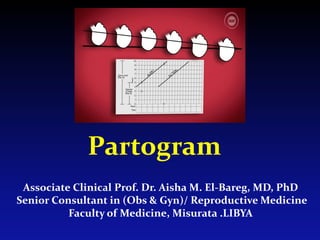
Partogram
Associate Clinical Prof. Dr. Aisha M. El-Bareg, MD, PhD
Senior Consultant in (Obs & Gyn)/ Reproductive Medicine
Faculty of Medicine, Misurata .LIBYA
• The intrapartum period is probably the most
dangerous and traumatic period – a time
associated with a high mortality and morbidity
for both mother and child.
• Maternal and fetal monitoring are essential to
pick up problems early and thus institute timely
intervention.
Why Monitor ???????
 Complication of prolonged labour
 Maternal
 Maternal exhaustion
 Increased incidence of CS
 Birth canal injuries if forceps is used
 Risk of rupture uterus -MP
 PPH, Puerperal sepsis
 Fetal
 Fetal distress, Chorioamnionitis, neonatal
sepsis.
 ICH- if forceps is used.
Partogram- Definition
 A composite graphical record of progress of labor
on a single sheet of paper.
 It was developed and extensively tested by the
WHO 1994.
 Can serve as an ‘early warning system’ & assist in
making decisions and interventions.
Advantages-Partogram
 To assess labor at glance, early detection of
abnormal progress of labor.
 Prevention of prolonged labor.
 Recognition of CPD long before obstructed labor
 Can allow time & discussion of further
management of labor (Augmentation or
termination of labor).
 Make observation & recording of Feto-maternal
condition more objectively.
Advantages-Partogram
 Early recognition of Feto-maternal problems.
 Highly effective in reducing complications from
prolonged labor for the mother (postpartum
hemorrhage, sepsis, uterine rupture and its
sequelae) and for the newborn (death, anoxia,
infections, etc.)
 Reduce incidence of CS rate.
 Facilitates handover procedure.
Disadvantages-Partogram
 Assumes that all women progress at same rate
– May influence intervention rate.
 Clinical findings have subjective variations.
 Lack of knowledge.
 Non availability of printed partographs.
 Duplication of recording.
Partogram - History
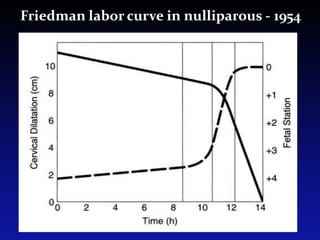
Emanuel Friedman's Partogram - 1954
 Based on observations of cervical dilatation and
fetal station against time elapsed in hours from
onset of labor.
 The time of onset of labor was based on the
patient's subjective perception of her contractility.
 Plotting cervical dilatation against time yielded the
typical Sigmoid or 'S' shaped curve, and station
against time gave rise to the Hyperbolic curve.
Friedman labor curve in nulliparous - 1954
0
2
4
6
8
10
12
2 4 6 8 10 12 14 16
Latent phase Active phase
2nd
stage
1st stage
max slope
acceleration
dec
Time (hours)
Cervicaldilatation(cm) Friedman labor curve in nulliparous
-3
-2
-1
0
+1
+2
+3
Normal progress in labor
1972-Philpott and Castle
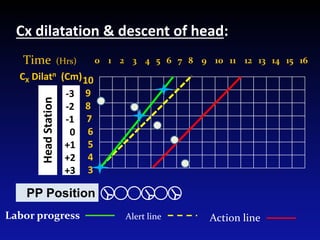
•Introduced the concept of “ALERT” & “ACTION”
lines.
•ALERT LINE – represent the mean rate of slowest
progress of labor (1cm/hr ) starting at zero time i.e.
time of admission.
•ACTION LINE – drawn 4 hrs. to the right of the
alert line and parallel to it. If the progress crossed
the alert line, appropriate action should be taken
within 4 hrs.
•Normal labor is plotted to the left alert line
The WHO Partogram has been modified in
2000 to make it simpler and easier to use.
 The latent phase has been removed and
plotting on the Partogram begins in the
active phase when the cervix is 4 cms
dilated.
Stages of labor
Onset End Duration
1-First stage
Onset of true
labour pains
Full cervical
dilatation
Primi: 12-16
hrs
Multi: 6-8 hrs
2-Second stage
Full cervical
dilatation
Delivery of the
fetus
Primi: 1-2 hrs
Mutti: average
0.5 hrs
3-Third stage
After delivery
of the baby
Complete
expulsion of
placenta and
membranes
Up to 30
minutes
Fourth stage: 1- 2 hours after delivery
(observational)
Component of the Partogram
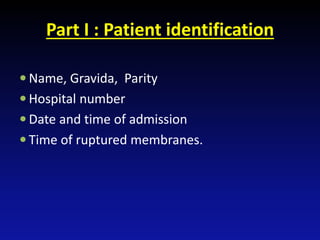
Patient identificationPart I :
 Name, Gravida, Parity
 Hospital number
 Date and time of admission
 Time of ruptured membranes.
Part II: fetal condition
 Monitor and assess fetal condition
1 - Fetal heart rate
2 - Liquor
3 - Moulding the fetal skull bones
FHR Chart:
0 1 2 3 4 5 6 7 8 9 10 11 12 13 14 15 16Time (Hrs)
180
170
160
150
140
130
120
110
100
90
FHR
Caput
Molding
Liquor
0 +
0 +
C C C C M B A
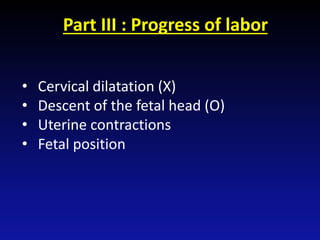
• Cervical dilatation (X)
• Descent of the fetal head (O)
• Uterine contractions
• Fetal position
Progress of laborPart III :
:dilatation & descent of headCx
PP Position
CX Dilatn (Cm)10
9
8
7
6
5
4
3
0 1 2 3 4 5 6 7 8 9 10 11 12 13 14 15 16Time (Hrs)
HeadStation
-3
-2
-1
0
+1
+2
+3
Action lineLabor progress Alert line
Uterine contractions
5
4
3
2
1
Ut. Contra. per
10 Min.
Contra. Duran (Sec)
Weak
Mod
Good
0 1 2 3 4 5 6 7 8 9 10 11 12 13 14 15 16Time (Hrs)
<20s
20-40s
>40s
Part IV: maternal condition
 Assess maternal condition regularly by monitoring:
 Pulse – Every 30 mins & marked with a dot (•).
 Blood pressure – Recorded in vertical line every 4
hours & marked with arrows.
 Temperature – Recorded every 2 hours.
 Urine volume , analysis for protein and acetone
– Everytime urine is passed.
maternal conditionPart IV:
 Oxytocin – Amount per volume IV fluids in drops
per minute, every 30 mins.
 Drugs – Any additional drugs given.
 IV Fluids – type and amount used.
Management of labor using the
Partogram
Pattern of abnormal progress of labor
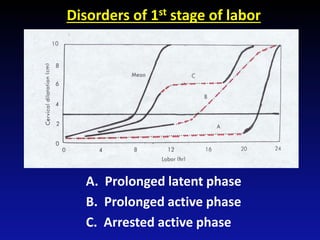
Disorders of 1st stage of labor
1. Prolonged latent phase
2. Disorders of active phase
A. Prolonged latent phase
B. Prolonged active phase
C. Arrested active phase
stage of laborst1Disorders of
Prolonged latent phase
 It is prolonged when its duration exceeds 20 hrs. in
Primi & 14 hrs in Multi.
 According to WHO Partogram, a prolonged latent
phase is “Cervix not dilated beyond 4cms after 8
hrs. from admission.
 Expectant
 Awaiting active labour- provided no indication
for delivery.
 Simple analgesics, Mobilization, reassurance
 Active
 If delivery is indicated- Induction /
augmentation labor
 Early ARM- increase risk of prolonged labour
with PPROM- risk of IU infection and neonatal
sepsis, risk of CS 10 folds.
Prolonged latent phase – Management:
 Plotting of cervical dilatation will normally remain
on or to the left of the alert line.
 Moves to the right of the alert line warns that labor
may be prolonged.
 Happens if the rate of cervical dilatation in active
phase of labor is less than 1cm/hour within 4hrs.
 At the action line, the woman must be carefully
reassessed for why labor is not progressing and a
decision made on further management.
Prolonged active phase
• When the cervical dilatation commences
normally but stops or slows significantly for 2
hours or more prior to full dilatation of cervix.
• Abnormal progress of labor may occur with
normal progress of descent of the fetal head
then followed by secondary arrest of descent of
fetal head.
Secondary arrest of cer vical dilatation
Secondary arrest of head descent
3. Prolonged 2nd stage of labour
 Definition
• PG
• > 2 hrs without epidural anesthesia
• > 3 hr with anesthesia
• MG
• > 1 hr without epidural anesthesia.
• > 2 hrs with anesthesia
1. Protraction of descent
 Descent of presenting part during the 2nd
stage of labor occuring at
 < 1cm/h in PG
 < 2cm/h in MG
2. Arrest (failure) of descent- no progress of
descent for < 2 hrs.

3. Prolonged 2nd stage of labor
 Assessment
 Evaluation of uterine activity
 Evaluation of maternal expulsive efforts
 FHR status every 5 min
 Fetal position, Clinical pelvimetry
 Re-estimation of fetal wt
 Management
 Increasing or initiating oxytocin to improve
maternal expulsive effort
 Operative vaginal delivery or CS.
Electronic Partogram
 Partogram is a Simple, clear, easy-to-use, cost-
effective tool for monitoring of labor and decisions
making.
 The use of the Partogram significantly improves
perinatal outcomes.
 The Partogram can be effectively used in facilities at
any level of care
Partogram- conclusions
 Strictly following the rules for Partogram use
ensures its effectiveness.
 The Partogram should be used for any labor, in high
and low risk women.
 Documented evidence for Medico Legal purpose.
 Educational value for all grades of staff.
Partograph

Partograph

  • 1.
    Partogram Associate Clinical Prof.Dr. Aisha M. El-Bareg, MD, PhD Senior Consultant in (Obs & Gyn)/ Reproductive Medicine Faculty of Medicine, Misurata .LIBYA
  • 2.
    • The intrapartumperiod is probably the most dangerous and traumatic period – a time associated with a high mortality and morbidity for both mother and child. • Maternal and fetal monitoring are essential to pick up problems early and thus institute timely intervention. Why Monitor ???????
  • 3.
     Complication ofprolonged labour  Maternal  Maternal exhaustion  Increased incidence of CS  Birth canal injuries if forceps is used  Risk of rupture uterus -MP  PPH, Puerperal sepsis  Fetal  Fetal distress, Chorioamnionitis, neonatal sepsis.  ICH- if forceps is used.
  • 4.
    Partogram- Definition  Acomposite graphical record of progress of labor on a single sheet of paper.  It was developed and extensively tested by the WHO 1994.  Can serve as an ‘early warning system’ & assist in making decisions and interventions.
  • 5.
    Advantages-Partogram  To assesslabor at glance, early detection of abnormal progress of labor.  Prevention of prolonged labor.  Recognition of CPD long before obstructed labor  Can allow time & discussion of further management of labor (Augmentation or termination of labor).  Make observation & recording of Feto-maternal condition more objectively.
  • 6.
    Advantages-Partogram  Early recognitionof Feto-maternal problems.  Highly effective in reducing complications from prolonged labor for the mother (postpartum hemorrhage, sepsis, uterine rupture and its sequelae) and for the newborn (death, anoxia, infections, etc.)  Reduce incidence of CS rate.  Facilitates handover procedure.
  • 7.
    Disadvantages-Partogram  Assumes thatall women progress at same rate – May influence intervention rate.  Clinical findings have subjective variations.  Lack of knowledge.  Non availability of printed partographs.  Duplication of recording.
  • 8.
    Partogram - History EmanuelFriedman's Partogram - 1954  Based on observations of cervical dilatation and fetal station against time elapsed in hours from onset of labor.  The time of onset of labor was based on the patient's subjective perception of her contractility.  Plotting cervical dilatation against time yielded the typical Sigmoid or 'S' shaped curve, and station against time gave rise to the Hyperbolic curve.
  • 9.
    Friedman labor curvein nulliparous - 1954
  • 10.
    0 2 4 6 8 10 12 2 4 68 10 12 14 16 Latent phase Active phase 2nd stage 1st stage max slope acceleration dec Time (hours) Cervicaldilatation(cm) Friedman labor curve in nulliparous -3 -2 -1 0 +1 +2 +3
  • 11.
  • 12.
    1972-Philpott and Castle •Introducedthe concept of “ALERT” & “ACTION” lines. •ALERT LINE – represent the mean rate of slowest progress of labor (1cm/hr ) starting at zero time i.e. time of admission. •ACTION LINE – drawn 4 hrs. to the right of the alert line and parallel to it. If the progress crossed the alert line, appropriate action should be taken within 4 hrs. •Normal labor is plotted to the left alert line
  • 13.
    The WHO Partogramhas been modified in 2000 to make it simpler and easier to use.  The latent phase has been removed and plotting on the Partogram begins in the active phase when the cervix is 4 cms dilated.
  • 16.
    Stages of labor OnsetEnd Duration 1-First stage Onset of true labour pains Full cervical dilatation Primi: 12-16 hrs Multi: 6-8 hrs 2-Second stage Full cervical dilatation Delivery of the fetus Primi: 1-2 hrs Mutti: average 0.5 hrs 3-Third stage After delivery of the baby Complete expulsion of placenta and membranes Up to 30 minutes Fourth stage: 1- 2 hours after delivery (observational)
  • 17.
  • 18.
    Patient identificationPart I:  Name, Gravida, Parity  Hospital number  Date and time of admission  Time of ruptured membranes.
  • 19.
    Part II: fetalcondition  Monitor and assess fetal condition 1 - Fetal heart rate 2 - Liquor 3 - Moulding the fetal skull bones
  • 20.
    FHR Chart: 0 12 3 4 5 6 7 8 9 10 11 12 13 14 15 16Time (Hrs) 180 170 160 150 140 130 120 110 100 90 FHR Caput Molding Liquor 0 + 0 + C C C C M B A
  • 21.
    • Cervical dilatation(X) • Descent of the fetal head (O) • Uterine contractions • Fetal position Progress of laborPart III :
  • 22.
    :dilatation & descentof headCx PP Position CX Dilatn (Cm)10 9 8 7 6 5 4 3 0 1 2 3 4 5 6 7 8 9 10 11 12 13 14 15 16Time (Hrs) HeadStation -3 -2 -1 0 +1 +2 +3 Action lineLabor progress Alert line
  • 23.
    Uterine contractions 5 4 3 2 1 Ut. Contra.per 10 Min. Contra. Duran (Sec) Weak Mod Good 0 1 2 3 4 5 6 7 8 9 10 11 12 13 14 15 16Time (Hrs) <20s 20-40s >40s
  • 24.
    Part IV: maternalcondition  Assess maternal condition regularly by monitoring:  Pulse – Every 30 mins & marked with a dot (•).  Blood pressure – Recorded in vertical line every 4 hours & marked with arrows.  Temperature – Recorded every 2 hours.  Urine volume , analysis for protein and acetone – Everytime urine is passed.
  • 25.
    maternal conditionPart IV: Oxytocin – Amount per volume IV fluids in drops per minute, every 30 mins.  Drugs – Any additional drugs given.  IV Fluids – type and amount used.
  • 27.
    Management of laborusing the Partogram
  • 28.
    Pattern of abnormalprogress of labor Disorders of 1st stage of labor 1. Prolonged latent phase 2. Disorders of active phase
  • 29.
    A. Prolonged latentphase B. Prolonged active phase C. Arrested active phase stage of laborst1Disorders of
  • 30.
    Prolonged latent phase It is prolonged when its duration exceeds 20 hrs. in Primi & 14 hrs in Multi.  According to WHO Partogram, a prolonged latent phase is “Cervix not dilated beyond 4cms after 8 hrs. from admission.
  • 31.
     Expectant  Awaitingactive labour- provided no indication for delivery.  Simple analgesics, Mobilization, reassurance  Active  If delivery is indicated- Induction / augmentation labor  Early ARM- increase risk of prolonged labour with PPROM- risk of IU infection and neonatal sepsis, risk of CS 10 folds. Prolonged latent phase – Management:
  • 32.
     Plotting ofcervical dilatation will normally remain on or to the left of the alert line.  Moves to the right of the alert line warns that labor may be prolonged.  Happens if the rate of cervical dilatation in active phase of labor is less than 1cm/hour within 4hrs.  At the action line, the woman must be carefully reassessed for why labor is not progressing and a decision made on further management. Prolonged active phase
  • 34.
    • When thecervical dilatation commences normally but stops or slows significantly for 2 hours or more prior to full dilatation of cervix. • Abnormal progress of labor may occur with normal progress of descent of the fetal head then followed by secondary arrest of descent of fetal head. Secondary arrest of cer vical dilatation Secondary arrest of head descent
  • 39.
    3. Prolonged 2ndstage of labour  Definition • PG • > 2 hrs without epidural anesthesia • > 3 hr with anesthesia • MG • > 1 hr without epidural anesthesia. • > 2 hrs with anesthesia
  • 40.
    1. Protraction ofdescent  Descent of presenting part during the 2nd stage of labor occuring at  < 1cm/h in PG  < 2cm/h in MG 2. Arrest (failure) of descent- no progress of descent for < 2 hrs.  3. Prolonged 2nd stage of labor
  • 41.
     Assessment  Evaluationof uterine activity  Evaluation of maternal expulsive efforts  FHR status every 5 min  Fetal position, Clinical pelvimetry  Re-estimation of fetal wt  Management  Increasing or initiating oxytocin to improve maternal expulsive effort  Operative vaginal delivery or CS.
  • 43.
  • 46.
     Partogram isa Simple, clear, easy-to-use, cost- effective tool for monitoring of labor and decisions making.  The use of the Partogram significantly improves perinatal outcomes.  The Partogram can be effectively used in facilities at any level of care Partogram- conclusions
  • 47.
    Partogram- conclusions  Strictlyfollowing the rules for Partogram use ensures its effectiveness.  The Partogram should be used for any labor, in high and low risk women.  Documented evidence for Medico Legal purpose.  Educational value for all grades of staff.