PRIMARY AMENORRHOEA

               Prof. M.C.Bansal
         MBBS., MS., FICOG., MICOG.
        Founder Principal & Controller,
  Jhalawar Medical College & Hospital Jjalawar.
       MGMC & Hospital , sitapura ., Jaipur
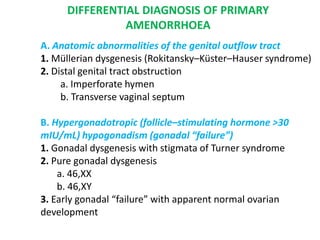
DIFFERENTIAL DIAGNOSIS OF PRIMARY
               AMENORRHOEA
A. Anatomic abnormalities of the genital outflow tract
1. Müllerian dysgenesis (Rokitansky–Küster–Hauser syndrome)
2. Distal genital tract obstruction
     a. Imperforate hymen
     b. Transverse vaginal septum

B. Hypergonadotropic (follicle–stimulating hormone >30
mIU/mL) hypogonadism (gonadal “failure”)
1. Gonadal dysgenesis with stigmata of Turner syndrome
2. Pure gonadal dysgenesis
    a. 46,XX
    b. 46,XY
3. Early gonadal “failure” with apparent normal ovarian
development
• C. Hypogonadotropic (luteinizing hormone and
  follicle–stimulating hormone <10 mIU/mL)
  hypogonadism
• 1. Constitutional delay
• 2. Isolated gonadotropin deficiency
       • a. Associated with midline defects (Kallmann
          syndrome)
       • b. Independent of associated disorders
       • c. Prader–Labhart–Willi syndrome
       • d. Laurence–Moon–Bardet–Biedl syndrome
       • e. Many other rare syndromes
• 3. Associated with multiple hormone deficiencies
• 4. Neoplasms of the hypothalamic–pituitary area
        • a. Craniopharyngiomas
        • b. Pituitary adenomas
        • c. Other
• 5. Infiltrative processes (Langerhans cell–type
  histiocytosis)

• 6. After irradiation of the central nervous system

• 7. Severe chronic illnesses with malnutrition

• 8. Anorexia nervosa and related disorders

• 9. Severe hypothalamic amenorrhea (rare)

• 10. Antidopaminergic and gonadotropin–releasing
  hormone–inhibiting drugs(especially psychotropic
  agents, opiates)
• 11. Primary hypothyroidism
• 12. Cushing syndrome
• 13. Use of chemotherapeutic (especially alkylating)
  agents
• II. Asynchronous pubertal development
• A. Complete androgen insensitivity syndrome (testicular
  feminization)
• B. Incomplete androgen insensitivity syndrome
DISCUSSION
Central signals                          Peripheral
                         HYPOTH             signals
    GABA,                ALAMUS
NPY,GLUTAMATE                           Leptin, Ghrelin


                     Kisspeptin-
                    GPR54 system


                          GnRH

                    ANT. PITUITARY


                   FSH             LH
FSH                                 LH


                   OVARY


          GRAN               THE


          Aromatisation
                             Androgen
          of androgens
                             production


                          ESTRADIOL
INHIBIN


                    Follicular growth
                    Mid cycle LH peak
• WHO divides patients into groups based on endogenous
  oestrogen production, follicle-stimulating hormone
  (FSH) levels, prolactin levels, and hypothalamic-pituitary
  dysfunction.
• This classification is a guide that eliminates several
  diagnoses based on initial information. However, further
  work-up is still required.
• Group I: low oestrogen, low FSH, and no hypothalamic-
  pituitary pathology, leading to a diagnosis of
  hypogonadotrophic hypogonadism.
• Group II: normal oestrogen, normal FSH, and normal
  prolactin, leading to a diagnosis of polycystic ovary
  syndrome.
• Group III: low oestrogen and high FSH, leading to a
  diagnosis of gonadal failure.
APPROACH TO A CASE OF PRIMARY
       AMENORRHOEA
                        HISTORY & CLINICAL EXAM


  ASYNCHRONOUS               IMMATURE             MATURE SECONDARY
  DEVELOPMENT                SECONDARY SEXUAL     SEXUAL
  BREAST > PUBIC HAIR        CHARACTERISTICS      CHARACTERISTICS


  ANDROGEN
                               FSH , PROLACTIN    DISTAL GENITAL
  INSENSITIVITY
                                                  TRACT OBSTRUCTION,
                                                  MULLERIAN AGENESIS
FSH , PROLACTIN


         HIGH FSH           LOW OR NORMAL FSH          HIGH PROLACTIN


         KARYOTYPE        PITUITARY FUNCTION             CHECK T4, TSH
                          TESTING
                          SELLAR X-RAY
                                                     NORMAL       HIGH TSH
NORMAL      ABNORMAL
                          NORMAL       ABNORMAL      TSH


                                                     MRI OR CT
• 46, XX     • 45,XX OR   •CONSTITUIONAL
  GONADAL      46,XY      DELAY
                                                            HYPOTHYROIDISM
  DYSGENE    • MOSAIC     •ISOLATED
  SIS          GONADAL    GONADOTROPIN
• PREMATU      DYSGENES   DEFICIENCY
  RE           IS         •MALNUTRITION
                                            • HYPOPITUITARISM
  OVARIAN                 •CHRONIC
                                            • CNS TUMOR
  FAILURE                 ILLNESS
Primary amenorrhoea

Primary amenorrhoea

  • 1.
    PRIMARY AMENORRHOEA Prof. M.C.Bansal MBBS., MS., FICOG., MICOG. Founder Principal & Controller, Jhalawar Medical College & Hospital Jjalawar. MGMC & Hospital , sitapura ., Jaipur
  • 2.
    DIFFERENTIAL DIAGNOSIS OFPRIMARY AMENORRHOEA A. Anatomic abnormalities of the genital outflow tract 1. Müllerian dysgenesis (Rokitansky–Küster–Hauser syndrome) 2. Distal genital tract obstruction a. Imperforate hymen b. Transverse vaginal septum B. Hypergonadotropic (follicle–stimulating hormone >30 mIU/mL) hypogonadism (gonadal “failure”) 1. Gonadal dysgenesis with stigmata of Turner syndrome 2. Pure gonadal dysgenesis a. 46,XX b. 46,XY 3. Early gonadal “failure” with apparent normal ovarian development
  • 3.
    • C. Hypogonadotropic(luteinizing hormone and follicle–stimulating hormone <10 mIU/mL) hypogonadism • 1. Constitutional delay • 2. Isolated gonadotropin deficiency • a. Associated with midline defects (Kallmann syndrome) • b. Independent of associated disorders • c. Prader–Labhart–Willi syndrome • d. Laurence–Moon–Bardet–Biedl syndrome • e. Many other rare syndromes • 3. Associated with multiple hormone deficiencies • 4. Neoplasms of the hypothalamic–pituitary area • a. Craniopharyngiomas • b. Pituitary adenomas • c. Other
  • 4.
    • 5. Infiltrativeprocesses (Langerhans cell–type histiocytosis) • 6. After irradiation of the central nervous system • 7. Severe chronic illnesses with malnutrition • 8. Anorexia nervosa and related disorders • 9. Severe hypothalamic amenorrhea (rare) • 10. Antidopaminergic and gonadotropin–releasing hormone–inhibiting drugs(especially psychotropic agents, opiates)
  • 5.
    • 11. Primaryhypothyroidism • 12. Cushing syndrome • 13. Use of chemotherapeutic (especially alkylating) agents • II. Asynchronous pubertal development • A. Complete androgen insensitivity syndrome (testicular feminization) • B. Incomplete androgen insensitivity syndrome
  • 6.
  • 7.
    Central signals Peripheral HYPOTH signals GABA, ALAMUS NPY,GLUTAMATE Leptin, Ghrelin Kisspeptin- GPR54 system GnRH ANT. PITUITARY FSH LH
  • 8.
    FSH LH OVARY GRAN THE Aromatisation Androgen of androgens production ESTRADIOL INHIBIN Follicular growth Mid cycle LH peak
  • 9.
    • WHO dividespatients into groups based on endogenous oestrogen production, follicle-stimulating hormone (FSH) levels, prolactin levels, and hypothalamic-pituitary dysfunction. • This classification is a guide that eliminates several diagnoses based on initial information. However, further work-up is still required. • Group I: low oestrogen, low FSH, and no hypothalamic- pituitary pathology, leading to a diagnosis of hypogonadotrophic hypogonadism. • Group II: normal oestrogen, normal FSH, and normal prolactin, leading to a diagnosis of polycystic ovary syndrome. • Group III: low oestrogen and high FSH, leading to a diagnosis of gonadal failure.
  • 10.
    APPROACH TO ACASE OF PRIMARY AMENORRHOEA HISTORY & CLINICAL EXAM ASYNCHRONOUS IMMATURE MATURE SECONDARY DEVELOPMENT SECONDARY SEXUAL SEXUAL BREAST > PUBIC HAIR CHARACTERISTICS CHARACTERISTICS ANDROGEN FSH , PROLACTIN DISTAL GENITAL INSENSITIVITY TRACT OBSTRUCTION, MULLERIAN AGENESIS
  • 11.
    FSH , PROLACTIN HIGH FSH LOW OR NORMAL FSH HIGH PROLACTIN KARYOTYPE PITUITARY FUNCTION CHECK T4, TSH TESTING SELLAR X-RAY NORMAL HIGH TSH NORMAL ABNORMAL NORMAL ABNORMAL TSH MRI OR CT • 46, XX • 45,XX OR •CONSTITUIONAL GONADAL 46,XY DELAY HYPOTHYROIDISM DYSGENE • MOSAIC •ISOLATED SIS GONADAL GONADOTROPIN • PREMATU DYSGENES DEFICIENCY RE IS •MALNUTRITION • HYPOPITUITARISM OVARIAN •CHRONIC • CNS TUMOR FAILURE ILLNESS