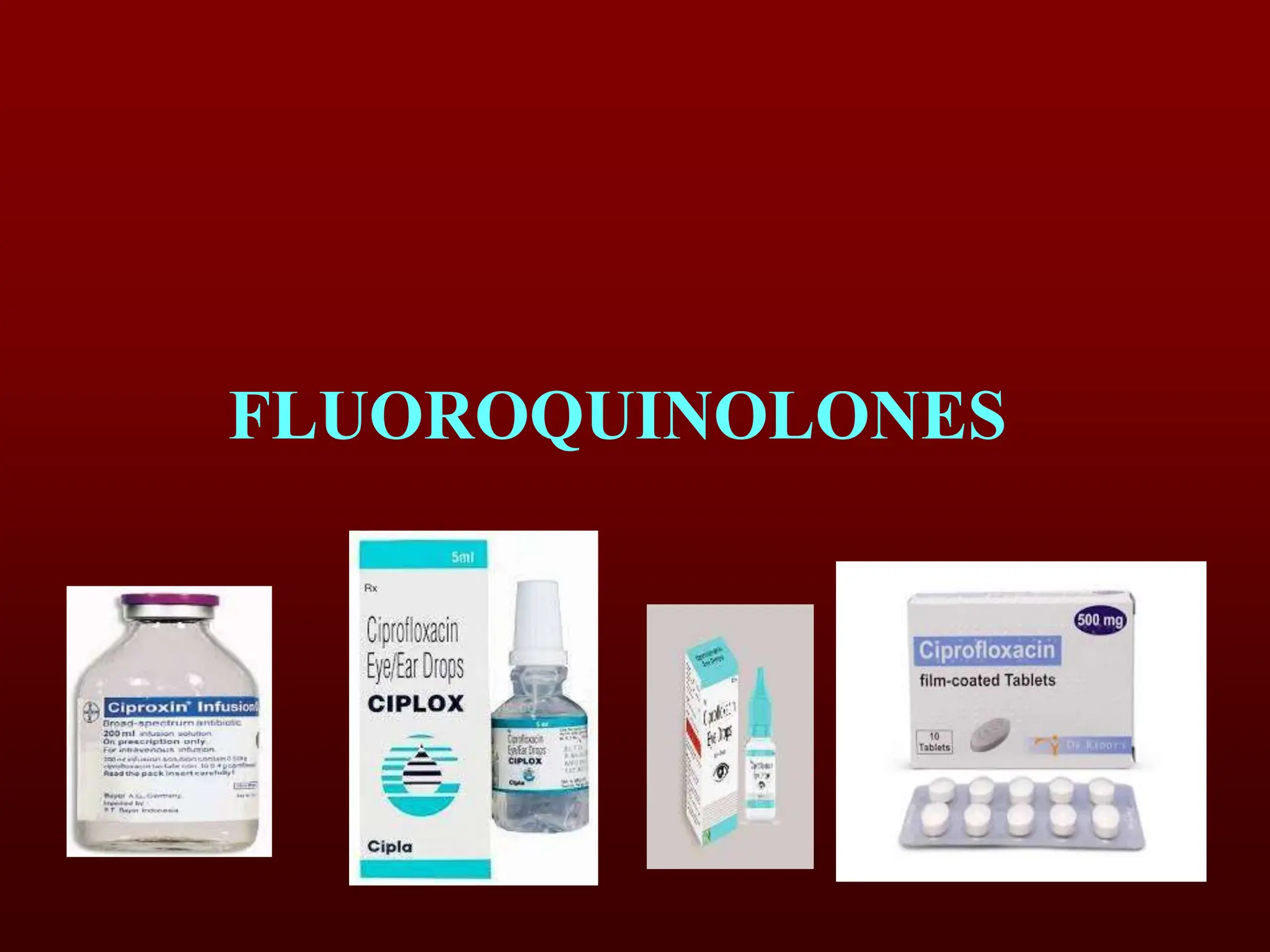
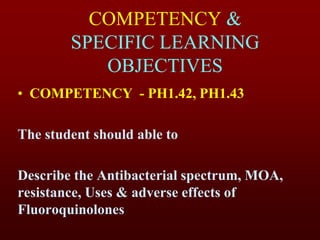
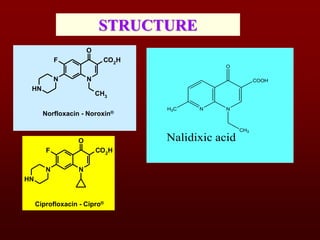
FLUOROQUINOLONES
COMPETENCY &
SPECIFIC LEARNING
OBJECTIVES
• COMPETENCY - PH1.42, PH1.43
The student should able to
Describe the Antibacterial spectrum, MOA,
resistance, Uses & adverse effects of
Fluoroquinolones
SPECIFIC LEARNING OBJECTIVES
At the end of the class, the student should able
to:
• Classify Fluoroquinolones (FQ) with examples.
• Describe the mechanism, spectrum, resistance and
pharmacokinetics of FQ.
• Describe the clinical uses, adverse effects, interactions
and contraindications of FQ.
• Compare and contrast between I & II generation FQ
Quinolones – accidental discovery
Quinine
Chloroquine
Mefloquine
Quinolones
1960’s
GEORGE LESHER & Co workers
Distillate of chloroquine
QUINOLONES
SYNTHETIC ANTIMICROBIALS
QUINOLONE STRUCTURE
GRAM NEGATIVE BACTERIA
FLUORINATED COMPOUNDS – ALSO GRAM
POSTIVE ONES.
N
N
O
H3C
CH3
COOH
Nalidixic acid
N
N
H
N
F
O
CH3
CO2H
Norfloxacin - Noroxin®
Ciprofloxacin - Cipro®
N
N
H
N
F
O
CO2H
STRUCTURE
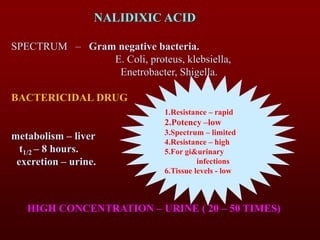
NALIDIXIC ACID
SPECTRUM – Gram negative bacteria.
E. Coli, proteus, klebsiella,
Enetrobacter, Shigella.
BACTERICIDAL DRUG
metabolism – liver
t1/2 – 8 hours.

excretion – urine.
1.Resistance – rapid
2.Potency –low
3.Spectrum – limited
4.Resistance – high
5.For gi&urinary
infections
6.Tissue levels - low
HIGH CONCENTRATION – URINE ( 20 – 50 TIMES)
ADVERSE EFFECTS
GIT, rashes.
Neurological – headache, drowsiness, vertigo, visual
disturbances, seizures.
Long term use – Parkinsonism like symptoms.
Leucopenia, biliary stasis.
Phototoxicity - Rare
G6PD deficiency – Hemolysis.
C/I - INFANTS.
USES
URINARY ANTISEPTIC.
DIARRHOEA – proteus, E.coli, shigella, salmonella.
Ampicillin resistant shigella enteritis.
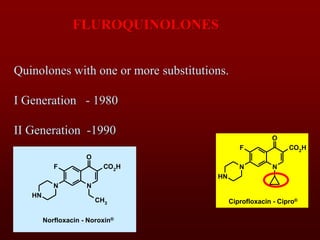
FLUROQUINOLONES
Quinolones with one or more substitutions.
I Generation - 1980
II Generation -1990
N
N
H
N
F
O
CH3
CO2H
Norfloxacin - Noroxin®
Ciprofloxacin - Cipro®
N
N
H
N
F
O
CO2H
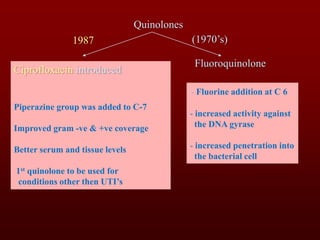
Quinolones
Fluoroquinolone
(1970’s)
- Fluorine addition at C 6
- increased activity against
the DNA gyrase
- increased penetration into
the bacterial cell
Ciprofloxacin introduced
Piperazine group was added to C-7
Improved gram -ve & +ve coverage
Better serum and tissue levels
1st quinolone to be used for
conditions other then UTI’s
1987
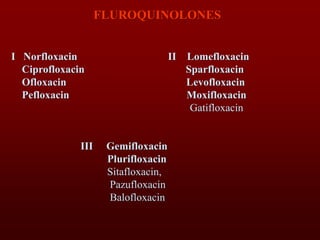
FLUROQUINOLONES
I Norfloxacin II Lomefloxacin
Ciprofloxacin Sparfloxacin
Ofloxacin Levofloxacin
Pefloxacin Moxifloxacin
Gatifloxacin
III Gemifloxacin
Plurifloxacin
Sitafloxacin,
Pazufloxacin
Balofloxacin
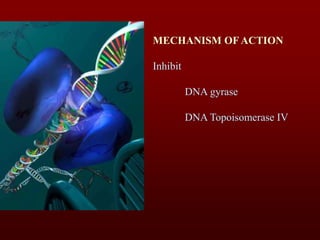
MECHANISM OF ACTION
Inhibit
DNA gyrase
DNA Topoisomerase IV
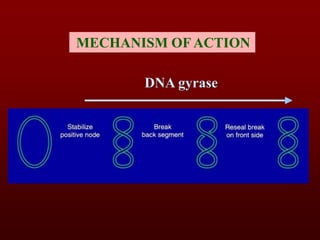
DNA gyrase
MECHANISM OF ACTION
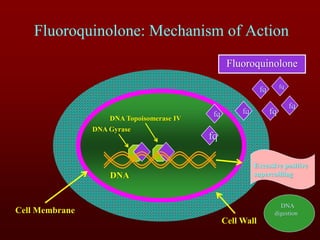
Fluoroquinolone: Mechanism of Action
Cell Wall
Cell Membrane
DNA Gyrase
DNA Topoisomerase IV
fq fq
fq
fq
fq
fq fq
Fluoroquinolone
DNA
Excessive positive
supercoiliing
DNA
digestion
MECHANISM OF ACTION
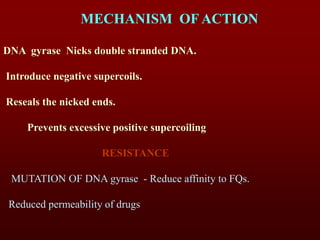
DNA gyrase Nicks double stranded DNA.
Introduce negative supercoils.
Reseals the nicked ends.
Prevents excessive positive supercoiling
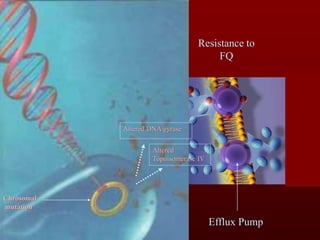
RESISTANCE
MUTATION OF DNA gyrase - Reduce affinity to FQs.
Reduced permeability of drugs
Efflux Pump
Chrosomal
mutation
Resistance to
FQ
Altered DNA gyrase
Altered
Topoisomerase IV
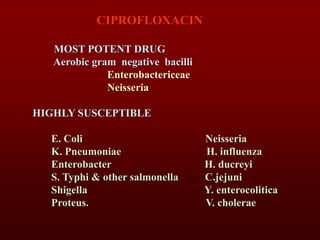
CIPROFLOXACIN
MOST POTENT DRUG
Aerobic gram negative bacilli
Enterobactericeae
Neisseria
HIGHLY SUSCEPTIBLE
E. Coli Neisseria
K. Pneumoniae H. influenza
Enterobacter H. ducreyi
S. Typhi & other salmonella C.jejuni
Shigella Y. enterocolitica
Proteus. V. cholerae
MODERATIVELY SENSITIVE
Pseudomonas
S. Aureus ( MRSA)
S. Epidermidis
branhemella catarrhalis
legionalla
Brucella
Listeria
Mycobact. Tuberculosis
LOW
S. Pyogens. Faecalis,
mycoplasma
Clamydia
Mycobact. Kansasii / avium
SPECIAL FEATURES
Rapid bactericidal activity
High potency
Long post – antibiotic effect
Mutational resistance – Low frequency
Plasmid type mutants – Low
Intestinal streptococci & anaerobes – Protected.
Against β lactam & aminoglycoside resistant bacteria
Acidic pH - Less active
RESISTANCE
Bacteroids
Clostridia
Anaerobic cocci.
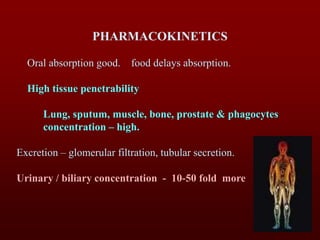
PHARMACOKINETICS
Oral absorption good. food delays absorption.
High tissue penetrability
Lung, sputum, muscle, bone, prostate & phagocytes
concentration – high.
Excretion – glomerular filtration, tubular secretion.
Urinary / biliary concentration - 10-50 fold more
ADVERSE EFFECTS
safety - good.
GIT - Nausea, vomiting, bad taste, anorexia.
CNS - Headache, dizziness, restlessness, anxiety, insomnia,
impairement of concentration & dexterity, tremor.
Seizures – rare. (?GABA RECEPTOR binding)
Skin - Rash, pruritis, photosensitivity, urticaria, swelling of
lips etc.,
Tendonitis & tendon rupture.
bothers
C/I – PREGNANCY
ARTHROPATHY -- IMMATURE ANIMALS
CARTILAGE DAMAGE (?)
Drug interactions
Inhibits metabolism – Theophylline (CYP 450 1A2)
Caffeine
Warfarin
NSAIDS enhance fluroquinolones toxicity
Antacids, sucralfate, Iron salts – Reduce absorption of FQs.
THERAPEUTIC USES
(1) UTI – complicated / uncomplicated
- High cure rates.
(2) Chancroid - 500 mg BD x 3 days.
(3) Gonorrhoea - 500mg single dose.
(4) Bacterial gastroenteritis –E.Coli
Shigella
Salmonella
C. Jejuni
Travellors diarrhoea (ETEC)
Decrease stool volume – Cholera.
(5) TYPHOID - 1st drug of choice.
500 mg – 750 mg BD x 10 days.
(or)
200 mg IV BD.
advantages (1) quick defervescence
(2) Relief of symptoms early.
Complications, relapse – low
(3) Prevention of carrier state
Cidal action
good penetration
biliary / Intestinal concentration.
For typhoid carriers. 750 mg BD – 4- 8weeks.
92% Eradication.
(6) Bone, soft tissue, gynaecological & wound infections – by
resistant staphlococci.
Gram negative bacteria.
+ metronidazole / clindamycin -- Diabetic foot.
(7) Respiratory infections.
Mycoplasma
Legionella
B. catarrhalis
Inhalational anthrax - US FDA
Tuleremia.
(8) Tuberculosis - Combination therapy
- Resistant TB.
(9) Gram negative septicaemias.
Ciprofloxacin + III gen. cephalsporin /Aminoglycoside.
(10) Meningitis - gram negative organisms
Immunocompromised.
CSF shunts.
(11) Prophylaxis – Neutropenia / cancer patients.
(12) Conjunctivitis – Gram negative bacteria.
Topical therapy
NORFLOXACIN
Less protent than ciprofloxacin
Use – Urinary / genital tract infections.
Bacterial diarrhoeas.
PEFLOXACIN
Methyl derivative of norfloxacin.
More lipid soluble.
Oral – complete absorption.
High CSF concentration.
T1/2 – long.
Alternative to ciprofloxacin in typhoid.
OFLOXACIN
Intermediate between ciprofloxacin & norfloxacin.
More portent than cipro - gram positive & anaerobes.
Chlamydia, mycoplasma.
PK – Lipid soluble
Plasma concentration – High.
Excretion – Urine ( unchanged)
Use – Systemic & mixed infections.
For chronic bronchitis.
Respiratory / ENT infections.
Gonorrhoea – 200mg single dose.
Non gonococcal urethritis / cervicitis.
TB / leprosy.
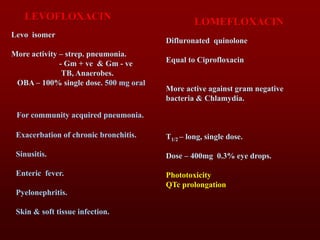
Levo isomer
More activity – strep. pneumonia.
- Gm + ve & Gm - ve
TB, Anaerobes.
OBA – 100% single dose. 500 mg oral
For community acquired pneumonia.
Exacerbation of chronic bronchitis.
Sinusitis.
Enteric fever.
Pyelonephritis.
Skin & soft tissue infection.
LEVOFLOXACIN
Difluronated quinolone
Equal to Ciprofloxacin
More active against gram negative
bacteria & Chlamydia.
T1/2 – long, single dose.
Dose – 400mg 0.3% eye drops.
Phototoxicity
QTc prolongation
LOMEFLOXACIN
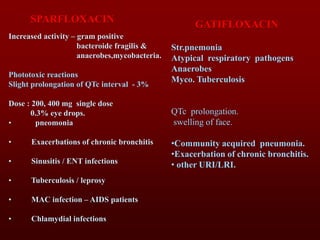
Increased activity – gram positive
bacteroide fragilis &
anaerobes,mycobacteria.
Phototoxic reactions
Slight prolongation of QTc interval - 3%
Dose : 200, 400 mg single dose
0.3% eye drops.
• pneomonia
• Exacerbations of chronic bronchitis
• Sinusitis / ENT infections
• Tuberculosis / leprosy
• MAC infection – AIDS patients
• Chlamydial infections
SPARFLOXACIN
Str.pnemonia
Atypical respiratory pathogens
Anaerobes
Myco. Tuberculosis
QTc prolongation.
swelling of face.
•Community acquired pneumonia.
•Exacerbation of chronic bronchitis.
• other URI/LRI.
GATIFLOXACIN
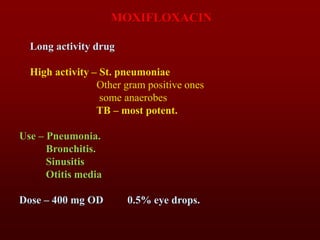
MOXIFLOXACIN
Long activity drug
High activity – St. pneumoniae
Other gram positive ones
some anaerobes
TB – most potent.
Use – Pneumonia.
Bronchitis.
Sinusitis
Otitis media
Dose – 400 mg OD 0.5% eye drops.
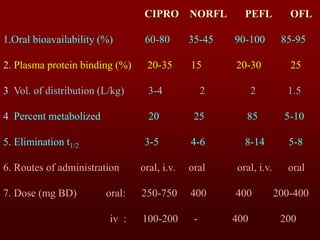
CIPRO NORFL PEFL OFL
1.Oral bioavailability (%) 60-80 35-45 90-100 85-95
2. Plasma protein binding (%) 20-35 15 20-30 25
3. Vol. of distribution (L/kg) 3-4 2 2 1.5
4. Percent metabolized 20 25 85 5-10
5. Elimination t1/2 3-5 4-6 8-14 5-8
6. Routes of administration oral, i.v. oral oral, i.v. oral
7. Dose (mg BD) oral: 250-750 400 400 200-400
iv : 100-200 - 400 200
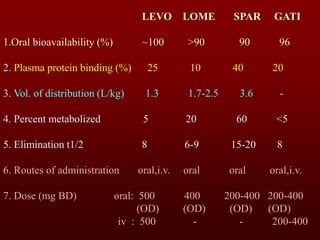
LEVO LOME SPAR GATI
1.Oral bioavailability (%) ~100 >90 90 96
2. Plasma protein binding (%) 25 10 40 20
3. Vol. of distribution (L/kg) 1.3 1.7-2.5 3.6 -
4. Percent metabolized 5 20 60 <5
5. Elimination t1/2 8 6-9 15-20 8
6. Routes of administration oral,i.v. oral oral oral,i.v.
7. Dose (mg BD) oral: 500 400 200-400 200-400
(OD) (OD) (OD) (OD)
iv : 500 - - 200-400
FLURO QUINOLONESfor MBBS studentsppt.ppt

FLURO QUINOLONESfor MBBS studentsppt.ppt

  • 1.
  • 2.
    COMPETENCY & SPECIFIC LEARNING OBJECTIVES •COMPETENCY - PH1.42, PH1.43 The student should able to Describe the Antibacterial spectrum, MOA, resistance, Uses & adverse effects of Fluoroquinolones
  • 3.
    SPECIFIC LEARNING OBJECTIVES Atthe end of the class, the student should able to: • Classify Fluoroquinolones (FQ) with examples. • Describe the mechanism, spectrum, resistance and pharmacokinetics of FQ. • Describe the clinical uses, adverse effects, interactions and contraindications of FQ. • Compare and contrast between I & II generation FQ
  • 4.
    Quinolones – accidentaldiscovery Quinine Chloroquine Mefloquine Quinolones 1960’s GEORGE LESHER & Co workers Distillate of chloroquine
  • 5.
    QUINOLONES SYNTHETIC ANTIMICROBIALS QUINOLONE STRUCTURE GRAMNEGATIVE BACTERIA FLUORINATED COMPOUNDS – ALSO GRAM POSTIVE ONES.
  • 6.
    N N O H3C CH3 COOH Nalidixic acid N N H N F O CH3 CO2H Norfloxacin -Noroxin® Ciprofloxacin - Cipro® N N H N F O CO2H STRUCTURE
  • 7.
    NALIDIXIC ACID SPECTRUM –Gram negative bacteria. E. Coli, proteus, klebsiella, Enetrobacter, Shigella. BACTERICIDAL DRUG metabolism – liver t1/2 – 8 hours. excretion – urine. 1.Resistance – rapid 2.Potency –low 3.Spectrum – limited 4.Resistance – high 5.For gi&urinary infections 6.Tissue levels - low HIGH CONCENTRATION – URINE ( 20 – 50 TIMES)
  • 8.
    ADVERSE EFFECTS GIT, rashes. Neurological– headache, drowsiness, vertigo, visual disturbances, seizures. Long term use – Parkinsonism like symptoms. Leucopenia, biliary stasis. Phototoxicity - Rare G6PD deficiency – Hemolysis. C/I - INFANTS.
  • 9.
    USES URINARY ANTISEPTIC. DIARRHOEA –proteus, E.coli, shigella, salmonella. Ampicillin resistant shigella enteritis.
  • 10.
    FLUROQUINOLONES Quinolones with oneor more substitutions. I Generation - 1980 II Generation -1990 N N H N F O CH3 CO2H Norfloxacin - Noroxin® Ciprofloxacin - Cipro® N N H N F O CO2H
  • 11.
    Quinolones Fluoroquinolone (1970’s) - Fluorine additionat C 6 - increased activity against the DNA gyrase - increased penetration into the bacterial cell Ciprofloxacin introduced Piperazine group was added to C-7 Improved gram -ve & +ve coverage Better serum and tissue levels 1st quinolone to be used for conditions other then UTI’s 1987
  • 12.
    FLUROQUINOLONES I Norfloxacin IILomefloxacin Ciprofloxacin Sparfloxacin Ofloxacin Levofloxacin Pefloxacin Moxifloxacin Gatifloxacin III Gemifloxacin Plurifloxacin Sitafloxacin, Pazufloxacin Balofloxacin
  • 13.
    MECHANISM OF ACTION Inhibit DNAgyrase DNA Topoisomerase IV
  • 14.
  • 15.
    Fluoroquinolone: Mechanism ofAction Cell Wall Cell Membrane DNA Gyrase DNA Topoisomerase IV fq fq fq fq fq fq fq Fluoroquinolone DNA Excessive positive supercoiliing DNA digestion
  • 16.
    MECHANISM OF ACTION DNAgyrase Nicks double stranded DNA. Introduce negative supercoils. Reseals the nicked ends. Prevents excessive positive supercoiling RESISTANCE MUTATION OF DNA gyrase - Reduce affinity to FQs. Reduced permeability of drugs
  • 17.
  • 18.
    CIPROFLOXACIN MOST POTENT DRUG Aerobicgram negative bacilli Enterobactericeae Neisseria HIGHLY SUSCEPTIBLE E. Coli Neisseria K. Pneumoniae H. influenza Enterobacter H. ducreyi S. Typhi & other salmonella C.jejuni Shigella Y. enterocolitica Proteus. V. cholerae
  • 19.
    MODERATIVELY SENSITIVE Pseudomonas S. Aureus( MRSA) S. Epidermidis branhemella catarrhalis legionalla Brucella Listeria Mycobact. Tuberculosis LOW S. Pyogens. Faecalis, mycoplasma Clamydia Mycobact. Kansasii / avium
  • 20.
    SPECIAL FEATURES Rapid bactericidalactivity High potency Long post – antibiotic effect Mutational resistance – Low frequency Plasmid type mutants – Low Intestinal streptococci & anaerobes – Protected. Against β lactam & aminoglycoside resistant bacteria Acidic pH - Less active
  • 21.
  • 22.
    PHARMACOKINETICS Oral absorption good.food delays absorption. High tissue penetrability Lung, sputum, muscle, bone, prostate & phagocytes concentration – high. Excretion – glomerular filtration, tubular secretion. Urinary / biliary concentration - 10-50 fold more
  • 23.
    ADVERSE EFFECTS safety -good. GIT - Nausea, vomiting, bad taste, anorexia. CNS - Headache, dizziness, restlessness, anxiety, insomnia, impairement of concentration & dexterity, tremor. Seizures – rare. (?GABA RECEPTOR binding) Skin - Rash, pruritis, photosensitivity, urticaria, swelling of lips etc., Tendonitis & tendon rupture. bothers
  • 24.
    C/I – PREGNANCY ARTHROPATHY-- IMMATURE ANIMALS CARTILAGE DAMAGE (?) Drug interactions Inhibits metabolism – Theophylline (CYP 450 1A2) Caffeine Warfarin NSAIDS enhance fluroquinolones toxicity Antacids, sucralfate, Iron salts – Reduce absorption of FQs.
  • 25.
    THERAPEUTIC USES (1) UTI– complicated / uncomplicated - High cure rates. (2) Chancroid - 500 mg BD x 3 days. (3) Gonorrhoea - 500mg single dose. (4) Bacterial gastroenteritis –E.Coli Shigella Salmonella C. Jejuni Travellors diarrhoea (ETEC) Decrease stool volume – Cholera.
  • 26.
    (5) TYPHOID -1st drug of choice. 500 mg – 750 mg BD x 10 days. (or) 200 mg IV BD. advantages (1) quick defervescence (2) Relief of symptoms early. Complications, relapse – low (3) Prevention of carrier state Cidal action good penetration biliary / Intestinal concentration. For typhoid carriers. 750 mg BD – 4- 8weeks. 92% Eradication.
  • 27.
    (6) Bone, softtissue, gynaecological & wound infections – by resistant staphlococci. Gram negative bacteria. + metronidazole / clindamycin -- Diabetic foot. (7) Respiratory infections. Mycoplasma Legionella B. catarrhalis Inhalational anthrax - US FDA Tuleremia.
  • 28.
    (8) Tuberculosis -Combination therapy - Resistant TB. (9) Gram negative septicaemias. Ciprofloxacin + III gen. cephalsporin /Aminoglycoside. (10) Meningitis - gram negative organisms Immunocompromised. CSF shunts. (11) Prophylaxis – Neutropenia / cancer patients. (12) Conjunctivitis – Gram negative bacteria. Topical therapy
  • 29.
    NORFLOXACIN Less protent thanciprofloxacin Use – Urinary / genital tract infections. Bacterial diarrhoeas. PEFLOXACIN Methyl derivative of norfloxacin. More lipid soluble. Oral – complete absorption. High CSF concentration. T1/2 – long. Alternative to ciprofloxacin in typhoid.
  • 30.
    OFLOXACIN Intermediate between ciprofloxacin& norfloxacin. More portent than cipro - gram positive & anaerobes. Chlamydia, mycoplasma.
  • 31.
    PK – Lipidsoluble Plasma concentration – High. Excretion – Urine ( unchanged) Use – Systemic & mixed infections. For chronic bronchitis. Respiratory / ENT infections. Gonorrhoea – 200mg single dose. Non gonococcal urethritis / cervicitis. TB / leprosy.
  • 32.
    Levo isomer More activity– strep. pneumonia. - Gm + ve & Gm - ve TB, Anaerobes. OBA – 100% single dose. 500 mg oral For community acquired pneumonia. Exacerbation of chronic bronchitis. Sinusitis. Enteric fever. Pyelonephritis. Skin & soft tissue infection. LEVOFLOXACIN Difluronated quinolone Equal to Ciprofloxacin More active against gram negative bacteria & Chlamydia. T1/2 – long, single dose. Dose – 400mg 0.3% eye drops. Phototoxicity QTc prolongation LOMEFLOXACIN
  • 33.
    Increased activity –gram positive bacteroide fragilis & anaerobes,mycobacteria. Phototoxic reactions Slight prolongation of QTc interval - 3% Dose : 200, 400 mg single dose 0.3% eye drops. • pneomonia • Exacerbations of chronic bronchitis • Sinusitis / ENT infections • Tuberculosis / leprosy • MAC infection – AIDS patients • Chlamydial infections SPARFLOXACIN Str.pnemonia Atypical respiratory pathogens Anaerobes Myco. Tuberculosis QTc prolongation. swelling of face. •Community acquired pneumonia. •Exacerbation of chronic bronchitis. • other URI/LRI. GATIFLOXACIN
  • 34.
    MOXIFLOXACIN Long activity drug Highactivity – St. pneumoniae Other gram positive ones some anaerobes TB – most potent. Use – Pneumonia. Bronchitis. Sinusitis Otitis media Dose – 400 mg OD 0.5% eye drops.
  • 35.
    CIPRO NORFL PEFLOFL 1.Oral bioavailability (%) 60-80 35-45 90-100 85-95 2. Plasma protein binding (%) 20-35 15 20-30 25 3. Vol. of distribution (L/kg) 3-4 2 2 1.5 4. Percent metabolized 20 25 85 5-10 5. Elimination t1/2 3-5 4-6 8-14 5-8 6. Routes of administration oral, i.v. oral oral, i.v. oral 7. Dose (mg BD) oral: 250-750 400 400 200-400 iv : 100-200 - 400 200
  • 36.
    LEVO LOME SPARGATI 1.Oral bioavailability (%) ~100 >90 90 96 2. Plasma protein binding (%) 25 10 40 20 3. Vol. of distribution (L/kg) 1.3 1.7-2.5 3.6 - 4. Percent metabolized 5 20 60 <5 5. Elimination t1/2 8 6-9 15-20 8 6. Routes of administration oral,i.v. oral oral oral,i.v. 7. Dose (mg BD) oral: 500 400 200-400 200-400 (OD) (OD) (OD) (OD) iv : 500 - - 200-400