Mouthpieces
Submitted by :-
Dheeraj Kumar Soni
SID-15109008
Flow through Mouthpiece
• A mouthpiece is a short tube of length not more than two to
three times its diameter, which is fitted to a tank for measuring
discharge of the flow from the tank.
• By fitting the mouthpiece, the discharge through an orifice of
the tank can be increased.
Classification:-
Mouthpieces are classified on the basis of their
shape, position and discharge conditions.
• According to the shape, they may be classified as, Cylindrical,
Convergent, Divergent and Convergent-Divergent.
• Based on the positions, they may be External or Internal
mouthpieces with respect to reservoir/tank to which it is
connected. An external mouthpiece projects outside the tank
whereas the internal mouthpiece projects inside the tank.
• On the basis of discharge conditions, they may be classified as
Running full and Running free mouthpieces.
Flow through an External Cylindrical
Mouthpiece :-
• Mouthpiece’s X-sectional area, a
• Area of jet at VC, ac
• Specific weight of liquid, ꝩ
• Height of liquid, h
• Absolute pressure head at section b-b
and at water surface(atmospheric), ha
• Absolute pressure head at c-c, hc
• Head loss through the mouthpiece, hL
• Velocity of jet at VC, Vc
• Velocity of jet at b-b, V
Flow through an External Cylindrical
Mouthpiece :-
Applying Bernoulli's equation between the free surface of the liquid in
the tank and section b-b , we get,
ha + h = ha + (V2/2g) + hL (1)
Similarly between the free surface of
liquid and section c-c,
ha + h = hc + (Vc
2/2g) (2)
The expression of head loss can be written
as:-
hL = (V2/2g)[(1/Cc) – 1]2
where Cc { = ac/a } is the contraction coeff.
Flow through an External Cylindrical
Mouthpiece :-
Hence, Eqn.(1) can be written as,
h = V2/2g[ 1 + {(1/Cc) – 1}2 ] (3)
As we know, the value of- Vth = √2gh
and also,
V = Cv . Vth = Cv√2gh (4)
Substituting Eqn. (4) in Eqn. (3), we get
Cv = [1/{1 + (1/Cc – 1)2}]1/2
Also, the coeff. of discharge, Cd = Cc x Cv
Hence, discharge through the mouthpiece can be written as
Q = Cd.a.√2gh
Flow through a Convergent-Divergent
Mouthpiece :-
• The formation of vena-contracta and subsequent enlargement
of the jet causes the loss of energy, which results in reducing
the coefficient of discharge of the mouthpiece.
• The energy loss of the jet can be minimized by designing the
shape of the mouthpiece similar to that of the flow pattern of
the jet at the entry, vena-contracta and exit of the
mouthpiece.
• However, the pressure at vena-contracta cannot be reduced
below absolute zero that limits the maximum divergence to
be provided for the mouthpiece.
Flow through a Convergent-Divergent
Mouthpiece :-
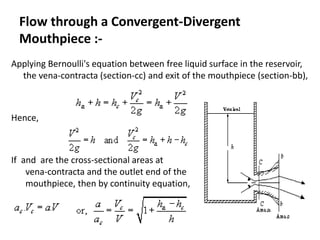
Applying Bernoulli's equation between free liquid surface in the reservoir,
the vena-contracta (section-cc) and exit of the mouthpiece (section-bb),
Hence,
If and are the cross-sectional areas at
vena-contracta and the outlet end of the
mouthpiece, then by continuity equation,
Flow through an Internal Mouthpiece :-
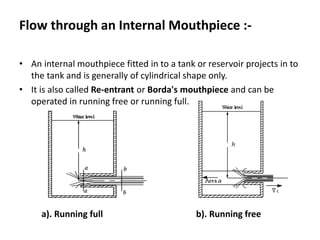
• An internal mouthpiece fitted in to a tank or reservoir projects in to
the tank and is generally of cylindrical shape only.
• It is also called Re-entrant or Borda's mouthpiece and can be
operated in running free or running full.
a). Running full b). Running free
Flow through an Internal Mouthpiece :-
If the internal mouthpiece runs free, the length of the mouthpiece is
small enough to ensure full expansion of the jet. As a result, a vena-
contracta
Static thrust on the fluid for the area a
= ꝩah
Rate of change of momentum of the jet by
this static thrust is
= [ꝩ.ac.Vc/g]Vc
Equating the above two, by applying Newton’s
Law of motion, we get
ac/a = gh/Vc
2 (5)
Flow through an Internal Mouthpiece :-
Since, the jet is not expanding, so the loss of the energy can be
neglected. Then, applying the energy equation between the free
surface of the liquid and outside the mouthpiece,
(6)
By combining Eqn. (5) with (6),
i.e. the coefficient of contraction for a Borda's mouthpiece is 0.5.
Borda’s mouthpiece running full :-
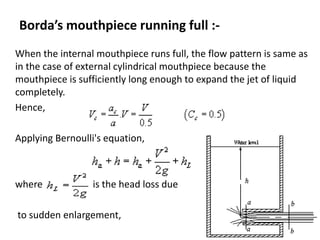
When the internal mouthpiece runs full, the flow pattern is same as
in the case of external cylindrical mouthpiece because the
mouthpiece is sufficiently long enough to expand the jet of liquid
completely.
Hence,
Applying Bernoulli's equation,
(7)
where is the head loss due
to sudden enlargement,
Borda’s mouthpiece running full :-
Then solving for velocity V from the Eqn, we get
Coefficient of velocity becomes,

Flow through Mouthpieces

  • 1.
    Mouthpieces Submitted by :- DheerajKumar Soni SID-15109008
  • 2.
    Flow through Mouthpiece •A mouthpiece is a short tube of length not more than two to three times its diameter, which is fitted to a tank for measuring discharge of the flow from the tank. • By fitting the mouthpiece, the discharge through an orifice of the tank can be increased.
  • 3.
    Classification:- Mouthpieces are classifiedon the basis of their shape, position and discharge conditions. • According to the shape, they may be classified as, Cylindrical, Convergent, Divergent and Convergent-Divergent. • Based on the positions, they may be External or Internal mouthpieces with respect to reservoir/tank to which it is connected. An external mouthpiece projects outside the tank whereas the internal mouthpiece projects inside the tank. • On the basis of discharge conditions, they may be classified as Running full and Running free mouthpieces.
  • 4.
    Flow through anExternal Cylindrical Mouthpiece :- • Mouthpiece’s X-sectional area, a • Area of jet at VC, ac • Specific weight of liquid, ꝩ • Height of liquid, h • Absolute pressure head at section b-b and at water surface(atmospheric), ha • Absolute pressure head at c-c, hc • Head loss through the mouthpiece, hL • Velocity of jet at VC, Vc • Velocity of jet at b-b, V
  • 5.
    Flow through anExternal Cylindrical Mouthpiece :- Applying Bernoulli's equation between the free surface of the liquid in the tank and section b-b , we get, ha + h = ha + (V2/2g) + hL (1) Similarly between the free surface of liquid and section c-c, ha + h = hc + (Vc 2/2g) (2) The expression of head loss can be written as:- hL = (V2/2g)[(1/Cc) – 1]2 where Cc { = ac/a } is the contraction coeff.
  • 6.
    Flow through anExternal Cylindrical Mouthpiece :- Hence, Eqn.(1) can be written as, h = V2/2g[ 1 + {(1/Cc) – 1}2 ] (3) As we know, the value of- Vth = √2gh and also, V = Cv . Vth = Cv√2gh (4) Substituting Eqn. (4) in Eqn. (3), we get Cv = [1/{1 + (1/Cc – 1)2}]1/2 Also, the coeff. of discharge, Cd = Cc x Cv Hence, discharge through the mouthpiece can be written as Q = Cd.a.√2gh
  • 7.
    Flow through aConvergent-Divergent Mouthpiece :- • The formation of vena-contracta and subsequent enlargement of the jet causes the loss of energy, which results in reducing the coefficient of discharge of the mouthpiece. • The energy loss of the jet can be minimized by designing the shape of the mouthpiece similar to that of the flow pattern of the jet at the entry, vena-contracta and exit of the mouthpiece. • However, the pressure at vena-contracta cannot be reduced below absolute zero that limits the maximum divergence to be provided for the mouthpiece.
  • 8.
    Flow through aConvergent-Divergent Mouthpiece :- Applying Bernoulli's equation between free liquid surface in the reservoir, the vena-contracta (section-cc) and exit of the mouthpiece (section-bb), Hence, If and are the cross-sectional areas at vena-contracta and the outlet end of the mouthpiece, then by continuity equation,
  • 9.
    Flow through anInternal Mouthpiece :- • An internal mouthpiece fitted in to a tank or reservoir projects in to the tank and is generally of cylindrical shape only. • It is also called Re-entrant or Borda's mouthpiece and can be operated in running free or running full. a). Running full b). Running free
  • 10.
    Flow through anInternal Mouthpiece :- If the internal mouthpiece runs free, the length of the mouthpiece is small enough to ensure full expansion of the jet. As a result, a vena- contracta Static thrust on the fluid for the area a = ꝩah Rate of change of momentum of the jet by this static thrust is = [ꝩ.ac.Vc/g]Vc Equating the above two, by applying Newton’s Law of motion, we get ac/a = gh/Vc 2 (5)
  • 11.
    Flow through anInternal Mouthpiece :- Since, the jet is not expanding, so the loss of the energy can be neglected. Then, applying the energy equation between the free surface of the liquid and outside the mouthpiece, (6) By combining Eqn. (5) with (6), i.e. the coefficient of contraction for a Borda's mouthpiece is 0.5.
  • 12.
    Borda’s mouthpiece runningfull :- When the internal mouthpiece runs full, the flow pattern is same as in the case of external cylindrical mouthpiece because the mouthpiece is sufficiently long enough to expand the jet of liquid completely. Hence, Applying Bernoulli's equation, (7) where is the head loss due to sudden enlargement,
  • 13.
    Borda’s mouthpiece runningfull :- Then solving for velocity V from the Eqn, we get Coefficient of velocity becomes,

Editor's Notes

  • #5 Consider a cylindrical mouthpiece of cross-sectional area  , which is attached externally to the tank as shown in Fig. 1. The tank is filled with a liquid of specific weight  up to a constant height  above the center of the mouthpiece. The discharge from the tank through the mouthpiece, compared to that of orifice, can be increased by running the mouthpiece full so that the jets of liquid emerging from the mouthpiece will be of same diameter as that of mouthpiece.   maintaining a sufficient pressure-head in the tank so as to achieve the mouthpiece running full. A mouthpiece will be running full, if its length is equal to about two to three times its diameter and the pressure head in the tank is maintained at some critical level. Any deviation in full running condition of mouthpiece will result in the formation of vena-contracta as in case of orifice.
  • #11 Let us consider an internal mouthpiece as shown in Fig. 3-b. It has a cross-sectional area, a  , discharging the liquid under a constant head, h  above the mouthpiece. Since the mouthpiece is running free, a vena-contracta will be formed. Let the cross-sectional area and velocity of the emerging jet at vena-contracta be ac  and Vc respectively.