Flow Through Orifice
Meter
BY

PULKIT SHUKLA -2012UCE1291
SIDDHARTH KATIYAR
RAKESH KUMAR
Objective


To calibrate the given Orifice meter.



To draw graph between Q vs H, logQ vs logH, Q vs √H.
What‟s Orifice Meter?
ORIFICE METER is another simple device used for the measuring the
discharge through pipes, orifice meter also works on the same principle
as that of Venturi meter i.e., by reducing the cross-sectional area of
flow passage ,a pressure difference between the two sections before
and after Orifice is developed and the measurement of the pressure
difference enables the determination of the discharge through the
pipe . However , an orifice meter is a cheaper arrangement for
discharge measurement through pipes and its installation requires a
smaller length as compared with Venturi meter. As such where the
space is limited, the orifice meter may be used for the measurement of
discharge through pipes .
Formulas Used
Discharge can be determined as follows:
Q=KH^n
K=(a1*a2* √2g)/ √((a1^2)-(a2^2)) m^3/sec
N=0.5(approximately)
Where, ,
Qth= Theoretical dischargea
a1= c/s area of the inlet = c/s area of pipea
a2= c/s area of the throat
H = head (in meters of fluid flowing through the pipe)


Continued……


H =h*((S1/S2)-1)

h = differential manometer reading(difference in limb 1 and limb 2)


S1= Specific gravity of manometric liquid



S2= Specific gravity of fluid in the pipe.(i.e; water & S2= 1)

The actual flow rate is expected to be less than that given by the equation above
because of frictional effects and consequent head loss between section at inlet and
throat . In practice it is customery to account for this loss by insertion of an
experimentally determined co-efficient known as “Coefficient of Discharge”
Cd=Q(actual)/Q(theoretical)
Experimental Setup


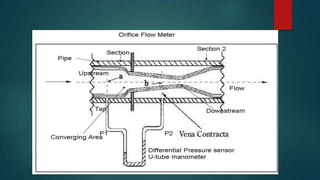
The set up consists of a long horizontal pipe line. A thin plate having
a concentric sharp edged circular of diameter „d‟ is fitted in the
pipe line. Sufficient straight length is provided on the upstream of
the orifice plate.



A valve is fitted at the end of pipe to regulate the discharge Q. the
pressure tapings, one on the upstream side at (D-d) to 2 (D-d) and
the other on the downstream side at 0.5 area provided on the
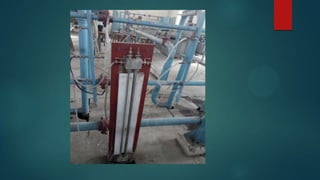
horizontal pipe line. A u-tube mercury manometer is used to
measure the pressure difference between sections 1 and 2 . A stop
watch is also required to measure time.
Procedure


Close the valves of inlet pipe, Orifice meter pipe line and
manometer.



The gate valve of the pipeline selected for the experimentation is
opened.



The needle valves of the corresponding manometer & Orifice meter
are opened.



Adjust the control valve kept at the exit side of the Orifice to a
desired flow rateand maintain the flow.



Note down the readings of manometer and final reading of
discharge tank for interval of 30 seconds.



Adjust the gate valve and repeat the experiment.
Observation Table 1
SNO
.

AREA OF
COLLECTING
TANK(cm^2)

DEPTH OF

WATER

INITIAL(cm FINAL(c
)
m)

COLLECTE
D

VOLUME OF
WATER
COLLECTED(m
DIFFERENC 3)
E

TIME DISCHARG
(sec E
)
Q(m3/sec)

1ST PIPE
1.

97*60

3

5

2

0.01164

30

0.000388

2.

97*60

5.5

7.6

2.1

0.01222

30

0.000407

3.

97*60

8.5

10.9

2.4

0.01396

30

0.000465

4.

97*60

11.5

15

3.5

0.02037

30

0.000679

5.

97*60

15.5

19.7

4.2

0.02444

30

0.000814

2ND PIPE
1.

97*60

23.7

25.3

1.6

0.009312

30

0.000310

2.

97*60

19

21.1

2.1

0.01222

30

0.000407

3.

97*60

21.2

25.4

4.2

0.02444

30

0.000814

4.

97*60

25.8

30.3

4.5

0.02619

30

0.000873

5.

97*60

29.7

34.6

4.9

0.028518

30

0.000950
Table 2
S
NO.

MANOMETER
LIMB 1(cm)

READING
LIMB 2(cm)

READING
DIFFERENCE(h)
cm

H=h*12.6

DISCHARGE
(Q) m3/sec

COEFFICIENT
OF
DISCHARGE

1ST PIPE
1.

18.5

8.5

10

126

0.000388

0.4075

2.

20

6.9

13.1

165.06

0.000407

0.373

3.

21

5.5

15.5

195.3

0.000465

0.394

4.

23.5

3.4

20.1

253.26

0.000679

0.5033

5.

24.2

2.8

21.4

269.64

0.000814

0.452

2ND PIPE
1.

13.3

12.8

0.5

6.3

0.000310

0.8516

2.

13.5

12.3

1.2

15.12

0.000407

0.722

3.

14.5

11.5

3.0

37.8

0.000814

0.913

4.

14.7

11.4

3.3

41.58

0.000873

0.933

5.

15.0

11.0

4.0

50.4

0.000950

0.842
CALCULATIONS


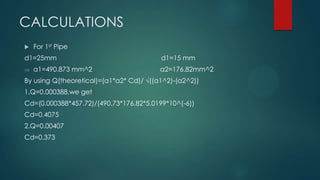
For 1st Pipe

d1=25mm
a1=490.873 mm^2

d1=15 mm
a2=176.82mm^2

By using Q(theoretical)=(a1*a2* Cd)/ √((a1^2)-(a2^2))
1.Q=0.000388,we get
Cd=(0.000388*457.72)/(490.73*176.82*5.0199*10^(-6))
Cd=0.4075

2.Q=0.00407
Cd=0.373
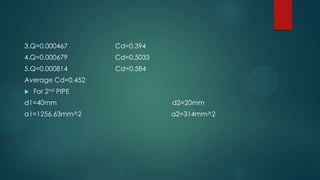
3.Q=0.000467

Cd=0.394

4.Q=0.000679

Cd=0.5033

5.Q=0.000814

Cd=0.584

Average Cd=0.452


For 2nd PIPE

d1=40mm

d2=20mm

a1=1256.63mm^2

a2=314mm^2
1.Q=0.000310

Cd=0.8516

2.Q=0.000407

Cd=0.722

3.Q=0.000814

Cd=0.913

4.Q=0.000873

Cd=0.933

5.Q=0.000950

Cd=0.842

Average Cd=0.852
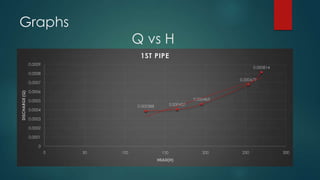
Graphs

Q vs H
1ST PIPE

0.0009

0.000814

0.0008
0.000679

DISCHARGE (Q)

0.0007
0.0006
0.000465

0.0005

0.000407

0.000388

0.0004
0.0003
0.0002

0.0001
0
0

50

100

150
HEAD(H)

200

250

300
Q vs H
2nd PIPE
0.00095

0.001

0.000873
0.000814

0.0009

DISCHARGE(Q)

0.0008
0.0007
0.0006
0.0005

0.000407

0.0004

0.00031

0.0003
0.0002

0.0001
0
0

10

20

30
HEAD(H)

40

50

60
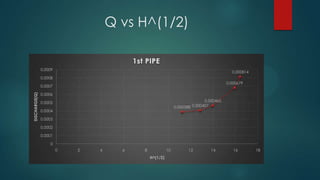
Q vs H^(1/2)
1st PIPE
0.0009

0.000814

0.0008
0.000679

DISCHARGE(Q)

0.0007
0.0006
0.000465
0.000388 0.000407

0.0005
0.0004
0.0003
0.0002
0.0001
0
0

2

4

6

8

10
H^(1/2)

12

14

16

18
Q vs H^(1/2)
2nd PIPE
0.00095

0.001

0.000873
0.000814

0.0009

DISCHARGE(Q)

0.0008
0.0007
0.0006
0.0005

0.000407

0.0004

0.00031

0.0003
0.0002

0.0001
0
0

1

2

3

4
H^(1/2)

5

6

7

8
Log Q vs Log H
1st PIPE
-3.05
2.05
-3.1

2.1

2.15

2.2

2.25

2.3

LOG Q

-3.2
-3.25
-3.3

-3.332

-3.35

-3.45

2.4
-3.168

-3.15

-3.4

2.35

-3.411

-3.39

LOG H

-3.089

2.45
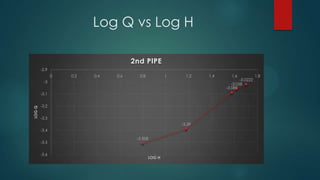
Log Q vs Log H
2nd PIPE
-2.9
0

0.2

0.4

0.6

0.8

1

1.2

-3

LOG Q

-3.1
-3.2
-3.3
-3.39
-3.4
-3.5
-3.6

-3.508

LOG H

1.4

1.6

-3.0222
-3.058
-3.089

1.8
Conclusion


The largest contribution to the uncertainty in the measured
coefficient is due to the time measurement.



The main disadvantage of this meter is the greater frictional loss it
causes as compared with the other devices and hence causes
large power consumption.



Within the limits of the experimental uncertainty and the Reynolds
number range investigated, the results obtained for the discharge
coefficient through an orifice plate agree with the empirical
relation.
Precaution


Drive out all entrapped air from differential mercury manometer.



Maintain a constant discharge before taking any reading.



Take a number of readings at lower value of Reynolds number, i.e.
at lower discharges.
Viva Voce


What is the use of an orifice meter ? Compare the advantages and
disadvantages of and orifice meter and a venturimetre ?



How will you ascertain the direction of flow in an installed orifice meter
with its pressure connections projecting out. ?



Is there any factor to limit the minimum value of d/D that is workable ?



Why is the coefficient of discharge for orifice meter much less than that
of a venturimeter ?, Though both work on the same principle ?



It is required to keep a fairly long length of pipe free from
bends, valves, or any other obstruction inside before the orifice section
what is the idea ?




what is the influence of factor d/D on the value of Cd
Conclude the effects of viscosity on the value of Cd ?
Quiz


1) Venacontracta is at a distance of half the diameter of the orifice

a) True
b) False


2) The orifice diameter is 0.5 times the diameter of the pipe

a) True
b) False


3) The principle of orifice meter is different from that of the
venturimeter

a) True
b) False

Flow through orifice meter

  • 1.
    Flow Through Orifice Meter BY PULKITSHUKLA -2012UCE1291 SIDDHARTH KATIYAR RAKESH KUMAR
  • 2.
    Objective  To calibrate thegiven Orifice meter.  To draw graph between Q vs H, logQ vs logH, Q vs √H.
  • 3.
    What‟s Orifice Meter? ORIFICEMETER is another simple device used for the measuring the discharge through pipes, orifice meter also works on the same principle as that of Venturi meter i.e., by reducing the cross-sectional area of flow passage ,a pressure difference between the two sections before and after Orifice is developed and the measurement of the pressure difference enables the determination of the discharge through the pipe . However , an orifice meter is a cheaper arrangement for discharge measurement through pipes and its installation requires a smaller length as compared with Venturi meter. As such where the space is limited, the orifice meter may be used for the measurement of discharge through pipes .
  • 4.
    Formulas Used Discharge canbe determined as follows: Q=KH^n K=(a1*a2* √2g)/ √((a1^2)-(a2^2)) m^3/sec N=0.5(approximately) Where, , Qth= Theoretical dischargea a1= c/s area of the inlet = c/s area of pipea a2= c/s area of the throat H = head (in meters of fluid flowing through the pipe)  Continued……
  • 5.
     H =h*((S1/S2)-1) h =differential manometer reading(difference in limb 1 and limb 2)  S1= Specific gravity of manometric liquid  S2= Specific gravity of fluid in the pipe.(i.e; water & S2= 1) The actual flow rate is expected to be less than that given by the equation above because of frictional effects and consequent head loss between section at inlet and throat . In practice it is customery to account for this loss by insertion of an experimentally determined co-efficient known as “Coefficient of Discharge” Cd=Q(actual)/Q(theoretical)
  • 9.
    Experimental Setup  The setup consists of a long horizontal pipe line. A thin plate having a concentric sharp edged circular of diameter „d‟ is fitted in the pipe line. Sufficient straight length is provided on the upstream of the orifice plate.  A valve is fitted at the end of pipe to regulate the discharge Q. the pressure tapings, one on the upstream side at (D-d) to 2 (D-d) and the other on the downstream side at 0.5 area provided on the horizontal pipe line. A u-tube mercury manometer is used to measure the pressure difference between sections 1 and 2 . A stop watch is also required to measure time.
  • 10.
    Procedure  Close the valvesof inlet pipe, Orifice meter pipe line and manometer.  The gate valve of the pipeline selected for the experimentation is opened.  The needle valves of the corresponding manometer & Orifice meter are opened.  Adjust the control valve kept at the exit side of the Orifice to a desired flow rateand maintain the flow.  Note down the readings of manometer and final reading of discharge tank for interval of 30 seconds.  Adjust the gate valve and repeat the experiment.
  • 11.
    Observation Table 1 SNO . AREAOF COLLECTING TANK(cm^2) DEPTH OF WATER INITIAL(cm FINAL(c ) m) COLLECTE D VOLUME OF WATER COLLECTED(m DIFFERENC 3) E TIME DISCHARG (sec E ) Q(m3/sec) 1ST PIPE 1. 97*60 3 5 2 0.01164 30 0.000388 2. 97*60 5.5 7.6 2.1 0.01222 30 0.000407 3. 97*60 8.5 10.9 2.4 0.01396 30 0.000465 4. 97*60 11.5 15 3.5 0.02037 30 0.000679 5. 97*60 15.5 19.7 4.2 0.02444 30 0.000814 2ND PIPE 1. 97*60 23.7 25.3 1.6 0.009312 30 0.000310 2. 97*60 19 21.1 2.1 0.01222 30 0.000407 3. 97*60 21.2 25.4 4.2 0.02444 30 0.000814 4. 97*60 25.8 30.3 4.5 0.02619 30 0.000873 5. 97*60 29.7 34.6 4.9 0.028518 30 0.000950
  • 12.
    Table 2 S NO. MANOMETER LIMB 1(cm) READING LIMB2(cm) READING DIFFERENCE(h) cm H=h*12.6 DISCHARGE (Q) m3/sec COEFFICIENT OF DISCHARGE 1ST PIPE 1. 18.5 8.5 10 126 0.000388 0.4075 2. 20 6.9 13.1 165.06 0.000407 0.373 3. 21 5.5 15.5 195.3 0.000465 0.394 4. 23.5 3.4 20.1 253.26 0.000679 0.5033 5. 24.2 2.8 21.4 269.64 0.000814 0.452 2ND PIPE 1. 13.3 12.8 0.5 6.3 0.000310 0.8516 2. 13.5 12.3 1.2 15.12 0.000407 0.722 3. 14.5 11.5 3.0 37.8 0.000814 0.913 4. 14.7 11.4 3.3 41.58 0.000873 0.933 5. 15.0 11.0 4.0 50.4 0.000950 0.842
  • 13.
    CALCULATIONS  For 1st Pipe d1=25mm a1=490.873mm^2 d1=15 mm a2=176.82mm^2 By using Q(theoretical)=(a1*a2* Cd)/ √((a1^2)-(a2^2)) 1.Q=0.000388,we get Cd=(0.000388*457.72)/(490.73*176.82*5.0199*10^(-6)) Cd=0.4075 2.Q=0.00407 Cd=0.373
  • 14.
  • 15.
  • 16.
    Graphs Q vs H 1STPIPE 0.0009 0.000814 0.0008 0.000679 DISCHARGE (Q) 0.0007 0.0006 0.000465 0.0005 0.000407 0.000388 0.0004 0.0003 0.0002 0.0001 0 0 50 100 150 HEAD(H) 200 250 300
  • 17.
    Q vs H 2ndPIPE 0.00095 0.001 0.000873 0.000814 0.0009 DISCHARGE(Q) 0.0008 0.0007 0.0006 0.0005 0.000407 0.0004 0.00031 0.0003 0.0002 0.0001 0 0 10 20 30 HEAD(H) 40 50 60
  • 18.
    Q vs H^(1/2) 1stPIPE 0.0009 0.000814 0.0008 0.000679 DISCHARGE(Q) 0.0007 0.0006 0.000465 0.000388 0.000407 0.0005 0.0004 0.0003 0.0002 0.0001 0 0 2 4 6 8 10 H^(1/2) 12 14 16 18
  • 19.
    Q vs H^(1/2) 2ndPIPE 0.00095 0.001 0.000873 0.000814 0.0009 DISCHARGE(Q) 0.0008 0.0007 0.0006 0.0005 0.000407 0.0004 0.00031 0.0003 0.0002 0.0001 0 0 1 2 3 4 H^(1/2) 5 6 7 8
  • 20.
    Log Q vsLog H 1st PIPE -3.05 2.05 -3.1 2.1 2.15 2.2 2.25 2.3 LOG Q -3.2 -3.25 -3.3 -3.332 -3.35 -3.45 2.4 -3.168 -3.15 -3.4 2.35 -3.411 -3.39 LOG H -3.089 2.45
  • 21.
    Log Q vsLog H 2nd PIPE -2.9 0 0.2 0.4 0.6 0.8 1 1.2 -3 LOG Q -3.1 -3.2 -3.3 -3.39 -3.4 -3.5 -3.6 -3.508 LOG H 1.4 1.6 -3.0222 -3.058 -3.089 1.8
  • 22.
    Conclusion  The largest contributionto the uncertainty in the measured coefficient is due to the time measurement.  The main disadvantage of this meter is the greater frictional loss it causes as compared with the other devices and hence causes large power consumption.  Within the limits of the experimental uncertainty and the Reynolds number range investigated, the results obtained for the discharge coefficient through an orifice plate agree with the empirical relation.
  • 23.
    Precaution  Drive out allentrapped air from differential mercury manometer.  Maintain a constant discharge before taking any reading.  Take a number of readings at lower value of Reynolds number, i.e. at lower discharges.
  • 24.
    Viva Voce  What isthe use of an orifice meter ? Compare the advantages and disadvantages of and orifice meter and a venturimetre ?  How will you ascertain the direction of flow in an installed orifice meter with its pressure connections projecting out. ?  Is there any factor to limit the minimum value of d/D that is workable ?  Why is the coefficient of discharge for orifice meter much less than that of a venturimeter ?, Though both work on the same principle ?  It is required to keep a fairly long length of pipe free from bends, valves, or any other obstruction inside before the orifice section what is the idea ?   what is the influence of factor d/D on the value of Cd Conclude the effects of viscosity on the value of Cd ?
  • 25.
    Quiz  1) Venacontracta isat a distance of half the diameter of the orifice a) True b) False  2) The orifice diameter is 0.5 times the diameter of the pipe a) True b) False  3) The principle of orifice meter is different from that of the venturimeter a) True b) False