LECTURE UNIT NO. 8

FLOW OF VISCOUS FLUIDS IN PIPELINES

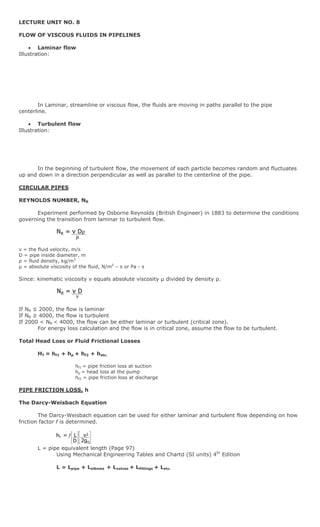
     Laminar flow
Illustration:


        In Laminar, streamline or viscous flow, the fluids are moving in paths parallel to the pipe
centerline.

     Turbulent flow
Illustration:


      In the beginning of turbulent flow, the movement of each particle becomes random and fluctuates
up and down in a direction perpendicular as well as parallel to the centerline of the pipe.

CIRCULAR PIPES

REYNOLDS NUMBER, NR

      Experiment performed by Osborne Reynolds (British Engineer) in 1883 to determine the conditions
governing the transition from laminar to turbulent flow.


v = the fluid velocity, m/s
D = pipe inside diameter, m
ρ = fluid density, kg/m3
μ = absolute viscosity of the fluid, N/m2 – s or Pa - s

Since: kinematic viscosity v equals absolute viscosity μ divided by density ρ.


If NR ≤ 2000, the flow is laminar
If NR ≥ 4000, the flow is turbulent
If 2000 < NR < 4000, the flow can be either laminar or turbulent (critical zone).
       For energy loss calculation and the flow is in critical zone, assume the flow to be turbulent.

Total Head Loss or Fluid Frictional Losses

        HT = hf1 + hp + hf2 + hetc.

                        hf1 = pipe friction loss at suction
                        hp = head loss at the pump
                        hf2 = pipe friction loss at discharge

PIPE FRICTION LOSS, h

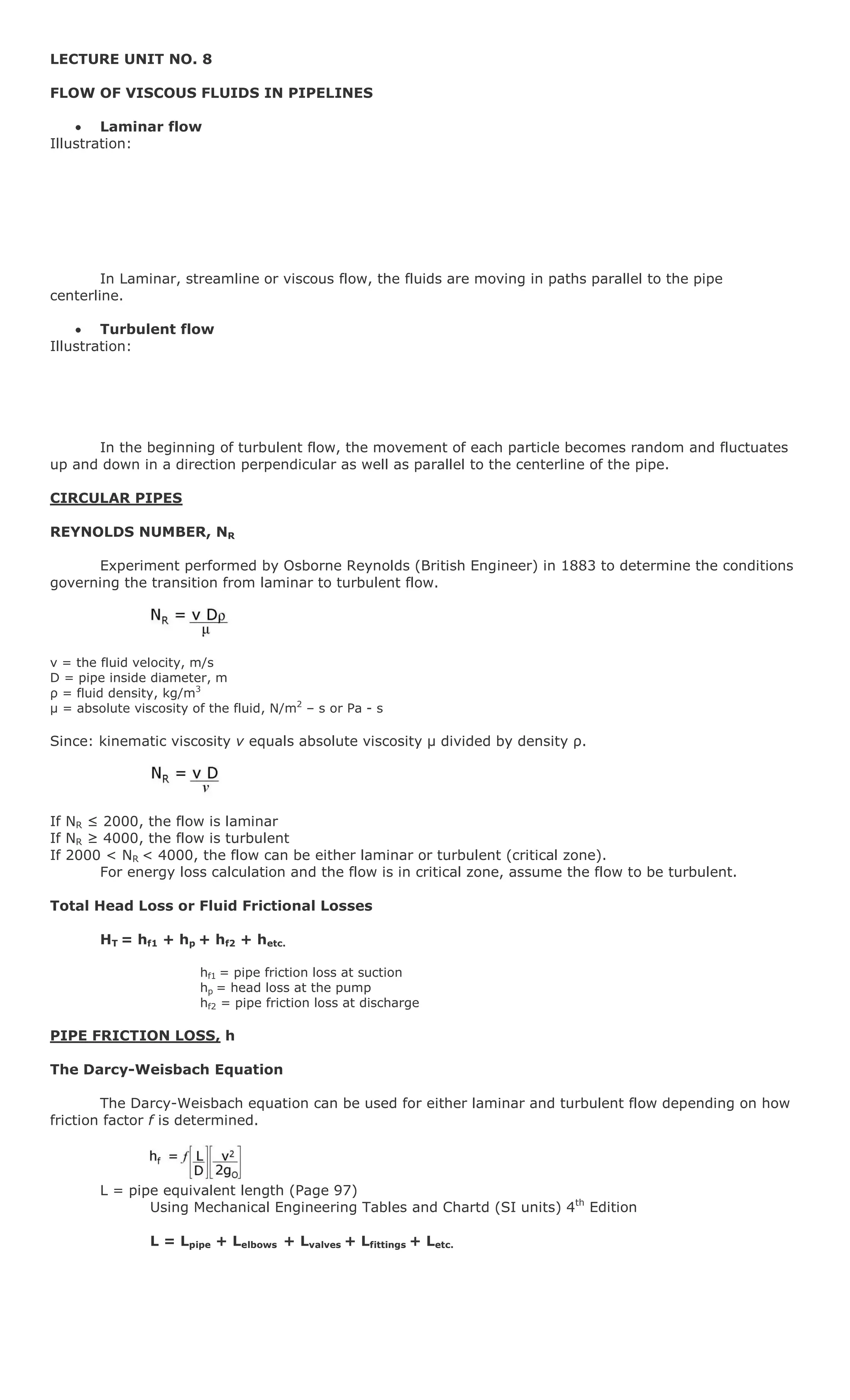
The Darcy-Weisbach Equation

        The Darcy-Weisbach equation can be used for either laminar and turbulent flow depending on how
friction factor f is determined.


        L = pipe equivalent length (Page 97)
               Using Mechanical Engineering Tables and Chartd (SI units) 4th Edition

                L = Lpipe + Lelbows + Lvalves + Lfittings + Letc.
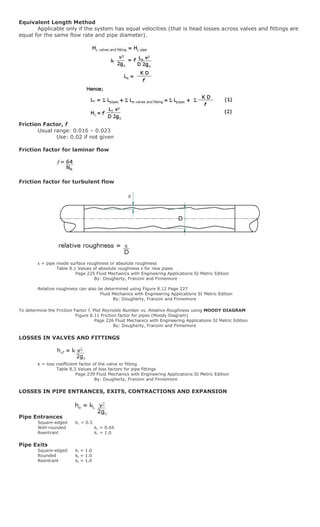
Equivalent Length Method
       Applicable only if the system has equal velocities (that is head losses across valves and fittings are
equal for the same flow rate and pipe diameter).


Friction Factor, f
       Usual range: 0.016 – 0.023
              Use: 0.02 if not given

Friction factor for laminar flow


Friction factor for turbulent flow

                                                    ε


                                                                           D


        ε = pipe inside surface roughness or absolute roughness
                 Table 8.1 Values of absolute roughness ε for new pipes
                          Page 225 Fluid Mechanics with Engineering Applications SI Metric Edition
                                   By: Dougherty, Franzini and Finnemore

        Relative roughness can also be determined using Figure 8.12 Page 227
                                     Fluid Mechanics with Engineering Applications SI Metric Edition
                                           By: Dougherty, Franzini and Finnemore

To determine the Friction Factor f, Plot Reynolds Number vs. Relative Roughness using MOODY DIAGRAM
                           Figure 8.11 Friction factor for pipes (Moody Diagram)
                                     Page 226 Fluid Mechanics with Engineering Applications SI Metric Edition
                                              By: Dougherty, Franzini and Finnemore

LOSSES IN VALVES AND FITTINGS


        k = loss coefficient factor of the valve or fitting
                 Table 8.3 Values of loss factors for pipe fittings
                           Page 239 Fluid Mechanics with Engineering Applications SI Metric Edition
                                     By: Dougherty, Franzini and Finnemore

LOSSES IN PIPE ENTRANCES, EXITS, CONTRACTIONS AND EXPANSION


Pipe Entrances
        Square-edged      kL = 0.5
        Well-rounded                 kL = 0.04
        Reentrant                    kL = 1.0

Pipe Exits
        Square-edged      kL = 1.0
        Rounded           kL = 1.0
        Reentrant         kL = 1.0
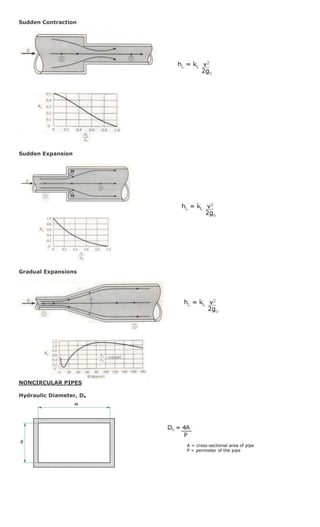
Sudden Contraction


Sudden Expansion


Gradual Expansions


NONCIRCULAR PIPES

Hydraulic Diameter, Dh
                   w


d
                         A = cross-sectional area of pipe
                         P = perimeter of the pipe
Dh for rectangular pipe of depth d and width d:


Dh for square duct of side s:


Dh for circular pipe of diameter D:


Hence, Darcy-Weisbach equation is still valid for non circular pipe.

Determination of f for Laminar Flow in Noncircular Pipe


       C = empirical constant, depends on the cross sectional shape
               C = 64 for circular pipe
               C = 57 for square (d/w = 1)
       NRh = Reynolds Number
               If NRh ≤ 2000, the flow is laminar
               If NRh ≥ 4000, the flow is turbulent
               If 2000 < NRh < 4000, the flow can be either laminar or turbulent (critical zone).

Reynolds Number for Noncircular Pipes


Noncircular Pipe Head loss


       f = C/NRh for laminar flow
       f using Moody Diagram for turbulent flow

Problems:

   1. A pipe has a diameter of 20 mm and a length of 80 m. A liquid having a kinematic viscosity of 4 x
      10-5 m2/s is flowing thru the pipe at a viscosity of 3 m/s. (a) Compute for the Reynolds number (b)
      determine the friction factor (c) compute for the head loss of the pipe.
   2. Oil flows thru a 50 mm dia. Pipe having a head loss if 12 m. The length of pipe is 120 m. long. If
      the oil has a Reynolds number equal to 1600, (a) Compute the velocity of the oil flowing in the pipe
      (b) What is the kinematic viscosity of oil in m2/s (c) What is equivalent viscosity of oil in strokes.
   3. SAE oil ρ = 869 kg/m3 flows through a cast iron pipe at a velocity of 1.0 m/s. The pipe is 45 m.
      long and has a diam. Of 150 mm. Absolute viscosity μ = 0.0814 Pa-s. Compute the following: (a)
      Reynolds number (b) Determine the type of flow (c) Head loss due to friction.
   4. The industrial scrubber B as shown in the figure consumes water (v =0.113 x 10⁻⁵ m2/s) at the rate
      of 0.1 m3/s. I the pipe is 150 mm commercial pipe and f = 0.016, compute the following (a)
      Reynolds number (b) The total head loss from A to B (c) The necessary tank pressure.
295m


                   25m

                                                                  150m


                                                        300m


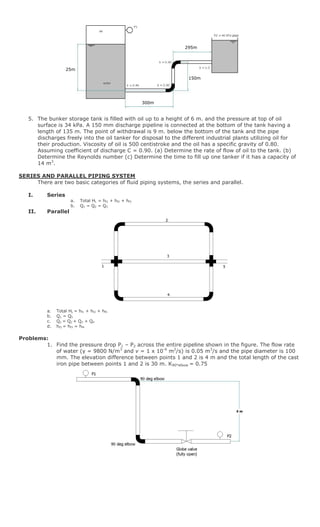
   5. The bunker storage tank is filled with oil up to a height of 6 m. and the pressure at top of oil
      surface is 34 kPa. A 150 mm discharge pipeline is connected at the bottom of the tank having a
      length of 135 m. The point of withdrawal is 9 m. below the bottom of the tank and the pipe
      discharges freely into the oil tanker for disposal to the different industrial plants utilizing oil for
      their production. Viscosity of oil is 500 centistroke and the oil has a specific gravity of 0.80.
      Assuming coefficient of discharge C = 0.90. (a) Determine the rate of flow of oil to the tank. (b)
      Determine the Reynolds number (c) Determine the time to fill up one tanker if it has a capacity of
      14 m3.

SERIES AND PARALLEL PIPING SYSTEM
     There are two basic categories of fluid piping systems, the series and parallel.

   I.     Series
                      a.   Total HL = hf1 + hf2 + hf3
                      b.   Q1 = Q2 = Q3
   II.    Parallel


          a.   Total HL = hf1 + hf2 + hf5
          b.   Q1 = Q5
          c.   Q1 = Q2 + Q3 + Q4
          d.   hf2 = hf3 = hf4

Problems:
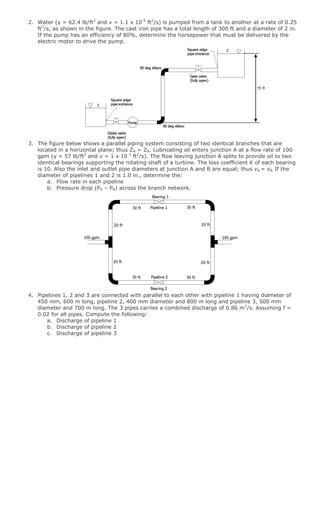
        1. Find the pressure drop P1 – P2 across the entire pipeline shown in the figure. The flow rate
           of water (γ = 9800 N/m3 and v = 1 x 10⁻⁶ m2/s) is 0.05 m3/s and the pipe diameter is 100
           mm. The elevation difference between points 1 and 2 is 4 m and the total length of the cast
           iron pipe between points 1 and 2 is 30 m. K90°elbow = 0.75
2. Water (γ = 62.4 lb/ft3 and v = 1.1 x 10⁻⁵ ft2/s) is pumped from a tank to another at a rate of 0.25
   ft3/s, as shown in the figure. The cast iron pipe has a total length of 300 ft and a diameter of 2 in.
   If the pump has an efficiency of 80%, determine the horsepower that must be delivered by the
   electric motor to drive the pump.


                                                                                         50 ft


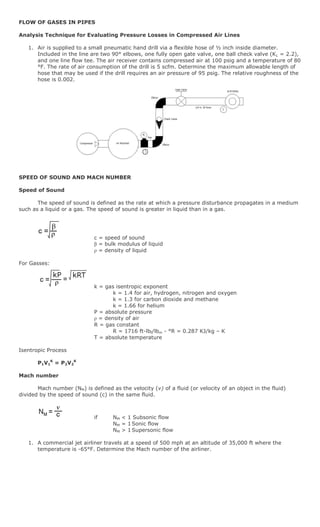
3. The figure below shows a parallel piping system consisting of two identical branches that are
   located in a horizontal plane; thus ZA = ZB. Lubricating oil enters junction A at a flow rate of 100
   gpm (γ = 57 lb/ft3 and v = 1 x 10⁻³ ft2/s). The flow leaving junction A splits to provide oil to two
   identical bearings supporting the rotating shaft of a turbine. The loss coefficient K of each bearing
   is 10. Also the inlet and outlet pipe diameters at junction A and B are equal; thus vA = vB. If the
   diameter of pipelines 1 and 2 is 1.0 in., determine the:
       a. Flow rate in each pipeline
       b. Pressure drop (PA – PB) across the branch network.


4. Pipelines 1, 2 and 3 are connected with parallel to each other with pipeline 1 having diameter of
   450 mm, 600 m long, pipeline 2, 400 mm diameter and 800 m long and pipeline 3, 500 mm
   diameter and 700 m long. The 3 pipes carries a combined discharge of 0.86 m 3/s. Assuming f =
   0.02 for all pipes. Compute the following:
      a. Discharge of pipeline 1
      b. Discharge of pipeline 2
      c. Discharge of pipeline 3
FLOW OF GASES IN PIPES

Analysis Technique for Evaluating Pressure Losses in Compressed Air Lines

   1. Air is supplied to a small pneumatic hand drill via a flexible hose of ½ inch inside diameter.
      Included in the line are two 90° elbows, one fully open gate valve, one ball check valve (K L = 2.2),
      and one line flow tee. The air receiver contains compressed air at 100 psig and a temperature of 80
      °F. The rate of air consumption of the drill is 5 scfm. Determine the maximum allowable length of
      hose that may be used if the drill requires an air pressure of 95 psig. The relative roughness of the
      hose is 0.002.


                                                P1


                                                 1


SPEED OF SOUND AND MACH NUMBER

Speed of Sound

       The speed of sound is defined as the rate at which a pressure disturbance propagates in a medium
such as a liquid or a gas. The speed of sound is greater in liquid than in a gas.


                             c = speed of sound
                             β = bulk modulus of liquid
                             ρ = density of liquid

For Gasses:


                             k = gas isentropic exponent
                                    k = 1.4 for air, hydrogen, nitrogen and oxygen
                                    k = 1.3 for carbon dioxide and methane
                                    k = 1.66 for helium
                             P = absolute pressure
                             ρ = density of air
                             R = gas constant
                                    R = 1716 ft-lbf/lbm - °R = 0.287 KJ/kg – K
                             T = absolute temperature

Isentropic Process

       P1V1K = P2V2K

Mach number

       Mach number (NM) is defined as the velocity (v) of a fluid (or velocity of an object in the fluid)
divided by the speed of sound (c) in the same fluid.


                             if      NM < 1 Subsonic flow
                                     NM = 1 Sonic flow
                                     NM > 1 Supersonic flow

   1. A commercial jet airliner travels at a speed of 500 mph at an altitude of 35,000 ft where the
      temperature is -65°F. Determine the Mach number of the airliner.

008

  • 1.
    LECTURE UNIT NO.8 FLOW OF VISCOUS FLUIDS IN PIPELINES  Laminar flow Illustration: In Laminar, streamline or viscous flow, the fluids are moving in paths parallel to the pipe centerline.  Turbulent flow Illustration: In the beginning of turbulent flow, the movement of each particle becomes random and fluctuates up and down in a direction perpendicular as well as parallel to the centerline of the pipe. CIRCULAR PIPES REYNOLDS NUMBER, NR Experiment performed by Osborne Reynolds (British Engineer) in 1883 to determine the conditions governing the transition from laminar to turbulent flow. v = the fluid velocity, m/s D = pipe inside diameter, m ρ = fluid density, kg/m3 μ = absolute viscosity of the fluid, N/m2 – s or Pa - s Since: kinematic viscosity v equals absolute viscosity μ divided by density ρ. If NR ≤ 2000, the flow is laminar If NR ≥ 4000, the flow is turbulent If 2000 < NR < 4000, the flow can be either laminar or turbulent (critical zone). For energy loss calculation and the flow is in critical zone, assume the flow to be turbulent. Total Head Loss or Fluid Frictional Losses HT = hf1 + hp + hf2 + hetc. hf1 = pipe friction loss at suction hp = head loss at the pump hf2 = pipe friction loss at discharge PIPE FRICTION LOSS, h The Darcy-Weisbach Equation The Darcy-Weisbach equation can be used for either laminar and turbulent flow depending on how friction factor f is determined. L = pipe equivalent length (Page 97) Using Mechanical Engineering Tables and Chartd (SI units) 4th Edition L = Lpipe + Lelbows + Lvalves + Lfittings + Letc.
  • 2.
    Equivalent Length Method Applicable only if the system has equal velocities (that is head losses across valves and fittings are equal for the same flow rate and pipe diameter). Friction Factor, f Usual range: 0.016 – 0.023 Use: 0.02 if not given Friction factor for laminar flow Friction factor for turbulent flow ε D ε = pipe inside surface roughness or absolute roughness Table 8.1 Values of absolute roughness ε for new pipes Page 225 Fluid Mechanics with Engineering Applications SI Metric Edition By: Dougherty, Franzini and Finnemore Relative roughness can also be determined using Figure 8.12 Page 227 Fluid Mechanics with Engineering Applications SI Metric Edition By: Dougherty, Franzini and Finnemore To determine the Friction Factor f, Plot Reynolds Number vs. Relative Roughness using MOODY DIAGRAM Figure 8.11 Friction factor for pipes (Moody Diagram) Page 226 Fluid Mechanics with Engineering Applications SI Metric Edition By: Dougherty, Franzini and Finnemore LOSSES IN VALVES AND FITTINGS k = loss coefficient factor of the valve or fitting Table 8.3 Values of loss factors for pipe fittings Page 239 Fluid Mechanics with Engineering Applications SI Metric Edition By: Dougherty, Franzini and Finnemore LOSSES IN PIPE ENTRANCES, EXITS, CONTRACTIONS AND EXPANSION Pipe Entrances Square-edged kL = 0.5 Well-rounded kL = 0.04 Reentrant kL = 1.0 Pipe Exits Square-edged kL = 1.0 Rounded kL = 1.0 Reentrant kL = 1.0
  • 3.
    Sudden Contraction Sudden Expansion GradualExpansions NONCIRCULAR PIPES Hydraulic Diameter, Dh w d A = cross-sectional area of pipe P = perimeter of the pipe
  • 4.
    Dh for rectangularpipe of depth d and width d: Dh for square duct of side s: Dh for circular pipe of diameter D: Hence, Darcy-Weisbach equation is still valid for non circular pipe. Determination of f for Laminar Flow in Noncircular Pipe C = empirical constant, depends on the cross sectional shape C = 64 for circular pipe C = 57 for square (d/w = 1) NRh = Reynolds Number If NRh ≤ 2000, the flow is laminar If NRh ≥ 4000, the flow is turbulent If 2000 < NRh < 4000, the flow can be either laminar or turbulent (critical zone). Reynolds Number for Noncircular Pipes Noncircular Pipe Head loss f = C/NRh for laminar flow f using Moody Diagram for turbulent flow Problems: 1. A pipe has a diameter of 20 mm and a length of 80 m. A liquid having a kinematic viscosity of 4 x 10⁻⁵ m2/s is flowing thru the pipe at a viscosity of 3 m/s. (a) Compute for the Reynolds number (b) determine the friction factor (c) compute for the head loss of the pipe. 2. Oil flows thru a 50 mm dia. Pipe having a head loss if 12 m. The length of pipe is 120 m. long. If the oil has a Reynolds number equal to 1600, (a) Compute the velocity of the oil flowing in the pipe (b) What is the kinematic viscosity of oil in m2/s (c) What is equivalent viscosity of oil in strokes. 3. SAE oil ρ = 869 kg/m3 flows through a cast iron pipe at a velocity of 1.0 m/s. The pipe is 45 m. long and has a diam. Of 150 mm. Absolute viscosity μ = 0.0814 Pa-s. Compute the following: (a) Reynolds number (b) Determine the type of flow (c) Head loss due to friction. 4. The industrial scrubber B as shown in the figure consumes water (v =0.113 x 10⁻⁵ m2/s) at the rate of 0.1 m3/s. I the pipe is 150 mm commercial pipe and f = 0.016, compute the following (a) Reynolds number (b) The total head loss from A to B (c) The necessary tank pressure.
  • 5.
    295m 25m 150m 300m 5. The bunker storage tank is filled with oil up to a height of 6 m. and the pressure at top of oil surface is 34 kPa. A 150 mm discharge pipeline is connected at the bottom of the tank having a length of 135 m. The point of withdrawal is 9 m. below the bottom of the tank and the pipe discharges freely into the oil tanker for disposal to the different industrial plants utilizing oil for their production. Viscosity of oil is 500 centistroke and the oil has a specific gravity of 0.80. Assuming coefficient of discharge C = 0.90. (a) Determine the rate of flow of oil to the tank. (b) Determine the Reynolds number (c) Determine the time to fill up one tanker if it has a capacity of 14 m3. SERIES AND PARALLEL PIPING SYSTEM There are two basic categories of fluid piping systems, the series and parallel. I. Series a. Total HL = hf1 + hf2 + hf3 b. Q1 = Q2 = Q3 II. Parallel a. Total HL = hf1 + hf2 + hf5 b. Q1 = Q5 c. Q1 = Q2 + Q3 + Q4 d. hf2 = hf3 = hf4 Problems: 1. Find the pressure drop P1 – P2 across the entire pipeline shown in the figure. The flow rate of water (γ = 9800 N/m3 and v = 1 x 10⁻⁶ m2/s) is 0.05 m3/s and the pipe diameter is 100 mm. The elevation difference between points 1 and 2 is 4 m and the total length of the cast iron pipe between points 1 and 2 is 30 m. K90°elbow = 0.75
  • 6.
    2. Water (γ= 62.4 lb/ft3 and v = 1.1 x 10⁻⁵ ft2/s) is pumped from a tank to another at a rate of 0.25 ft3/s, as shown in the figure. The cast iron pipe has a total length of 300 ft and a diameter of 2 in. If the pump has an efficiency of 80%, determine the horsepower that must be delivered by the electric motor to drive the pump. 50 ft 3. The figure below shows a parallel piping system consisting of two identical branches that are located in a horizontal plane; thus ZA = ZB. Lubricating oil enters junction A at a flow rate of 100 gpm (γ = 57 lb/ft3 and v = 1 x 10⁻³ ft2/s). The flow leaving junction A splits to provide oil to two identical bearings supporting the rotating shaft of a turbine. The loss coefficient K of each bearing is 10. Also the inlet and outlet pipe diameters at junction A and B are equal; thus vA = vB. If the diameter of pipelines 1 and 2 is 1.0 in., determine the: a. Flow rate in each pipeline b. Pressure drop (PA – PB) across the branch network. 4. Pipelines 1, 2 and 3 are connected with parallel to each other with pipeline 1 having diameter of 450 mm, 600 m long, pipeline 2, 400 mm diameter and 800 m long and pipeline 3, 500 mm diameter and 700 m long. The 3 pipes carries a combined discharge of 0.86 m 3/s. Assuming f = 0.02 for all pipes. Compute the following: a. Discharge of pipeline 1 b. Discharge of pipeline 2 c. Discharge of pipeline 3
  • 7.
    FLOW OF GASESIN PIPES Analysis Technique for Evaluating Pressure Losses in Compressed Air Lines 1. Air is supplied to a small pneumatic hand drill via a flexible hose of ½ inch inside diameter. Included in the line are two 90° elbows, one fully open gate valve, one ball check valve (K L = 2.2), and one line flow tee. The air receiver contains compressed air at 100 psig and a temperature of 80 °F. The rate of air consumption of the drill is 5 scfm. Determine the maximum allowable length of hose that may be used if the drill requires an air pressure of 95 psig. The relative roughness of the hose is 0.002. P1 1 SPEED OF SOUND AND MACH NUMBER Speed of Sound The speed of sound is defined as the rate at which a pressure disturbance propagates in a medium such as a liquid or a gas. The speed of sound is greater in liquid than in a gas. c = speed of sound β = bulk modulus of liquid ρ = density of liquid For Gasses: k = gas isentropic exponent k = 1.4 for air, hydrogen, nitrogen and oxygen k = 1.3 for carbon dioxide and methane k = 1.66 for helium P = absolute pressure ρ = density of air R = gas constant R = 1716 ft-lbf/lbm - °R = 0.287 KJ/kg – K T = absolute temperature Isentropic Process P1V1K = P2V2K Mach number Mach number (NM) is defined as the velocity (v) of a fluid (or velocity of an object in the fluid) divided by the speed of sound (c) in the same fluid. if NM < 1 Subsonic flow NM = 1 Sonic flow NM > 1 Supersonic flow 1. A commercial jet airliner travels at a speed of 500 mph at an altitude of 35,000 ft where the temperature is -65°F. Determine the Mach number of the airliner.