Topic: Pump Cavitation &
Net Positive Suction Head
PRESENTED BY: HASNAIN NAWAZ (16 CH 42 )
&
FATIMA MAHMOOD (16 CH 19)
PRESENTED TO: SIR MANZOOR-UL-HAQ RAJPUT
CHEMICAL ENGINEERING FLUID MECHANICS-II
CONTENTS
 Introduction to Pump Cavitation
 Problems Caused by Cavitation
 Introduction to NPSH
 NPSH(Available)
 NPSH(Required)
 NPSH(Available) vs NPSH(Required)
 Effects of Certain Variables on NPSH
Introduction to Cavitation
 When pumping the liquids, it is possible for the local
pressure ‘‘p’’ inside the pump to fall below the Vapour
Pressure ‘’Pv’’ of the Liquid, which is also called Saturation
Pressure ‘’Psat’’, namely
P < Pv or P < Psat
 Where, ’Psat’’is the pressure of the liquid at which phase
change occurs.
 And Pv is the Vapor Pressure that can be defined as, at any
particular temperature, the pressure acted over the substance( solid
or liquid) at which the Vapors are formed then that pressure is called
Vapor Pressure.
Introduction to Cavitation
 When P < Pv, the liquid starts boiling, typically on the
suction side of rotating impeller blades, where the pressure
is lowest.
 And Vapour-filled bubbles called ‘’Cavitation Bubbles’’
appear.
 These bubbles are then transported to the region where
the pressure is higher, causing rapid collapse bubbles on a
localized that is actually undesirable.
Problems Caused by Cavitation
 The collapse of cavitation bubbles at higher pressure
region is undesirable because they cause,
1. Noise
2. Vibrations
3. Reduced Efficiency
and the most importantly is
4. Damage the Impeller, as shown next.
Impeller Damage due to Cavitation
Introduction to Cavitation
 Repeated collapse of bubbles near the blade surface
of the impeller leads to the Pitting and Erosion of the
blade, and eventually catastrophic blade failure.
 To avoid cavitation we must ensure that the local
pressure ‘’P’’ everywhere inside the pump stays above the
Vapour/ Saturation Pressure ‘’Pv or Psat’’ of the flowing
Liquid.
 Since pressure is mostly estimated at the Inlet of Pump,
so cavitation criteria is typically specified at Pump’s Inlet.
 So its useful to employ a flow parameter called Net
Positive Suction Head ( NPSH ).
Introduction to NPSH
NPSH-
Stands for Net Positive Suction Head.
•Net = Result of adding some positives and some negatives.
•Positive = + (always positive)
•Suction = The Inlet of the pump.
•Head = Energy (Pressure) in feet, absolute( includes
atmospheric pressure).
Definition
 NPSH is the the amount of energy at the pump suction
available to exert pressure on the fluid (head is energy,
measured in feet).
OR
 It the pressure required at the pump’s inlet
to make the liquids flow through suction side
without cavitation.
OR
 It is the absolute static pressure above the vapor pressure
of the liquid in the pump.
NPSH
As already discussed, to avoid cavitation, one must
ensure that the local pressure at all the points inside the
centrifugal pump stays above the saturation pressure of the
fluid, flowing through the pump.
 So the quantity that is used to determine whether the
local pressure inside the pump is adequate w.r.t the vapor
pressure of flowing fluid without causing cavitation is termed
as NPSH: Net Positive Suction Head
 The pump has a NPSH requirement in order to prevent
cavitation damage occurring and causing severe damage.
NPSH
 NPSH can be clearly understood in two parts,
1. Net Positive Suction Head Available NPSH(Available).
2. Net Positive Suction Head Required NPSH(Required).
NPSH(Available)
 Every pump has an associated inlet system comprising
vessel, pipes, valves, strainers, and other fittings.
 The liquid, which has a certain suction pressure,
experiences losses as it travels from the reservoir to the
pump through the inlet system.
So NPSH(Available) is defined as,
it is the liquids net inlet pressure (in absolute terms)
considering the piping system and fitting losses is called the
Net Positive Suction Head–Available OR
NPSH(Available)
NPSH (Available), is a function of the system in which the
pump operates. It is the excess pressure of the liquid in feet
absolute over its vapor pressure as it arrives at the pump
suction.
 The energy that is available to the liquid at the eye to
perform the energy transformation process and assure that
the liquid remains in a liquid state.
 NPSH(Available) is the difference between the pressure at
the suction of the pump and the saturation pressure of the
fluid that is being pumped.
NPSH(A) = P(suction) – P(saturation)
NPSH(Required)
 NPSH(Available) is a function of your System and it must
be calculated, whereas, NPSH(Required) is a function of the
Pump and must be provided by the Pump Manufacturer.
 In a most simplified way, NPSH(Required) is the minimum
NPSH necessary to avoid cavitation in the pump. OR
 To avoid cavitation, the minimum net positive suction
head necessary, is known as the Net Positive Suction Head
Required.
 It is important to get the NPSH(R) value from your pump
manufacturer and insure that your NPSH(A) will be enough
to cover those needs.
NPSH(Required)
 The pump can only perform its functions properly when
the energy available will be equal to or greater than the
energy required.
NPSH(A) ≥ NPSH(R)
 And if we consider a margin of safety, then this rule can
be best stated as:
NPSH(A) > NPSH(R)
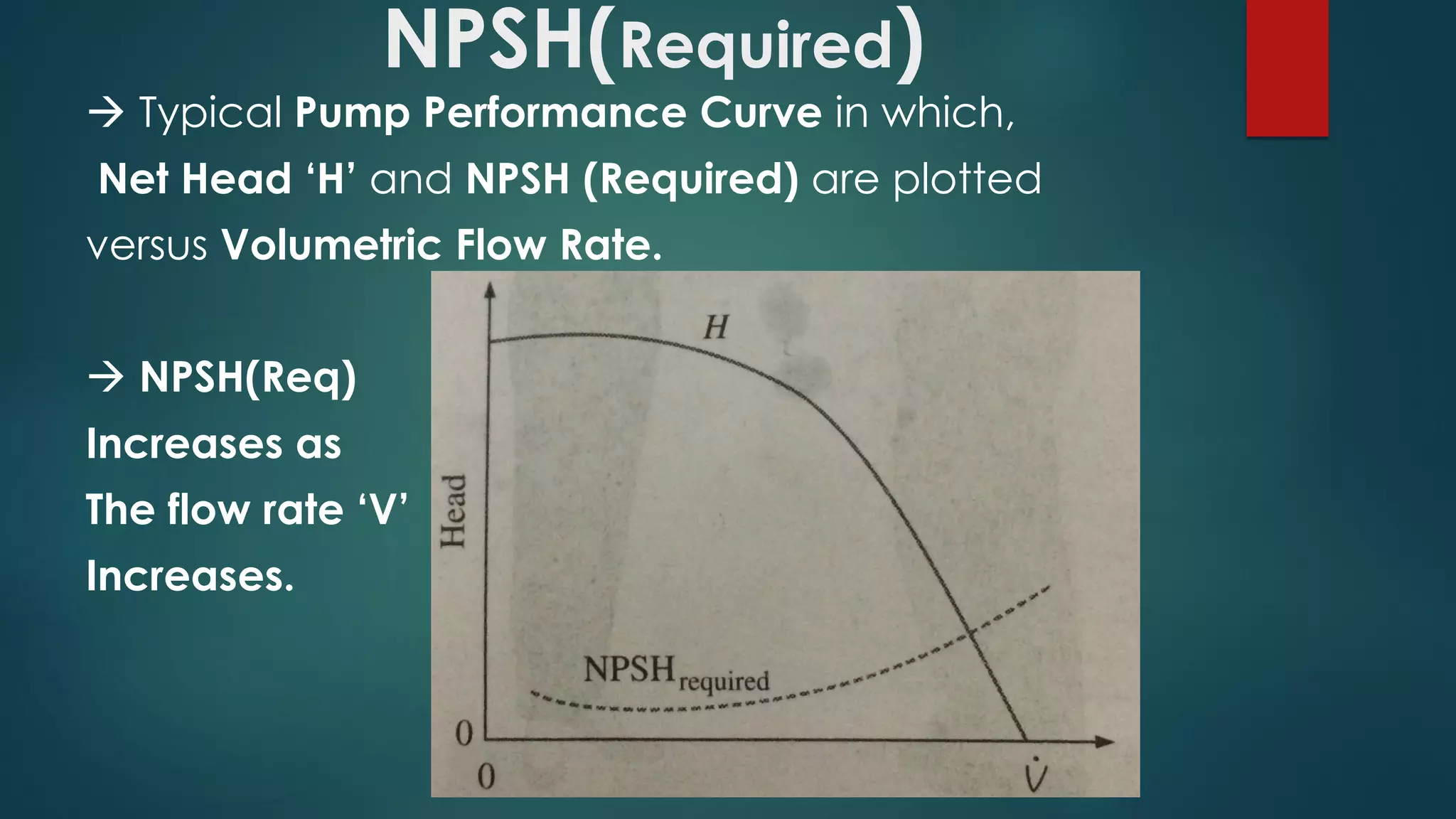
 NPSH(Required) varies with the Volumetric Flow Rate of
Fluids, therefore it can be plotted on the same performance
curve, as shown next,
NPSH(Required)
 Typical Pump Performance Curve in which,
Net Head ‘H’ and NPSH (Required) are plotted
versus Volumetric Flow Rate.
 NPSH(Req)
Increases as
The flow rate ‘V’
Increases.
NPSH(Available) vs NPSH(Req)
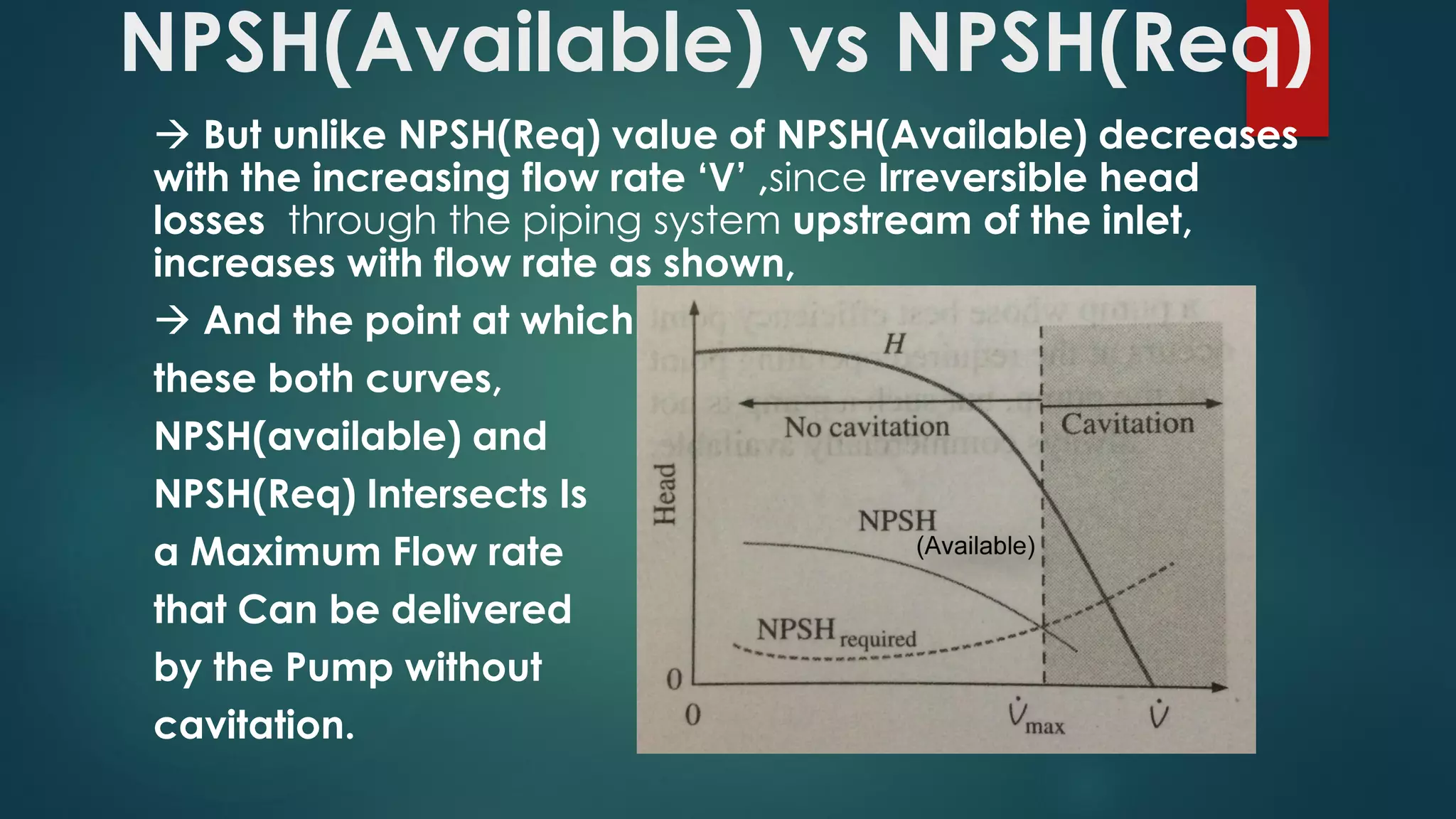
 But unlike NPSH(Req) value of NPSH(Available) decreases
with the increasing flow rate ‘V’ ,since Irreversible head
losses through the piping system upstream of the inlet,
increases with flow rate as shown,
 And the point at which
these both curves,
NPSH(available) and
NPSH(Req) Intersects Is
a Maximum Flow rate
that Can be delivered
by the Pump without
cavitation.
Effects of Variable on NPSH
 Value of NPSH varies not only with flow rate but also
with the Liquids temperature, since vapour pressure Pv is
a function of Temperature( i.e. Pv varies with varying
temperature).
 In addition to this NPSH also depends upon type of
liquid being pumped, since every liquid has its own Pv vs
Temperature curve.
References
1. FLUID MECHANICS (THIRD EDITION)
(Yunus A. Çengel, John M. Cimbala).
2. ROTECH
(PUMPS AND SYSTEMS INC)
3. PRINCIPLES OF TURBOMACHINERY
(R.K. TURTON)
4. Centrifugal Pumps
(JOHAN FRIEDRICH Gülich)
---------------------------THE END-----------------------------

Pump Cavitation & Net Positive Suction Head

  • 1.
    Topic: Pump Cavitation& Net Positive Suction Head PRESENTED BY: HASNAIN NAWAZ (16 CH 42 ) & FATIMA MAHMOOD (16 CH 19) PRESENTED TO: SIR MANZOOR-UL-HAQ RAJPUT CHEMICAL ENGINEERING FLUID MECHANICS-II
  • 2.
    CONTENTS  Introduction toPump Cavitation  Problems Caused by Cavitation  Introduction to NPSH  NPSH(Available)  NPSH(Required)  NPSH(Available) vs NPSH(Required)  Effects of Certain Variables on NPSH
  • 3.
  • 4.
    Introduction to Cavitation When pumping the liquids, it is possible for the local pressure ‘‘p’’ inside the pump to fall below the Vapour Pressure ‘’Pv’’ of the Liquid, which is also called Saturation Pressure ‘’Psat’’, namely P < Pv or P < Psat  Where, ’Psat’’is the pressure of the liquid at which phase change occurs.  And Pv is the Vapor Pressure that can be defined as, at any particular temperature, the pressure acted over the substance( solid or liquid) at which the Vapors are formed then that pressure is called Vapor Pressure.
  • 5.
    Introduction to Cavitation When P < Pv, the liquid starts boiling, typically on the suction side of rotating impeller blades, where the pressure is lowest.  And Vapour-filled bubbles called ‘’Cavitation Bubbles’’ appear.  These bubbles are then transported to the region where the pressure is higher, causing rapid collapse bubbles on a localized that is actually undesirable.
  • 6.
    Problems Caused byCavitation  The collapse of cavitation bubbles at higher pressure region is undesirable because they cause, 1. Noise 2. Vibrations 3. Reduced Efficiency and the most importantly is 4. Damage the Impeller, as shown next.
  • 7.
    Impeller Damage dueto Cavitation
  • 8.
    Introduction to Cavitation Repeated collapse of bubbles near the blade surface of the impeller leads to the Pitting and Erosion of the blade, and eventually catastrophic blade failure.  To avoid cavitation we must ensure that the local pressure ‘’P’’ everywhere inside the pump stays above the Vapour/ Saturation Pressure ‘’Pv or Psat’’ of the flowing Liquid.  Since pressure is mostly estimated at the Inlet of Pump, so cavitation criteria is typically specified at Pump’s Inlet.  So its useful to employ a flow parameter called Net Positive Suction Head ( NPSH ).
  • 9.
    Introduction to NPSH NPSH- Standsfor Net Positive Suction Head. •Net = Result of adding some positives and some negatives. •Positive = + (always positive) •Suction = The Inlet of the pump. •Head = Energy (Pressure) in feet, absolute( includes atmospheric pressure).
  • 10.
    Definition  NPSH isthe the amount of energy at the pump suction available to exert pressure on the fluid (head is energy, measured in feet). OR  It the pressure required at the pump’s inlet to make the liquids flow through suction side without cavitation. OR  It is the absolute static pressure above the vapor pressure of the liquid in the pump.
  • 11.
    NPSH As already discussed,to avoid cavitation, one must ensure that the local pressure at all the points inside the centrifugal pump stays above the saturation pressure of the fluid, flowing through the pump.  So the quantity that is used to determine whether the local pressure inside the pump is adequate w.r.t the vapor pressure of flowing fluid without causing cavitation is termed as NPSH: Net Positive Suction Head  The pump has a NPSH requirement in order to prevent cavitation damage occurring and causing severe damage.
  • 12.
    NPSH  NPSH canbe clearly understood in two parts, 1. Net Positive Suction Head Available NPSH(Available). 2. Net Positive Suction Head Required NPSH(Required).
  • 13.
    NPSH(Available)  Every pumphas an associated inlet system comprising vessel, pipes, valves, strainers, and other fittings.  The liquid, which has a certain suction pressure, experiences losses as it travels from the reservoir to the pump through the inlet system. So NPSH(Available) is defined as, it is the liquids net inlet pressure (in absolute terms) considering the piping system and fitting losses is called the Net Positive Suction Head–Available OR
  • 14.
    NPSH(Available) NPSH (Available), isa function of the system in which the pump operates. It is the excess pressure of the liquid in feet absolute over its vapor pressure as it arrives at the pump suction.  The energy that is available to the liquid at the eye to perform the energy transformation process and assure that the liquid remains in a liquid state.  NPSH(Available) is the difference between the pressure at the suction of the pump and the saturation pressure of the fluid that is being pumped. NPSH(A) = P(suction) – P(saturation)
  • 15.
    NPSH(Required)  NPSH(Available) isa function of your System and it must be calculated, whereas, NPSH(Required) is a function of the Pump and must be provided by the Pump Manufacturer.  In a most simplified way, NPSH(Required) is the minimum NPSH necessary to avoid cavitation in the pump. OR  To avoid cavitation, the minimum net positive suction head necessary, is known as the Net Positive Suction Head Required.  It is important to get the NPSH(R) value from your pump manufacturer and insure that your NPSH(A) will be enough to cover those needs.
  • 16.
    NPSH(Required)  The pumpcan only perform its functions properly when the energy available will be equal to or greater than the energy required. NPSH(A) ≥ NPSH(R)  And if we consider a margin of safety, then this rule can be best stated as: NPSH(A) > NPSH(R)  NPSH(Required) varies with the Volumetric Flow Rate of Fluids, therefore it can be plotted on the same performance curve, as shown next,
  • 17.
    NPSH(Required)  Typical PumpPerformance Curve in which, Net Head ‘H’ and NPSH (Required) are plotted versus Volumetric Flow Rate.  NPSH(Req) Increases as The flow rate ‘V’ Increases.
  • 18.
    NPSH(Available) vs NPSH(Req) But unlike NPSH(Req) value of NPSH(Available) decreases with the increasing flow rate ‘V’ ,since Irreversible head losses through the piping system upstream of the inlet, increases with flow rate as shown,  And the point at which these both curves, NPSH(available) and NPSH(Req) Intersects Is a Maximum Flow rate that Can be delivered by the Pump without cavitation.
  • 19.
    Effects of Variableon NPSH  Value of NPSH varies not only with flow rate but also with the Liquids temperature, since vapour pressure Pv is a function of Temperature( i.e. Pv varies with varying temperature).  In addition to this NPSH also depends upon type of liquid being pumped, since every liquid has its own Pv vs Temperature curve.
  • 20.
    References 1. FLUID MECHANICS(THIRD EDITION) (Yunus A. Çengel, John M. Cimbala). 2. ROTECH (PUMPS AND SYSTEMS INC) 3. PRINCIPLES OF TURBOMACHINERY (R.K. TURTON) 4. Centrifugal Pumps (JOHAN FRIEDRICH Gülich)
  • 21.