Chapter 8:
Hydraulic jump and its analysis
1
Hydraulics
Er. Binu Karki
Lecturer
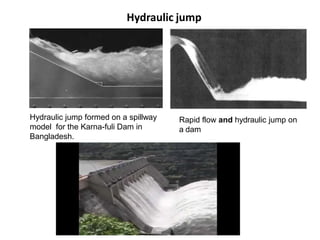
Hydraulic jump
Hydraulic jump formed on a spillway
model for the Karna-fuli Dam in
Bangladesh.
Rapid flow and hydraulic jump on
a dam
Characteristics of R.V.F
• A rapid variation of flow depth and velocity
occurs in short reach of channel
• R.V.F occurs in small reach so friction force is
quite small compared to other forces and
may be neglected.
• Velocity coefficient, alpha and momentum
coefficients, beta are greater than unity and
difficult to ascertain accurately
• In R.V.F, the flow pattern and velocity
distribution is complicated
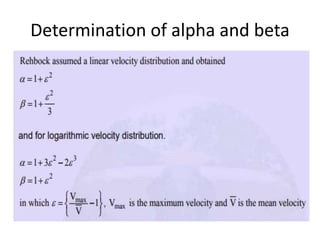
Determination of alpha and beta
Hydraulics Jump or Standing Wave
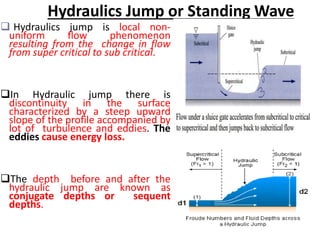
 Hydraulics jump is local non-
uniform flow phenomenon
resulting from the change in flow
from super critical to sub critical.
In Hydraulic jump there is
discontinuity in the surface
characterized by a steep upward
slope of the profile accompanied by
lot of turbulence and eddies. The
eddies cause energy loss.
The depth before and after the
hydraulic jump are known as
conjugate depths or sequent
depths.
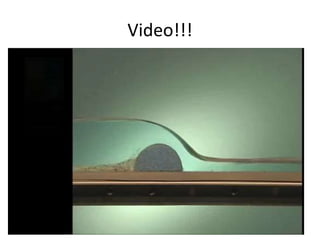
Video!!!
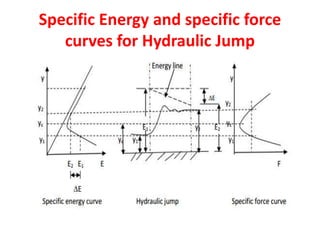
Specific Energy and specific force
curves for Hydraulic Jump
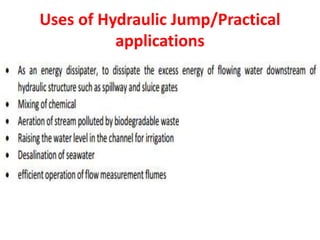
Uses of Hydraulic Jump/Practical
applications
Classification of Hydraulic jump
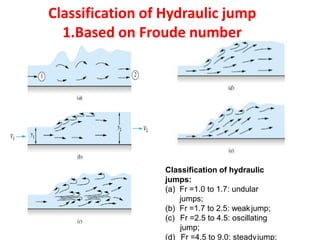
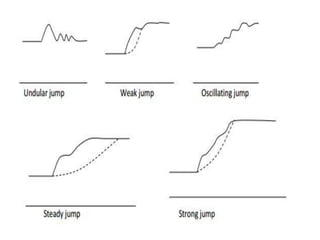
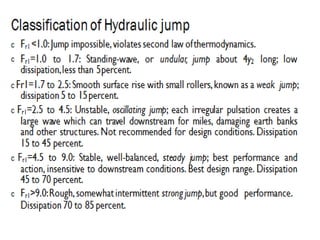
1.Based on Froude number
Classification of hydraulic
jumps:
(a) Fr =1.0 to 1.7: undular
jumps;
(b) Fr =1.7 to 2.5: weakjump;
(c) Fr =2.5 to 4.5: oscillating
jump;
(d) Fr =4.5 to 9.0: steadyjump;
2.Based on Tail water depth
• The depth downstream of a hydraulic structure is called
tailwater depth.
yt = tailwater depth, ya = Depth at the vena-contracta, y2 =
sequent depth to ya
1) Free jump: The jump with yt equal to or less than y2 is
called free jump. When yt = y2, a free jump will form at the
vena-contracta.
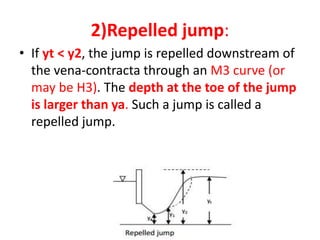
2)Repelled jump:
• If yt < y2, the jump is repelled downstream of
the vena-contracta through an M3 curve (or
may be H3). The depth at the toe of the jump
is larger than ya. Such a jump is called a
repelled jump.
3)Submerged jump:
• If yt > y2, the jump is no longer free but gets
drowned out. Such a jump is called
drowned jump or submerged jump. The loss
of energy in a submerged jump is smaller
than that in a free jump
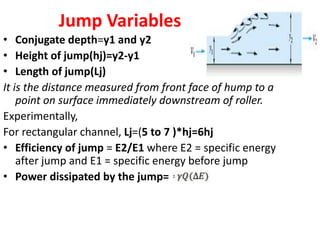
Jump Variables
• Conjugate depth=y1 and y2
• Height of jump(hj)=y2-y1
• Length of jump(Lj)
It is the distance measured from front face of hump to a
point on surface immediately downstream of roller.
Experimentally,
For rectangular channel, Lj=(5 to 7 )*hj=6hj
• Efficiency of jump = E2/E1 where E2 = specific energy
after jump and E1 = specific energy before jump
• Power dissipated by the jump=
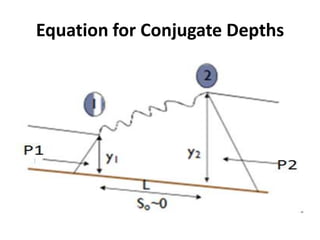
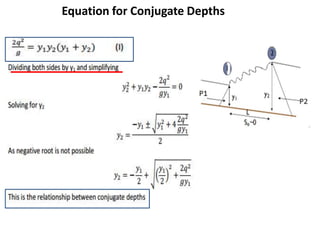
Equation for Conjugate Depths
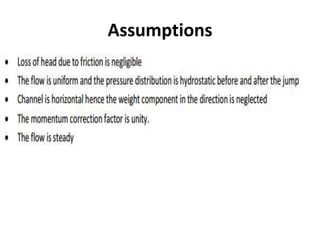
Assumptions
Equation for Conjugate Depths
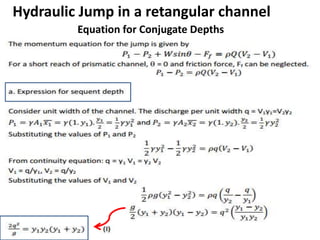
Hydraulic Jump in a retangular channel
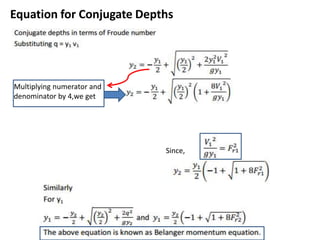
Equation for Conjugate Depths
Multiplying numerator and
denominator by 4,we get
Since,
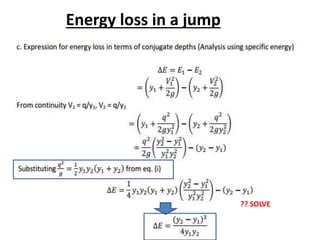
Energy loss in a jump
?? SOLVE

Chapter 8:Hydraulic Jump and its characterstics

  • 1.
    Chapter 8: Hydraulic jumpand its analysis 1 Hydraulics Er. Binu Karki Lecturer
  • 2.
    Hydraulic jump Hydraulic jumpformed on a spillway model for the Karna-fuli Dam in Bangladesh. Rapid flow and hydraulic jump on a dam
  • 3.
    Characteristics of R.V.F •A rapid variation of flow depth and velocity occurs in short reach of channel • R.V.F occurs in small reach so friction force is quite small compared to other forces and may be neglected. • Velocity coefficient, alpha and momentum coefficients, beta are greater than unity and difficult to ascertain accurately • In R.V.F, the flow pattern and velocity distribution is complicated
  • 4.
  • 5.
    Hydraulics Jump orStanding Wave  Hydraulics jump is local non- uniform flow phenomenon resulting from the change in flow from super critical to sub critical. In Hydraulic jump there is discontinuity in the surface characterized by a steep upward slope of the profile accompanied by lot of turbulence and eddies. The eddies cause energy loss. The depth before and after the hydraulic jump are known as conjugate depths or sequent depths.
  • 6.
  • 7.
    Specific Energy andspecific force curves for Hydraulic Jump
  • 8.
    Uses of HydraulicJump/Practical applications
  • 9.
    Classification of Hydraulicjump 1.Based on Froude number Classification of hydraulic jumps: (a) Fr =1.0 to 1.7: undular jumps; (b) Fr =1.7 to 2.5: weakjump; (c) Fr =2.5 to 4.5: oscillating jump; (d) Fr =4.5 to 9.0: steadyjump;
  • 12.
    2.Based on Tailwater depth • The depth downstream of a hydraulic structure is called tailwater depth. yt = tailwater depth, ya = Depth at the vena-contracta, y2 = sequent depth to ya 1) Free jump: The jump with yt equal to or less than y2 is called free jump. When yt = y2, a free jump will form at the vena-contracta.
  • 13.
    2)Repelled jump: • Ifyt < y2, the jump is repelled downstream of the vena-contracta through an M3 curve (or may be H3). The depth at the toe of the jump is larger than ya. Such a jump is called a repelled jump.
  • 14.
    3)Submerged jump: • Ifyt > y2, the jump is no longer free but gets drowned out. Such a jump is called drowned jump or submerged jump. The loss of energy in a submerged jump is smaller than that in a free jump
  • 15.
    Jump Variables • Conjugatedepth=y1 and y2 • Height of jump(hj)=y2-y1 • Length of jump(Lj) It is the distance measured from front face of hump to a point on surface immediately downstream of roller. Experimentally, For rectangular channel, Lj=(5 to 7 )*hj=6hj • Efficiency of jump = E2/E1 where E2 = specific energy after jump and E1 = specific energy before jump • Power dissipated by the jump=
  • 16.
  • 17.
  • 18.
    Equation for ConjugateDepths Hydraulic Jump in a retangular channel
  • 19.
  • 20.
    Equation for ConjugateDepths Multiplying numerator and denominator by 4,we get Since,
  • 21.
    Energy loss ina jump ?? SOLVE