Lecture  18  & 19  Roadmap University of Education Understand the Following Topics: Flow and Error Control Stop and Wait  Sliding window Stop and Wait ARQ Go Back N ARQ Selective Reject ARQ
University of Education Flow and Error Control Flow Control Error Control
University of Education Flow control refers to a set of procedures used to restrict the amount of data that the sender can send before waiting for acknowledgment. Note :
Flow Control Limits the amount or rate of data that is sent Reasons: Source may send frames faster than destination can process headers Higher-level protocol user at destination may be slow in retrieving data Destination may need to limit incoming flow to match outgoing flow for retransmission University of Education
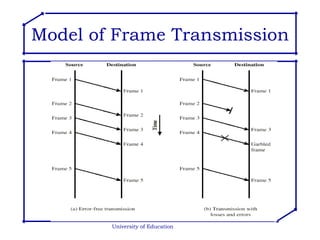
Model of Frame Transmission University of Education
Stop and Wait Source transmits frame Destination receives frame and replies with acknowledgement Source waits for ACK before sending next frame Destination can stop flow by not send ACK Works well for a few large frames University of Education
Fragmentation Large block of data may be split into small frames Limited buffer size Errors detected sooner (when whole frame received) On error, retransmission of smaller frames is needed Prevents one station occupying medium for long periods Stop and wait becomes inadequate   University of Education
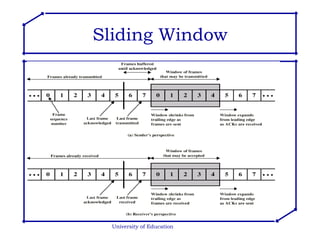
Sliding Window  Sliding window: Allow multiple frames to be in transit Receiver has buffer W long Transmitter can send up to W frames without ACK Each frame is numbered ( sequence number) ACK includes number of next frame expected University of Education
Sliding Window University of Education
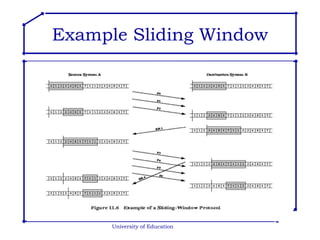
Example Sliding Window University of Education
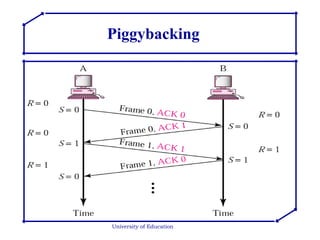
Sliding Window Enhancements Receiver can acknowledge frames without permitting further transmission (receive not ready) Must send a normal acknowledge to resume If duplex, use piggybacking If no data to send, use acknowledgement frame If data but no acknowledgement to send, send last acknowledgement number again, or have ACK valid flag (TCP) University of Education
University of Education Error control in the data link layer is based on automatic repeat request, which is the retransmission of data.  Error Control Note :
Error Control Used to recover lost or damaged PDUs Involves error detection and PDU retransmission Implemented together with flow control in a single mechanism Performed at various protocol levels University of Education
Error Control Error recovery Re-transmission ARQ ( automatic repeat request) primarily based on sliding window mechanism Stop and wait Go back N Selective reject (selective retransmission) Assume 2 end systems connected by direct  Link University of Education
Automatic Repeat Request (ARQ) Automatic repeat request Error detection Positive acknowledgment Retransmission after timeout Negative acknowledgement and retransmission Stop and wait ARQ Sliding window ARQ – Go back N – Selective reject (selective retransmission) University of Education
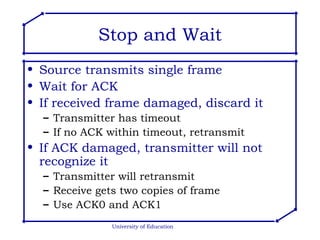
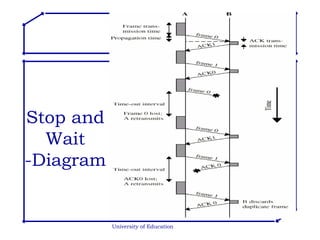
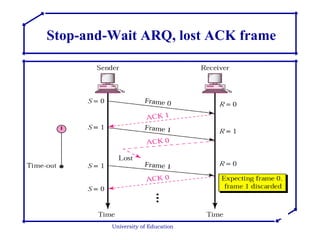
Stop and Wait Source transmits single frame Wait for ACK If received frame damaged, discard it Transmitter has timeout If no ACK within timeout, retransmit If ACK damaged, transmitter will not recognize it Transmitter will retransmit Receive gets two copies of frame Use ACK0 and ACK1 University of Education
Stop and Wait -Diagram University of Education
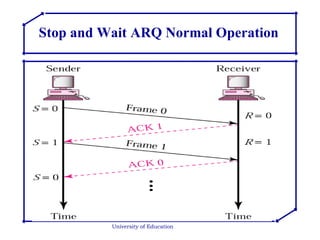
University of Education Stop and Wait ARQ Normal Operation
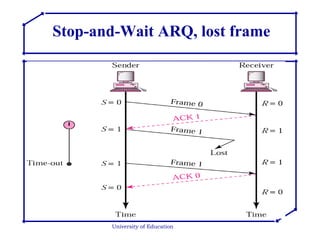
University of Education Stop-and-Wait ARQ, lost frame
University of Education Stop-and-Wait ARQ, lost ACK frame
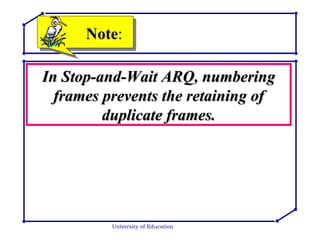
University of Education In Stop-and-Wait ARQ, numbering frames prevents the retaining of duplicate frames. Note :
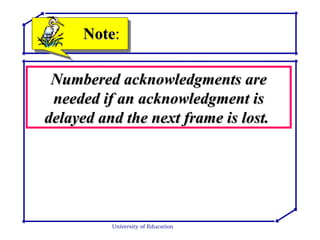
University of Education Numbered acknowledgments are needed if an acknowledgment is delayed and the next frame is lost.  Note :
University of Education Piggybacking
University of Education Go-Back-N ARQ Sequence Number Sender and Receiver Sliding Window Control Variables and Timers Acknowledgment Resending Frames Operation
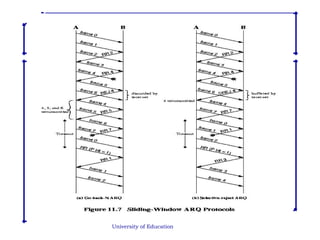
Go-back-n ARQ Based on sliding window If no error, ACK as usual with next frame expected Use window to control number of outstanding frames If error, reply with rejection Discard that frame and all future frames until error frame received correctly Transmitter must go back and retransmit that frame and all subsequent frames University of Education
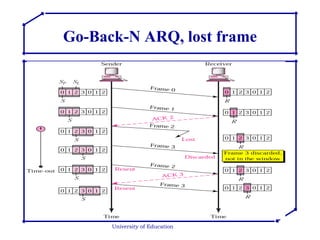
Go-back-n ARQ Damaged frame Receiver detects error in frame  i Receiver sends rejection- i Transmitter gets rejection- i Transmitter retransmits frame  i  and all subsequent Lost frame Frame  i   lost Transmitter sends  i+1 Receiver gets frame  i+1  out of sequence Receiver send reject  i Transmitter goes back to frame  i  and retransmits University of Education
Go-back-n ARQ Lost frame Frame  i   lost and no additional frame sent Receiver gets nothing and returns neither acknowledgement nor rejection Transmitter times out and sends acknowledgement frame with P bit set to 1 Receiver interprets this as command which it acknowledges with the number of the next frame it expects (frame  i  ) Transmitter then retransmits frame  i University of Education
Go-back-n ARQ Damaged acknowledgement Receiver gets frame  i  and send acknowledgement ( i+1 ) which is lost Acknowledgements are cumulative, so next acknowledgement ( i+n ) may arrive before transmitter times out on frame  i If transmitter times out, it sends acknowledgement with P bit set as before This can be repeated a number of times before a reset procedure is initiated Damaged rejection As for lost frame University of Education
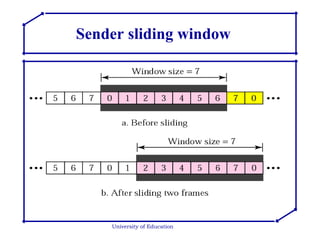
University of Education Sender sliding window
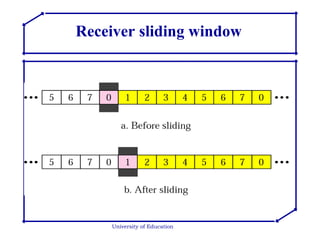
University of Education Receiver sliding window
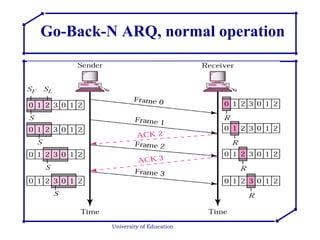
University of Education Go-Back-N ARQ, normal operation
University of Education Go-Back-N ARQ, lost frame
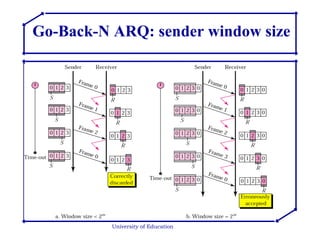
University of Education Go-Back-N ARQ: sender window size
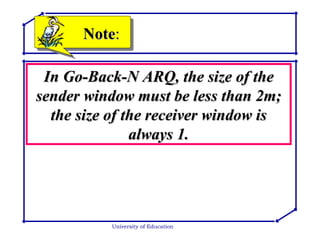
University of Education In Go-Back-N ARQ, the size of the sender window must be less than 2m; the size of the receiver window is always 1. Note :
Selective Reject Also called selective retransmission Only rejected frames are retransmitted Subsequent frames are accepted by the receiver and buffered Minimizes retransmission Receiver must maintain large enough buffer More complex logic in transmitter University of Education
Figure 11.7 University of Education

Flow & Error Control

  • 1.
    Lecture 18 & 19 Roadmap University of Education Understand the Following Topics: Flow and Error Control Stop and Wait Sliding window Stop and Wait ARQ Go Back N ARQ Selective Reject ARQ
  • 2.
    University of EducationFlow and Error Control Flow Control Error Control
  • 3.
    University of EducationFlow control refers to a set of procedures used to restrict the amount of data that the sender can send before waiting for acknowledgment. Note :
  • 4.
    Flow Control Limitsthe amount or rate of data that is sent Reasons: Source may send frames faster than destination can process headers Higher-level protocol user at destination may be slow in retrieving data Destination may need to limit incoming flow to match outgoing flow for retransmission University of Education
  • 5.
    Model of FrameTransmission University of Education
  • 6.
    Stop and WaitSource transmits frame Destination receives frame and replies with acknowledgement Source waits for ACK before sending next frame Destination can stop flow by not send ACK Works well for a few large frames University of Education
  • 7.
    Fragmentation Large blockof data may be split into small frames Limited buffer size Errors detected sooner (when whole frame received) On error, retransmission of smaller frames is needed Prevents one station occupying medium for long periods Stop and wait becomes inadequate University of Education
  • 8.
    Sliding Window Sliding window: Allow multiple frames to be in transit Receiver has buffer W long Transmitter can send up to W frames without ACK Each frame is numbered ( sequence number) ACK includes number of next frame expected University of Education
  • 9.
  • 10.
    Example Sliding WindowUniversity of Education
  • 11.
    Sliding Window EnhancementsReceiver can acknowledge frames without permitting further transmission (receive not ready) Must send a normal acknowledge to resume If duplex, use piggybacking If no data to send, use acknowledgement frame If data but no acknowledgement to send, send last acknowledgement number again, or have ACK valid flag (TCP) University of Education
  • 12.
    University of EducationError control in the data link layer is based on automatic repeat request, which is the retransmission of data. Error Control Note :
  • 13.
    Error Control Usedto recover lost or damaged PDUs Involves error detection and PDU retransmission Implemented together with flow control in a single mechanism Performed at various protocol levels University of Education
  • 14.
    Error Control Errorrecovery Re-transmission ARQ ( automatic repeat request) primarily based on sliding window mechanism Stop and wait Go back N Selective reject (selective retransmission) Assume 2 end systems connected by direct Link University of Education
  • 15.
    Automatic Repeat Request(ARQ) Automatic repeat request Error detection Positive acknowledgment Retransmission after timeout Negative acknowledgement and retransmission Stop and wait ARQ Sliding window ARQ – Go back N – Selective reject (selective retransmission) University of Education
  • 16.
    Stop and WaitSource transmits single frame Wait for ACK If received frame damaged, discard it Transmitter has timeout If no ACK within timeout, retransmit If ACK damaged, transmitter will not recognize it Transmitter will retransmit Receive gets two copies of frame Use ACK0 and ACK1 University of Education
  • 17.
    Stop and Wait-Diagram University of Education
  • 18.
    University of EducationStop and Wait ARQ Normal Operation
  • 19.
    University of EducationStop-and-Wait ARQ, lost frame
  • 20.
    University of EducationStop-and-Wait ARQ, lost ACK frame
  • 21.
    University of EducationIn Stop-and-Wait ARQ, numbering frames prevents the retaining of duplicate frames. Note :
  • 22.
    University of EducationNumbered acknowledgments are needed if an acknowledgment is delayed and the next frame is lost. Note :
  • 23.
  • 24.
    University of EducationGo-Back-N ARQ Sequence Number Sender and Receiver Sliding Window Control Variables and Timers Acknowledgment Resending Frames Operation
  • 25.
    Go-back-n ARQ Basedon sliding window If no error, ACK as usual with next frame expected Use window to control number of outstanding frames If error, reply with rejection Discard that frame and all future frames until error frame received correctly Transmitter must go back and retransmit that frame and all subsequent frames University of Education
  • 26.
    Go-back-n ARQ Damagedframe Receiver detects error in frame i Receiver sends rejection- i Transmitter gets rejection- i Transmitter retransmits frame i and all subsequent Lost frame Frame i lost Transmitter sends i+1 Receiver gets frame i+1 out of sequence Receiver send reject i Transmitter goes back to frame i and retransmits University of Education
  • 27.
    Go-back-n ARQ Lostframe Frame i lost and no additional frame sent Receiver gets nothing and returns neither acknowledgement nor rejection Transmitter times out and sends acknowledgement frame with P bit set to 1 Receiver interprets this as command which it acknowledges with the number of the next frame it expects (frame i ) Transmitter then retransmits frame i University of Education
  • 28.
    Go-back-n ARQ Damagedacknowledgement Receiver gets frame i and send acknowledgement ( i+1 ) which is lost Acknowledgements are cumulative, so next acknowledgement ( i+n ) may arrive before transmitter times out on frame i If transmitter times out, it sends acknowledgement with P bit set as before This can be repeated a number of times before a reset procedure is initiated Damaged rejection As for lost frame University of Education
  • 29.
    University of EducationSender sliding window
  • 30.
    University of EducationReceiver sliding window
  • 31.
    University of EducationGo-Back-N ARQ, normal operation
  • 32.
    University of EducationGo-Back-N ARQ, lost frame
  • 33.
    University of EducationGo-Back-N ARQ: sender window size
  • 34.
    University of EducationIn Go-Back-N ARQ, the size of the sender window must be less than 2m; the size of the receiver window is always 1. Note :
  • 35.
    Selective Reject Alsocalled selective retransmission Only rejected frames are retransmitted Subsequent frames are accepted by the receiver and buffered Minimizes retransmission Receiver must maintain large enough buffer More complex logic in transmitter University of Education
  • 36.