DATA LINK CONTROL
Data Link Layer Design Issues
• Services Provided to the Network Layer
• Framing
• Error Control
• Flow Control
FRAMING
The data link layer needs to pack bits into frames, so
that each frame is distinguishable from another. Our
postal system practices a type of framing. The simple
act of inserting a letter into an envelope separates one
piece of information from another; the envelope serves
as the delimiter.
Fixed-Size Framing
Variable-Size Framing
Topics discussed in this section:
Types of Framing
 Fixed Size Framing
 Variable Size Framing--- Character
oriented protocols and Bit oriented
Protocols.
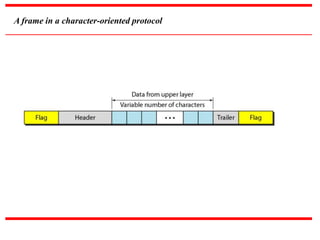
A frame in a character-oriented protocol
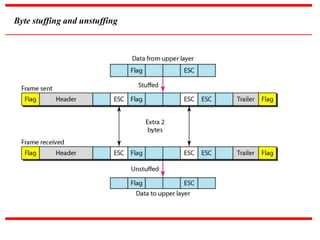
Byte stuffing and unstuffing
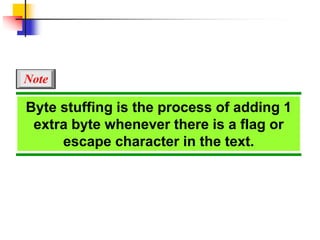
Byte stuffing is the process of adding 1
extra byte whenever there is a flag or
escape character in the text.
Note
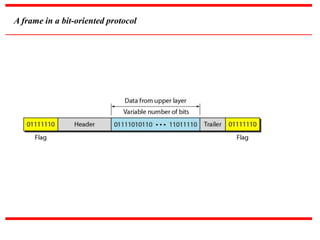
A frame in a bit-oriented protocol
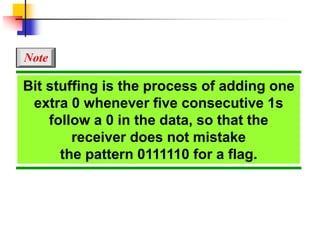
Bit stuffing is the process of adding one
extra 0 whenever five consecutive 1s
follow a 0 in the data, so that the
receiver does not mistake
the pattern 0111110 for a flag.
Note
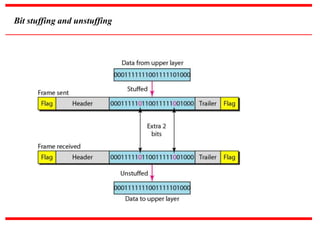
Bit stuffing and unstuffing
FLOW AND ERROR CONTROL
The most important responsibilities of the data link
layer are flow control and error control. Collectively,
these functions are known as data link control.
Flow Control
Error Control
Topics discussed in this section:
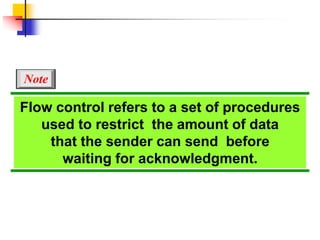
Flow control refers to a set of procedures
used to restrict the amount of data
that the sender can send before
waiting for acknowledgment.
Note
Error control in the data link layer is
based on automatic repeat request,
which is the retransmission of data.
Note
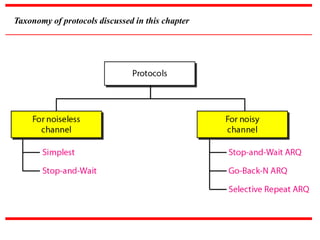
Taxonomy of protocols discussed in this chapter
NOISELESS CHANNELS
Let us first assume we have an ideal channel in which
no frames are lost, duplicated, or corrupted. We
introduce two protocols for this type of channel.
Simplest Protocol
Stop-and-Wait Protocol
Topics discussed in this section:
Simplest Protocol
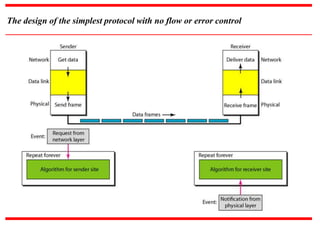
 No flow and Error Control
The design of the simplest protocol with no flow or error control
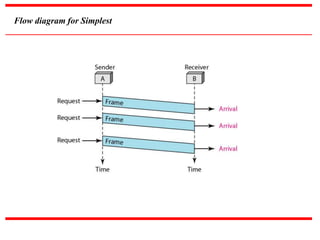
Flow diagram for Simplest
Stop-and-Wait Protocol
 Sender sends one frame, stops until it
gets confirmation from receiver.
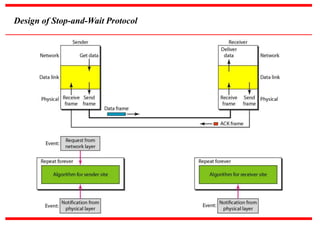
Design of Stop-and-Wait Protocol
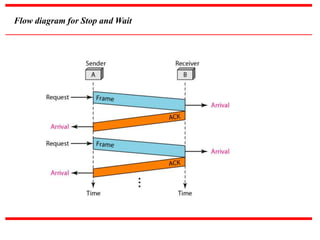
Flow diagram for Stop and Wait
NOISY CHANNELS
Although the Stop-and-Wait Protocol gives us an idea
of how to add flow control to its predecessor, noiseless
channels are nonexistent. We discuss three protocols
in this section that use error control.
Stop-and-Wait Automatic Repeat Request
Go-Back-N Automatic Repeat Request
Selective Repeat Automatic Repeat Request
Topics discussed in this section:
In Stop-and-Wait ARQ, we use sequence
numbers to number the frames.
The sequence numbers can be
1,0,1,0,1…
Note
In Stop-and-Wait ARQ, the
acknowledgment number is 0 if
sequence number is 1 and
acknowledgment number is 1 if
sequence number is 0
Note
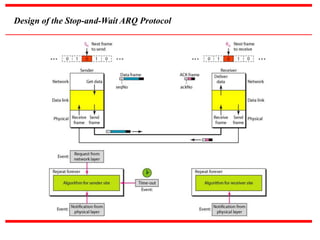
Design of the Stop-and-Wait ARQ Protocol
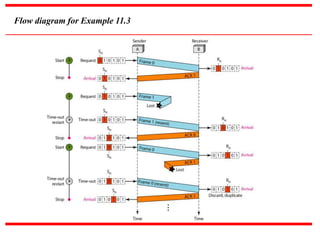
Flow diagram for Example 11.3
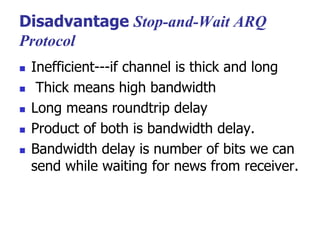
Disadvantage Stop-and-Wait ARQ
Protocol
 Inefficient---if channel is thick and long
 Thick means high bandwidth
 Long means roundtrip delay
 Product of both is bandwidth delay.
 Bandwidth delay is number of bits we can
send while waiting for news from receiver.
11.28
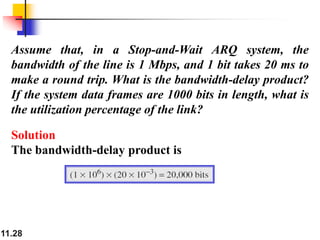
Assume that, in a Stop-and-Wait ARQ system, the
bandwidth of the line is 1 Mbps, and 1 bit takes 20 ms to
make a round trip. What is the bandwidth-delay product?
If the system data frames are 1000 bits in length, what is
the utilization percentage of the link?
Solution
The bandwidth-delay product is
11.29
The system can send 20,000 bits during the time it takes
for the data to go from the sender to the receiver and then
back again. However, the system sends only 1000 bits. We
can say that the link utilization is only 1000/20,000, or 5
percent. For this reason, for a link with a high bandwidth
or long delay, the use of Stop-and-Wait ARQ wastes the
capacity of the link.
Pipelining
 Task begins before end of first task.
 Stop-and-Wait ARQ does not use pipelining
but other two techniques do.
 This improves efficiency.
Go-Back-N Protocol
 This sends multiple frames before
receiving acknowledgment from receiver.
Sliding Window
 Defines the range of sequence numbers
that is concern of sender and receiver.
 The range which is concern of sender is
called sender sliding window.
 The range which is concern of receiver is
called receiver sliding window.
The send window can slide one
or more slots when a valid
acknowledgment arrives.
Note
Go-Back-N Protocol
 This sends multiple frames before
receiving acknowledgment from receiver.
 In Go-Back-N ARQ, N is the sender's
window size.
 Note: Suppose we say that Go-Back-3, which means that the three
frames can be sent at a time before expecting the acknowledgment
from the receiver.
 Go-Back-N ARQ protocol is also known as
Go-Back-N Automatic Repeat Request.
 It is a data link layer protocol that uses a
sliding window method.
 In this, if any frame is corrupted or lost,
all subsequent frames have to be
sent again.
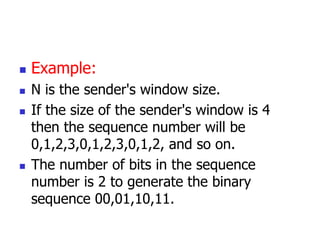
 Example:
 N is the sender's window size.
 If the size of the sender's window is 4
then the sequence number will be
0,1,2,3,0,1,2,3,0,1,2, and so on.
 The number of bits in the sequence
number is 2 to generate the binary
sequence 00,01,10,11.
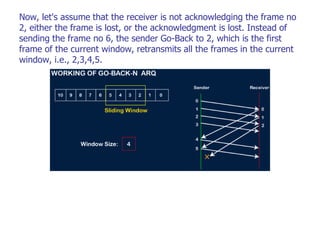
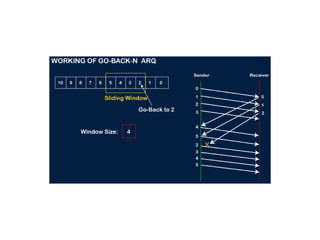
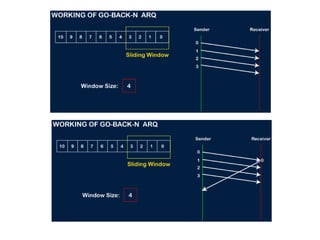
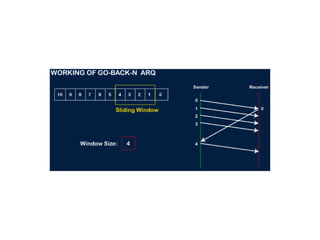
Now, let's assume that the receiver is not acknowledging the frame no
2, either the frame is lost, or the acknowledgment is lost. Instead of
sending the frame no 6, the sender Go-Back to 2, which is the first
frame of the current window, retransmits all the frames in the current
window, i.e., 2,3,4,5.
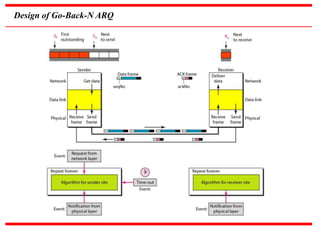
Design of Go-Back-N ARQ
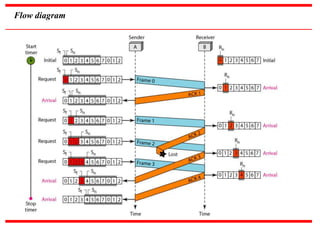
Flow diagram
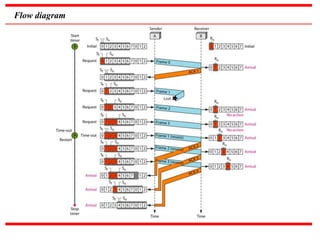
Flow diagram
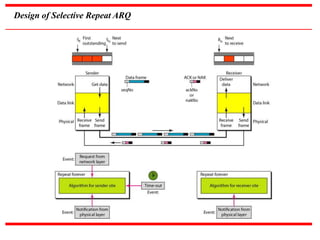
Design of Selective Repeat ARQ
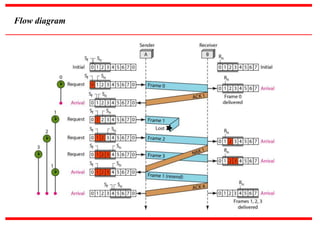
Flow diagram
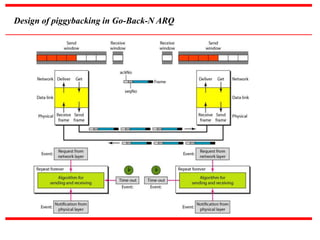
Design of piggybacking in Go-Back-N ARQ
In this protocol, the size of the sender window is always equal
to the size of the receiver window.
• If the receiver receives a corrupt frame, it does not directly
discard it.
• It sends a negative acknowledgment to the sender.
• The sender sends that frame again as soon as on the
receiving negative acknowledgment.
• There is no waiting for any time-out to send that frame.

DataLinkControl.ppt

  • 1.
  • 2.
    Data Link LayerDesign Issues • Services Provided to the Network Layer • Framing • Error Control • Flow Control
  • 3.
    FRAMING The data linklayer needs to pack bits into frames, so that each frame is distinguishable from another. Our postal system practices a type of framing. The simple act of inserting a letter into an envelope separates one piece of information from another; the envelope serves as the delimiter. Fixed-Size Framing Variable-Size Framing Topics discussed in this section:
  • 4.
    Types of Framing Fixed Size Framing  Variable Size Framing--- Character oriented protocols and Bit oriented Protocols.
  • 5.
    A frame ina character-oriented protocol
  • 6.
  • 7.
    Byte stuffing isthe process of adding 1 extra byte whenever there is a flag or escape character in the text. Note
  • 8.
    A frame ina bit-oriented protocol
  • 9.
    Bit stuffing isthe process of adding one extra 0 whenever five consecutive 1s follow a 0 in the data, so that the receiver does not mistake the pattern 0111110 for a flag. Note
  • 10.
    Bit stuffing andunstuffing
  • 11.
    FLOW AND ERRORCONTROL The most important responsibilities of the data link layer are flow control and error control. Collectively, these functions are known as data link control. Flow Control Error Control Topics discussed in this section:
  • 12.
    Flow control refersto a set of procedures used to restrict the amount of data that the sender can send before waiting for acknowledgment. Note
  • 13.
    Error control inthe data link layer is based on automatic repeat request, which is the retransmission of data. Note
  • 14.
    Taxonomy of protocolsdiscussed in this chapter
  • 15.
    NOISELESS CHANNELS Let usfirst assume we have an ideal channel in which no frames are lost, duplicated, or corrupted. We introduce two protocols for this type of channel. Simplest Protocol Stop-and-Wait Protocol Topics discussed in this section:
  • 16.
    Simplest Protocol  Noflow and Error Control
  • 17.
    The design ofthe simplest protocol with no flow or error control
  • 18.
  • 19.
    Stop-and-Wait Protocol  Sendersends one frame, stops until it gets confirmation from receiver.
  • 20.
  • 21.
    Flow diagram forStop and Wait
  • 22.
    NOISY CHANNELS Although theStop-and-Wait Protocol gives us an idea of how to add flow control to its predecessor, noiseless channels are nonexistent. We discuss three protocols in this section that use error control. Stop-and-Wait Automatic Repeat Request Go-Back-N Automatic Repeat Request Selective Repeat Automatic Repeat Request Topics discussed in this section:
  • 23.
    In Stop-and-Wait ARQ,we use sequence numbers to number the frames. The sequence numbers can be 1,0,1,0,1… Note
  • 24.
    In Stop-and-Wait ARQ,the acknowledgment number is 0 if sequence number is 1 and acknowledgment number is 1 if sequence number is 0 Note
  • 25.
    Design of theStop-and-Wait ARQ Protocol
  • 26.
    Flow diagram forExample 11.3
  • 27.
    Disadvantage Stop-and-Wait ARQ Protocol Inefficient---if channel is thick and long  Thick means high bandwidth  Long means roundtrip delay  Product of both is bandwidth delay.  Bandwidth delay is number of bits we can send while waiting for news from receiver.
  • 28.
    11.28 Assume that, ina Stop-and-Wait ARQ system, the bandwidth of the line is 1 Mbps, and 1 bit takes 20 ms to make a round trip. What is the bandwidth-delay product? If the system data frames are 1000 bits in length, what is the utilization percentage of the link? Solution The bandwidth-delay product is
  • 29.
    11.29 The system cansend 20,000 bits during the time it takes for the data to go from the sender to the receiver and then back again. However, the system sends only 1000 bits. We can say that the link utilization is only 1000/20,000, or 5 percent. For this reason, for a link with a high bandwidth or long delay, the use of Stop-and-Wait ARQ wastes the capacity of the link.
  • 30.
    Pipelining  Task beginsbefore end of first task.  Stop-and-Wait ARQ does not use pipelining but other two techniques do.  This improves efficiency.
  • 31.
    Go-Back-N Protocol  Thissends multiple frames before receiving acknowledgment from receiver.
  • 32.
    Sliding Window  Definesthe range of sequence numbers that is concern of sender and receiver.  The range which is concern of sender is called sender sliding window.  The range which is concern of receiver is called receiver sliding window.
  • 33.
    The send windowcan slide one or more slots when a valid acknowledgment arrives. Note
  • 34.
    Go-Back-N Protocol  Thissends multiple frames before receiving acknowledgment from receiver.  In Go-Back-N ARQ, N is the sender's window size.  Note: Suppose we say that Go-Back-3, which means that the three frames can be sent at a time before expecting the acknowledgment from the receiver.
  • 35.
     Go-Back-N ARQprotocol is also known as Go-Back-N Automatic Repeat Request.  It is a data link layer protocol that uses a sliding window method.  In this, if any frame is corrupted or lost, all subsequent frames have to be sent again.
  • 36.
     Example:  Nis the sender's window size.  If the size of the sender's window is 4 then the sequence number will be 0,1,2,3,0,1,2,3,0,1,2, and so on.  The number of bits in the sequence number is 2 to generate the binary sequence 00,01,10,11.
  • 39.
    Now, let's assumethat the receiver is not acknowledging the frame no 2, either the frame is lost, or the acknowledgment is lost. Instead of sending the frame no 6, the sender Go-Back to 2, which is the first frame of the current window, retransmits all the frames in the current window, i.e., 2,3,4,5.
  • 41.
  • 42.
  • 43.
  • 44.
  • 45.
  • 46.
    Design of piggybackingin Go-Back-N ARQ
  • 47.
    In this protocol,the size of the sender window is always equal to the size of the receiver window. • If the receiver receives a corrupt frame, it does not directly discard it. • It sends a negative acknowledgment to the sender. • The sender sends that frame again as soon as on the receiving negative acknowledgment. • There is no waiting for any time-out to send that frame.