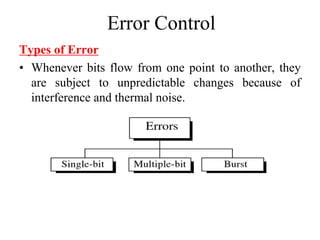
Types of Error
• Whenever bits flow from one point to another, they
are subject to unpredictable changes because of
interference and thermal noise.
Error Control
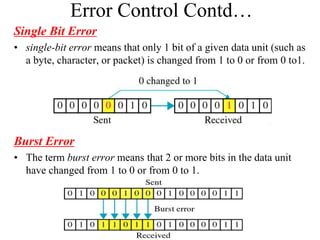
Single Bit Error
• single-bit error means that only 1 bit of a given data unit (such as
a byte, character, or packet) is changed from 1 to 0 or from 0 to1.
Burst Error
• The term burst error means that 2 or more bits in the data unit
have changed from 1 to 0 or from 0 to 1.
Error Control Contd…
Error Control
Error Control Contd…
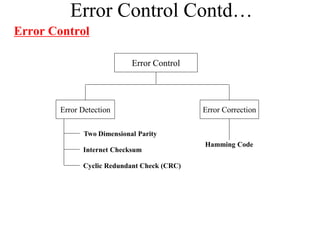
Error Control
Error Detection Error Correction
Two Dimensional Parity
Internet Checksum
Cyclic Redundant Check (CRC)
Hamming Code
Error Detection Techniques
 Two approaches when the recipient detects an error
 Notify the sender that the message was corrupted, so the sender can
send again, if the error is rare, then the retransmitted message will
be error-free
 Using some error correct detection and correction algorithm, the
receiver reconstructs the message.
 Common technique for detecting transmission error
 CRC (Cyclic Redundancy Check)
 Used in HDLC, DDCMP, CSMA/CD
 Other approaches
 Two Dimensional Parity (used in BISYNC)
 Checksum (used in IP)
Error Control Contd…
Basic Idea of Error Detection
– To add redundant information to a frame that can be used
to determine if errors have been introduced
– Imagine (Extreme Case)
• Transmitting two complete copies of data
– Identical  No error
– Differ  Error
– Poor Scheme ???
» n bit message, n bit redundant information
» Error can go undetected
• In general, we can provide strong error detection technique
– k redundant bits, n bits message, k << n
– In Ethernet, a frame carrying up to 12,000 bits of data requires only 32-
bit CRC.
Error Control Contd…
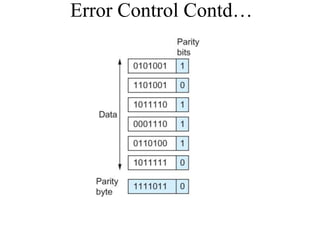
TWO-DIMENSIONAL PARITY
 It is based on “simple” (one-dimensional) parity, which usually
involves adding one extra bit to a 7-bit code to balance the
number of 1s in the byte. For example,
 Odd parity sets the eighth bit to 1 if needed to give an odd number of
1s in the byte.
 Even parity sets the eighth bit to 1 if needed to give an even number
of 1s in the byte.
 Two-dimensional parity does a similar calculation for each bit
position across each of the bytes contained in the frame
 This results in an extra parity byte for the entire frame, in addition
to a parity bit for each byte
 Two-dimensional parity catches all 1-, 2-, and 3-bit errors and
most 4-bit errors
Error Control Contd…
Internet Checksum:
Error Control Contd…
In internet checksum n=16
 Add up all the words that are transmitted and then transmit the
result of that sum
o The result is called the checksum.
 The receiver performs the same calculation on the received data
and compares the result with the received checksum
 If any transmitted data, including the checksum itself, is
corrupted, then the results will not match, so the receiver knows
that an error occurred
 Consider the data being checksummed as a sequence of 16-bit
integers.
• Add them together using 16-bit ones complement arithmetic and
then take the ones complement of the result. That 16-bit number
is the checksum.
• In ones complement arithmetic, a negative integer −x is
represented as the complement of x;
– Each bit of x is inverted.
Error Control Contd…
 When adding numbers in ones complement arithmetic, a
carryout from the most significant bit needs to be added to the
result (Wrapping).
Sender Side:
 The message is divided into 16-bit words.
 The value of the checksum word is set to 0.
 All words including the checksum are added using one's complement
addition.
 The sum is complemented and becomes the checksum.
 The checksum is sent with the data.
Receiver Side:
 The message (including checksum) is divided into 16-bit words.
 All words are added using one's complement addition.
 The sum becomes the new checksum.
 If the value of checksum is 0, the message is accepted; otherwise, it is
rejected.
Error Control Contd…
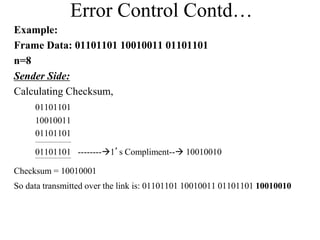
Example:
Frame Data: 01101101 10010011 01101101
n=8
Sender Side:
Calculating Checksum,
01101101
10010011
01101101
---------------------------
01101101 --------1’s Compliment-- 10010010---------------------------
Checksum = 10010001
So data transmitted over the link is: 01101101 10010011 01101101 10010010
Error Control Contd…
Receiver Side: (without Error)
Received Data: 01101101 10010011 01101101 10010001
Calculating Sum,
01101101
10010011
01101101
10010010
---------------------------
11111111 ----> All 1’s So accepted (No error)---------------------------
Receiver Side: (with Error)
Received Data: 11101101 10010011 01101101
11101101
10010011
01101101
10010010
---------------------------
01111111 ---> Not all 1’s. So not accepted (Contains Error)---------------------------
Error Control Contd…

Error control

  • 2.
    Types of Error •Whenever bits flow from one point to another, they are subject to unpredictable changes because of interference and thermal noise. Error Control
  • 3.
    Single Bit Error •single-bit error means that only 1 bit of a given data unit (such as a byte, character, or packet) is changed from 1 to 0 or from 0 to1. Burst Error • The term burst error means that 2 or more bits in the data unit have changed from 1 to 0 or from 0 to 1. Error Control Contd…
  • 4.
    Error Control Error ControlContd… Error Control Error Detection Error Correction Two Dimensional Parity Internet Checksum Cyclic Redundant Check (CRC) Hamming Code
  • 5.
    Error Detection Techniques Two approaches when the recipient detects an error  Notify the sender that the message was corrupted, so the sender can send again, if the error is rare, then the retransmitted message will be error-free  Using some error correct detection and correction algorithm, the receiver reconstructs the message.  Common technique for detecting transmission error  CRC (Cyclic Redundancy Check)  Used in HDLC, DDCMP, CSMA/CD  Other approaches  Two Dimensional Parity (used in BISYNC)  Checksum (used in IP) Error Control Contd…
  • 6.
    Basic Idea ofError Detection – To add redundant information to a frame that can be used to determine if errors have been introduced – Imagine (Extreme Case) • Transmitting two complete copies of data – Identical  No error – Differ  Error – Poor Scheme ??? » n bit message, n bit redundant information » Error can go undetected • In general, we can provide strong error detection technique – k redundant bits, n bits message, k << n – In Ethernet, a frame carrying up to 12,000 bits of data requires only 32- bit CRC. Error Control Contd…
  • 7.
    TWO-DIMENSIONAL PARITY  Itis based on “simple” (one-dimensional) parity, which usually involves adding one extra bit to a 7-bit code to balance the number of 1s in the byte. For example,  Odd parity sets the eighth bit to 1 if needed to give an odd number of 1s in the byte.  Even parity sets the eighth bit to 1 if needed to give an even number of 1s in the byte.  Two-dimensional parity does a similar calculation for each bit position across each of the bytes contained in the frame  This results in an extra parity byte for the entire frame, in addition to a parity bit for each byte  Two-dimensional parity catches all 1-, 2-, and 3-bit errors and most 4-bit errors Error Control Contd…
  • 8.
  • 9.
    Internet Checksum: Error ControlContd… In internet checksum n=16
  • 10.
     Add upall the words that are transmitted and then transmit the result of that sum o The result is called the checksum.  The receiver performs the same calculation on the received data and compares the result with the received checksum  If any transmitted data, including the checksum itself, is corrupted, then the results will not match, so the receiver knows that an error occurred  Consider the data being checksummed as a sequence of 16-bit integers. • Add them together using 16-bit ones complement arithmetic and then take the ones complement of the result. That 16-bit number is the checksum. • In ones complement arithmetic, a negative integer −x is represented as the complement of x; – Each bit of x is inverted. Error Control Contd…
  • 11.
     When addingnumbers in ones complement arithmetic, a carryout from the most significant bit needs to be added to the result (Wrapping). Sender Side:  The message is divided into 16-bit words.  The value of the checksum word is set to 0.  All words including the checksum are added using one's complement addition.  The sum is complemented and becomes the checksum.  The checksum is sent with the data. Receiver Side:  The message (including checksum) is divided into 16-bit words.  All words are added using one's complement addition.  The sum becomes the new checksum.  If the value of checksum is 0, the message is accepted; otherwise, it is rejected. Error Control Contd…
  • 12.
    Example: Frame Data: 0110110110010011 01101101 n=8 Sender Side: Calculating Checksum, 01101101 10010011 01101101 --------------------------- 01101101 --------1’s Compliment-- 10010010--------------------------- Checksum = 10010001 So data transmitted over the link is: 01101101 10010011 01101101 10010010 Error Control Contd…
  • 13.
    Receiver Side: (withoutError) Received Data: 01101101 10010011 01101101 10010001 Calculating Sum, 01101101 10010011 01101101 10010010 --------------------------- 11111111 ----> All 1’s So accepted (No error)--------------------------- Receiver Side: (with Error) Received Data: 11101101 10010011 01101101 11101101 10010011 01101101 10010010 --------------------------- 01111111 ---> Not all 1’s. So not accepted (Contains Error)--------------------------- Error Control Contd…