
Mahendra.G.S.
M.Pharm
Pharmaceutical Chemistry
JSSCP,Mysore
Introduction
 The concept of "flow chemistry" defines a very general
range of chemical processes that occur in a continuous
flowing stream, conventionally taking place in a
reactor zone.
 The application of flow chemistry relies on the concept
of pumping reagents using many reactors types to
perform specific reactions.
(piston pump, syringe pump etc., )
 Organic synthesis has traditionally been performed in
batch process..(RBF, Test tubes, clossed vessels..)
 Recently continues flow methodologies have gained
much attention from synthetic organic chemistry.
 Until a few year ago, continuous flow process were
majorly used by petrochemical & bulk chemical
industries and they proved as most economical
method.
 It can also be easily combined with other enabling
techenique such as: microwave irradiation, supported
reagent or catalyst, photochemistry, elecrtochemistry
etc.,
 This combination could allow the development of fully
automated process with an increased efficiency.
 Some synthetic steps that were not permitted for safety
reason can also be obtained under continuous flow ,
with minimum risk.
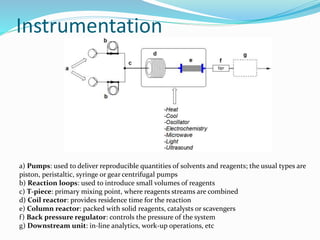
Instrumentation
a) Pumps: used to deliver reproducible quantities of solvents and reagents; the usual types are
piston, peristaltic, syringe or gear centrifugal pumps
b) Reaction loops: used to introduce small volumes of reagents
c) T-piece: primary mixing point, where reagents streams are combined
d) Coil reactor: provides residence time for the reaction
e) Column reactor: packed with solid reagents, catalysts or scavengers
f) Back pressure regulator: controls the pressure of the system
g) Downstream unit: in-line analytics, work-up operations, etc
Why flow chemistry…?
 Researchers from the Novartis-MIT Center for
Continuous Manufacturing in Cambridge reported in
a spectacular work the end-to-end continuous
manufacturing of an API, aliskiren hemifumarate.
 Process starts from a chemical intermediate and
perform the reaction & the required additional
operations in a continuous flow,
(quench, crystallization, isolation, purification).
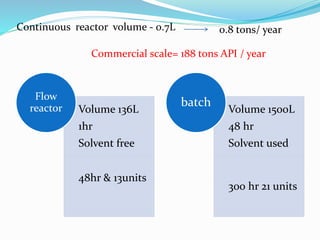
Volume 136L
1hr
Solvent free
48hr & 13units
Flow
reactor Volume 1500L
48 hr
Solvent used
300 hr 21 units
batch
Continuous reactor volume - 0.7L 0.8 tons/ year
Commercial scale= 188 tons API / year
Scaling-up..
 Scaling up a chemical reaction is a challenging
process, since many problems may arise like,.
by product formation
inefficient mixing
runaway reaction
 But reaction scale-up in micro-reactor is easy when
compare to batch and there are 3 approaches.
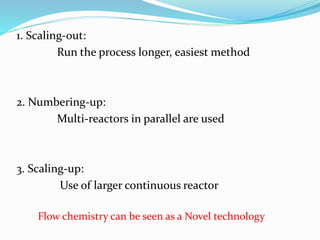
1. Scaling-out:
Run the process longer, easiest method
2. Numbering-up:
Multi-reactors in parallel are used
3. Scaling-up:
Use of larger continuous reactor
Flow chemistry can be seen as a Novel technology
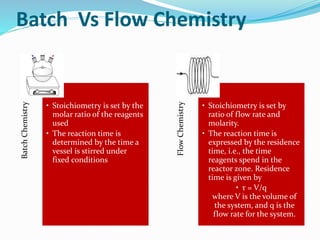
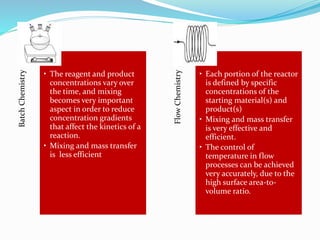
Batch Vs Flow ChemistryBatchChemistry
• Stoichiometry is set by the
molar ratio of the reagents
used
• The reaction time is
determined by the time a
vessel is stirred under
fixed conditions
FlowChemistry
• Stoichiometry is set by
ratio of flow rate and
molarity.
• The reaction time is
expressed by the residence
time, i.e., the time
reagents spend in the
reactor zone. Residence
time is given by
• τ = V/q
where V is the volume of
the system, and q is the
flow rate for the system.
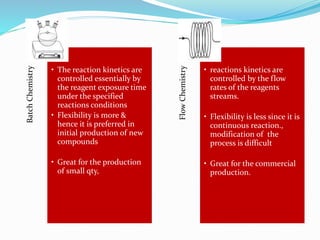
BatchChemistry
• The reaction kinetics are
controlled essentially by
the reagent exposure time
under the specified
reactions conditions
• Flexibility is more &
hence it is preferred in
initial production of new
compounds
• Great for the production
of small qty,
FlowChemistry
• reactions kinetics are
controlled by the flow
rates of the reagents
streams.
• Flexibility is less since it is
continuous reaction.,
modification of the
process is difficult
• Great for the commercial
production.
BatchChemistry
• The reagent and product
concentrations vary over
the time, and mixing
becomes very important
aspect in order to reduce
concentration gradients
that affect the kinetics of a
reaction.
• Mixing and mass transfer
is less efficient
FlowChemistry
• Each portion of the reactor
is defined by specific
concentrations of the
starting material(s) and
product(s)
• Mixing and mass transfer
is very effective and
efficient.
• The control of
temperature in flow
processes can be achieved
very accurately, due to the
high surface area-to-
volume ratio.
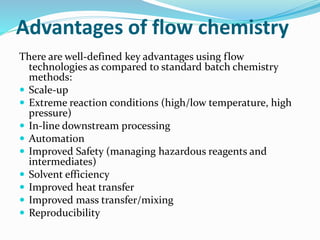
Advantages of flow chemistry
There are well-defined key advantages using flow
technologies as compared to standard batch chemistry
methods:
 Scale-up
 Extreme reaction conditions (high/low temperature, high
pressure)
 In-line downstream processing
 Automation
 Improved Safety (managing hazardous reagents and
intermediates)
 Solvent efficiency
 Improved heat transfer
 Improved mass transfer/mixing
 Reproducibility
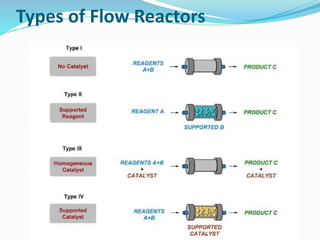
Types of Flow Reactors
 Plug flow reactors
 Column reactors
 Gas reactors
 Reactors for slurries
 Photochemical flow reactors
 Trickle bed reactors
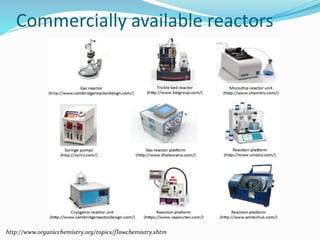
Commercially available reactors
http://www.organicchemistry.org/topics/flowchemistry.shtm
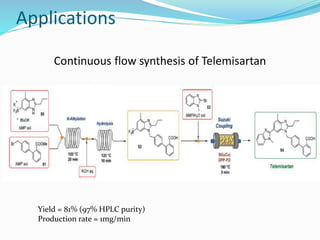
Applications
Continuous flow synthesis of Telemisartan
Yield = 81% (97% HPLC purity)
Production rate = 1mg/min
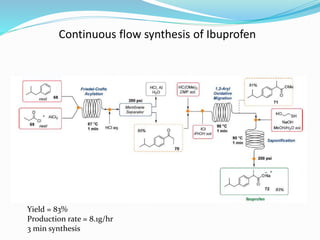
Continuous flow synthesis of Ibuprofen
Yield = 83%
Production rate = 8.1g/hr
3 min synthesis
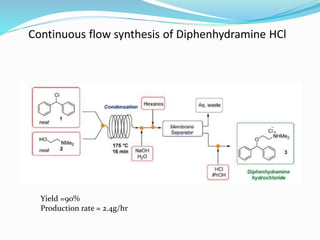
Continuous flow synthesis of Diphenhydramine HCl
Yield =90%
Production rate = 2.4g/hr
limitations
 In the synthesis of API ; clogging of the reactor
happens due to the precipitation of solids.
this is why sophisticated technologies are developed
for the handling of solids.
 Catalytic deactivation
 Future challenge is to accomplish efficient synthesis of
enantiomericaly pure product under continous flow
conditions.
REFERENCES
 Review article on- flow chemistry: Recent
Developments in the synthesis of pharmaceutical
product;;, Riccardo Porta, Maurizio Benaglia, and
Alessandra Puglisi
 http://www.flowchemistrysociety.com/
 http://www.flowchemistrysociety.com/journal_of_fc.p
hp
 https://en.wikipedia.org/wiki/Flow_chemistry
Flow chemistry

Flow chemistry

  • 1.
  • 2.
    Introduction  The conceptof "flow chemistry" defines a very general range of chemical processes that occur in a continuous flowing stream, conventionally taking place in a reactor zone.  The application of flow chemistry relies on the concept of pumping reagents using many reactors types to perform specific reactions. (piston pump, syringe pump etc., )
  • 3.
     Organic synthesishas traditionally been performed in batch process..(RBF, Test tubes, clossed vessels..)  Recently continues flow methodologies have gained much attention from synthetic organic chemistry.  Until a few year ago, continuous flow process were majorly used by petrochemical & bulk chemical industries and they proved as most economical method.
  • 4.
     It canalso be easily combined with other enabling techenique such as: microwave irradiation, supported reagent or catalyst, photochemistry, elecrtochemistry etc.,  This combination could allow the development of fully automated process with an increased efficiency.  Some synthetic steps that were not permitted for safety reason can also be obtained under continuous flow , with minimum risk.
  • 5.
    Instrumentation a) Pumps: usedto deliver reproducible quantities of solvents and reagents; the usual types are piston, peristaltic, syringe or gear centrifugal pumps b) Reaction loops: used to introduce small volumes of reagents c) T-piece: primary mixing point, where reagents streams are combined d) Coil reactor: provides residence time for the reaction e) Column reactor: packed with solid reagents, catalysts or scavengers f) Back pressure regulator: controls the pressure of the system g) Downstream unit: in-line analytics, work-up operations, etc
  • 6.
    Why flow chemistry…? Researchers from the Novartis-MIT Center for Continuous Manufacturing in Cambridge reported in a spectacular work the end-to-end continuous manufacturing of an API, aliskiren hemifumarate.  Process starts from a chemical intermediate and perform the reaction & the required additional operations in a continuous flow, (quench, crystallization, isolation, purification).
  • 7.
    Volume 136L 1hr Solvent free 48hr& 13units Flow reactor Volume 1500L 48 hr Solvent used 300 hr 21 units batch Continuous reactor volume - 0.7L 0.8 tons/ year Commercial scale= 188 tons API / year
  • 8.
    Scaling-up..  Scaling upa chemical reaction is a challenging process, since many problems may arise like,. by product formation inefficient mixing runaway reaction  But reaction scale-up in micro-reactor is easy when compare to batch and there are 3 approaches.
  • 9.
    1. Scaling-out: Run theprocess longer, easiest method 2. Numbering-up: Multi-reactors in parallel are used 3. Scaling-up: Use of larger continuous reactor Flow chemistry can be seen as a Novel technology
  • 10.
    Batch Vs FlowChemistryBatchChemistry • Stoichiometry is set by the molar ratio of the reagents used • The reaction time is determined by the time a vessel is stirred under fixed conditions FlowChemistry • Stoichiometry is set by ratio of flow rate and molarity. • The reaction time is expressed by the residence time, i.e., the time reagents spend in the reactor zone. Residence time is given by • τ = V/q where V is the volume of the system, and q is the flow rate for the system.
  • 11.
    BatchChemistry • The reactionkinetics are controlled essentially by the reagent exposure time under the specified reactions conditions • Flexibility is more & hence it is preferred in initial production of new compounds • Great for the production of small qty, FlowChemistry • reactions kinetics are controlled by the flow rates of the reagents streams. • Flexibility is less since it is continuous reaction., modification of the process is difficult • Great for the commercial production.
  • 12.
    BatchChemistry • The reagentand product concentrations vary over the time, and mixing becomes very important aspect in order to reduce concentration gradients that affect the kinetics of a reaction. • Mixing and mass transfer is less efficient FlowChemistry • Each portion of the reactor is defined by specific concentrations of the starting material(s) and product(s) • Mixing and mass transfer is very effective and efficient. • The control of temperature in flow processes can be achieved very accurately, due to the high surface area-to- volume ratio.
  • 13.
    Advantages of flowchemistry There are well-defined key advantages using flow technologies as compared to standard batch chemistry methods:  Scale-up  Extreme reaction conditions (high/low temperature, high pressure)  In-line downstream processing  Automation  Improved Safety (managing hazardous reagents and intermediates)  Solvent efficiency  Improved heat transfer  Improved mass transfer/mixing  Reproducibility
  • 14.
    Types of FlowReactors
  • 15.
    Types of FlowReactors  Plug flow reactors  Column reactors  Gas reactors  Reactors for slurries  Photochemical flow reactors  Trickle bed reactors
  • 16.
  • 17.
    Applications Continuous flow synthesisof Telemisartan Yield = 81% (97% HPLC purity) Production rate = 1mg/min
  • 18.
    Continuous flow synthesisof Ibuprofen Yield = 83% Production rate = 8.1g/hr 3 min synthesis
  • 19.
    Continuous flow synthesisof Diphenhydramine HCl Yield =90% Production rate = 2.4g/hr
  • 20.
    limitations  In thesynthesis of API ; clogging of the reactor happens due to the precipitation of solids. this is why sophisticated technologies are developed for the handling of solids.  Catalytic deactivation  Future challenge is to accomplish efficient synthesis of enantiomericaly pure product under continous flow conditions.
  • 21.
    REFERENCES  Review articleon- flow chemistry: Recent Developments in the synthesis of pharmaceutical product;;, Riccardo Porta, Maurizio Benaglia, and Alessandra Puglisi  http://www.flowchemistrysociety.com/  http://www.flowchemistrysociety.com/journal_of_fc.p hp  https://en.wikipedia.org/wiki/Flow_chemistry