CONTINUOUS
FLOW REACTOR
PULKIT MAHESHWARI
M.Pharma 2nd
Sem
Pharmaceutical Chemistry
INDEX
1. INTRODUCTION
2. WORKING PRINCIPLES
3. TYPES OF CONTINUOUS FLOW REACTORS
4. ADVANTAGES
5. DISADVANTAGES
6. SYNTHETIC APPLICATIONS
7. RECENT ADVANCES
INTRODUCTION
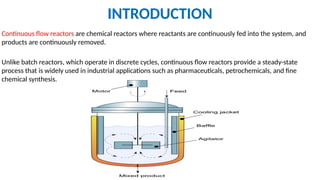
Continuous flow reactors are chemical reactors where reactants are continuously fed into the system, and
products are continuously removed.
Unlike batch reactors, which operate in discrete cycles, continuous flow reactors provide a steady-state
process that is widely used in industrial applications such as pharmaceuticals, petrochemicals, and fine
chemical synthesis.
WORKING PRINCIPLE
Continuous flow reactors operate based on the principle of continuous mixing and reaction of reactants.
The reactants are introduced at a constant rate, and as they flow through the reactor, they undergo the
desired chemical transformation.
The reaction is controlled by factors such as temperature, pressure, flow rate, and residence time.
The product stream is continuously collected at the outlet.
Cont.
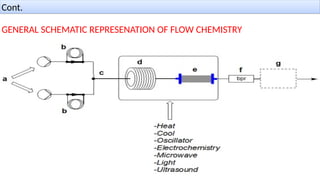
GENERAL SCHEMATIC REPRESENATION OF FLOW CHEMISTRY
Cont.
a) Pumps: used to deliver reproducible quantities of solvents and reagents; the usual types are piston,
peristaltic, syringe or gear centrifugal pumps.
b) Reaction loops: used to introduce small volumes of reagents.
c) T-piece: primary mixing point, where reagents streams are combined.
d) Coil reactor: provides residence time for the reaction.
e) Column reactor: packed with solid reagents, catalysts or scavengers.
f) Back pressure regulator: controls the pressure of the system.
g) Downstream unit: in-line analytics, work-up operations, etc.
TYPES OF CONTINUOUS FLOW REACTOR
1.Plug Flow Reactor (PFR) - Reactants flow through a tubular reactor with little back-mixing, maintaining a
concentration gradient.
2.Continuous Stirred Tank Reactor (CSTR) - Reactants are continuously stirred in a well-mixed tank to ensure
uniform reaction conditions.
3.Microreactors - Small-scale reactors designed for precise control of reaction conditions and efficient heat
and mass transfer.
4.Fixed bed reactors - A heterogeneous catalyst is used frequently in industry where gases flow through a
solid catalyst (which is often in the form of small pellets to increase the surface area). Examples of their use
are the manufacture of sulfuric acid (the Contact Process, with vanadium(V) oxide as catalyst), the
manufacture of nitric acid and the manufacture of ammonia (the Haber Process, with iron as the catalyst).
Cont.
Fixed Bed Reactor Plug Flow Reactor
ADVANTAGES
• Enhanced Safety: Continuous flow reactors handle smaller reaction volumes, reducing the risk of hazardous
reactions.
• Improved Efficiency: Higher heat and mass transfer efficiency due to constant mixing and flow.
• Scalability: Easier to scale-up from laboratory to industrial levels without significant redesign.
• Precise Control: Better control over reaction parameters like temperature, pressure, and concentration.
• Reduced Waste: Minimized by-product formation and optimized reagent usage.
• Easy integration of in-line reaction analysis : Real-time feedback on reaction progression.
DISADVANTAGES
• High Initial Cost: Requires specialized equipment and process design.
• Complex Operation: Requires precise monitoring and control systems.
• Limited Suitability: Not ideal for reactions that require long residence times or solid handling.
• Maintenance Challenges: Continuous operation demands regular maintenance and cleaning to prevent
clogging and fouling.
SYNTHETIC APPLICATIONS
Pharmaceutical Industry: Continuous flow reactors are widely used for the synthesis of active pharmaceutical
ingredients (APIs). For example, the production of Artemisinin, an anti-malarial drug, has been successfully
optimized using continuous flow processes, ensuring higher yield and purity. Similarly, the synthesis of
Ibuprofen and other pain-relief medications benefits from precise control of reaction conditions, leading to
improved efficiency and reduced waste.
Petrochemical Industry: Employed in refining processes such as hydrocracking and polymerization.
Fine Chemical Production: Used for the synthesis of specialty chemicals, dyes, and agrochemicals.
Polymerization Reactions: Applied in the continuous production of polymers such as polyethylene and
polypropylene.
Green Chemistry Applications: Continuous flow technology supports sustainable synthesis by reducing
solvent usage and improving energy efficiency. For instance, the synthesis of bio-based solvents and
renewable feedstock-derived chemicals, such as ethyl lactate and biodiesel precursors, has been optimized
using continuous flow reactors. Additionally, photocatalytic continuous flow processes have been developed
for environmentally friendly oxidation reactions.
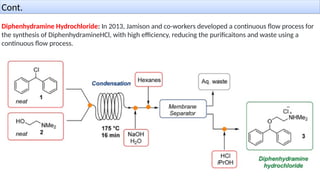
Diphenhydramine Hydrochloride: In 2013, Jamison and co-workers developed a continuous flow process for
the synthesis of DiphenhydramineHCl, with high efficiency, reducing the purificaitons and waste using a
continuous flow process.
Cont.
Cont.
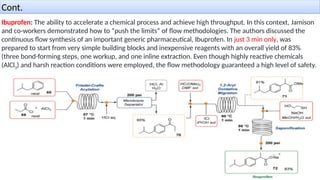
Ibuprofen: The ability to accelerate a chemical process and achieve high throughput. In this context, Jamison
and co-workers demonstrated how to “push the limits” of flow methodologies. The authors discussed the
continuous flow synthesis of an important generic pharmaceutical, Ibuprofen. In just 3 min only, was
prepared to start from very simple building blocks and inexpensive reagents with an overall yield of 83%
(three bond-forming steps, one workup, and one inline extraction. Even though highly reactive chemicals
(AlCl3) and harsh reaction conditions were employed, the flow methodology guaranteed a high level of safety.
Cont.
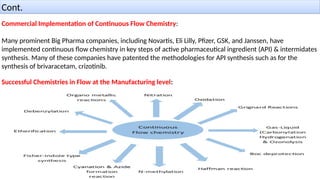
Commercial Implementation of Continuous Flow Chemistry:
Many prominent Big Pharma companies, including Novartis, Eli Lilly, Pfizer, GSK, and Janssen, have
implemented continuous flow chemistry in key steps of active pharmaceutical ingredient (API) & intermidates
synthesis. Many of these companies have patented the methodologies for API synthesis such as for the
synthesis of brivaracetam, crizotinib.
Successful Chemistries in Flow at the Manufacturing level:
RECENT ADVANCES
1. Integration of Biocatalysis: The incorporation of engineered enzymes into continuous flow systems has
revolutionized the synthesis of chiral building blocks for active pharmaceutical ingredients (APIs). A prominent
example is the development of an enzymatic route for sitagliptin, the active ingredient in Januvia®, a
medication for type II diabetes. This biocatalytic process offers improved efficiency and sustainability
compared to traditional methods.
2. High-Pressure Asymmetric Hydrogenation: Eli Lilly and Company developed a fully continuous process for
an asymmetric hydrogenation reaction, producing a key intermediate for LY500307, a potent ERβ agonist.
3. Enhanced Gas-Liquid Reactions: Continuous flow reactors have improved the handling of gas-liquid
reactions, such as hydrogenation and carbonylation. The controlled environment of flow systems allows for
safer and more efficient use of hazardous gases, reducing the need for extensive safety precautions
associated with batch processing.
4. Integration with Photochemistry and Electrochemistry: The combination of continuous flow reactors with
photochemical and electrochemical processes has led to more efficient and selective reactions. These
integrations allow for precise control over reaction conditions, leading to improved yields and reduced by-
products.
REFERENCE
1. ORGANIC CHEMISTRY PORTAL -
https://www.organic-chemistry.org/topics/flowchemistry.shtm
2. AURIGENE SERVICES -
https://www.aurigeneservices.com/blogs/continuous-flow-chemistry-a-gam
e-changer-for-pharmaceutical-production
3. WIKIPEDIA
CONTINUOUS FLOW REACTORS MPC202T Advanced Organic Chemistry - 2.pptx

CONTINUOUS FLOW REACTORS MPC202T Advanced Organic Chemistry - 2.pptx

  • 1.
  • 2.
    INDEX 1. INTRODUCTION 2. WORKINGPRINCIPLES 3. TYPES OF CONTINUOUS FLOW REACTORS 4. ADVANTAGES 5. DISADVANTAGES 6. SYNTHETIC APPLICATIONS 7. RECENT ADVANCES
  • 3.
    INTRODUCTION Continuous flow reactorsare chemical reactors where reactants are continuously fed into the system, and products are continuously removed. Unlike batch reactors, which operate in discrete cycles, continuous flow reactors provide a steady-state process that is widely used in industrial applications such as pharmaceuticals, petrochemicals, and fine chemical synthesis.
  • 4.
    WORKING PRINCIPLE Continuous flowreactors operate based on the principle of continuous mixing and reaction of reactants. The reactants are introduced at a constant rate, and as they flow through the reactor, they undergo the desired chemical transformation. The reaction is controlled by factors such as temperature, pressure, flow rate, and residence time. The product stream is continuously collected at the outlet.
  • 5.
  • 6.
    Cont. a) Pumps: usedto deliver reproducible quantities of solvents and reagents; the usual types are piston, peristaltic, syringe or gear centrifugal pumps. b) Reaction loops: used to introduce small volumes of reagents. c) T-piece: primary mixing point, where reagents streams are combined. d) Coil reactor: provides residence time for the reaction. e) Column reactor: packed with solid reagents, catalysts or scavengers. f) Back pressure regulator: controls the pressure of the system. g) Downstream unit: in-line analytics, work-up operations, etc.
  • 7.
    TYPES OF CONTINUOUSFLOW REACTOR 1.Plug Flow Reactor (PFR) - Reactants flow through a tubular reactor with little back-mixing, maintaining a concentration gradient. 2.Continuous Stirred Tank Reactor (CSTR) - Reactants are continuously stirred in a well-mixed tank to ensure uniform reaction conditions. 3.Microreactors - Small-scale reactors designed for precise control of reaction conditions and efficient heat and mass transfer. 4.Fixed bed reactors - A heterogeneous catalyst is used frequently in industry where gases flow through a solid catalyst (which is often in the form of small pellets to increase the surface area). Examples of their use are the manufacture of sulfuric acid (the Contact Process, with vanadium(V) oxide as catalyst), the manufacture of nitric acid and the manufacture of ammonia (the Haber Process, with iron as the catalyst).
  • 8.
    Cont. Fixed Bed ReactorPlug Flow Reactor
  • 9.
    ADVANTAGES • Enhanced Safety:Continuous flow reactors handle smaller reaction volumes, reducing the risk of hazardous reactions. • Improved Efficiency: Higher heat and mass transfer efficiency due to constant mixing and flow. • Scalability: Easier to scale-up from laboratory to industrial levels without significant redesign. • Precise Control: Better control over reaction parameters like temperature, pressure, and concentration. • Reduced Waste: Minimized by-product formation and optimized reagent usage. • Easy integration of in-line reaction analysis : Real-time feedback on reaction progression.
  • 10.
    DISADVANTAGES • High InitialCost: Requires specialized equipment and process design. • Complex Operation: Requires precise monitoring and control systems. • Limited Suitability: Not ideal for reactions that require long residence times or solid handling. • Maintenance Challenges: Continuous operation demands regular maintenance and cleaning to prevent clogging and fouling.
  • 11.
    SYNTHETIC APPLICATIONS Pharmaceutical Industry:Continuous flow reactors are widely used for the synthesis of active pharmaceutical ingredients (APIs). For example, the production of Artemisinin, an anti-malarial drug, has been successfully optimized using continuous flow processes, ensuring higher yield and purity. Similarly, the synthesis of Ibuprofen and other pain-relief medications benefits from precise control of reaction conditions, leading to improved efficiency and reduced waste. Petrochemical Industry: Employed in refining processes such as hydrocracking and polymerization. Fine Chemical Production: Used for the synthesis of specialty chemicals, dyes, and agrochemicals. Polymerization Reactions: Applied in the continuous production of polymers such as polyethylene and polypropylene. Green Chemistry Applications: Continuous flow technology supports sustainable synthesis by reducing solvent usage and improving energy efficiency. For instance, the synthesis of bio-based solvents and renewable feedstock-derived chemicals, such as ethyl lactate and biodiesel precursors, has been optimized using continuous flow reactors. Additionally, photocatalytic continuous flow processes have been developed for environmentally friendly oxidation reactions.
  • 12.
    Diphenhydramine Hydrochloride: In2013, Jamison and co-workers developed a continuous flow process for the synthesis of DiphenhydramineHCl, with high efficiency, reducing the purificaitons and waste using a continuous flow process. Cont.
  • 13.
    Cont. Ibuprofen: The abilityto accelerate a chemical process and achieve high throughput. In this context, Jamison and co-workers demonstrated how to “push the limits” of flow methodologies. The authors discussed the continuous flow synthesis of an important generic pharmaceutical, Ibuprofen. In just 3 min only, was prepared to start from very simple building blocks and inexpensive reagents with an overall yield of 83% (three bond-forming steps, one workup, and one inline extraction. Even though highly reactive chemicals (AlCl3) and harsh reaction conditions were employed, the flow methodology guaranteed a high level of safety.
  • 14.
    Cont. Commercial Implementation ofContinuous Flow Chemistry: Many prominent Big Pharma companies, including Novartis, Eli Lilly, Pfizer, GSK, and Janssen, have implemented continuous flow chemistry in key steps of active pharmaceutical ingredient (API) & intermidates synthesis. Many of these companies have patented the methodologies for API synthesis such as for the synthesis of brivaracetam, crizotinib. Successful Chemistries in Flow at the Manufacturing level:
  • 15.
    RECENT ADVANCES 1. Integrationof Biocatalysis: The incorporation of engineered enzymes into continuous flow systems has revolutionized the synthesis of chiral building blocks for active pharmaceutical ingredients (APIs). A prominent example is the development of an enzymatic route for sitagliptin, the active ingredient in Januvia®, a medication for type II diabetes. This biocatalytic process offers improved efficiency and sustainability compared to traditional methods. 2. High-Pressure Asymmetric Hydrogenation: Eli Lilly and Company developed a fully continuous process for an asymmetric hydrogenation reaction, producing a key intermediate for LY500307, a potent ERβ agonist. 3. Enhanced Gas-Liquid Reactions: Continuous flow reactors have improved the handling of gas-liquid reactions, such as hydrogenation and carbonylation. The controlled environment of flow systems allows for safer and more efficient use of hazardous gases, reducing the need for extensive safety precautions associated with batch processing. 4. Integration with Photochemistry and Electrochemistry: The combination of continuous flow reactors with photochemical and electrochemical processes has led to more efficient and selective reactions. These integrations allow for precise control over reaction conditions, leading to improved yields and reduced by- products.
  • 16.
    REFERENCE 1. ORGANIC CHEMISTRYPORTAL - https://www.organic-chemistry.org/topics/flowchemistry.shtm 2. AURIGENE SERVICES - https://www.aurigeneservices.com/blogs/continuous-flow-chemistry-a-gam e-changer-for-pharmaceutical-production 3. WIKIPEDIA