Crystallization
Presented by: Tanusree Manna
M.Pharm (Pharmaceutical Chemistry)
1ST Year, 2ND Sem
Bharat Technology
Contents
 Introduction
 Crystallization from aqueous and non-aqueous solution
 Factors affecting crystallization
 Nucleation
1
Introduction
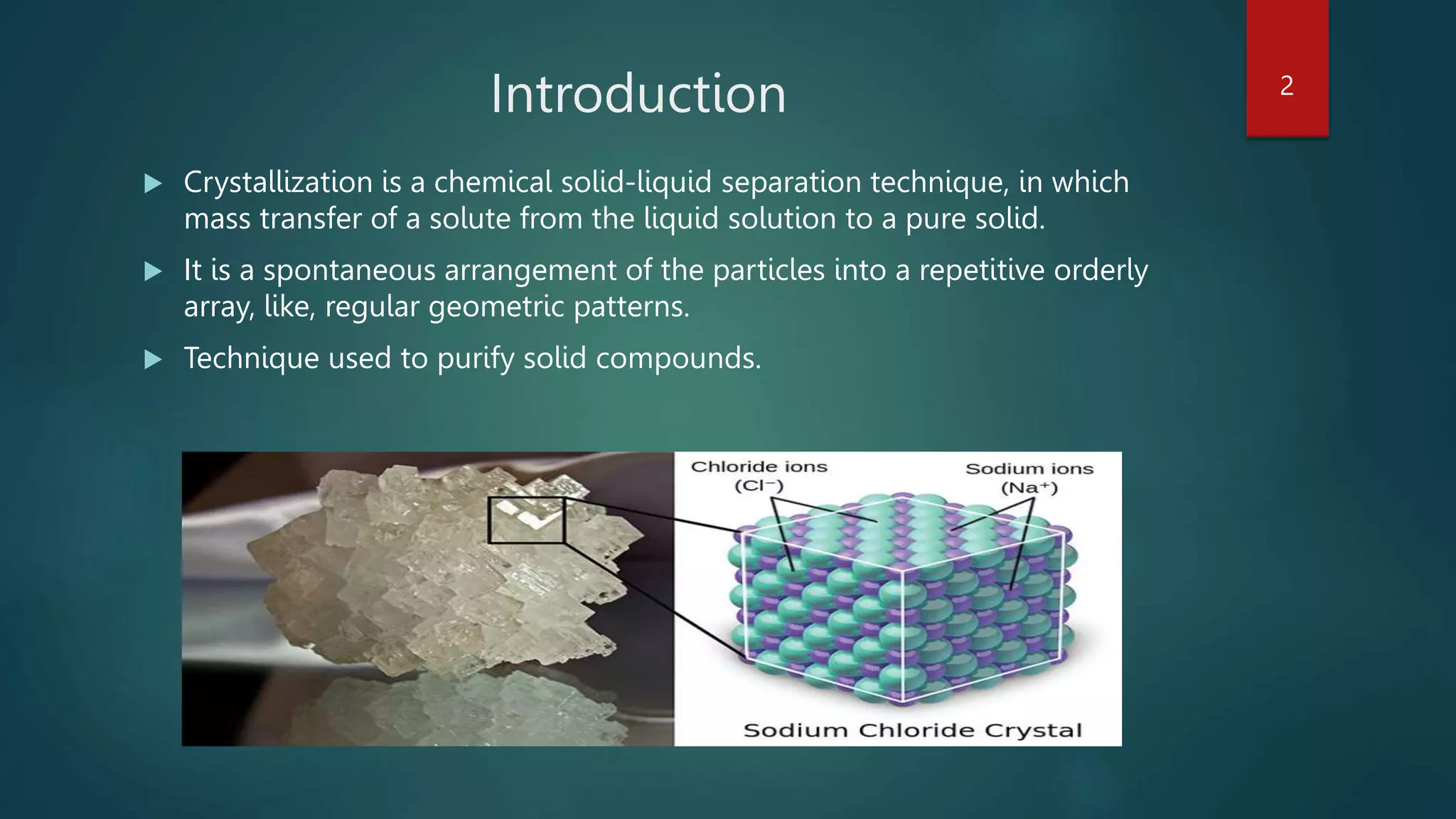
 Crystallization is a chemical solid-liquid separation technique, in which
mass transfer of a solute from the liquid solution to a pure solid.
 It is a spontaneous arrangement of the particles into a repetitive orderly
array, like, regular geometric patterns.
 Technique used to purify solid compounds.
2
Crystallization from aqueous solution
 Water of crystallization are water molecules that are present inside the
crystals.
 Water is often incorporated in the formation of crystals from aqueous
solution.
 Water of crystallization is the total mass of water in a substance at a given
temperature and is mostly present in a definite ratio.
 Water of crystallization refers to water that is found in the crystallization
framework of metal complex or a salt, which is not directly bonded to the
metal cation.
 Upon crystallization from water or moist solvents, many compounds
incorporate water molecule in their crystalline framework.
 Water of crystallization can generally be removed by heating a sample but
the crystalline properties are often lost.
3
 Growth of non-aqueous solutions often allows realization of special
crystallization, aims by control of the solution properties.
 Solvents are further classified according to their solubility of electrolytes
and non- electrolytes.
 Several solvents and solubility effects are then pointed out such as the
effect on the nucleation, which is easier when solubility is higher than ion
of the crystallization of polymorphs and on the surface morphology of the
crystals.
4
Crystallization from non-aqueous solution
Factors affecting crystallization
1. Presence of another substance
2. Solvent
3. Nucleation
4. Crystal growth
5. Rate of cooling/ Time
5
1. Presence of another substance
 Sodium chloride crystallized from aqueous solutions produces cubic
crystals.
 If sodium chloride is crystallized from a solution containing a small
amount of urea, the crystals obtained will have octahedral faces.
2. Solvent consideration
 The solvent with moderate solubility is prefer for crystallization.
 Presence of benzene can help crystal growth.
 Avoid highly volatile solvents.
6
3. Nucleation
 Crystals initially forms via “nucleating events”.
 After a crystallite has nucleated must grow.
 Nucleation sites are necessary for formation of crystals.
 Excess nucleation sites cause smaller average crystal size.
4. Crystal growth
 Crystals grow by the ordered deposition of the solute molecules onto the surface of a
pre-existing crystal.
 Crystal growth is facilitated by the environment changing slowly over time.
 Keep crystal growth vessel away from sources of mechanical agitation (e.g. vibrations).
 Set-up away from vacuum pump, doors, drawers, hoods and so on.
7
5. Rate of cooling/ Time
 Quality crystals grow best over time in near equilibrium conditions.
 The longer the time, the better the crystals.
 Faster crystallization is not as good as slow crystallization.
 In faster crystallization there are chances of production of lower quality
crystals.
8
Nucleation
 Nucleation refers to the birth of very small crystalline bodies of new phase
within a homogenous supersaturated liquid phase. It is further classified
into two groups-
1. Primary Nucleation(Homogenous)- in the absence of crystals
 The phenomena is based on sequences of bimolecular collisions and
interactions in a supersaturated fluid, which results in the buildup of
lattice-structured bodies that may or may not achieve thermodynamic
stability.
2. Secondary Nucleation(Heterogenous)- in the presence of crystals
 Can take place only if crystals of the species under consideration are
already present.
9
10
Thank you…

Crystallization (process chem).pptx

  • 1.
    Crystallization Presented by: TanusreeManna M.Pharm (Pharmaceutical Chemistry) 1ST Year, 2ND Sem Bharat Technology
  • 2.
    Contents  Introduction  Crystallizationfrom aqueous and non-aqueous solution  Factors affecting crystallization  Nucleation 1
  • 3.
    Introduction  Crystallization isa chemical solid-liquid separation technique, in which mass transfer of a solute from the liquid solution to a pure solid.  It is a spontaneous arrangement of the particles into a repetitive orderly array, like, regular geometric patterns.  Technique used to purify solid compounds. 2
  • 4.
    Crystallization from aqueoussolution  Water of crystallization are water molecules that are present inside the crystals.  Water is often incorporated in the formation of crystals from aqueous solution.  Water of crystallization is the total mass of water in a substance at a given temperature and is mostly present in a definite ratio.  Water of crystallization refers to water that is found in the crystallization framework of metal complex or a salt, which is not directly bonded to the metal cation.  Upon crystallization from water or moist solvents, many compounds incorporate water molecule in their crystalline framework.  Water of crystallization can generally be removed by heating a sample but the crystalline properties are often lost. 3
  • 5.
     Growth ofnon-aqueous solutions often allows realization of special crystallization, aims by control of the solution properties.  Solvents are further classified according to their solubility of electrolytes and non- electrolytes.  Several solvents and solubility effects are then pointed out such as the effect on the nucleation, which is easier when solubility is higher than ion of the crystallization of polymorphs and on the surface morphology of the crystals. 4 Crystallization from non-aqueous solution
  • 6.
    Factors affecting crystallization 1.Presence of another substance 2. Solvent 3. Nucleation 4. Crystal growth 5. Rate of cooling/ Time 5
  • 7.
    1. Presence ofanother substance  Sodium chloride crystallized from aqueous solutions produces cubic crystals.  If sodium chloride is crystallized from a solution containing a small amount of urea, the crystals obtained will have octahedral faces. 2. Solvent consideration  The solvent with moderate solubility is prefer for crystallization.  Presence of benzene can help crystal growth.  Avoid highly volatile solvents. 6
  • 8.
    3. Nucleation  Crystalsinitially forms via “nucleating events”.  After a crystallite has nucleated must grow.  Nucleation sites are necessary for formation of crystals.  Excess nucleation sites cause smaller average crystal size. 4. Crystal growth  Crystals grow by the ordered deposition of the solute molecules onto the surface of a pre-existing crystal.  Crystal growth is facilitated by the environment changing slowly over time.  Keep crystal growth vessel away from sources of mechanical agitation (e.g. vibrations).  Set-up away from vacuum pump, doors, drawers, hoods and so on. 7
  • 9.
    5. Rate ofcooling/ Time  Quality crystals grow best over time in near equilibrium conditions.  The longer the time, the better the crystals.  Faster crystallization is not as good as slow crystallization.  In faster crystallization there are chances of production of lower quality crystals. 8
  • 10.
    Nucleation  Nucleation refersto the birth of very small crystalline bodies of new phase within a homogenous supersaturated liquid phase. It is further classified into two groups- 1. Primary Nucleation(Homogenous)- in the absence of crystals  The phenomena is based on sequences of bimolecular collisions and interactions in a supersaturated fluid, which results in the buildup of lattice-structured bodies that may or may not achieve thermodynamic stability. 2. Secondary Nucleation(Heterogenous)- in the presence of crystals  Can take place only if crystals of the species under consideration are already present. 9
  • 11.