
MORE CHEMISRY 
AN ECO-FRIENDLY TECHNOLOGY 
NAME – MOUMITA BANERJEE 
B.PHARM 
3RD YEAR 
24201911013
(MORE) CHEMISTRY 
It can be termed as “E-Chemistry” because it is easy 
effective, eco friendly and economic and is believed a step 
towards a green chemistry and pharmaceutical 
applications. 
Microwave induced organic reaction enhancement chemistry is gaining 
popularity as a non-conventional technique for rapid organic synthesis. 
Important features of this technique are easy access to very high 
temperature, good control over energy input over a reaction and rapid 
synthesis. 
Advantages include requirement of simple, inexpensive instrument, lesser 
quantity of solvents and eco friendly technology.
MICROWAVE 
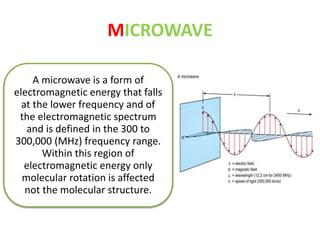
A microwave is a form of 
electromagnetic energy that falls 
at the lower frequency and of 
the electromagnetic spectrum 
and is defined in the 300 to 
300,000 (MHz) frequency range. 
Within this region of 
electromagnetic energy only 
molecular rotation is affected 
not the molecular structure.
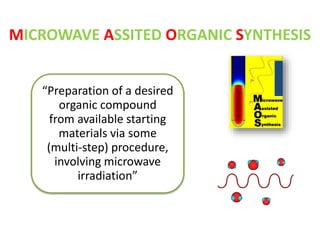
MICROWAVE ASSITED ORGANIC SYNTHESIS 
“Preparation of a desired 
organic compound 
from available starting 
materials via some 
(multi-step) procedure, 
involving microwave 
irradiation”
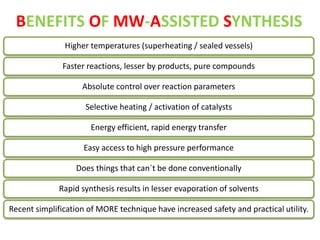
BENEFITS OF MW-ASSISTED SYNTHESIS 
Higher temperatures (superheating / sealed vessels) 
Faster reactions, lesser by products, pure compounds 
Absolute control over reaction parameters 
Selective heating / activation of catalysts 
Energy efficient, rapid energy transfer 
Easy access to high pressure performance 
Does things that can´t be done conventionally 
Rapid synthesis results in lesser evaporation of solvents 
Recent simplification of MORE technique have increased safety and practical utility.
DEMERITS OF MW-ASSISTED SYNTHESIS 
Heat Force controlled is difficult. 
Water Evaporation. 
Closed container is dangerous because it can blast.
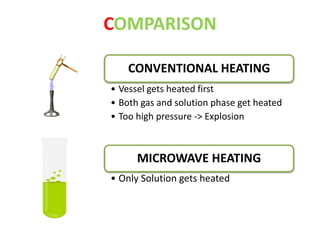
COMPARISON 
CONVENTIONAL HEATING 
• Vessel gets heated first 
• Both gas and solution phase get heated 
• Too high pressure -> Explosion 
MICROWAVE HEATING 
• Only Solution gets heated
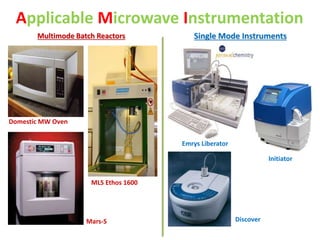
Applicable Microwave Instrumentation 
Multimode Batch Reactors 
MLS Ethos 1600 
Domestic MW Oven 
Mars-S 
Single Mode Instruments 
Emrys Liberator 
Initiator 
Discover
SOLVENTS 
Energy Transfer Medium Boiling Point Dielectric Constant (20°/25°) 
Acetone 56.6 20.70 
Acetyl Acetone 140.6 25.70 
Acetonitrile 82.0 37.50 
Benzene 80.1 2.27 
1-Butanol 117.7 17.80 
Carbon Disulfide 46.3 2.64 
Carbon Tetrachloride 76.7 2.23 
Chlorobenzene 132.1 5.62 
Chloroform 61.7 4.81 
1,2-Dichloroethane 83.5 10.65 
Diethyl Ether 34.6 4.34 
Diethyl Glycol 244.8 31.70 
Dimethyl Formamide 153.0 36.71 
Dimethyl Sulfoxide 189.0 46.60
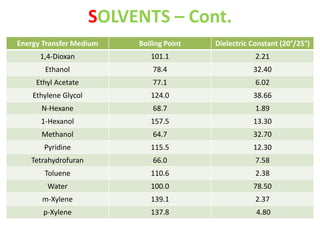
SOLVENTS – Cont. 
Energy Transfer Medium Boiling Point Dielectric Constant (20°/25°) 
1,4-Dioxan 101.1 2.21 
Ethanol 78.4 32.40 
Ethyl Acetate 77.1 6.02 
Ethylene Glycol 124.0 38.66 
N-Hexane 68.7 1.89 
1-Hexanol 157.5 13.30 
Methanol 64.7 32.70 
Pyridine 115.5 12.30 
Tetrahydrofuran 66.0 7.58 
Toluene 110.6 2.38 
Water 100.0 78.50 
m-Xylene 139.1 2.37 
p-Xylene 137.8 4.80
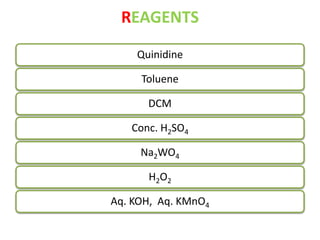
REAGENTS 
Quinidine 
Toluene 
DCM 
Conc. H2SO4 
Na2WO4 
H2O2 
Aq. KOH, Aq. KMnO4
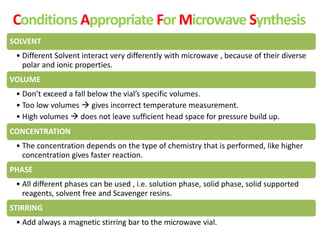
Conditions Appropriate For Microwave Synthesis 
SOLVENT 
• Different Solvent interact very differently with microwave , because of their diverse 
polar and ionic properties. 
VOLUME 
• Don’t exceed a fall below the vial’s specific volumes. 
• Too low volumes  gives incorrect temperature measurement. 
• High volumes  does not leave sufficient head space for pressure build up. 
CONCENTRATION 
• The concentration depends on the type of chemistry that is performed, like higher 
concentration gives faster reaction. 
PHASE 
• All different phases can be used , i.e. solution phase, solid phase, solid supported 
reagents, solvent free and Scavenger resins. 
STIRRING 
• Add always a magnetic stirring bar to the microwave vial.
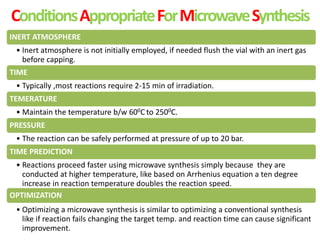
Conditions Appropriate For Microwave Synthesis 
INERT ATMOSPHERE 
• Inert atmosphere is not initially employed, if needed flush the vial with an inert gas 
before capping. 
TIME 
• Typically ,most reactions require 2-15 min of irradiation. 
TEMERATURE 
• Maintain the temperature b/w 600C to 2500C. 
PRESSURE 
• The reaction can be safely performed at pressure of up to 20 bar. 
TIME PREDICTION 
• Reactions proceed faster using microwave synthesis simply because they are 
conducted at higher temperature, like based on Arrhenius equation a ten degree 
increase in reaction temperature doubles the reaction speed. 
OPTIMIZATION 
• Optimizing a microwave synthesis is similar to optimizing a conventional synthesis 
like if reaction fails changing the target temp. and reaction time can cause significant 
improvement.
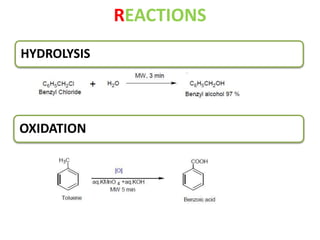
REACTIONS 
HYDROLYSIS 
OXIDATION
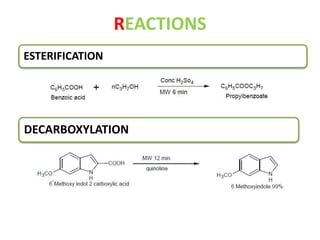
REACTIONS 
ESTERIFICATION 
DECARBOXYLATION
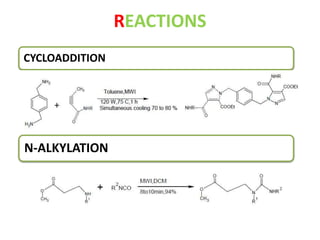
REACTIONS 
CYCLOADDITION 
N-ALKYLATION
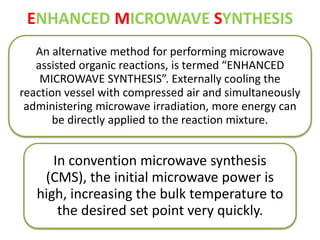
ENHANCED MICROWAVE SYNTHESIS 
An alternative method for performing microwave 
assisted organic reactions, is termed “ENHANCED 
MICROWAVE SYNTHESIS”. Externally cooling the 
reaction vessel with compressed air and simultaneously 
administering microwave irradiation, more energy can 
be directly applied to the reaction mixture. 
In convention microwave synthesis 
(CMS), the initial microwave power is 
high, increasing the bulk temperature to 
the desired set point very quickly.
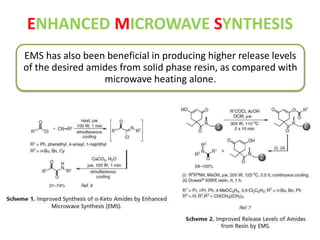
ENHANCED MICROWAVE SYNTHESIS 
EMS has also been beneficial in producing higher release levels 
of the desired amides from solid phase resin, as compared with 
microwave heating alone.
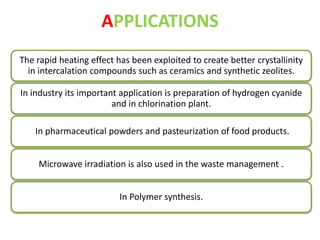
APPLICATIONS 
The rapid heating effect has been exploited to create better crystallinity 
in intercalation compounds such as ceramics and synthetic zeolites. 
In industry its important application is preparation of hydrogen cyanide 
and in chlorination plant. 
In pharmaceutical powders and pasteurization of food products. 
Microwave irradiation is also used in the waste management . 
In Polymer synthesis.
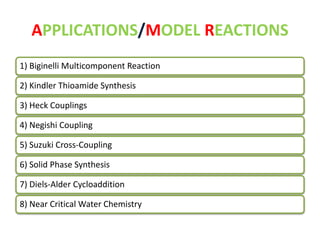
APPLICATIONS/MODEL REACTIONS 
1) Biginelli Multicomponent Reaction 
2) Kindler Thioamide Synthesis 
3) Heck Couplings 
4) Negishi Coupling 
5) Suzuki Cross-Coupling 
6) Solid Phase Synthesis 
7) Diels-Alder Cycloaddition 
8) Near Critical Water Chemistry
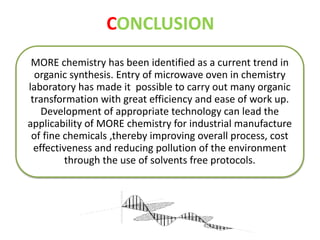
CONCLUSION 
MORE chemistry has been identified as a current trend in 
organic synthesis. Entry of microwave oven in chemistry 
laboratory has made it possible to carry out many organic 
transformation with great efficiency and ease of work up. 
Development of appropriate technology can lead the 
applicability of MORE chemistry for industrial manufacture 
of fine chemicals ,thereby improving overall process, cost 
effectiveness and reducing pollution of the environment 
through the use of solvents free protocols.
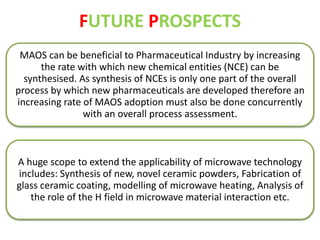
FUTURE PROSPECTS 
MAOS can be beneficial to Pharmaceutical Industry by increasing 
the rate with which new chemical entities (NCE) can be 
synthesised. As synthesis of NCEs is only one part of the overall 
process by which new pharmaceuticals are developed therefore an 
increasing rate of MAOS adoption must also be done concurrently 
with an overall process assessment. 
A huge scope to extend the applicability of microwave technology 
includes: Synthesis of new, novel ceramic powders, Fabrication of 
glass ceramic coating, modelling of microwave heating, Analysis of 
the role of the H field in microwave material interaction etc.
REFERENCES 
Bagnell, L. S. C. R. Chem. Commun. 1999, 287-288 
Borman, S., Chem. Eng. News, 1998, 6, 47 
Brain, C. T.;Paul, J. M. Synlett 1999, 1642-1644 
Brittany L. Hayes Ph.D., Microwave Synthesis Chemistry at the Speed of Light, 2002, pp. 14,70,34 
Brittany L. Hayes Ph.D., Recent Advance in Microwave Assisted Synthesis, 2002, pp. 1-6 
Eur. J. Org. Chem., 2005, 3672-3679 
Mali, R. S.; Massey, A P. J. Chem. Res. 1998, 230-231 
Org. Process Res. Dev. 2003, 707-716 
Org. Biomol. Chem. 2004, 2, 154-156 
Shaabani, A. J. Chem. Res. 1998, 672-673 
Wan, J.S.K. , U.S. Patent No. , 1982, 4, 345, 983
THANK YOU 
EVERYONE 
& 
ENJOY!!!

Microwave assisted organic synthesis

  • 1.
    MORE CHEMISRY ANECO-FRIENDLY TECHNOLOGY NAME – MOUMITA BANERJEE B.PHARM 3RD YEAR 24201911013
  • 2.
    (MORE) CHEMISTRY Itcan be termed as “E-Chemistry” because it is easy effective, eco friendly and economic and is believed a step towards a green chemistry and pharmaceutical applications. Microwave induced organic reaction enhancement chemistry is gaining popularity as a non-conventional technique for rapid organic synthesis. Important features of this technique are easy access to very high temperature, good control over energy input over a reaction and rapid synthesis. Advantages include requirement of simple, inexpensive instrument, lesser quantity of solvents and eco friendly technology.
  • 3.
    MICROWAVE A microwaveis a form of electromagnetic energy that falls at the lower frequency and of the electromagnetic spectrum and is defined in the 300 to 300,000 (MHz) frequency range. Within this region of electromagnetic energy only molecular rotation is affected not the molecular structure.
  • 4.
    MICROWAVE ASSITED ORGANICSYNTHESIS “Preparation of a desired organic compound from available starting materials via some (multi-step) procedure, involving microwave irradiation”
  • 5.
    BENEFITS OF MW-ASSISTEDSYNTHESIS Higher temperatures (superheating / sealed vessels) Faster reactions, lesser by products, pure compounds Absolute control over reaction parameters Selective heating / activation of catalysts Energy efficient, rapid energy transfer Easy access to high pressure performance Does things that can´t be done conventionally Rapid synthesis results in lesser evaporation of solvents Recent simplification of MORE technique have increased safety and practical utility.
  • 6.
    DEMERITS OF MW-ASSISTEDSYNTHESIS Heat Force controlled is difficult. Water Evaporation. Closed container is dangerous because it can blast.
  • 7.
    COMPARISON CONVENTIONAL HEATING • Vessel gets heated first • Both gas and solution phase get heated • Too high pressure -> Explosion MICROWAVE HEATING • Only Solution gets heated
  • 8.
    Applicable Microwave Instrumentation Multimode Batch Reactors MLS Ethos 1600 Domestic MW Oven Mars-S Single Mode Instruments Emrys Liberator Initiator Discover
  • 9.
    SOLVENTS Energy TransferMedium Boiling Point Dielectric Constant (20°/25°) Acetone 56.6 20.70 Acetyl Acetone 140.6 25.70 Acetonitrile 82.0 37.50 Benzene 80.1 2.27 1-Butanol 117.7 17.80 Carbon Disulfide 46.3 2.64 Carbon Tetrachloride 76.7 2.23 Chlorobenzene 132.1 5.62 Chloroform 61.7 4.81 1,2-Dichloroethane 83.5 10.65 Diethyl Ether 34.6 4.34 Diethyl Glycol 244.8 31.70 Dimethyl Formamide 153.0 36.71 Dimethyl Sulfoxide 189.0 46.60
  • 10.
    SOLVENTS – Cont. Energy Transfer Medium Boiling Point Dielectric Constant (20°/25°) 1,4-Dioxan 101.1 2.21 Ethanol 78.4 32.40 Ethyl Acetate 77.1 6.02 Ethylene Glycol 124.0 38.66 N-Hexane 68.7 1.89 1-Hexanol 157.5 13.30 Methanol 64.7 32.70 Pyridine 115.5 12.30 Tetrahydrofuran 66.0 7.58 Toluene 110.6 2.38 Water 100.0 78.50 m-Xylene 139.1 2.37 p-Xylene 137.8 4.80
  • 11.
    REAGENTS Quinidine Toluene DCM Conc. H2SO4 Na2WO4 H2O2 Aq. KOH, Aq. KMnO4
  • 12.
    Conditions Appropriate ForMicrowave Synthesis SOLVENT • Different Solvent interact very differently with microwave , because of their diverse polar and ionic properties. VOLUME • Don’t exceed a fall below the vial’s specific volumes. • Too low volumes  gives incorrect temperature measurement. • High volumes  does not leave sufficient head space for pressure build up. CONCENTRATION • The concentration depends on the type of chemistry that is performed, like higher concentration gives faster reaction. PHASE • All different phases can be used , i.e. solution phase, solid phase, solid supported reagents, solvent free and Scavenger resins. STIRRING • Add always a magnetic stirring bar to the microwave vial.
  • 13.
    Conditions Appropriate ForMicrowave Synthesis INERT ATMOSPHERE • Inert atmosphere is not initially employed, if needed flush the vial with an inert gas before capping. TIME • Typically ,most reactions require 2-15 min of irradiation. TEMERATURE • Maintain the temperature b/w 600C to 2500C. PRESSURE • The reaction can be safely performed at pressure of up to 20 bar. TIME PREDICTION • Reactions proceed faster using microwave synthesis simply because they are conducted at higher temperature, like based on Arrhenius equation a ten degree increase in reaction temperature doubles the reaction speed. OPTIMIZATION • Optimizing a microwave synthesis is similar to optimizing a conventional synthesis like if reaction fails changing the target temp. and reaction time can cause significant improvement.
  • 14.
  • 15.
  • 16.
  • 17.
    ENHANCED MICROWAVE SYNTHESIS An alternative method for performing microwave assisted organic reactions, is termed “ENHANCED MICROWAVE SYNTHESIS”. Externally cooling the reaction vessel with compressed air and simultaneously administering microwave irradiation, more energy can be directly applied to the reaction mixture. In convention microwave synthesis (CMS), the initial microwave power is high, increasing the bulk temperature to the desired set point very quickly.
  • 18.
    ENHANCED MICROWAVE SYNTHESIS EMS has also been beneficial in producing higher release levels of the desired amides from solid phase resin, as compared with microwave heating alone.
  • 19.
    APPLICATIONS The rapidheating effect has been exploited to create better crystallinity in intercalation compounds such as ceramics and synthetic zeolites. In industry its important application is preparation of hydrogen cyanide and in chlorination plant. In pharmaceutical powders and pasteurization of food products. Microwave irradiation is also used in the waste management . In Polymer synthesis.
  • 20.
    APPLICATIONS/MODEL REACTIONS 1)Biginelli Multicomponent Reaction 2) Kindler Thioamide Synthesis 3) Heck Couplings 4) Negishi Coupling 5) Suzuki Cross-Coupling 6) Solid Phase Synthesis 7) Diels-Alder Cycloaddition 8) Near Critical Water Chemistry
  • 21.
    CONCLUSION MORE chemistryhas been identified as a current trend in organic synthesis. Entry of microwave oven in chemistry laboratory has made it possible to carry out many organic transformation with great efficiency and ease of work up. Development of appropriate technology can lead the applicability of MORE chemistry for industrial manufacture of fine chemicals ,thereby improving overall process, cost effectiveness and reducing pollution of the environment through the use of solvents free protocols.
  • 22.
    FUTURE PROSPECTS MAOScan be beneficial to Pharmaceutical Industry by increasing the rate with which new chemical entities (NCE) can be synthesised. As synthesis of NCEs is only one part of the overall process by which new pharmaceuticals are developed therefore an increasing rate of MAOS adoption must also be done concurrently with an overall process assessment. A huge scope to extend the applicability of microwave technology includes: Synthesis of new, novel ceramic powders, Fabrication of glass ceramic coating, modelling of microwave heating, Analysis of the role of the H field in microwave material interaction etc.
  • 23.
    REFERENCES Bagnell, L.S. C. R. Chem. Commun. 1999, 287-288 Borman, S., Chem. Eng. News, 1998, 6, 47 Brain, C. T.;Paul, J. M. Synlett 1999, 1642-1644 Brittany L. Hayes Ph.D., Microwave Synthesis Chemistry at the Speed of Light, 2002, pp. 14,70,34 Brittany L. Hayes Ph.D., Recent Advance in Microwave Assisted Synthesis, 2002, pp. 1-6 Eur. J. Org. Chem., 2005, 3672-3679 Mali, R. S.; Massey, A P. J. Chem. Res. 1998, 230-231 Org. Process Res. Dev. 2003, 707-716 Org. Biomol. Chem. 2004, 2, 154-156 Shaabani, A. J. Chem. Res. 1998, 672-673 Wan, J.S.K. , U.S. Patent No. , 1982, 4, 345, 983
  • 24.
    THANK YOU EVERYONE & ENJOY!!!