 M. Fahad Saleem 137
 M. Faysal Maqsood 138
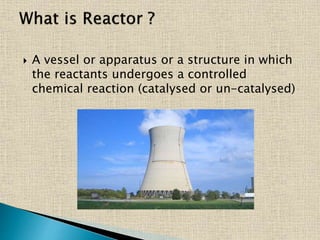
 A vessel or apparatus or a structure in which
the reactants undergoes a controlled
chemical reaction (catalysed or un-catalysed)
 Batch Reactor
 PFR
 CSTR
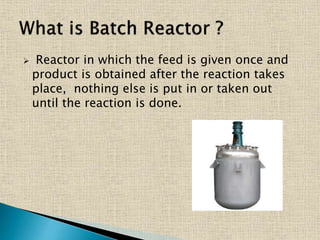
 Reactor in which the feed is given once and
product is obtained after the reaction takes
place, nothing else is put in or taken out
until the reaction is done.
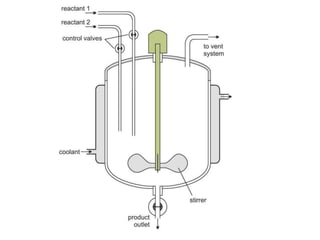
 A typical batch reactor consists of a tank with
an agitator and integral heating/cooling
system.
 These vessels may vary in size from less than
1 liter to more than 15,000 liters.
 They are usually fabricated in steel, stainless
steel, glass lined steel, glass or exotic alloy.
 Liquids and solids are usually charged via
connections in the top cover of the reactor.
 Vapors and gases also discharge through
connections in the top. Liquids are usually
discharged out of the bottom.
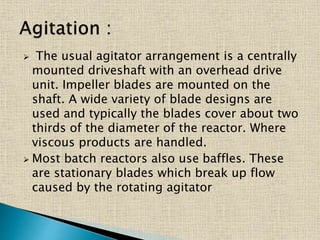
 The usual agitator arrangement is a centrally
mounted driveshaft with an overhead drive
unit. Impeller blades are mounted on the
shaft. A wide variety of blade designs are
used and typically the blades cover about two
thirds of the diameter of the reactor. Where
viscous products are handled.
 Most batch reactors also use baffles. These
are stationary blades which break up flow
caused by the rotating agitator
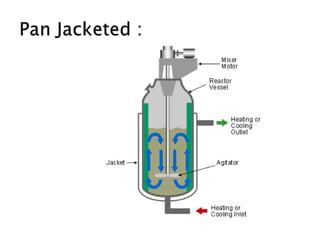
 Pan Jacketed
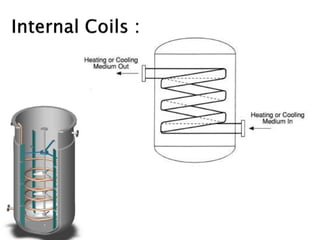
 Internal Coils
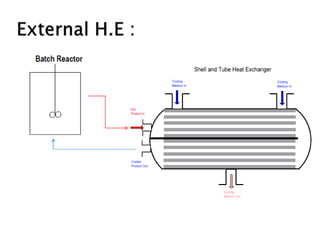
 External Heat Exchanger
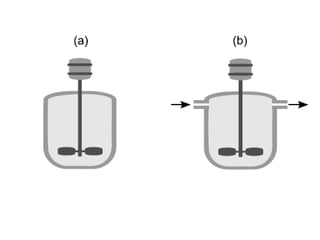
 Semi-batch (semi-flow) reactors operate
much like batch reactors in that they take
place in a single stirred tank with similar
equipment. However, they are modified to
allow reactant addition and/or product
removal during reaction.
 A semi-batch reactor is operated with both
continuous and batch inputs and outputs.
A normal batch reactor is filled with reactants
in a single stirred tank at time=0 and the
reaction proceeds. A semibatch reactor,
however, allows partial filling of reactants
with the flexibility of adding more as time
progresses. Stirring in both types is very
efficient, which allows batch and semibatch
reactors to assume a uniform composition
and temperature throughout.
 A fermenter, for example, is loaded with
a batch, which constantly produces
carbon dioxide, which has to be removed
continuously. Analogously, driving a reaction
of gas with a liquid is usually difficult, since
the gas bubbles off. Therefore, a continuous
feed of gas is injected into the batch of a
liquid. An example of such a reaction is
chlorination
 The advantages of the batch reactor lie with its
versatility. A single vessel can carry out a
sequence of different operations without the
need to break containment. This is particularly
useful when processing toxic or
highly potent compounds.
 High conversion per unit volume for one pass.
 Flexibility of operation i.e., same reactor can
produce one product one time and a different
product the next
 Easy to clean.
 High operating cost.
 Product quality more variable than with
continuous operation.
 High labor costs per batch.
 Small scale production.
 The difficulty of large-scale production.
 Intermediate or one shot production.
 Pharmaceutical.
 Fermentation.
 Batch reactors are often used in the process
industry. Batch reactors also have many
laboratory applications, such as small scale
production and inducing fermentation for
beverage products. They also have many uses in
medical production. Batch reactors are generally
considered expensive to run, as well as variable
product reliability. They are also used for
experiments of reaction kinetics, volatiles and
thermodynamics. Batch reactors are also highly
used in waste water treatment. They are effective
in reducing BOD (biological oxygen demand)of
influent untreated water
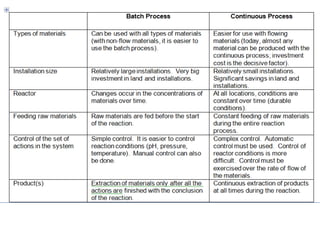
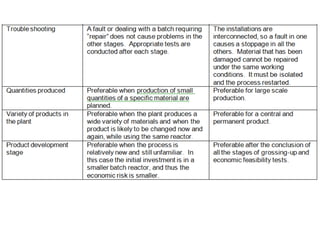
 Continuous processes :
A chemical that is needed in a large
amount is usually made by a continuous process.
Production goes on all the time. Ammonia is
made by a continuous process called the Haber
process.
 Batch processes
A chemical that is needed in a small
amount or only as needed (a specialty chemical)
is usually made by a batch process. Production
does not go on all the time. Pharmaceutical drugs
(medicines) are made by batch processes.
 The batch process has the following
advantages versus the continuous process:
• Flexibility when the feed water quality
changes
• System recovery can be maximized batch by
batch
• Cleaning is easily implemented
• Simple automatic controls
• Permeate quality can be controlled by
termination of the process
• Permeate quality can be improved by total or
partial second-pass treatment
• Favorable operating conditions for single (or
low number) element systems, because
the membranes are only in contact with the
final concentrate for a short time
• Expansion is rather easy
• Lower investment costs
 The disadvantages are:
• No continuous permeate flow
• No constant permeate quality
• Large feed tank required
• Larger pump required
• Larger power consumption
• Longer residence time for feed/concentrate
• Higher total running costs
Similarities In both methods:
 Recycling of raw materials according to
economic feasibility can be carried out.
 Required product quality can be attained in
accordance with customer requirements and
economic feasibility.
 Optimal efficiency can be attained according
to reaction conditions and economic
feasibility.
Presentation1
Presentation1
Presentation1
Presentation1

Presentation1

  • 2.
     M. FahadSaleem 137  M. Faysal Maqsood 138
  • 5.
     A vesselor apparatus or a structure in which the reactants undergoes a controlled chemical reaction (catalysed or un-catalysed)
  • 6.
  • 7.
     Reactor inwhich the feed is given once and product is obtained after the reaction takes place, nothing else is put in or taken out until the reaction is done.
  • 8.
     A typicalbatch reactor consists of a tank with an agitator and integral heating/cooling system.  These vessels may vary in size from less than 1 liter to more than 15,000 liters.  They are usually fabricated in steel, stainless steel, glass lined steel, glass or exotic alloy.  Liquids and solids are usually charged via connections in the top cover of the reactor.  Vapors and gases also discharge through connections in the top. Liquids are usually discharged out of the bottom.
  • 10.
     The usualagitator arrangement is a centrally mounted driveshaft with an overhead drive unit. Impeller blades are mounted on the shaft. A wide variety of blade designs are used and typically the blades cover about two thirds of the diameter of the reactor. Where viscous products are handled.  Most batch reactors also use baffles. These are stationary blades which break up flow caused by the rotating agitator
  • 11.
     Pan Jacketed Internal Coils  External Heat Exchanger
  • 15.
     Semi-batch (semi-flow)reactors operate much like batch reactors in that they take place in a single stirred tank with similar equipment. However, they are modified to allow reactant addition and/or product removal during reaction.  A semi-batch reactor is operated with both continuous and batch inputs and outputs.
  • 16.
    A normal batchreactor is filled with reactants in a single stirred tank at time=0 and the reaction proceeds. A semibatch reactor, however, allows partial filling of reactants with the flexibility of adding more as time progresses. Stirring in both types is very efficient, which allows batch and semibatch reactors to assume a uniform composition and temperature throughout.
  • 17.
     A fermenter,for example, is loaded with a batch, which constantly produces carbon dioxide, which has to be removed continuously. Analogously, driving a reaction of gas with a liquid is usually difficult, since the gas bubbles off. Therefore, a continuous feed of gas is injected into the batch of a liquid. An example of such a reaction is chlorination
  • 18.
     The advantagesof the batch reactor lie with its versatility. A single vessel can carry out a sequence of different operations without the need to break containment. This is particularly useful when processing toxic or highly potent compounds.  High conversion per unit volume for one pass.  Flexibility of operation i.e., same reactor can produce one product one time and a different product the next  Easy to clean.
  • 19.
     High operatingcost.  Product quality more variable than with continuous operation.  High labor costs per batch.  Small scale production.  The difficulty of large-scale production.  Intermediate or one shot production.  Pharmaceutical.  Fermentation.
  • 20.
     Batch reactorsare often used in the process industry. Batch reactors also have many laboratory applications, such as small scale production and inducing fermentation for beverage products. They also have many uses in medical production. Batch reactors are generally considered expensive to run, as well as variable product reliability. They are also used for experiments of reaction kinetics, volatiles and thermodynamics. Batch reactors are also highly used in waste water treatment. They are effective in reducing BOD (biological oxygen demand)of influent untreated water
  • 21.
     Continuous processes: A chemical that is needed in a large amount is usually made by a continuous process. Production goes on all the time. Ammonia is made by a continuous process called the Haber process.  Batch processes A chemical that is needed in a small amount or only as needed (a specialty chemical) is usually made by a batch process. Production does not go on all the time. Pharmaceutical drugs (medicines) are made by batch processes.
  • 22.
     The batchprocess has the following advantages versus the continuous process: • Flexibility when the feed water quality changes • System recovery can be maximized batch by batch • Cleaning is easily implemented • Simple automatic controls • Permeate quality can be controlled by termination of the process
  • 23.
    • Permeate qualitycan be improved by total or partial second-pass treatment • Favorable operating conditions for single (or low number) element systems, because the membranes are only in contact with the final concentrate for a short time • Expansion is rather easy • Lower investment costs
  • 24.
     The disadvantagesare: • No continuous permeate flow • No constant permeate quality • Large feed tank required • Larger pump required • Larger power consumption • Longer residence time for feed/concentrate • Higher total running costs
  • 25.
    Similarities In bothmethods:  Recycling of raw materials according to economic feasibility can be carried out.  Required product quality can be attained in accordance with customer requirements and economic feasibility.  Optimal efficiency can be attained according to reaction conditions and economic feasibility.