PHARMACEUTICAL
CHEMISTRY
PREPARED BY
KALYANI RAJPUT
SSR COLLEGE OF PHARMACY,SILVASSA
TO KNOW ABOUT THE UNIT PROCESS…..
• Any commercial production of chemicals is usually a combination of physical and chemical changes.
UNIT OPERATIONS
• They may be defined as major physical changes useful to chemical industries. Important unit operations are
heat transfer, flow of fluids, material handling, filtration, distillation, extraction, drying etc.
UNIT PROCESS
• Unit processes may be defined as major chemical transformations which are important to the chemical
industries e.g. Nitration, halogenation, sulfonation, oxidation, reduction etc. The study of these processes
includes
• The basic knowledge of a particular chemical reaction
• Equipment for the reaction
• Running the reaction so as to get the purest product in minimum time and at minimum
possible cost
NITRATION
• WHAT?
Introduction of one or more nitro groups (-NO2) into a reacting molecule.
• Nitro aromatic or Nitro paraffinic compound: When nitro group attached to carbon.
• Nitrate ester: When nitro group attached to oxygen.
• Nitramine: When nitro group attached to nitrogen.
We shall consider only those nitration in which nitro group replaces hydrogen atom, since these reactions are
technically important
NITRATION OF BENZENE
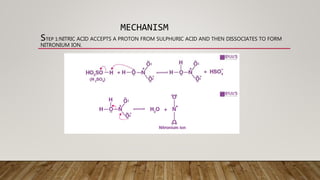
MECHANISM
STEP 1:NITRIC ACID ACCEPTS A PROTON FROM SULPHURIC ACID AND THEN DISSOCIATES TO FORM
NITRONIUM ION.
STEP 2:THE NITRONIUM ION ACTS AS AN ELECTROPHILE IN THE PROCESS WHICH FURTHER REACTS
WITH BENZENE TO FORM AN ARENIUM ION.
STEP 3: THE ARENIUM ION THEN LOSES ITS PROTON TO LEWIS BASE FORMING NITROBENZENE.
NITRATING AGENTS
A variety of nitrating agents can be used depending upon compound to be nitrated
• Dilute, concentrated or fuming nitric acid can be used.
• HNO3 dissolved in acetic acid, H2SO4, acetic anhydride, CHCl3,H3PO4
• Mixed acids: This is a mixture of HNO3 and H2SO4. The HNO3 may be
concentrated or fuming N2O5 and N2O4
WHY NITRATING AGENTS??????
• Functions of H2SO4
• It removes the water produced during nitration.
• Being a stronger acid than nitric acid, it protonates nitric acid to form a nitryl ion
• which is strong nitrating agent.
• HNO3 + 2H2SO4 NO2++H3O+ + 2HSO4 ̄
EQUIPMENTS……??
• Types of Reactors per Chemical Aspects
• To carry out such chemical reactions, we require extraordinary control for the conversion of reactants into
We term these controlling pieces of equipment as Reactors.
• Therefore, choosing appropriate types of reactors for production depends on the expected output from the
mass.
• Apart from that, operating conditions like pressure, temperature, and mixing speeds become necessary to run the
process optimally.
• Based on this, reactors are selected from the following different types.
1. Batch (Batch and Semi-batch)
2. Continuous (Continuous Stirred Tank Reactor)
3. Tubular (Plug Flow Reactor)
4. Catalytic (Fixed and Fluidized Bed)
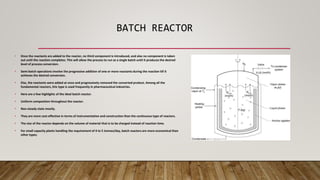
BATCH REACTOR
• Once the reactants are added to the reactor, no third component is introduced, and also no component is taken
out until the reaction completes. This will allow the process to run as a single batch until it produces the desired
level of process conversion.
• Semi-batch operations involve the progressive addition of one or more reactants during the reaction till it
achieves the desired conversion.
• Else, the reactants were added at once and progressively removed the converted product. Among all the
fundamental reactors, this type is used frequently in pharmaceutical industries.
• Here are a few highlights of the ideal batch reactor.
• Uniform composition throughout the reactor.
• Non-steady state mostly.
• They are more cost-effective in terms of instrumentation and construction than the continuous type of reactors.
• The size of the reactor depends on the volume of material that is to be charged instead of reaction time.
• For small capacity plants handling the requirement of 4 to 5 tonnes/day, batch reactors are more economical than
other types.
• WWW.BYJUS CHEMISTRY.COM
• https://pharmagxp.com/process-engineering/types-of-reactors/
CONTINUOUS (STEADY-STATE)
• Unlike the batch reactor, a continuous stirred tank reactor carries out the
reaction simultaneously, i.e. reactant addition and product removal
simultaneously.
• The level of the reaction mass is maintained constant such that the internal
composition of the reaction mass is the same as discharged mass. Apart from
other types of reactors, this type involves more common use in chemical
process plants.
Here are few highlights of the continuous flow reactors.
• Being at steady-state, composition at any point does not change with time.
• Optimum quality parameters can be maintained for desired product
conversions.
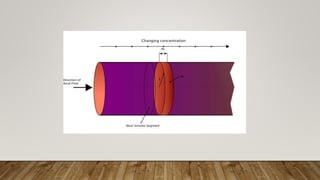
TUBULAR/PLUG FLOW REACTORS
• Tubular types of reactors such as Plug Flow Reactors have cylindrical tubes used
to carry out the reaction.
• Reactants enter one end, react, harvest the product while traveling through the
tube, and exit at the other end.
• They are more efficient than CSTR for the same volume because of turbulent
flow at the inlet. They generally have a flat velocity profile resulting in radial
mixing.
• The time the fluid particle spends in the plug flow is called Residence time and it
is the same for all the particles.
CATALYTIC REACTORS
• The driving force for these types of reactors involves heat transfer, mass transfer,
and catalysts. Applications include Chemical Synthesis, Polymerization,
Hydrogen Cracking, etc.
• The common classification of these reactors is decided by the movement
pattern of catalysts as given below:
i. Fixed Bed
ii. Trickle Bed
iii.Fluidized Bed
NITRATOR
SCHMID
• The material to be nitrated is fed into the top of the
nitrator and is immediately drawn down through the
sleeve and thoroughly mixed with the spent acid
and reacting material. • In the bottom of the nitrator
fresh mixed acid is fed in and mixed with the other
reactant by means of agitator and baffles provided. •
The reacting material then pass upwards with high
velocity through the tubes surrounded by
refrigerated brine. Product and spent acid are
withdrawn continuously from the nitrator through
the overflow line.
BIAZZI
• In this apparatus the turbine type agitator provides
intensive agitation. A vortex is formed in the center
about the agitator shaft. • The reactants fed from
the top are immediately drawn into the vortex
thoroughly mixed and circulated down through the
center of the bank of cooling coils. • The high
velocity imparted to the nitrator contents makes for
efficient mixing and heat transfer. Due to throwing of
cold body on hot body flashing and evaporation
takes place so you have to provide suction line for
vapours.
PHARMACEUTICAL CLASSIFICATION
• Pharmaceutical or healthcare-related industries have ordered types of reactors based on the
material of construction and process of interest specifically;
i. Stainless Steel Reactors
ii. Glass Lined Reactors
• The application and selection of these types of reactors depend on the process in scope.
Chemically, three types of processes exist;
1. Acidic (pH<7) – Appropriate to use Glass Lined Reactors
2. Alkaline (pH>7) – Appropriate to use Stainless Steel Reactors
3. Neutral (pH=7) – Appropriate to use Stainless Steel Reactors
APPLICATION OF NITRATION PRODUCTS
• Solvents
• Dyestuffs
• Pharmaceuticals
• Explosives
They also serve as useful intermediates for the preparation of other compounds,
particularly amines which are prepared by the reduction of the corresponding
nitro compound.
PHARMACEUTICAL CHEMISTRY(NITRATION)

PHARMACEUTICAL CHEMISTRY(NITRATION)

  • 1.
  • 2.
    TO KNOW ABOUTTHE UNIT PROCESS….. • Any commercial production of chemicals is usually a combination of physical and chemical changes. UNIT OPERATIONS • They may be defined as major physical changes useful to chemical industries. Important unit operations are heat transfer, flow of fluids, material handling, filtration, distillation, extraction, drying etc. UNIT PROCESS • Unit processes may be defined as major chemical transformations which are important to the chemical industries e.g. Nitration, halogenation, sulfonation, oxidation, reduction etc. The study of these processes includes • The basic knowledge of a particular chemical reaction • Equipment for the reaction • Running the reaction so as to get the purest product in minimum time and at minimum possible cost
  • 3.
    NITRATION • WHAT? Introduction ofone or more nitro groups (-NO2) into a reacting molecule. • Nitro aromatic or Nitro paraffinic compound: When nitro group attached to carbon. • Nitrate ester: When nitro group attached to oxygen. • Nitramine: When nitro group attached to nitrogen. We shall consider only those nitration in which nitro group replaces hydrogen atom, since these reactions are technically important
  • 4.
  • 5.
    MECHANISM STEP 1:NITRIC ACIDACCEPTS A PROTON FROM SULPHURIC ACID AND THEN DISSOCIATES TO FORM NITRONIUM ION.
  • 6.
    STEP 2:THE NITRONIUMION ACTS AS AN ELECTROPHILE IN THE PROCESS WHICH FURTHER REACTS WITH BENZENE TO FORM AN ARENIUM ION.
  • 7.
    STEP 3: THEARENIUM ION THEN LOSES ITS PROTON TO LEWIS BASE FORMING NITROBENZENE.
  • 8.
    NITRATING AGENTS A varietyof nitrating agents can be used depending upon compound to be nitrated • Dilute, concentrated or fuming nitric acid can be used. • HNO3 dissolved in acetic acid, H2SO4, acetic anhydride, CHCl3,H3PO4 • Mixed acids: This is a mixture of HNO3 and H2SO4. The HNO3 may be concentrated or fuming N2O5 and N2O4
  • 9.
    WHY NITRATING AGENTS?????? •Functions of H2SO4 • It removes the water produced during nitration. • Being a stronger acid than nitric acid, it protonates nitric acid to form a nitryl ion • which is strong nitrating agent. • HNO3 + 2H2SO4 NO2++H3O+ + 2HSO4 ̄
  • 10.
    EQUIPMENTS……?? • Types ofReactors per Chemical Aspects • To carry out such chemical reactions, we require extraordinary control for the conversion of reactants into We term these controlling pieces of equipment as Reactors. • Therefore, choosing appropriate types of reactors for production depends on the expected output from the mass. • Apart from that, operating conditions like pressure, temperature, and mixing speeds become necessary to run the process optimally. • Based on this, reactors are selected from the following different types. 1. Batch (Batch and Semi-batch) 2. Continuous (Continuous Stirred Tank Reactor) 3. Tubular (Plug Flow Reactor) 4. Catalytic (Fixed and Fluidized Bed)
  • 11.
    BATCH REACTOR • Oncethe reactants are added to the reactor, no third component is introduced, and also no component is taken out until the reaction completes. This will allow the process to run as a single batch until it produces the desired level of process conversion. • Semi-batch operations involve the progressive addition of one or more reactants during the reaction till it achieves the desired conversion. • Else, the reactants were added at once and progressively removed the converted product. Among all the fundamental reactors, this type is used frequently in pharmaceutical industries. • Here are a few highlights of the ideal batch reactor. • Uniform composition throughout the reactor. • Non-steady state mostly. • They are more cost-effective in terms of instrumentation and construction than the continuous type of reactors. • The size of the reactor depends on the volume of material that is to be charged instead of reaction time. • For small capacity plants handling the requirement of 4 to 5 tonnes/day, batch reactors are more economical than other types.
  • 12.
    • WWW.BYJUS CHEMISTRY.COM •https://pharmagxp.com/process-engineering/types-of-reactors/
  • 13.
    CONTINUOUS (STEADY-STATE) • Unlikethe batch reactor, a continuous stirred tank reactor carries out the reaction simultaneously, i.e. reactant addition and product removal simultaneously. • The level of the reaction mass is maintained constant such that the internal composition of the reaction mass is the same as discharged mass. Apart from other types of reactors, this type involves more common use in chemical process plants. Here are few highlights of the continuous flow reactors. • Being at steady-state, composition at any point does not change with time. • Optimum quality parameters can be maintained for desired product conversions.
  • 15.
    TUBULAR/PLUG FLOW REACTORS •Tubular types of reactors such as Plug Flow Reactors have cylindrical tubes used to carry out the reaction. • Reactants enter one end, react, harvest the product while traveling through the tube, and exit at the other end. • They are more efficient than CSTR for the same volume because of turbulent flow at the inlet. They generally have a flat velocity profile resulting in radial mixing. • The time the fluid particle spends in the plug flow is called Residence time and it is the same for all the particles.
  • 17.
    CATALYTIC REACTORS • Thedriving force for these types of reactors involves heat transfer, mass transfer, and catalysts. Applications include Chemical Synthesis, Polymerization, Hydrogen Cracking, etc. • The common classification of these reactors is decided by the movement pattern of catalysts as given below: i. Fixed Bed ii. Trickle Bed iii.Fluidized Bed
  • 19.
    NITRATOR SCHMID • The materialto be nitrated is fed into the top of the nitrator and is immediately drawn down through the sleeve and thoroughly mixed with the spent acid and reacting material. • In the bottom of the nitrator fresh mixed acid is fed in and mixed with the other reactant by means of agitator and baffles provided. • The reacting material then pass upwards with high velocity through the tubes surrounded by refrigerated brine. Product and spent acid are withdrawn continuously from the nitrator through the overflow line. BIAZZI • In this apparatus the turbine type agitator provides intensive agitation. A vortex is formed in the center about the agitator shaft. • The reactants fed from the top are immediately drawn into the vortex thoroughly mixed and circulated down through the center of the bank of cooling coils. • The high velocity imparted to the nitrator contents makes for efficient mixing and heat transfer. Due to throwing of cold body on hot body flashing and evaporation takes place so you have to provide suction line for vapours.
  • 21.
    PHARMACEUTICAL CLASSIFICATION • Pharmaceuticalor healthcare-related industries have ordered types of reactors based on the material of construction and process of interest specifically; i. Stainless Steel Reactors ii. Glass Lined Reactors • The application and selection of these types of reactors depend on the process in scope. Chemically, three types of processes exist; 1. Acidic (pH<7) – Appropriate to use Glass Lined Reactors 2. Alkaline (pH>7) – Appropriate to use Stainless Steel Reactors 3. Neutral (pH=7) – Appropriate to use Stainless Steel Reactors
  • 22.
    APPLICATION OF NITRATIONPRODUCTS • Solvents • Dyestuffs • Pharmaceuticals • Explosives They also serve as useful intermediates for the preparation of other compounds, particularly amines which are prepared by the reduction of the corresponding nitro compound.