Ultrasound assisted reactions and
Continuous flow reactors
Master of Pharmacy First Year (Sem-II),
Department of Pharmaceutical Chemistry,
SMT. KISHORITAI BHOYAR COLLEGE OF PHARMACY KAMPTEE
Guided by:
Shyam W. Rangari
Presented by:
Nikita Rahangdale
Contents
 Introduction
 Working principle
 Type of sonochemical reaction
 Synthetic application
 Uses of ultasound
INTRODUCTION
 Sonochemistry is term used describe the effects of ultrasound on
chemical reaction.
 The name is derived from the prefix "SONO" indicating sound
paralleling the longer established various techniques as above.
 Sonochemistry is branch of chemistry dealing with the chemical
effects and application of ultrasonic waves i.e. sound with
frequencies above 20KHz (20,000 cycles per second )that lie
beyond the upper limit of human hearing although frequencies
can be extended up to 100MHz that's especially affects on
chemical reactivity.
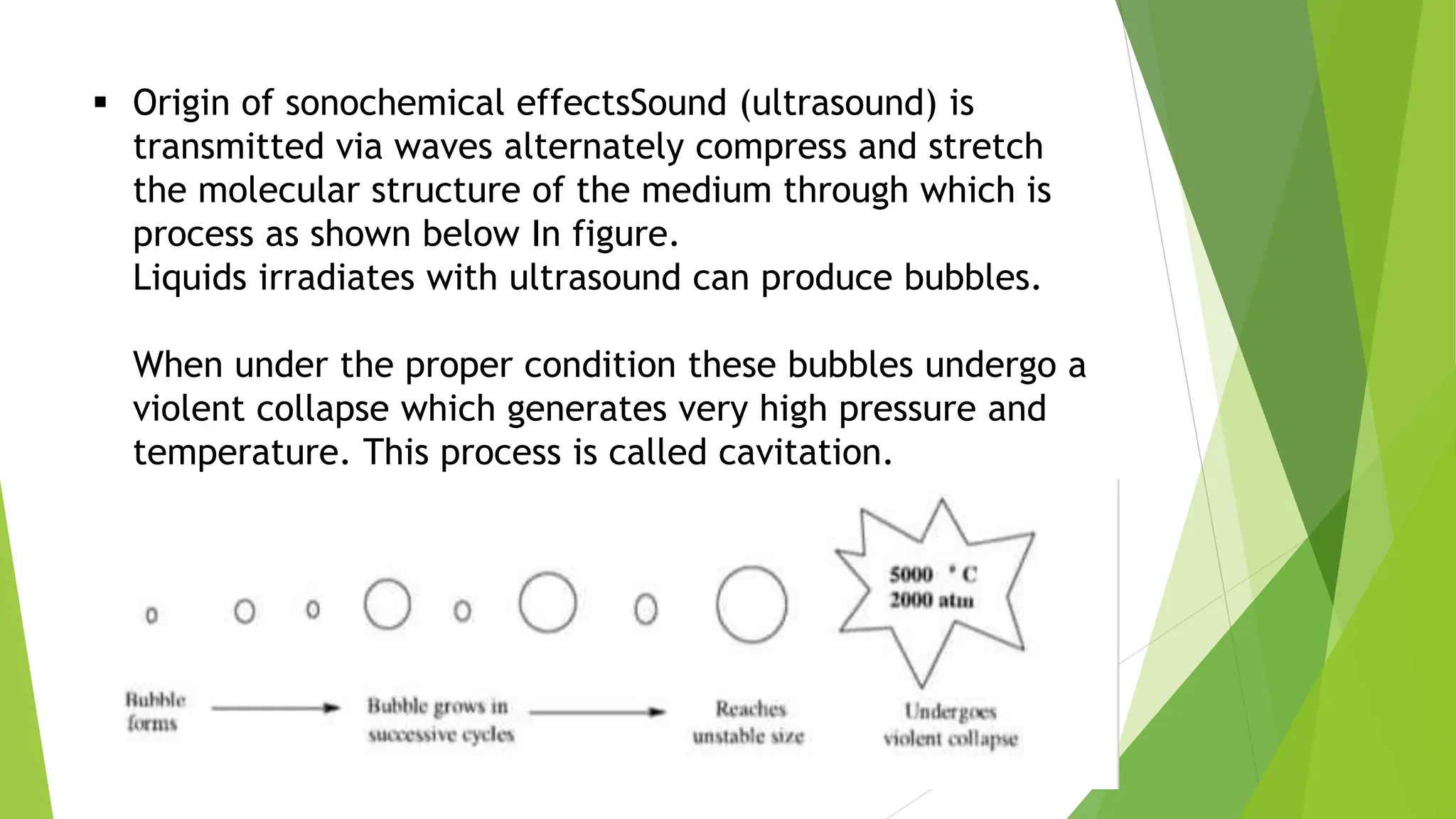
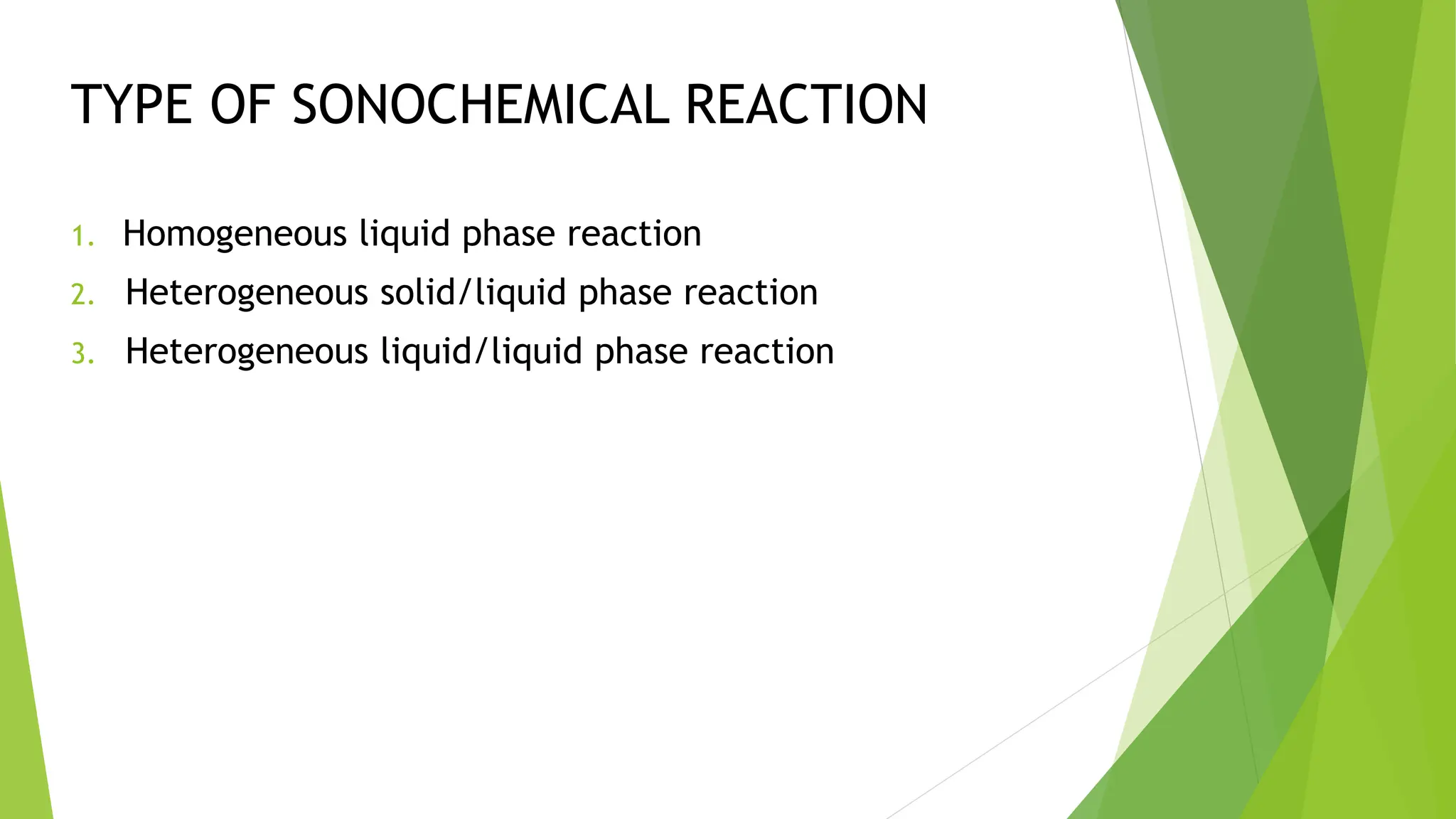
 Origin of sonochemical effectsSound (ultrasound) is
transmitted via waves alternately compress and stretch
the molecular structure of the medium through which is
process as shown below In figure.
Liquids irradiates with ultrasound can produce bubbles.
When under the proper condition these bubbles undergo a
violent collapse which generates very high pressure and
temperature. This process is called cavitation.
 Working Principle
Mechanism
 Heat / energy generation in Sonochemistry.
 Generation of ultra sound-High Fregency generatur is needed that Converts the
normal main Frequeng 50-60HZ into Frequency Vibration b/w 20-40 KHZ
TYPE OF SONOCHEMICAL REACTION
1. Homogeneous liquid phase reaction
2. Heterogeneous solid/liquid phase reaction
3. Heterogeneous liquid/liquid phase reaction
1. Homogeneous liquid phase reaction
 In the bulk liquid immediately surrounding the bubble
where the rapid collapse of Bubble generates shear forces
which can produce mechanical effects.
 In the bubble itself where any species introduced during
its formation will be Subjected to extreme condition of
temperature and pressure on collapse leading to Chemical
effects.
2. Heterogeneous solid/liquid phase reaction
 Acoustic cavitation can produce dramatic effects on solid
in liquid imperfection Or trapped gas can act as the nuclei
for cavitation bubble formation on the surface collapse
Can the lead to shock waves break the particle apart.
 cavitation bubble collapse in the liquid Phase near to a
particle can produce force into rapid motion
3.Heterogeneous liquid/liquid phase reaction
In heterogeneous liquid /liquid reaction cavitation collapse
at or near the interface will Causes disruption and mixing
resulting in the formation of very fine emulsions.
 Synthetic application
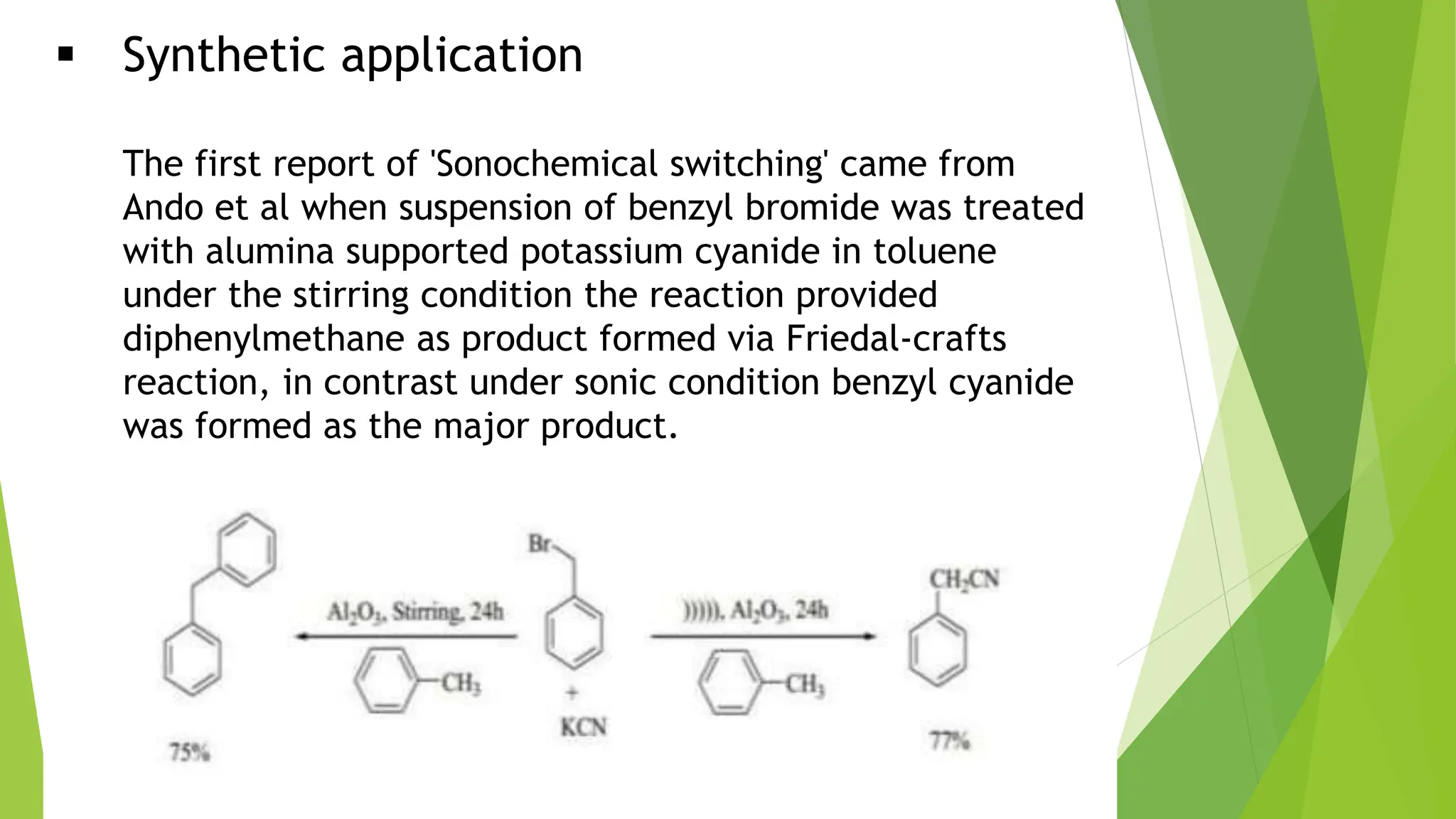
The first report of 'Sonochemical switching' came from
Ando et al when suspension of benzyl bromide was treated
with alumina supported potassium cyanide in toluene
under the stirring condition the reaction provided
diphenylmethane as product formed via Friedal-crafts
reaction, in contrast under sonic condition benzyl cyanide
was formed as the major product.
1.Reformatsky reaction
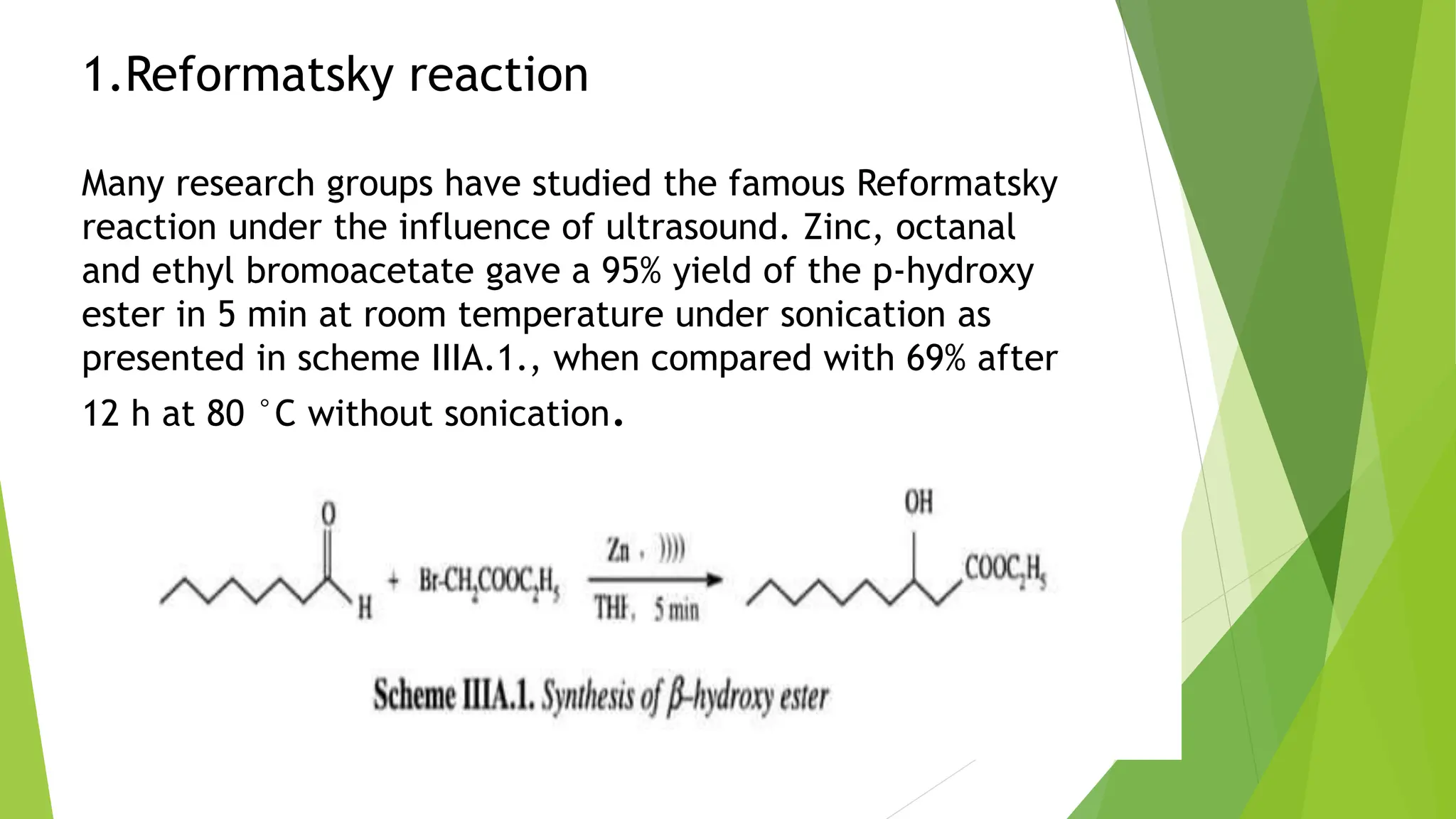
Many research groups have studied the famous Reformatsky
reaction under the influence of ultrasound. Zinc, octanal
and ethyl bromoacetate gave a 95% yield of the p-hydroxy
ester in 5 min at room temperature under sonication as
presented in scheme IIIA.1., when compared with 69% after
12 h at 80 °C without sonication.
2. Synthesis of B-lactams
In a similar reaction Bose et al have synthesized ẞ-lactams
from zinc, ethyl chromoacetate and a diaryl Schiff base in
95% yield within 4 h at room temperature as shown in
scheme IIIA.2, the conventional method of refluxing in
toluene gives a yield of 60%.
 Uses of ultrasound
1.Target detection using SONAR
-(Sound Navigation and Ranging)
2. Medical applications:
-Medicalsonography (ultrasonography)
-Acoustic targeted drug delivery
-Cleaning teeth in dental hygiene
3. Industrial Applications:
-Ultrasonic testing (non-destructive)
-Ultrasonic cleaning
Continuous flow reactors
Reactors
A reactor is a vessel or system in which a
chemical reaction takes place.
Example: -Batch reactors
-Continuous flow reactors
-Continuous stirred tank reactor
-Plug flow reactors
-Fixed bed reactors
- Fluidized bed reactors
The choice of reactor type depends on various
factors, including the type of reaction, the
reaction rate, the required product yield, and the
required reaction conditions.
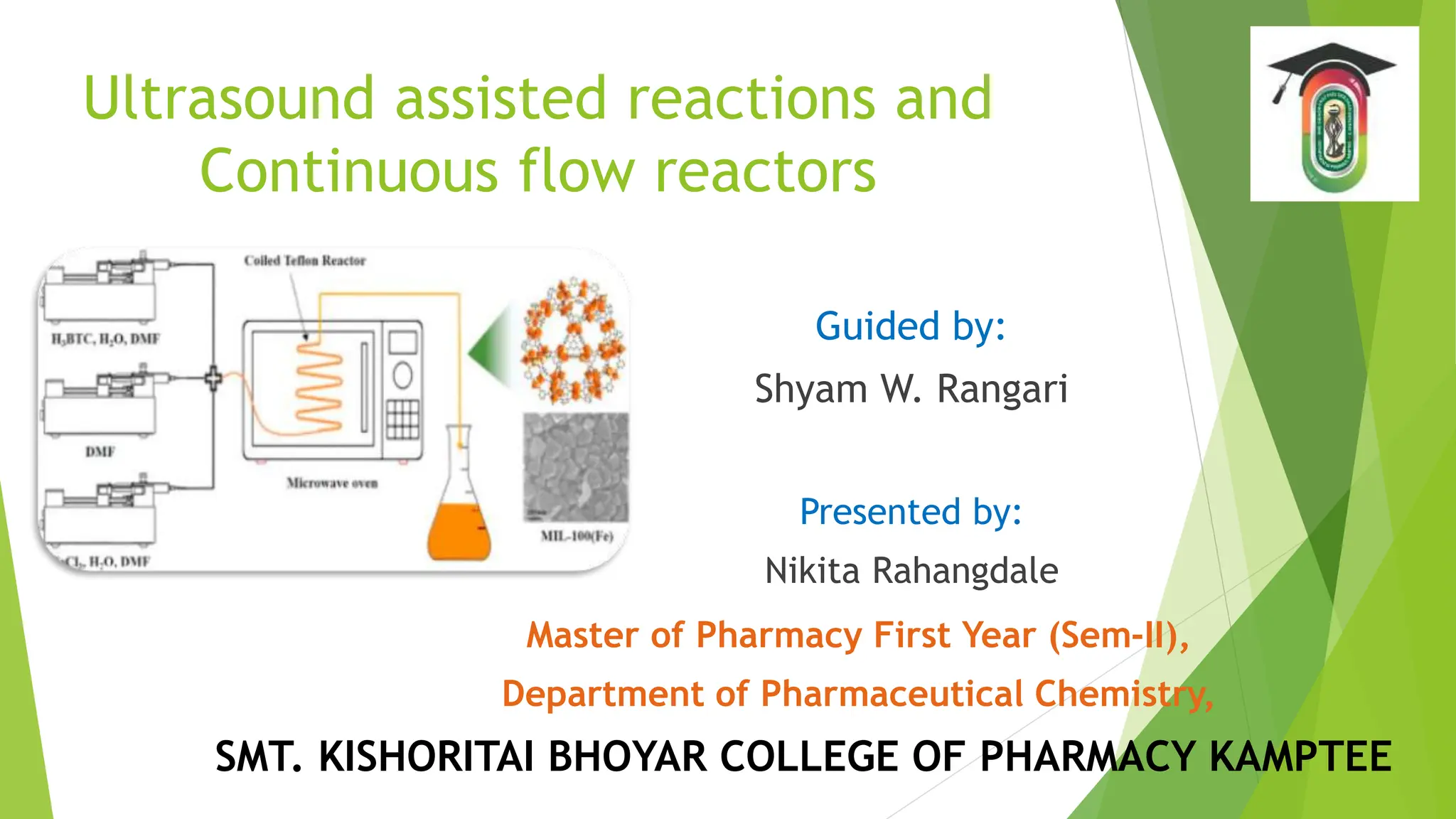
Continuous flow reactor is based on concept of continuous flow, and
residence time.
The reactant are continuous feed into the reactor and the reactant
takes place as the reactant flow through the reactor.
The products are simultaneously remove from the reactor resulting in
a continuous and steady straight operation.
Principle
Working:-
1. Feeding of reactant : Constant flow rate maintain constant concentration
of reactant with the reactor.
2. Mixing of reactant: To get homogeneous mixture degree of mixing is
controlled.
3.Reaction:Reactant mixed reaction occur rate reaction controlled by factor-
catalyst, temperature, pressure, concentration of reactant.
4.Collection of product:Flow rate maintain, constant concentration of
product.
5. Monitoring and control:Optimal condition, temperature sensor, flow
meter, pressure sensor, computer controlled feedback system.
Advantages:
-Improved Safety: Better control over reaction conditions, reduces the likelihood of
accidental exposure to hazardous materials.
-Higher Efficiency: The continuous flow of reactants and products allows for better
control over reaction parameters like temperature pressure, concentration of reactant and
product, easier separation of the products.
-Scalability: Flow chemistry is easily scalable, meaning that a small reaction can be
easily scaled up to a larger industrial-scale production.
-Faster Reactions: Flow chemistry can result in faster reaction times and more rapid
product formation,which can save time and resources.
-Reduced Waste: The efficient use of reagents and catalysts, fewer byproducts are
produced, reducing waste and minimizing the need for purification steps.
-Improve product quality: Purity, quality control and check by sensors maximum yield
and minimum impurities.
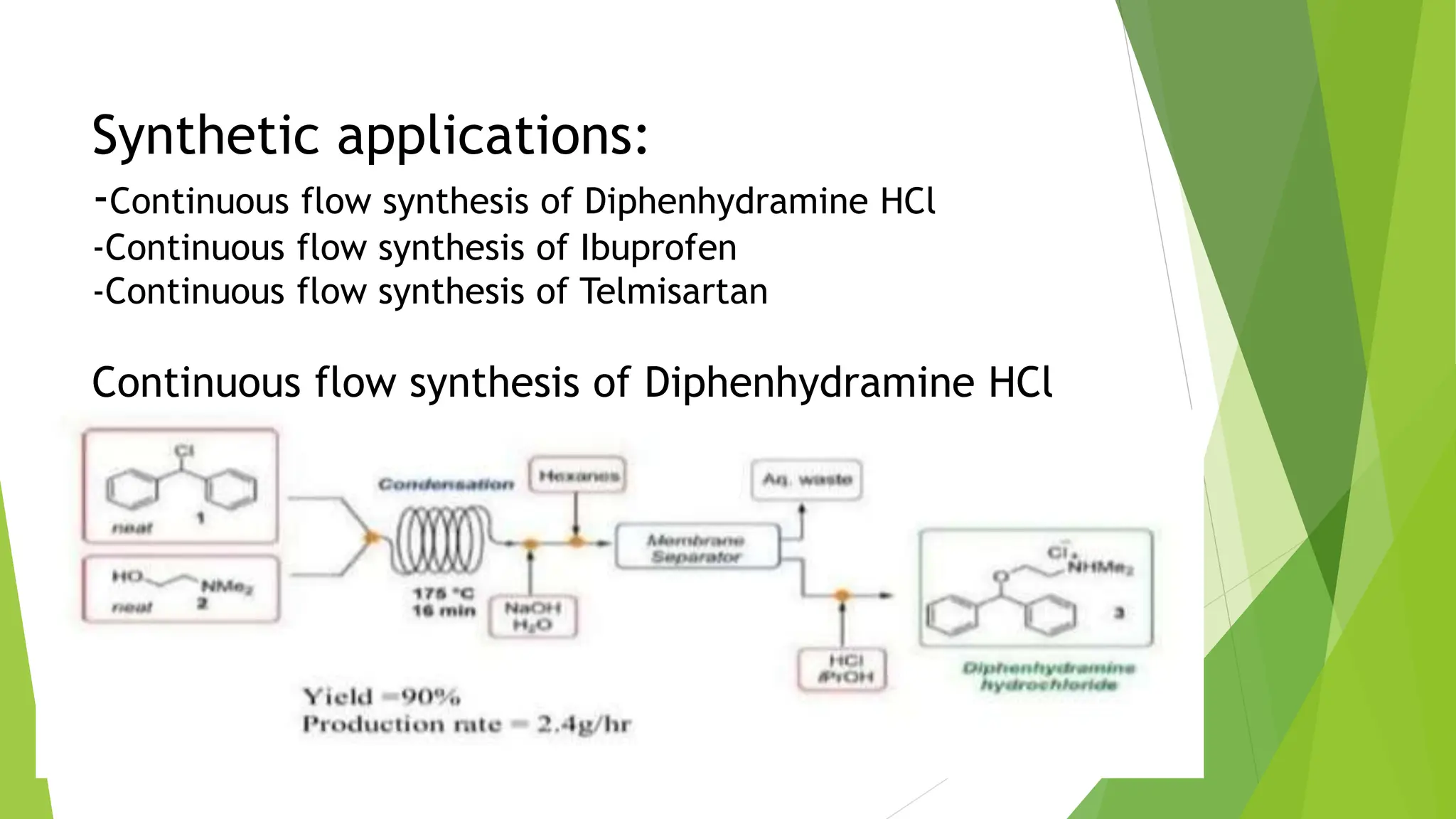
Synthetic applications:
-Continuous flow synthesis of Diphenhydramine HCl
-Continuous flow synthesis of Ibuprofen
-Continuous flow synthesis of Telmisartan
Continuous flow synthesis of Diphenhydramine HCl
THANK YOU

Ultrasound assisted reactions and Continuous flow reactors.pptx

  • 1.
    Ultrasound assisted reactionsand Continuous flow reactors Master of Pharmacy First Year (Sem-II), Department of Pharmaceutical Chemistry, SMT. KISHORITAI BHOYAR COLLEGE OF PHARMACY KAMPTEE Guided by: Shyam W. Rangari Presented by: Nikita Rahangdale
  • 2.
    Contents  Introduction  Workingprinciple  Type of sonochemical reaction  Synthetic application  Uses of ultasound
  • 3.
    INTRODUCTION  Sonochemistry isterm used describe the effects of ultrasound on chemical reaction.  The name is derived from the prefix "SONO" indicating sound paralleling the longer established various techniques as above.  Sonochemistry is branch of chemistry dealing with the chemical effects and application of ultrasonic waves i.e. sound with frequencies above 20KHz (20,000 cycles per second )that lie beyond the upper limit of human hearing although frequencies can be extended up to 100MHz that's especially affects on chemical reactivity.
  • 4.
     Origin ofsonochemical effectsSound (ultrasound) is transmitted via waves alternately compress and stretch the molecular structure of the medium through which is process as shown below In figure. Liquids irradiates with ultrasound can produce bubbles. When under the proper condition these bubbles undergo a violent collapse which generates very high pressure and temperature. This process is called cavitation.
  • 5.
     Working Principle Mechanism Heat / energy generation in Sonochemistry.  Generation of ultra sound-High Fregency generatur is needed that Converts the normal main Frequeng 50-60HZ into Frequency Vibration b/w 20-40 KHZ
  • 6.
    TYPE OF SONOCHEMICALREACTION 1. Homogeneous liquid phase reaction 2. Heterogeneous solid/liquid phase reaction 3. Heterogeneous liquid/liquid phase reaction
  • 7.
    1. Homogeneous liquidphase reaction  In the bulk liquid immediately surrounding the bubble where the rapid collapse of Bubble generates shear forces which can produce mechanical effects.  In the bubble itself where any species introduced during its formation will be Subjected to extreme condition of temperature and pressure on collapse leading to Chemical effects.
  • 8.
    2. Heterogeneous solid/liquidphase reaction  Acoustic cavitation can produce dramatic effects on solid in liquid imperfection Or trapped gas can act as the nuclei for cavitation bubble formation on the surface collapse Can the lead to shock waves break the particle apart.  cavitation bubble collapse in the liquid Phase near to a particle can produce force into rapid motion
  • 9.
    3.Heterogeneous liquid/liquid phasereaction In heterogeneous liquid /liquid reaction cavitation collapse at or near the interface will Causes disruption and mixing resulting in the formation of very fine emulsions.
  • 10.
     Synthetic application Thefirst report of 'Sonochemical switching' came from Ando et al when suspension of benzyl bromide was treated with alumina supported potassium cyanide in toluene under the stirring condition the reaction provided diphenylmethane as product formed via Friedal-crafts reaction, in contrast under sonic condition benzyl cyanide was formed as the major product.
  • 11.
    1.Reformatsky reaction Many researchgroups have studied the famous Reformatsky reaction under the influence of ultrasound. Zinc, octanal and ethyl bromoacetate gave a 95% yield of the p-hydroxy ester in 5 min at room temperature under sonication as presented in scheme IIIA.1., when compared with 69% after 12 h at 80 °C without sonication.
  • 12.
    2. Synthesis ofB-lactams In a similar reaction Bose et al have synthesized ẞ-lactams from zinc, ethyl chromoacetate and a diaryl Schiff base in 95% yield within 4 h at room temperature as shown in scheme IIIA.2, the conventional method of refluxing in toluene gives a yield of 60%.
  • 13.
     Uses ofultrasound 1.Target detection using SONAR -(Sound Navigation and Ranging) 2. Medical applications: -Medicalsonography (ultrasonography) -Acoustic targeted drug delivery -Cleaning teeth in dental hygiene 3. Industrial Applications: -Ultrasonic testing (non-destructive) -Ultrasonic cleaning
  • 14.
    Continuous flow reactors Reactors Areactor is a vessel or system in which a chemical reaction takes place. Example: -Batch reactors -Continuous flow reactors -Continuous stirred tank reactor -Plug flow reactors -Fixed bed reactors - Fluidized bed reactors The choice of reactor type depends on various factors, including the type of reaction, the reaction rate, the required product yield, and the required reaction conditions.
  • 15.
    Continuous flow reactoris based on concept of continuous flow, and residence time. The reactant are continuous feed into the reactor and the reactant takes place as the reactant flow through the reactor. The products are simultaneously remove from the reactor resulting in a continuous and steady straight operation. Principle
  • 16.
    Working:- 1. Feeding ofreactant : Constant flow rate maintain constant concentration of reactant with the reactor. 2. Mixing of reactant: To get homogeneous mixture degree of mixing is controlled. 3.Reaction:Reactant mixed reaction occur rate reaction controlled by factor- catalyst, temperature, pressure, concentration of reactant. 4.Collection of product:Flow rate maintain, constant concentration of product. 5. Monitoring and control:Optimal condition, temperature sensor, flow meter, pressure sensor, computer controlled feedback system.
  • 17.
    Advantages: -Improved Safety: Bettercontrol over reaction conditions, reduces the likelihood of accidental exposure to hazardous materials. -Higher Efficiency: The continuous flow of reactants and products allows for better control over reaction parameters like temperature pressure, concentration of reactant and product, easier separation of the products. -Scalability: Flow chemistry is easily scalable, meaning that a small reaction can be easily scaled up to a larger industrial-scale production. -Faster Reactions: Flow chemistry can result in faster reaction times and more rapid product formation,which can save time and resources. -Reduced Waste: The efficient use of reagents and catalysts, fewer byproducts are produced, reducing waste and minimizing the need for purification steps. -Improve product quality: Purity, quality control and check by sensors maximum yield and minimum impurities.
  • 18.
    Synthetic applications: -Continuous flowsynthesis of Diphenhydramine HCl -Continuous flow synthesis of Ibuprofen -Continuous flow synthesis of Telmisartan Continuous flow synthesis of Diphenhydramine HCl
  • 19.