ADVANCED ORGANIC CHEMISTRY-2
Seminar
On
CONTINUOUS FLOW REACTIONS/CHEMISTRY
Presented by:
Mr. Gagan S
1st M-pharm, Ph’ chemistry.
GCP, Bengaluru.
Presented to:
Dr. Chandrashekar javali sir
HOD, Ph’ Chemistry
GCP, Bengaluru.
CONTENTS :
• Introduction
• Batch v/s flow chemistry
• General working principle
• Types of reactors
• Advantages
• Disadvantages
• Synthetic applications
INTRODUCTION
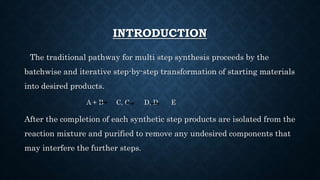
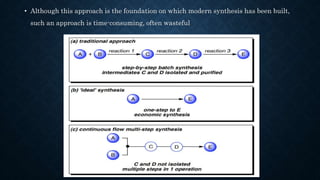
The traditional pathway for multi step synthesis proceeds by the
batchwise and iterative step-by-step transformation of starting materials
into desired products.
A + B C, C D, D E
After the completion of each synthetic step products are isolated from the
reaction mixture and purified to remove any undesired components that
may interfere the further steps.
.
• Although this approach is the foundation on which modern synthesis has been built,
such an approach is time-consuming, often wasteful
• A recently introduced method for streamlining multi-step syntheses is
the use of continuous flow techniques to combine multiple synthetic
steps into a single continuous reactor network, thereby circumventing
the need to isolate intermediate products.
• Thus the concept of "flow chemistry" defines a very general range of
chemical processes that occur in a continuous flowing stream,
conventionally taking place in a reactor zone.
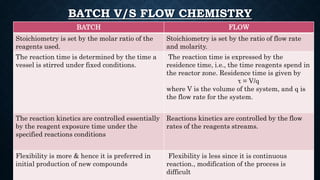
BATCH V/S FLOW CHEMISTRY
BATCH FLOW
Stoichiometry is set by the molar ratio of the
reagents used.
Stoichiometry is set by the ratio of flow rate
and molarity.
The reaction time is determined by the time a
vessel is stirred under fixed conditions.
The reaction time is expressed by the
residence time, i.e., the time reagents spend in
the reactor zone. Residence time is given by
τ = V/q
where V is the volume of the system, and q is
the flow rate for the system.
The reaction kinetics are controlled essentially
by the reagent exposure time under the
specified reactions conditions
Reactions kinetics are controlled by the flow
rates of the reagents streams.
Flexibility is more & hence it is preferred in
initial production of new compounds
Flexibility is less since it is continuous
reaction., modification of the process is
difficult
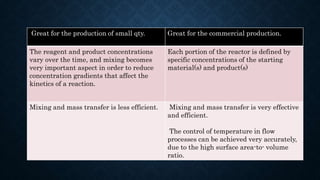
Great for the production of small qty. Great for the commercial production.
The reagent and product concentrations
vary over the time, and mixing becomes
very important aspect in order to reduce
concentration gradients that affect the
kinetics of a reaction.
Each portion of the reactor is defined by
specific concentrations of the starting
material(s) and product(s)
Mixing and mass transfer is less efficient. Mixing and mass transfer is very effective
and efficient.
The control of temperature in flow
processes can be achieved very accurately,
due to the high surface area-to- volume
ratio.
GENERAL SCHEMATIC REPRESENTATION OF A
FLOW CHEMISTRY:
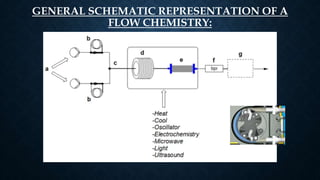
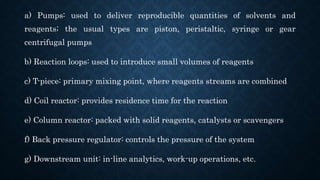
a) Pumps: used to deliver reproducible quantities of solvents and
reagents; the usual types are piston, peristaltic, syringe or gear
centrifugal pumps
b) Reaction loops: used to introduce small volumes of reagents
c) T-piece: primary mixing point, where reagents streams are combined
d) Coil reactor: provides residence time for the reaction
e) Column reactor: packed with solid reagents, catalysts or scavengers
f) Back pressure regulator: controls the pressure of the system
g) Downstream unit: in-line analytics, work-up operations, etc.
TYPES OF REACTORS:
• Plug flow reactors
• Column reactors
• Gas reactors
• Reactors for slurries
• Photochemical flow reactors
• Trickle bed reactors:
 Gas and liquid are present in the reactor.
 Downward movement of a liquid and the downward or upward movement of gas.
 Liquid-phase hydrogenation, hydrodesulfurization, and hydro-de-nitro-genation in
refineries
ADVANTAGES:
• Continuous flow synthesis is a great alternative to traditional batch
synthesis/production when it comes to demanding chemistries.
• Continuous flow processing provides many technical advantages over
traditional batch methods.
• Some products that cannot be produced in large batch processes due to
the thermodynamic nature of the reactions involved.
Under continuous flow conditions, however, because only small
quantities of reagents and products are present at any given time, these
issues can be avoided.
• Flow chemistry is often considered as an option when exploring new chemical
routes.
• Reactions which involve reagents containing dissolved gases are easily
handled, whereas in batch a pressurized "bomb" reactor would be necessary.
• Multi phase liquid reactions (e.g. phase transfer catalysis) can be performed in
a straightforward way.
• Scale up of a proven reaction can be achieved rapidly with little or no process
development work.
DISADVANTAGES:
• The main issue is the large existing batch manufacturing infrastructure.
• If a company gets trapped in the question ‘use existing or build new?. It will use the
existing equipment in the present business environment.
• Dedicated equipment is needed for precise continuous dosing (e.g. pumps),
connections, etc.
• Scale up of micro effects such as the high area to volume ratio is not possible and
economy of scale may not apply.
• Continuous equipment like microreactors are added when needed, and the existing
vessels modified to serve other purposes, such as hold-up tanks used to define the
batch for regulatory purposes.
SYNTHETIC APPLICATIONS:
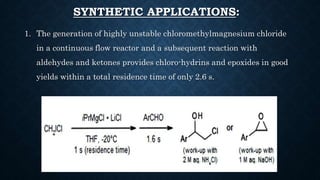
1. The generation of highly unstable chloromethylmagnesium chloride
in a continuous flow reactor and a subsequent reaction with
aldehydes and ketones provides chloro-hydrins and epoxides in good
yields within a total residence time of only 2.6 s.
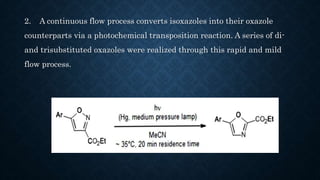
2. A continuous flow process converts isoxazoles into their oxazole
counterparts via a photochemical transposition reaction. A series of di-
and trisubstituted oxazoles were realized through this rapid and mild
flow process.
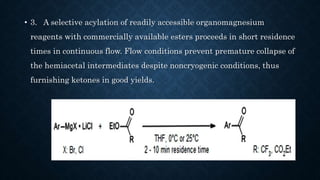
• 3. A selective acylation of readily accessible organomagnesium
reagents with commercially available esters proceeds in short residence
times in continuous flow. Flow conditions prevent premature collapse of
the hemiacetal intermediates despite noncryogenic conditions, thus
furnishing ketones in good yields.
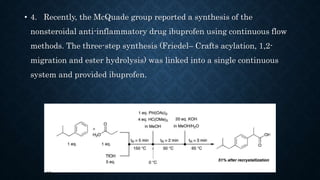
• 4. Recently, the McQuade group reported a synthesis of the
nonsteroidal anti-inflammatory drug ibuprofen using continuous flow
methods. The three-step synthesis (Friedel– Crafts acylation, 1,2-
migration and ester hydrolysis) was linked into a single continuous
system and provided ibuprofen.
REFERENCES:
• www.organic chemistry.org/topics/flow chemistry. shtm
• The synthesis of active pharmaceutical ingredients (APIs)
using continuous flow chemistry, Beilstein journal of organic
chemistry.
• Continuous Flow Multi-Step Organic Synthesis, MIT open
access article.
QUESTION MAY APPEAR AS
• Write a note on Continuous flow reaction.
• Write a note on working principle, Advantages and
Synthetic applications of Continuous flow reactions.
Continuous flow reaction/ Chemistry

Continuous flow reaction/ Chemistry

  • 1.
    ADVANCED ORGANIC CHEMISTRY-2 Seminar On CONTINUOUSFLOW REACTIONS/CHEMISTRY Presented by: Mr. Gagan S 1st M-pharm, Ph’ chemistry. GCP, Bengaluru. Presented to: Dr. Chandrashekar javali sir HOD, Ph’ Chemistry GCP, Bengaluru.
  • 2.
    CONTENTS : • Introduction •Batch v/s flow chemistry • General working principle • Types of reactors • Advantages • Disadvantages • Synthetic applications
  • 3.
    INTRODUCTION The traditional pathwayfor multi step synthesis proceeds by the batchwise and iterative step-by-step transformation of starting materials into desired products. A + B C, C D, D E After the completion of each synthetic step products are isolated from the reaction mixture and purified to remove any undesired components that may interfere the further steps.
  • 4.
    . • Although thisapproach is the foundation on which modern synthesis has been built, such an approach is time-consuming, often wasteful
  • 5.
    • A recentlyintroduced method for streamlining multi-step syntheses is the use of continuous flow techniques to combine multiple synthetic steps into a single continuous reactor network, thereby circumventing the need to isolate intermediate products. • Thus the concept of "flow chemistry" defines a very general range of chemical processes that occur in a continuous flowing stream, conventionally taking place in a reactor zone.
  • 6.
    BATCH V/S FLOWCHEMISTRY BATCH FLOW Stoichiometry is set by the molar ratio of the reagents used. Stoichiometry is set by the ratio of flow rate and molarity. The reaction time is determined by the time a vessel is stirred under fixed conditions. The reaction time is expressed by the residence time, i.e., the time reagents spend in the reactor zone. Residence time is given by τ = V/q where V is the volume of the system, and q is the flow rate for the system. The reaction kinetics are controlled essentially by the reagent exposure time under the specified reactions conditions Reactions kinetics are controlled by the flow rates of the reagents streams. Flexibility is more & hence it is preferred in initial production of new compounds Flexibility is less since it is continuous reaction., modification of the process is difficult
  • 7.
    Great for theproduction of small qty. Great for the commercial production. The reagent and product concentrations vary over the time, and mixing becomes very important aspect in order to reduce concentration gradients that affect the kinetics of a reaction. Each portion of the reactor is defined by specific concentrations of the starting material(s) and product(s) Mixing and mass transfer is less efficient. Mixing and mass transfer is very effective and efficient. The control of temperature in flow processes can be achieved very accurately, due to the high surface area-to- volume ratio.
  • 8.
  • 9.
    a) Pumps: usedto deliver reproducible quantities of solvents and reagents; the usual types are piston, peristaltic, syringe or gear centrifugal pumps b) Reaction loops: used to introduce small volumes of reagents c) T-piece: primary mixing point, where reagents streams are combined d) Coil reactor: provides residence time for the reaction e) Column reactor: packed with solid reagents, catalysts or scavengers f) Back pressure regulator: controls the pressure of the system g) Downstream unit: in-line analytics, work-up operations, etc.
  • 10.
    TYPES OF REACTORS: •Plug flow reactors • Column reactors • Gas reactors • Reactors for slurries • Photochemical flow reactors • Trickle bed reactors:  Gas and liquid are present in the reactor.  Downward movement of a liquid and the downward or upward movement of gas.  Liquid-phase hydrogenation, hydrodesulfurization, and hydro-de-nitro-genation in refineries
  • 11.
    ADVANTAGES: • Continuous flowsynthesis is a great alternative to traditional batch synthesis/production when it comes to demanding chemistries. • Continuous flow processing provides many technical advantages over traditional batch methods. • Some products that cannot be produced in large batch processes due to the thermodynamic nature of the reactions involved. Under continuous flow conditions, however, because only small quantities of reagents and products are present at any given time, these issues can be avoided.
  • 12.
    • Flow chemistryis often considered as an option when exploring new chemical routes. • Reactions which involve reagents containing dissolved gases are easily handled, whereas in batch a pressurized "bomb" reactor would be necessary. • Multi phase liquid reactions (e.g. phase transfer catalysis) can be performed in a straightforward way. • Scale up of a proven reaction can be achieved rapidly with little or no process development work.
  • 13.
    DISADVANTAGES: • The mainissue is the large existing batch manufacturing infrastructure. • If a company gets trapped in the question ‘use existing or build new?. It will use the existing equipment in the present business environment. • Dedicated equipment is needed for precise continuous dosing (e.g. pumps), connections, etc. • Scale up of micro effects such as the high area to volume ratio is not possible and economy of scale may not apply. • Continuous equipment like microreactors are added when needed, and the existing vessels modified to serve other purposes, such as hold-up tanks used to define the batch for regulatory purposes.
  • 14.
    SYNTHETIC APPLICATIONS: 1. Thegeneration of highly unstable chloromethylmagnesium chloride in a continuous flow reactor and a subsequent reaction with aldehydes and ketones provides chloro-hydrins and epoxides in good yields within a total residence time of only 2.6 s.
  • 15.
    2. A continuousflow process converts isoxazoles into their oxazole counterparts via a photochemical transposition reaction. A series of di- and trisubstituted oxazoles were realized through this rapid and mild flow process.
  • 16.
    • 3. Aselective acylation of readily accessible organomagnesium reagents with commercially available esters proceeds in short residence times in continuous flow. Flow conditions prevent premature collapse of the hemiacetal intermediates despite noncryogenic conditions, thus furnishing ketones in good yields.
  • 17.
    • 4. Recently,the McQuade group reported a synthesis of the nonsteroidal anti-inflammatory drug ibuprofen using continuous flow methods. The three-step synthesis (Friedel– Crafts acylation, 1,2- migration and ester hydrolysis) was linked into a single continuous system and provided ibuprofen.
  • 18.
    REFERENCES: • www.organic chemistry.org/topics/flowchemistry. shtm • The synthesis of active pharmaceutical ingredients (APIs) using continuous flow chemistry, Beilstein journal of organic chemistry. • Continuous Flow Multi-Step Organic Synthesis, MIT open access article.
  • 19.
    QUESTION MAY APPEARAS • Write a note on Continuous flow reaction. • Write a note on working principle, Advantages and Synthetic applications of Continuous flow reactions.