CONTINUOUS FLOW REACTOR
HYGIA INSTITUTE OF PHARMACEUTICAL EDUCATION AND RESEARCH
Ghaila Road, Gazipur Balram Rd, near IIM Road, Prabandh Nagar, Lucknow, Uttar
Pradesh 226020
By Kartik Tiwari
CONTENTS
 Introduction
Advantages
Instrumentation
Component of flow reactor
Parameter of Flow Chemistry
Types of flow reactor
Synthetic Application
INTRODUCTION
Flow chemistry, continuous processing, or continuous flow chemistry, begins with two or more streams of
different reactants pumped at specific flow rates into a single chamber, tube, or micro reactor.
The solution may also be directed to subsequent flow reactor loops to generate the final product.
Only small amounts of material are needed, which dramatically enhances process safety. Because of the
inherent design of continuous flow technology, reaction conditions that cannot be safely achieved with batch
reactions are possible.
A reaction takes place, and the stream containing the resultant compound is collected at the outlet.
The result is product with higher quality, less impurity, and faster reaction cycle time.
The application of flow chemistry relies on the concept of pumping reagents using many reactors types to
perform specific reaction. (piston pump, syringe pump etc.).
Advantages of flow chemistry:
Improved heat transfer
Improved mass transfer/mixing
Reproducibility
Scale-up
Extreme reaction conditions (high/low temperature, high pressure)
Multistep (telescoping)
In-line downstream processing
Automation
Improved Safety (managing hazardous reagents and intermediates)
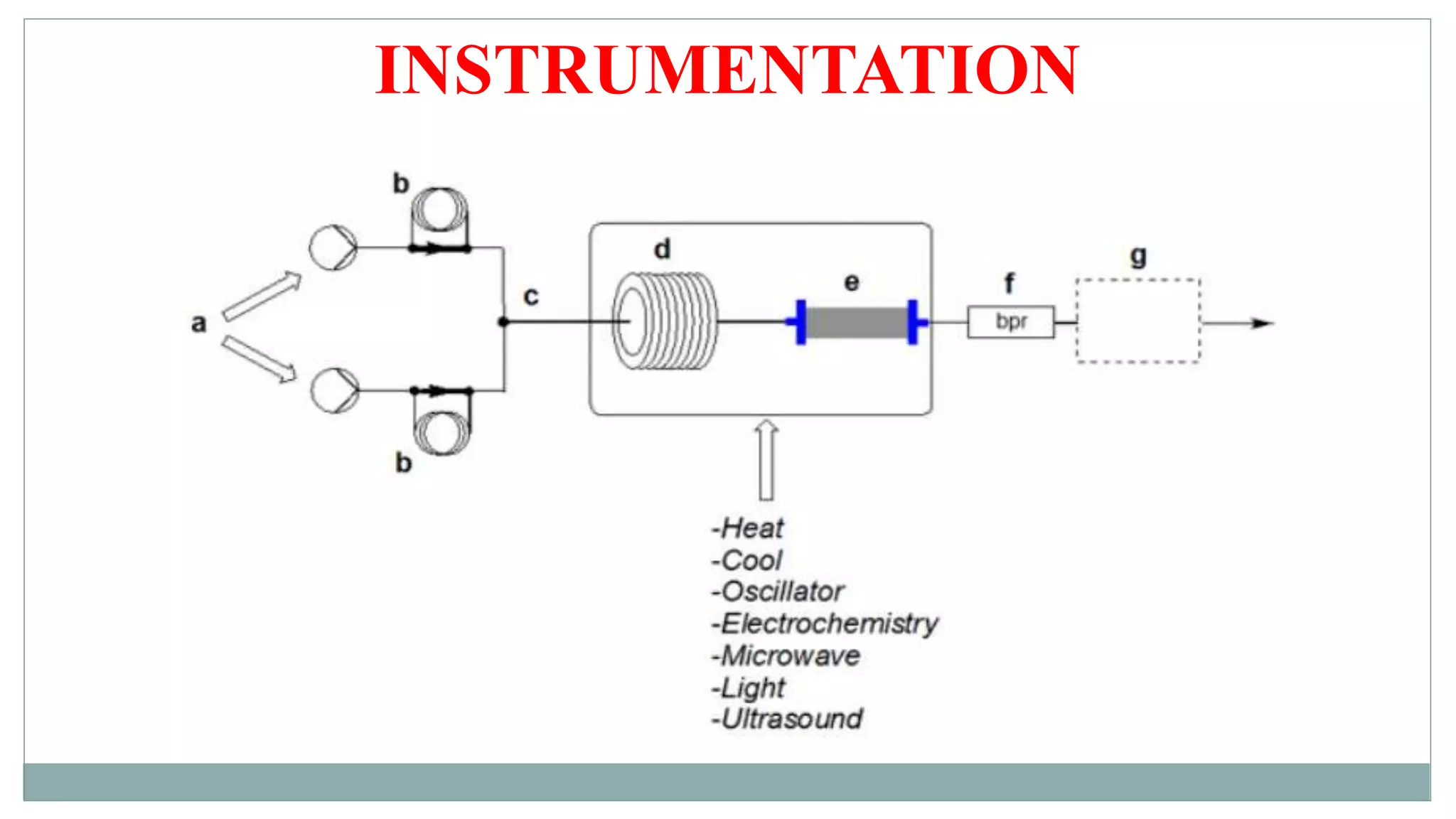
INSTRUMENTATION
Components of Flow Reactor
a. Pumps: used to deliver reproducible quantities of solvents and reagents; the usual
types are piston, peristaltic, syringe or gear centrifugal pumps
b. Reaction loops: used to introduce small volumes of reagents
c. T-piece: primary mixing point, where reagents streams are combined
d. Coil reactor: provides residence time for the reaction
e. Column reactor: packed with solid reagents, catalysts or scavengers
f. Back pressure regulator: controls the pressure of the system
g. Downstream unit: in-line analytics, work-up operations, etc.
Parameters in flow chemistry:
Reaction Stoichiometry: In traditional chemistry this is defined by the concentration of chemical reagents
and their volumetric ratio. In flow chemistry this is defined by The concentration of the chemical reagents
and the ratio of their flow rate.
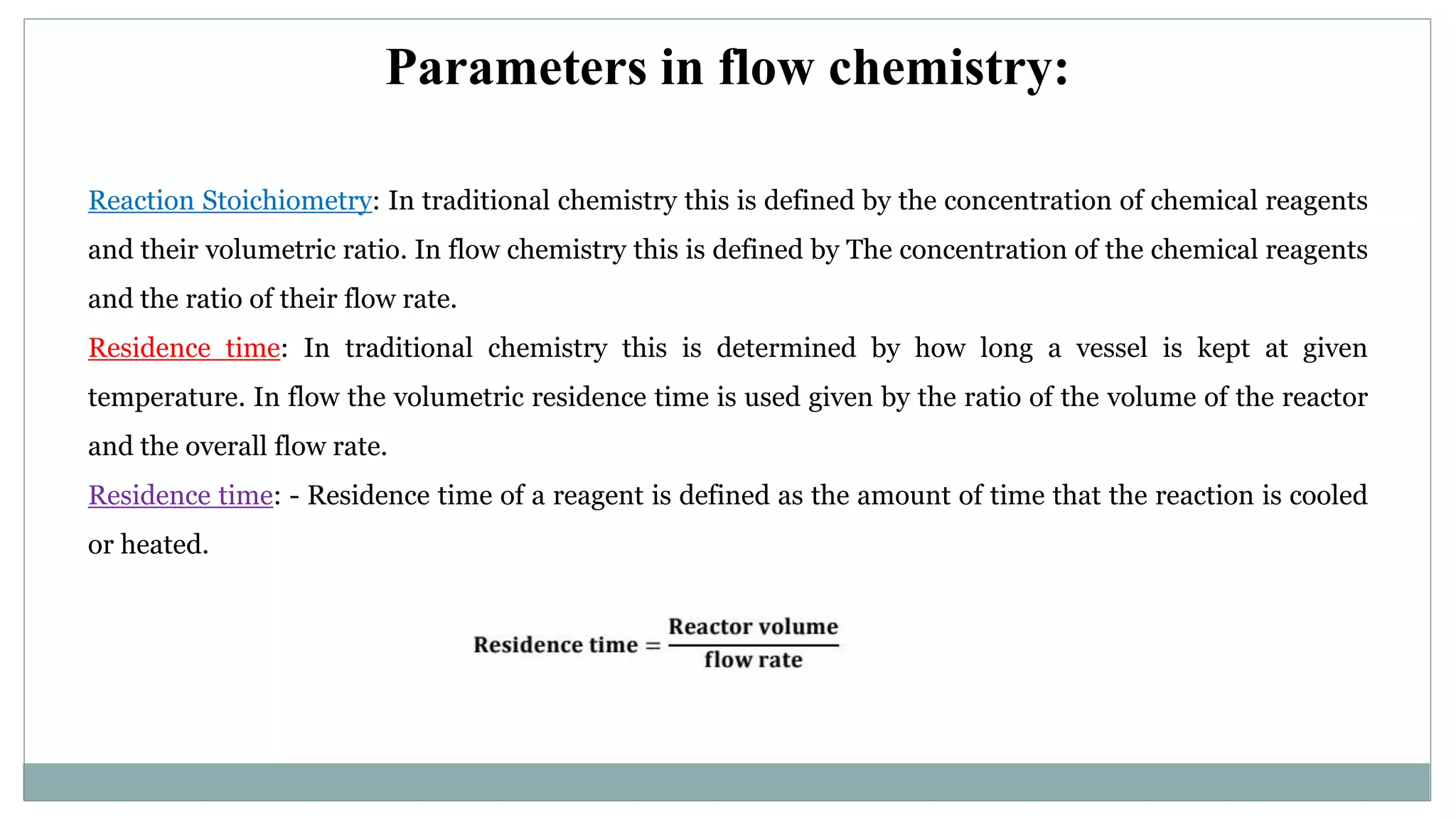
Residence time: In traditional chemistry this is determined by how long a vessel is kept at given
temperature. In flow the volumetric residence time is used given by the ratio of the volume of the reactor
and the overall flow rate.
Residence time: - Residence time of a reagent is defined as the amount of time that the reaction is cooled
or heated.
Flow rates: While in batch mode, the reaction kinetics are controlled essentially by the reagent exposure
time under the specified reactions conditions, under flow conditions reactions kinetics are controlled by the
flow rates of the reagents streams. The flow rates of the reagents indeed will influence the residence time of
the reaction and have an impact on the outcome of the transformation.
q is usually expressed in units such as mL/min
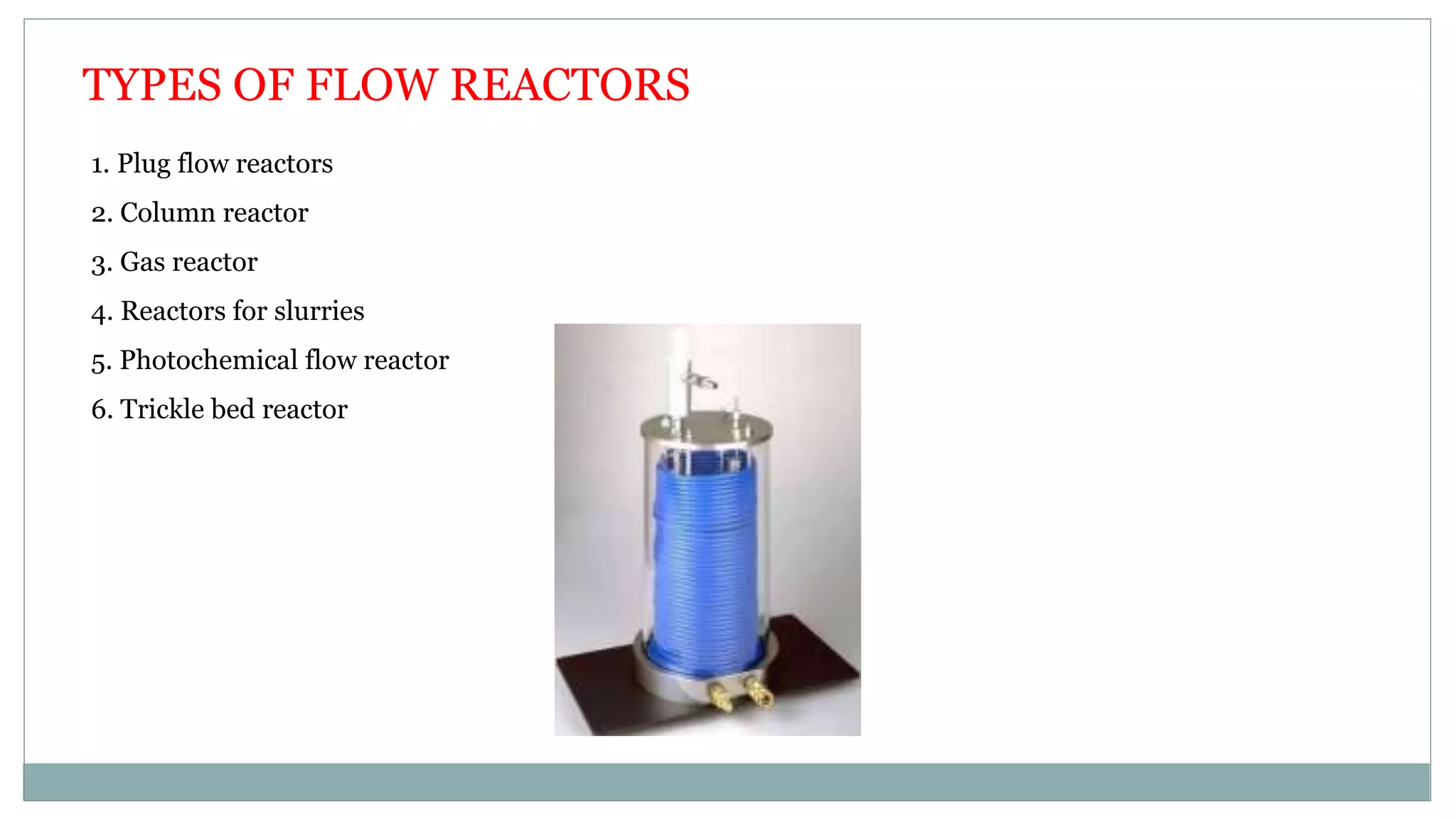
TYPES OF FLOW REACTORS
1. Plug flow reactors
2. Column reactor
3. Gas reactor
4. Reactors for slurries
5. Photochemical flow reactor
6. Trickle bed reactor
SYNTHETIC APPLICATION
1. Continuous flow through Reduction of Imine into Amine
2. Continuous flow synthesis of Telmisartan
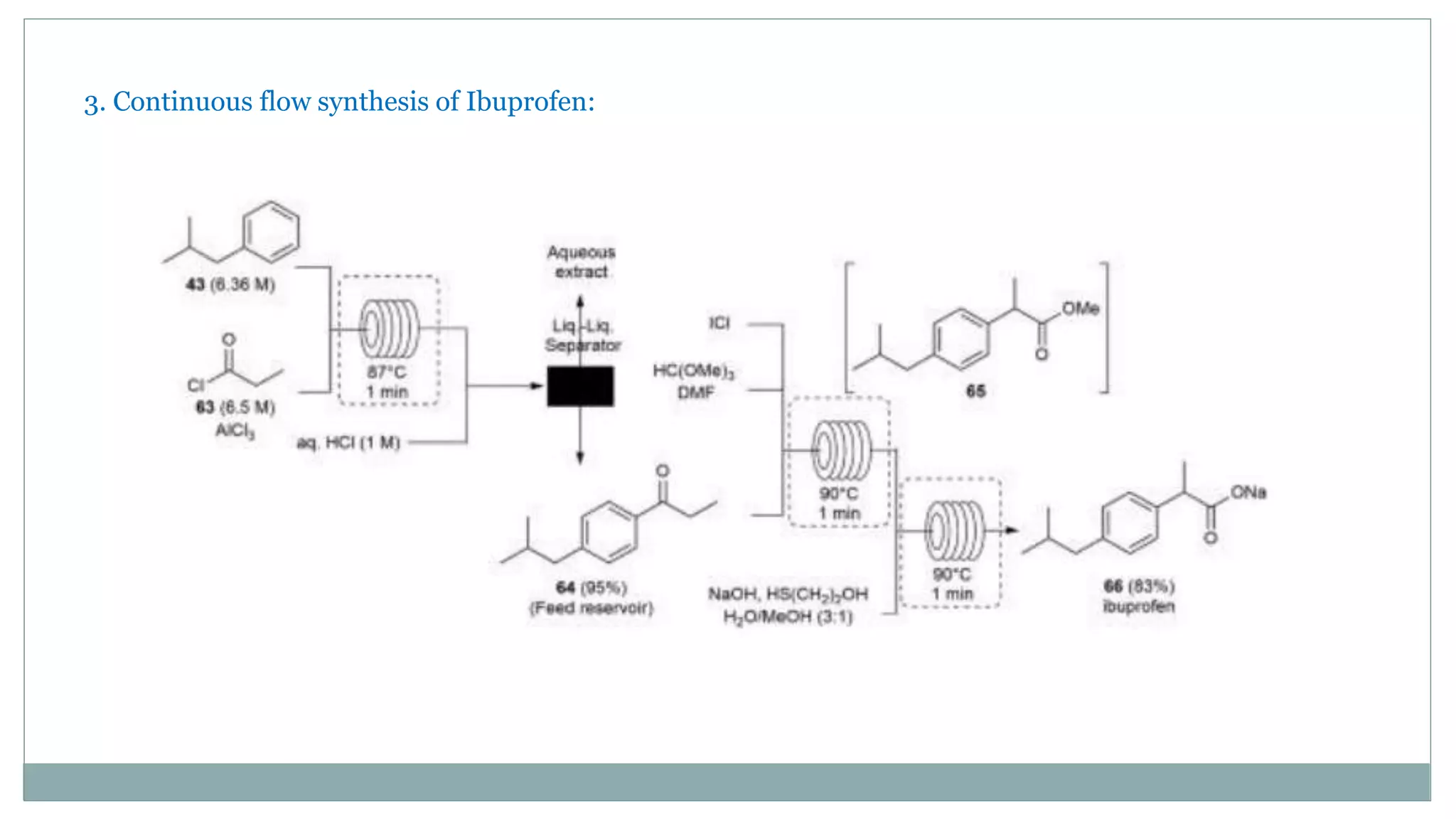
3. Continuous flow synthesis of Ibuprofen:
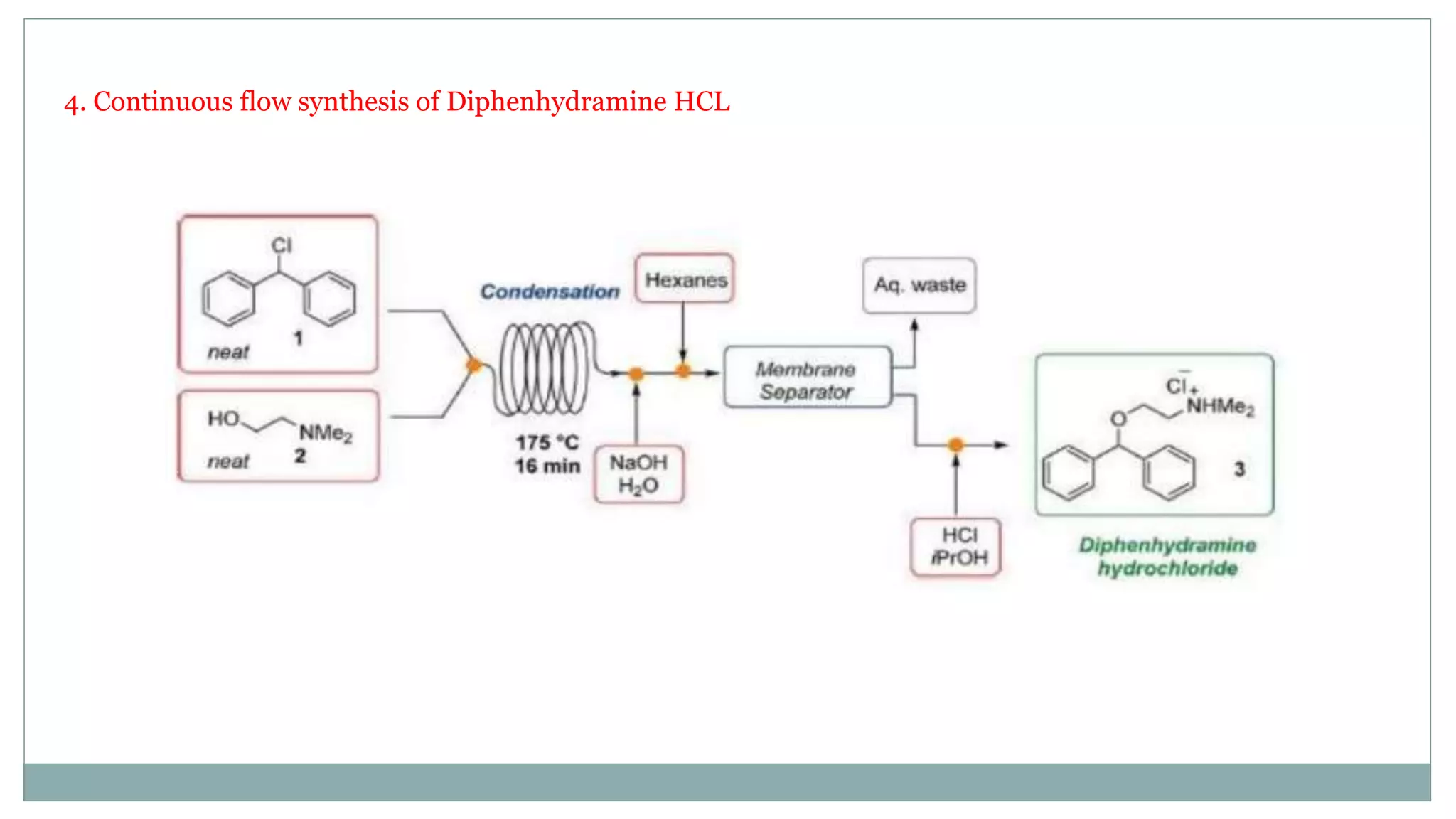
4. Continuous flow synthesis of Diphenhydramine HCL
continuous flow reactor M.Pharm .pptx

continuous flow reactor M.Pharm .pptx

  • 1.
    CONTINUOUS FLOW REACTOR HYGIAINSTITUTE OF PHARMACEUTICAL EDUCATION AND RESEARCH Ghaila Road, Gazipur Balram Rd, near IIM Road, Prabandh Nagar, Lucknow, Uttar Pradesh 226020 By Kartik Tiwari
  • 2.
    CONTENTS  Introduction Advantages Instrumentation Component offlow reactor Parameter of Flow Chemistry Types of flow reactor Synthetic Application
  • 3.
    INTRODUCTION Flow chemistry, continuousprocessing, or continuous flow chemistry, begins with two or more streams of different reactants pumped at specific flow rates into a single chamber, tube, or micro reactor. The solution may also be directed to subsequent flow reactor loops to generate the final product. Only small amounts of material are needed, which dramatically enhances process safety. Because of the inherent design of continuous flow technology, reaction conditions that cannot be safely achieved with batch reactions are possible. A reaction takes place, and the stream containing the resultant compound is collected at the outlet. The result is product with higher quality, less impurity, and faster reaction cycle time. The application of flow chemistry relies on the concept of pumping reagents using many reactors types to perform specific reaction. (piston pump, syringe pump etc.).
  • 4.
    Advantages of flowchemistry: Improved heat transfer Improved mass transfer/mixing Reproducibility Scale-up Extreme reaction conditions (high/low temperature, high pressure) Multistep (telescoping) In-line downstream processing Automation Improved Safety (managing hazardous reagents and intermediates)
  • 5.
  • 6.
    Components of FlowReactor a. Pumps: used to deliver reproducible quantities of solvents and reagents; the usual types are piston, peristaltic, syringe or gear centrifugal pumps b. Reaction loops: used to introduce small volumes of reagents c. T-piece: primary mixing point, where reagents streams are combined d. Coil reactor: provides residence time for the reaction e. Column reactor: packed with solid reagents, catalysts or scavengers f. Back pressure regulator: controls the pressure of the system g. Downstream unit: in-line analytics, work-up operations, etc.
  • 7.
    Parameters in flowchemistry: Reaction Stoichiometry: In traditional chemistry this is defined by the concentration of chemical reagents and their volumetric ratio. In flow chemistry this is defined by The concentration of the chemical reagents and the ratio of their flow rate. Residence time: In traditional chemistry this is determined by how long a vessel is kept at given temperature. In flow the volumetric residence time is used given by the ratio of the volume of the reactor and the overall flow rate. Residence time: - Residence time of a reagent is defined as the amount of time that the reaction is cooled or heated.
  • 8.
    Flow rates: Whilein batch mode, the reaction kinetics are controlled essentially by the reagent exposure time under the specified reactions conditions, under flow conditions reactions kinetics are controlled by the flow rates of the reagents streams. The flow rates of the reagents indeed will influence the residence time of the reaction and have an impact on the outcome of the transformation. q is usually expressed in units such as mL/min
  • 9.
    TYPES OF FLOWREACTORS 1. Plug flow reactors 2. Column reactor 3. Gas reactor 4. Reactors for slurries 5. Photochemical flow reactor 6. Trickle bed reactor
  • 10.
    SYNTHETIC APPLICATION 1. Continuousflow through Reduction of Imine into Amine
  • 11.
    2. Continuous flowsynthesis of Telmisartan
  • 12.
    3. Continuous flowsynthesis of Ibuprofen:
  • 13.
    4. Continuous flowsynthesis of Diphenhydramine HCL