

Advances in haemodynamic 
monitoring in Anaesthesia and ICU 
Dr Tuong Phan 
Staff Specialist Anaesthetist 
Dept Anaesthesia and Pain Medicine 
St Vincent’s Hospital Melbourne
the technology 
Beyond standard monitoring 
Keys to understanding 
utility 
Accuracy 
Trending ability 
utility 
Clinical studies 
Recommendations and summary 
Minimally invasive cardiac output 
monitoring 
monitoring
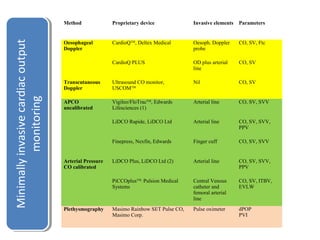
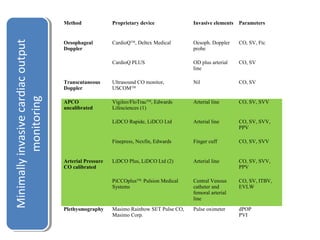
Method Proprietary device Invasive elements Parameters 
Oesophageal 
Doppler 
CardioQTM, Deltex Medical Oesoph. Doppler 
output 
probe 
cardiac invasive Minimally PVI CO, SV, Ftc 
CardioQ PLUS OD plus arterial 
line 
CO, SV 
Transcutaneous 
Doppler 
Ultrasound CO monitor, 
USCOMTM 
Nil CO, SV 
APCO 
uncalibrated 
Vigileo/FloTracTM, Edwards 
Lifesciences (1) 
Arterial line CO, SV, SVV 
LiDCO Rapide, LiDCO Ltd Arterial line CO, SV, SVV, 
PPV 
Finepress, Nexfin, Edwards Finger cuff CO, SV, SVV 
Arterial Pressure 
CO calibrated 
LiDCO Plus, LiDCO Ltd (2) Arterial line CO, SV, SVV, 
PPV 
PiCCOplusTM, Pulsion Medical 
Systems 
Central Venous 
catheter and 
femoral arterial 
line 
CO, SV, ITBV, 
EVLW 
Plethysmography Masimo Rainbow SET Pulse CO, 
Masimo Corp. 
Pulse oximeter dPOP 
monitoring 
monitoring 
Minimally invasive cardiac output
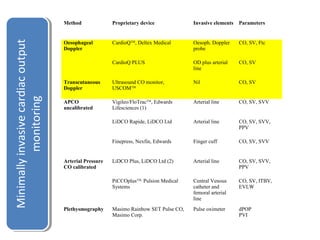
Method Proprietary device Invasive elements Parameters 
Oesophageal 
Doppler 
CardioQTM, Deltex Medical Oesoph. Doppler 
output 
probe 
cardiac invasive Minimally PVI CO, SV, Ftc 
CardioQ PLUS OD plus arterial 
line 
CO, SV 
Transcutaneous 
Doppler 
Ultrasound CO monitor, 
USCOMTM 
Nil CO, SV 
APCO 
uncalibrated 
Vigileo/FloTracTM, Edwards 
Lifesciences (1) 
Arterial line CO, SV, SVV 
LiDCO Rapide, LiDCO Ltd Arterial line CO, SV, SVV, 
PPV 
Finepress, Nexfin, Edwards Finger cuff CO, SV, SVV 
Arterial Pressure 
CO calibrated 
LiDCO Plus, LiDCO Ltd (2) Arterial line CO, SV, SVV, 
PPV 
PiCCOplusTM, Pulsion Medical 
Systems 
Central Venous 
catheter and 
femoral arterial 
line 
CO, SV, ITBV, 
EVLW 
Plethysmography Masimo Rainbow SET Pulse CO, 
Masimo Corp. 
Pulse oximeter dPOP 
monitoring 
monitoring 
Minimally invasive cardiac output
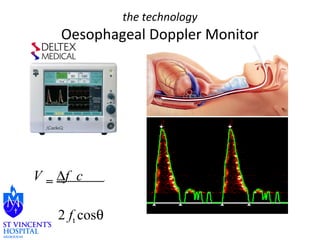
V = Df c . 
2 ft cosq 
the technology 
Oesophageal Doppler Monitor
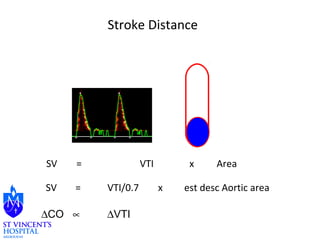
Stroke Distance 
SV = VTI x Area 
SV = VTI/0.7 x est desc Aortic area 
DCO µ DVTI
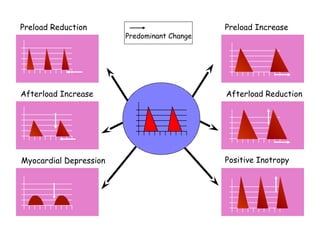
Preload Reduction Preload Increase 
Predominant Change 
Afterload Increase Afterload Reduction 
Myocardial Depression Positive Inotropy
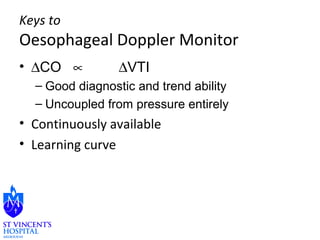
Keys to 
Oesophageal Doppler Monitor 
• DCO µ DVTI 
– Good diagnostic and trend ability 
– Uncoupled from pressure entirely 
• Continuously available 
• Learning curve
Method Proprietary device Invasive elements Parameters 
Oesophageal 
Doppler 
CardioQTM, Deltex Medical Oesoph. Doppler 
output 
probe 
cardiac invasive Minimally PVI CO, SV, Ftc 
CardioQ PLUS OD plus arterial 
line 
CO, SV 
Transcutaneous 
Doppler 
Ultrasound CO monitor, 
USCOMTM 
Nil CO, SV 
APCO 
uncalibrated 
Vigileo/FloTracTM, Edwards 
Lifesciences (1) 
Arterial line CO, SV, SVV 
LiDCO Rapide, LiDCO Ltd Arterial line CO, SV, SVV, 
PPV 
Finepress, Nexfin, Edwards Finger cuff CO, SV, SVV 
Arterial Pressure 
CO calibrated 
LiDCO Plus, LiDCO Ltd (2) Arterial line CO, SV, SVV, 
PPV 
PiCCOplusTM, Pulsion Medical 
Systems 
Central Venous 
catheter and 
femoral arterial 
line 
CO, SV, ITBV, 
EVLW 
Plethysmography Masimo Rainbow SET Pulse CO, 
Masimo Corp. 
Pulse oximeter dPOP 
monitoring 
monitoring 
Minimally invasive cardiac output
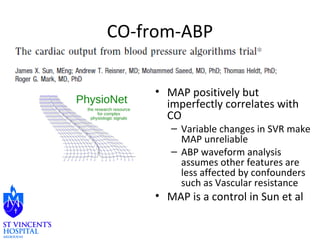
CO-from-ABP 
• MAP positively but 
imperfectly correlates with 
CO 
– Variable changes in SVR make 
MAP unreliable 
– ABP waveform analysis 
assumes other features are 
less affected by confounders 
such as Vascular resistance 
• MAP is a control in Sun et al
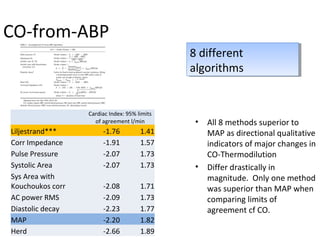
CO-from-ABP 
8 different 
algorithms 
8 different 
algorithms 
• All 8 methods superior to 
MAP as directional qualitative 
indicators of major changes in 
CO-Thermodilution 
• Differ drastically in 
magnitude. Only one method 
was superior than MAP when 
comparing limits of 
agreement cf CO. 
Cardiac Index: 95% limits 
of agreement l/min 
Liljestrand*** -1.76 1.41 
Corr Impedance -1.91 1.57 
Pulse Pressure -2.07 1.73 
Systolic Area -2.07 1.73 
Sys Area with 
Kouchoukos corr -2.08 1.71 
AC power RMS -2.09 1.73 
Diastolic decay -2.23 1.77 
MAP -2.20 1.82 
Herd -2.66 1.89
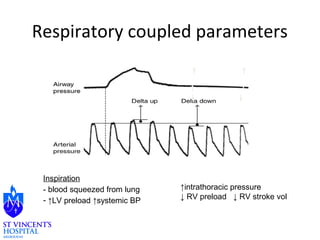
Respiratory coupled parameters 
SPV 
Inspiration 
- blood squeezed from lung 
- ↑LV preload ↑systemic BP 
↑intrathoracic pressure 
↓ RV preload ↓ RV stroke vol
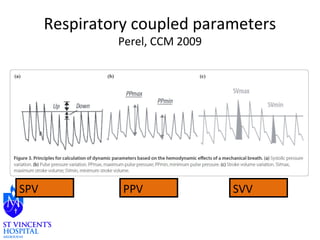
Respiratory coupled parameters 
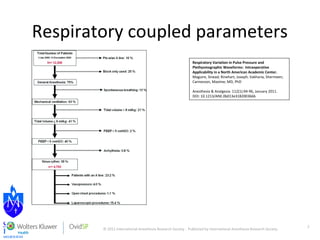
Perel, CCM 2009 
SPV PPV SVV
Respiratory coupled parameters 
© 2011 International Anesthesia Research Society . Published by International Anesthesia Research Society. 
2 
Respiratory Variation in Pulse Pressure and 
Plethysmographic Waveforms: Intraoperative 
Applicability in a North American Academic Center. 
Maguire, Sinead; Rinehart, Joseph; Vakharia, Shermeen; 
Cannesson, Maxime; MD, PhD 
Anesthesia & Analgesia. 112(1):94-96, January 2011. 
DOI: 10.1213/ANE.0b013e318200366b
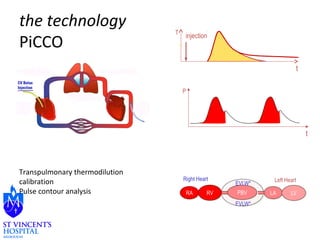
the technology 
PiCCO injection 
t 
T 
P 
t 
Transpulmonary thermodilution 
calibration 
Pulse contour analysis
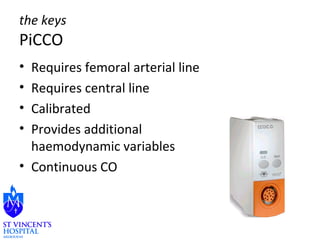
the keys 
PiCCO 
• Requires femoral arterial line 
• Requires central line 
• Calibrated 
• Provides additional 
haemodynamic variables 
• Continuous CO
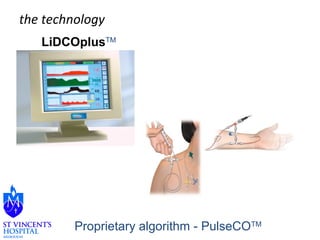
the technology 
LiDCOplusTM 
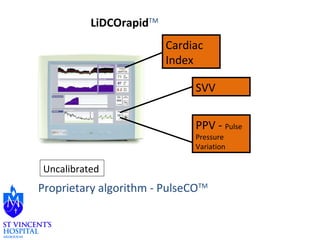
Proprietary algorithm - PulseCOTM
LiDCOrapidTM 
Uncalibrated 
Cardiac 
Index 
SVV 
PPV - Pulse 
Pressure 
Variation 
Proprietary algorithm - PulseCOTM
the keys to 
LiDCO Plus and Rapid 
• Fick principle Lithium dilution calibration 
• Pulse power algorithm 
– “Morphology independent” 
• Arterial line required but utilises data cable 
from standard monitoring system. No specific 
transducer is needed
the technology 
Vigeleo Flotrac 
• Arterial pulsatility - sd of 
pressure wave 
• K 
• sex, age, ht and wgt 
• Waveform characteristics 
(skewness and kurtosis)
the technology 
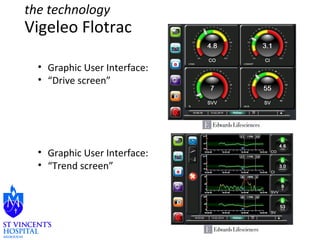
Vigeleo Flotrac 
• Graphic User Interface: 
• “Drive screen” 
• Graphic User Interface: 
• “Trend screen”
the technology 
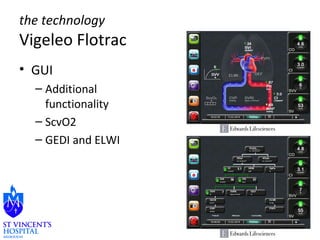
Vigeleo Flotrac 
• GUI 
– Additional 
functionality 
– ScvO2 
– GEDI and ELWI
the keys to 
Vigeleo Flotrac 
• Equipment: arterial line 
• Flow sensor connected directly to arterial line 
• Accuracy has been dependent on software 
upgrades/version. 
– Previously struggled with changes in compliance, 
low SVR states 
– version 4 being released.
the technology 
Nexfin, aka Finepress 
• Volume clamp with finger cuff 
• HRS: heart reference system 
– measures and corrects pressure difference btw finger 
and heart 
•200Hz sampling rate 
• Stroke Volume – 3 element Windkessel model 
• Up to 12% may have inadequate signal
the technology 
Finepress 
• Nexfin and 
arterial 
pressure 
– MAP 
correlates well 
– SBP 
underestimate 
s 
– CI has looser 
agreement 
Fischer M O et al. Br. J. Anaesth. 2012;109:514-521 
© The Author [2012]. Published by Oxford University Press on behalf of the British Journal of 
Anaesthesia. All rights reserved. For Permissions, please email: 
journals.permissions@oup.com
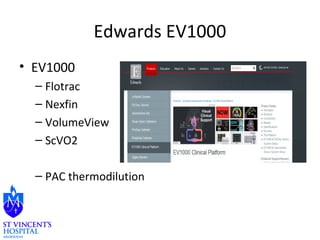
Edwards EV1000 
• EV1000 
– Flotrac 
– Nexfin 
– VolumeView 
– ScVO2 
– PAC thermodilution
the technology 
Masimo 
• Pulse oximetry 
• Plethysmographic 
variability index (PVI) 
– It measures the dynamic 
changes in perfusion index 
(PI) over respiratory cycles 
and calculated as follows: 
– PVI = [(PImax – PImin)/PImax] x 
100%. 
• ΔPOP 
• COHb 
• Continuous Hb
utility 
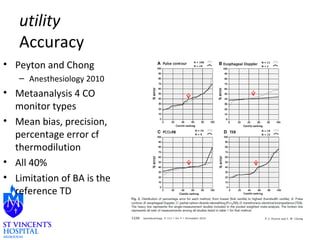
Accuracy 
• Peyton and Chong 
– Anesthesiology 2010 
• Metaanalysis 4 CO 
monitor types 
• Mean bias, precision, 
percentage error cf 
thermodilution 
• All 40% 
• Limitation of BA is the 
reference TD
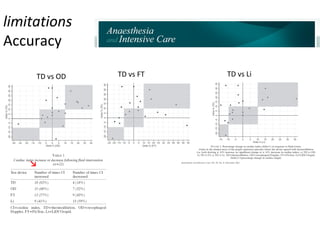
limitations 
Accuracy 
TD vs OD TD vs FT TD vs Li 
↘
limitations 
Accuracy 
Lorsomradee, JCVA 2009
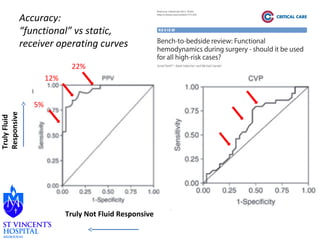
Accuracy: 
“functional” vs static, 
receiver operating curves 
Truly Not Fluid Responsive 
Truly Fluid 
Responsive 
22% 
12% 
5%
utility 
Accuracy 
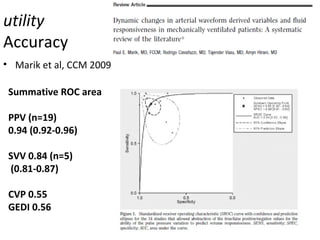
• Marik et al, CCM 2009 
Summative ROC area 
PPV (n=19) 
0.94 (0.92-0.96) 
SVV 0.84 (n=5) 
(0.81-0.87) 
CVP 0.55 
GEDI 0.56
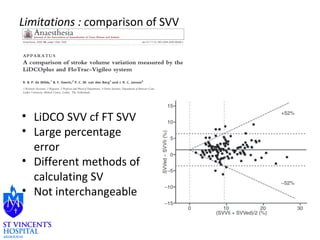
Limitations : comparison of SVV 
• LiDCO SVV cf FT SVV 
• Large percentage 
error 
• Different methods of 
calculating SV 
• Not interchangeable
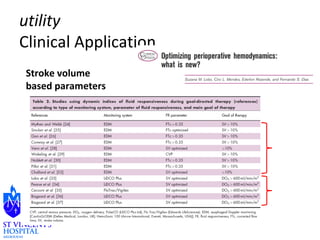
utility 
Clinical Application 
Stroke volume 
based parameters
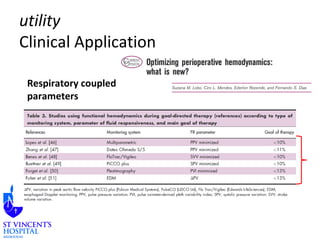
utility 
Clinical Application 
Respiratory coupled 
parameters
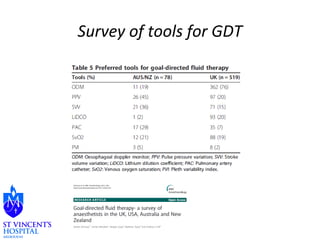
Survey of tools for GDT
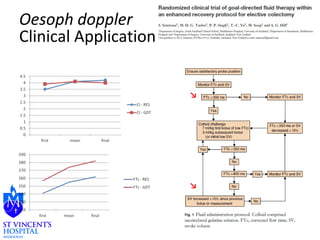
Oesoph doppler 
Clinical Application 
↘ 
↘
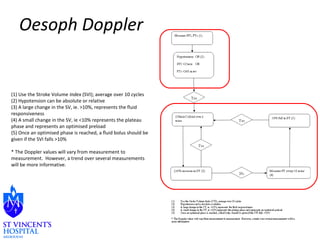
Oesoph Doppler 
(1) Use the Stroke Volume Index (SVI); average over 10 cycles 
(2) Hypotension can be absolute or relative 
(3) A large change in the SV, ie. >10%, represents the fluid 
responsiveness 
(4) A small change in the SV, ie <10% represents the plateau 
phase and represents an optimised preload 
(5) Once an optimised phase is reached, a fluid bolus should be 
given if the SVI falls >10% 
* The Doppler values will vary from measurement to 
measurement. However, a trend over several measurements 
will be more informative.
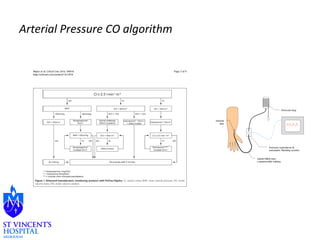
Arterial Pressure CO algorithm
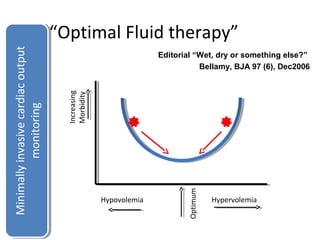
“Optimal Fluid therapy” 
Optimum 
Increasing 
Morbidity 
Hypovolemia Hypervolemia 
Minimally invasive cardiac output 
monitoring 
monitoring 
Editorial “Wet, dry or something else?” 
Bellamy, BJA 97 (6), Dec2006
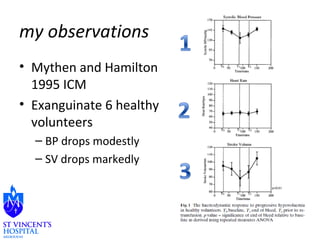
my observations 
• Mythen and Hamilton 
1995 ICM 
• Exanguinate 6 healthy 
volunteers 
– BP drops modestly 
– SV drops markedly
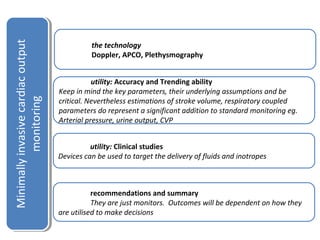
the technology 
Doppler, APCO, Plethysmography 
utility: Accuracy and Trending ability 
Keep in mind the key parameters, their underlying assumptions and be 
critical. Nevertheless estimations of stroke volume, respiratory coupled 
parameters do represent a significant addition to standard monitoring eg. 
Arterial pressure, urine output, CVP 
utility: Clinical studies 
Devices can be used to target the delivery of fluids and inotropes 
recommendations and summary 
They are just monitors. Outcomes will be dependent on how they 
are utilised to make decisions 
Minimally invasive cardiac output 
monitoring 
monitoring

01 tuong phan

  • 1.
    Advances in haemodynamic monitoring in Anaesthesia and ICU Dr Tuong Phan Staff Specialist Anaesthetist Dept Anaesthesia and Pain Medicine St Vincent’s Hospital Melbourne
  • 2.
    the technology Beyondstandard monitoring Keys to understanding utility Accuracy Trending ability utility Clinical studies Recommendations and summary Minimally invasive cardiac output Minimally invasive cardiac output monitoring monitoring
  • 3.
    Method Proprietary deviceInvasive elements Parameters Oesophageal Doppler CardioQTM, Deltex Medical Oesoph. Doppler output probe cardiac invasive Minimally PVI CO, SV, Ftc CardioQ PLUS OD plus arterial line CO, SV Transcutaneous Doppler Ultrasound CO monitor, USCOMTM Nil CO, SV APCO uncalibrated Vigileo/FloTracTM, Edwards Lifesciences (1) Arterial line CO, SV, SVV LiDCO Rapide, LiDCO Ltd Arterial line CO, SV, SVV, PPV Finepress, Nexfin, Edwards Finger cuff CO, SV, SVV Arterial Pressure CO calibrated LiDCO Plus, LiDCO Ltd (2) Arterial line CO, SV, SVV, PPV PiCCOplusTM, Pulsion Medical Systems Central Venous catheter and femoral arterial line CO, SV, ITBV, EVLW Plethysmography Masimo Rainbow SET Pulse CO, Masimo Corp. Pulse oximeter dPOP monitoring monitoring Minimally invasive cardiac output
  • 4.
    Method Proprietary deviceInvasive elements Parameters Oesophageal Doppler CardioQTM, Deltex Medical Oesoph. Doppler output probe cardiac invasive Minimally PVI CO, SV, Ftc CardioQ PLUS OD plus arterial line CO, SV Transcutaneous Doppler Ultrasound CO monitor, USCOMTM Nil CO, SV APCO uncalibrated Vigileo/FloTracTM, Edwards Lifesciences (1) Arterial line CO, SV, SVV LiDCO Rapide, LiDCO Ltd Arterial line CO, SV, SVV, PPV Finepress, Nexfin, Edwards Finger cuff CO, SV, SVV Arterial Pressure CO calibrated LiDCO Plus, LiDCO Ltd (2) Arterial line CO, SV, SVV, PPV PiCCOplusTM, Pulsion Medical Systems Central Venous catheter and femoral arterial line CO, SV, ITBV, EVLW Plethysmography Masimo Rainbow SET Pulse CO, Masimo Corp. Pulse oximeter dPOP monitoring monitoring Minimally invasive cardiac output
  • 5.
    V = Dfc . 2 ft cosq the technology Oesophageal Doppler Monitor
  • 6.
    Stroke Distance SV= VTI x Area SV = VTI/0.7 x est desc Aortic area DCO µ DVTI
  • 7.
    Preload Reduction PreloadIncrease Predominant Change Afterload Increase Afterload Reduction Myocardial Depression Positive Inotropy
  • 8.
    Keys to OesophagealDoppler Monitor • DCO µ DVTI – Good diagnostic and trend ability – Uncoupled from pressure entirely • Continuously available • Learning curve
  • 9.
    Method Proprietary deviceInvasive elements Parameters Oesophageal Doppler CardioQTM, Deltex Medical Oesoph. Doppler output probe cardiac invasive Minimally PVI CO, SV, Ftc CardioQ PLUS OD plus arterial line CO, SV Transcutaneous Doppler Ultrasound CO monitor, USCOMTM Nil CO, SV APCO uncalibrated Vigileo/FloTracTM, Edwards Lifesciences (1) Arterial line CO, SV, SVV LiDCO Rapide, LiDCO Ltd Arterial line CO, SV, SVV, PPV Finepress, Nexfin, Edwards Finger cuff CO, SV, SVV Arterial Pressure CO calibrated LiDCO Plus, LiDCO Ltd (2) Arterial line CO, SV, SVV, PPV PiCCOplusTM, Pulsion Medical Systems Central Venous catheter and femoral arterial line CO, SV, ITBV, EVLW Plethysmography Masimo Rainbow SET Pulse CO, Masimo Corp. Pulse oximeter dPOP monitoring monitoring Minimally invasive cardiac output
  • 10.
    CO-from-ABP • MAPpositively but imperfectly correlates with CO – Variable changes in SVR make MAP unreliable – ABP waveform analysis assumes other features are less affected by confounders such as Vascular resistance • MAP is a control in Sun et al
  • 11.
    CO-from-ABP 8 different algorithms 8 different algorithms • All 8 methods superior to MAP as directional qualitative indicators of major changes in CO-Thermodilution • Differ drastically in magnitude. Only one method was superior than MAP when comparing limits of agreement cf CO. Cardiac Index: 95% limits of agreement l/min Liljestrand*** -1.76 1.41 Corr Impedance -1.91 1.57 Pulse Pressure -2.07 1.73 Systolic Area -2.07 1.73 Sys Area with Kouchoukos corr -2.08 1.71 AC power RMS -2.09 1.73 Diastolic decay -2.23 1.77 MAP -2.20 1.82 Herd -2.66 1.89
  • 12.
    Respiratory coupled parameters SPV Inspiration - blood squeezed from lung - ↑LV preload ↑systemic BP ↑intrathoracic pressure ↓ RV preload ↓ RV stroke vol
  • 13.
    Respiratory coupled parameters Perel, CCM 2009 SPV PPV SVV
  • 14.
    Respiratory coupled parameters © 2011 International Anesthesia Research Society . Published by International Anesthesia Research Society. 2 Respiratory Variation in Pulse Pressure and Plethysmographic Waveforms: Intraoperative Applicability in a North American Academic Center. Maguire, Sinead; Rinehart, Joseph; Vakharia, Shermeen; Cannesson, Maxime; MD, PhD Anesthesia & Analgesia. 112(1):94-96, January 2011. DOI: 10.1213/ANE.0b013e318200366b
  • 15.
    the technology PiCCOinjection t T P t Transpulmonary thermodilution calibration Pulse contour analysis
  • 16.
    the keys PiCCO • Requires femoral arterial line • Requires central line • Calibrated • Provides additional haemodynamic variables • Continuous CO
  • 17.
    the technology LiDCOplusTM Proprietary algorithm - PulseCOTM
  • 18.
    LiDCOrapidTM Uncalibrated Cardiac Index SVV PPV - Pulse Pressure Variation Proprietary algorithm - PulseCOTM
  • 19.
    the keys to LiDCO Plus and Rapid • Fick principle Lithium dilution calibration • Pulse power algorithm – “Morphology independent” • Arterial line required but utilises data cable from standard monitoring system. No specific transducer is needed
  • 20.
    the technology VigeleoFlotrac • Arterial pulsatility - sd of pressure wave • K • sex, age, ht and wgt • Waveform characteristics (skewness and kurtosis)
  • 21.
    the technology VigeleoFlotrac • Graphic User Interface: • “Drive screen” • Graphic User Interface: • “Trend screen”
  • 22.
    the technology VigeleoFlotrac • GUI – Additional functionality – ScvO2 – GEDI and ELWI
  • 23.
    the keys to Vigeleo Flotrac • Equipment: arterial line • Flow sensor connected directly to arterial line • Accuracy has been dependent on software upgrades/version. – Previously struggled with changes in compliance, low SVR states – version 4 being released.
  • 24.
    the technology Nexfin,aka Finepress • Volume clamp with finger cuff • HRS: heart reference system – measures and corrects pressure difference btw finger and heart •200Hz sampling rate • Stroke Volume – 3 element Windkessel model • Up to 12% may have inadequate signal
  • 26.
    the technology Finepress • Nexfin and arterial pressure – MAP correlates well – SBP underestimate s – CI has looser agreement Fischer M O et al. Br. J. Anaesth. 2012;109:514-521 © The Author [2012]. Published by Oxford University Press on behalf of the British Journal of Anaesthesia. All rights reserved. For Permissions, please email: journals.permissions@oup.com
  • 27.
    Edwards EV1000 •EV1000 – Flotrac – Nexfin – VolumeView – ScVO2 – PAC thermodilution
  • 28.
    the technology Masimo • Pulse oximetry • Plethysmographic variability index (PVI) – It measures the dynamic changes in perfusion index (PI) over respiratory cycles and calculated as follows: – PVI = [(PImax – PImin)/PImax] x 100%. • ΔPOP • COHb • Continuous Hb
  • 29.
    utility Accuracy •Peyton and Chong – Anesthesiology 2010 • Metaanalysis 4 CO monitor types • Mean bias, precision, percentage error cf thermodilution • All 40% • Limitation of BA is the reference TD
  • 30.
    limitations Accuracy TDvs OD TD vs FT TD vs Li ↘
  • 31.
  • 32.
    Accuracy: “functional” vsstatic, receiver operating curves Truly Not Fluid Responsive Truly Fluid Responsive 22% 12% 5%
  • 33.
    utility Accuracy •Marik et al, CCM 2009 Summative ROC area PPV (n=19) 0.94 (0.92-0.96) SVV 0.84 (n=5) (0.81-0.87) CVP 0.55 GEDI 0.56
  • 34.
    Limitations : comparisonof SVV • LiDCO SVV cf FT SVV • Large percentage error • Different methods of calculating SV • Not interchangeable
  • 35.
    utility Clinical Application Stroke volume based parameters
  • 36.
    utility Clinical Application Respiratory coupled parameters
  • 37.
  • 38.
    Oesoph doppler ClinicalApplication ↘ ↘
  • 39.
    Oesoph Doppler (1)Use the Stroke Volume Index (SVI); average over 10 cycles (2) Hypotension can be absolute or relative (3) A large change in the SV, ie. >10%, represents the fluid responsiveness (4) A small change in the SV, ie <10% represents the plateau phase and represents an optimised preload (5) Once an optimised phase is reached, a fluid bolus should be given if the SVI falls >10% * The Doppler values will vary from measurement to measurement. However, a trend over several measurements will be more informative.
  • 40.
  • 41.
    “Optimal Fluid therapy” Optimum Increasing Morbidity Hypovolemia Hypervolemia Minimally invasive cardiac output Minimally invasive cardiac output monitoring monitoring Editorial “Wet, dry or something else?” Bellamy, BJA 97 (6), Dec2006
  • 42.
    my observations •Mythen and Hamilton 1995 ICM • Exanguinate 6 healthy volunteers – BP drops modestly – SV drops markedly
  • 43.
    the technology Doppler,APCO, Plethysmography utility: Accuracy and Trending ability Keep in mind the key parameters, their underlying assumptions and be critical. Nevertheless estimations of stroke volume, respiratory coupled parameters do represent a significant addition to standard monitoring eg. Arterial pressure, urine output, CVP utility: Clinical studies Devices can be used to target the delivery of fluids and inotropes recommendations and summary They are just monitors. Outcomes will be dependent on how they are utilised to make decisions Minimally invasive cardiac output Minimally invasive cardiac output monitoring monitoring

Editor's Notes

  • #2 AACA invitation to speak Disclosure – ANZCA and local research funds. Unrestricted use of equipment from Lidco. No commercial interest to declare.
  • #4 Bmeye, netherlands Nexfin is based on a volume clamp system penaz 1980s Cuff will vary to keep the arterial unloaded – position where arterial and cuff pressure are equal. As the arterial pressure rises in the mid phallanx, the cuff pressure rises in parallel. Pressure waveform is derived. And hydrostatic pressure correction. This indirect arterial pressure is then utilised to form a reconstructed brachial pressure waveform that acts as the basis for estimated CO and SV.
  • #5 Bmeye, netherlands Nexfin is based on a volume clamp system penaz 1980s Cuff will vary to keep the arterial unloaded – position where arterial and cuff pressure are equal. As the arterial pressure rises in the mid phallanx, the cuff pressure rises in parallel. Pressure waveform is derived. And hydrostatic pressure correction. This indirect arterial pressure is then utilised to form a reconstructed brachial pressure waveform that acts as the basis for estimated CO and SV.
  • #6 TOE: spectral display is the form that the velocities are represented on the screem. Y velocity of rbc, X time, brightness no of rbc’s. Velocity Time Integral x CSA (measured) = SV VTI x CSA (nomogram) = SV
  • #8 Brief talk about the shapes and how they change. Don’t get too bogged down in this, except LVF is one of the shape questions.
  • #10 Bmeye, netherlands Nexfin is based on a volume clamp system penaz 1980s Cuff will vary to keep the arterial unloaded – position where arterial and cuff pressure are equal. As the arterial pressure rises in the mid phallanx, the cuff pressure rises in parallel. Pressure waveform is derived. And hydrostatic pressure correction. This indirect arterial pressure is then utilised to form a reconstructed brachial pressure waveform that acts as the basis for estimated CO and SV.
  • #11 CCM 2009 MIT, MGH, Harvard, Macgill Beth Israel Open source database containing Critical care physiologic parameters MAP and CO TD Used that to model 8 different ways of calculating CO from ABP Some PP/RMS=Lidco, Modelflow, PICCO but only estimations of proprietary which remain black box. All better than MAP at directional CO. Good agreement best 78% Lillestrand Magnitude varied enormously. Only Lillestrand better than MAP They have called on vendors to subject their devices to this database so we can test the accuracy and allow for comparison.
  • #13 The difference between the maximum and the minimum systolic pressure over a single respiratory cycle, the systolic pressure variation (SPV). Inspiration - blood squeezed from lung LV preload systemic BP intrathoracic pressure- RV preload RV stroke vol
  • #14 The respiratory changes in stroke volume can be measure as the Systolic pressure variation less accurate Pulse Pressure variation diff btw sbp and dbp or svv apco monitor
  • #15 Maguire 2011 Screened for applicability using a retrospective database. GA, PPV, TV, PEEP, SR 39% - POP can be used 23% had arterial line AND meet criteria Don’t take numbers to heart. As retrospective and used all comers not just those in whom CO monitoring was beig considered. Issue with low TV ventilation as well. Futier NEJM 2013 “improve study”
  • #18 Lithium injected centrally or peripherally Lithium sensor placed on ART line Dilution curve shown on screen
  • #19 Lithium injected centrally or peripherally Lithium sensor placed on ART line Dilution curve shown on screen
  • #22 GUI graphical User interface Enticing Trend screen Drive screen Treatment algorithm Beating heart screen Important – marks an improvement. Same two key parameters bundled
  • #27 The relationship between absolute values of (a) arterial invasive and photoplethysmographic systolic arterial pressure (220 paired data points); (b) arterial invasive and photoplethysmographic diastolic arterial pressure (220 paired data points); (c) arterial invasive and photoplethysmographic mean arterial pressure (220 paired data points); and (d) transpulmonary thermodilution and photoplethysmographic CI (120 paired data points). AI, arterial invasive; CI, cardiac index; DAP, diastolic arterial pressure; MAP, mean arterial pressure; NF, Nexfin; SAP, systolic arterial pressure; TD, transpulmonary thermodilution.
  • #28 An important concept Integration. Into the anaesthetic monitoring modules - aside from PPV. Ev1000.
  • #30 However, it means an even wider precision is now being quoted in subsequent papers as being acceptable. All under certain conditions will obtain that no matter how bad they are. Eg. Stable ICU vs post CPB Certainly PE does not allow discimination between the monitors
  • #31 Whilst we may conclude that with TD, they are broadly the same as seen in the numerous calibatration study. There are relatively few study that compare them head to head. Small study we did in 2009. Grey zones represent agreement in direction. RUQ and LLQ. Difficult to demonstrate good agreement in general. But OD tracked fluid changes better. FT and li less so. 22 Cardiac patients in 2009
  • #32 Larger variability in vasopressors Lorsomradee JCVA 2009 FT 1.07 52 elective cabg Also higher error sternotomy, phenylephrine post cpb and AI cf baseline Inability to manage morhpological changes in arterial waveform..
  • #33 In assessing FR parameters, ROC to show sensitivity – ability to show true positives. And also true negatives – not FR. PPV at this threshold say 12% good sensitivity at it increases. And good specificity as it decreases. AUC Conversely, CVP at any threshold has a specificity and sensitivity or 50% not much better than toss of a coin. Which I think is being a little harsh and dosent’ reflect dCVP. ROC aren’t everything but are used for resp coupled parameters In this review of functional haemodynamics Main author declared interest in haemodynamic monitoring BM Eye, Pulsion.
  • #34 Marik CCM 2009 Metaanalysis of “dynamic changes in arterial waveform derived variables and FR” Highly accurate. Link btw cumulative fluid balance and poor outcomes – makes sense to give fluid in those who have demonstrated FR. PPV/SVV dynamically reflects patients position on the starling curve
  • #35 Limitations aside, there are outcome studies that utilise these monitors. Calculation of SV. Key is correction for individual arterial compliance. Lidco uses pulse power. Flotrac uses Langewouter equation. Both systems lead to diminished SV at higher pressure compared to lower pressurelevels with the same pressure curve. Large PE 52%, if one 10% SVV the other could be 5 or 15% 95% of the time. Urged caution in use as sole variable. Threshold probably set higher. HUT, FL in 15 cardiac patients Not interchangeable.
  • #36 Tabulation of monitoring system and the goal of therapy Interesting to note that the users of APCO chose not just fluid but inotrope optimisation. Speculate why? Perhaps fluid optimisation alone with APCO unlikely to yield a significant treatmet effect? Or is it a function of ICU where ease of integration of APCO cf complexity of OD? Initialy OD but now also APCO Utility of the devices and the parameters, needs the value of outcome studies beyond calibration/accuracy studies. However, still limited by small studies in disparate populations. Reproducibility in unclear. Still better than textbook anaesthesia “uo, blood pressure, assumptions to how dry the patient is, cvp, lacatate, bxs” which is devoid of rct of whatever description”
  • #37 More recently, no also minimsation of respiratory coupled paramenters. Inlcuding PVI. Interestinglys Futier decided to use dPV which is a standout rather than the standard. Not conviced about respiratory couple doppler.
  • #39 Srinivasa, Taylor, Hill No significant change in the CO (SV not mentioned) makes it unclear whether optimisation was achieved. 591 vs 297 colloid *
  • #42 Some studies I suspect start with hypovolemia and as a result tdargetted therapy may have benefitted the patients Some studies are hypervolemia. Compare traditional approach to a new therapeutic idea in a sufficiently high number of patients If the study group is better than the control then the study group is the future If not then nothing changes Problems No easily defined control – heterogeneity of practice. Btw clinicians and hospitals and countries. Not just of fluid practice but periop practice What is restrictive in one group is liberal in another
  • #43 Whilst it is very difficult to demonstrate definitive benefit. RCT with GDT not replicating those large treatment effects seen in earlier studies. To be published soon. What you do with those parameters may be contestable. But they tell you more about preload, stroke volume. Keep in mind the key parameters, their underlying assumptions and be critical. The role of a second monitor Sth that is not BP or UO Reinforces decision making. Alters decision making.