COMPUTER AIDED MANUFACTURING(2171903)
By :- Sajan Gohel (160123119010)
Branch: - Mechanical
Batch: - 7D1
Guided by: prof. himanshu barot
Gandhinagar Institute of Technology
Topic: -
FLEXIBLE MANUFACTURING SYSTEM
Content
Component of FMS
Types of flexibility
Flexible manufacturing system
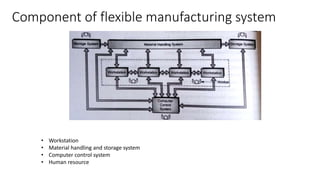
Component of flexible manufacturing system
• Workstation
• Material handling and storage system
• Computer control system
• Human resource
Types of flexibility
• Flexibility of product variety
• flexibility of production volume
• flexibility of delivery time
• flexibility of material handling
• flexibility of operations
• flexibility of expansion
• flexibility of market
Flexible manufacturing system
• The FMS was first conceptualized for machining, and it
• required the prior development of NC.
• This concept is credited to David Williamson, a British engineer during
mid-1960s.
• In late 1960s the first FMS machining system was installed at
Ingersoll-Randcompany in Virginia.
• Germany implemented its first FMS in 1969, in cooperation with the
university of Stuttgart.
• Russia and Japan implemented FMS in 1972.
What is FMS ???
• A flexible manufacturing system is An automated machine cell,
consisting of a group of processing workstations, interconnected with
automated material handling and storage system.
• The FMS is most suited for the mid-variety, mid-volume production
range
Why FMS ?
• External changes such as change in product design and production
system.
• Optimizing the manufacturing cycle time
• Reduced production costs
• Overcoming internal changes like breakdowns etc
What makes it flexible???
• Three capabilities that a manufacturing system must possess to be a
flexible.
1.The ability to identify and distinguish among the different part styles
processed by the system.
2.Quick changeover of operating instructions, and
3.Quick changeover of physical setup.
Classification of FMS
• Flexible manufacturing systems can be distinguished according to the
number of machines in the system.
The following are typical categories:
• Single machine cell
• Flexible manufacturing cell
• Flexible manufacturing system
Single Machine Cell (SMC)
• A single machine cell consists of one CNC machining centre combined
with a parts storage system for unattended operation.
• Completed parts are periodically unloaded from the parts storage
unit, and raw work parts are loaded into it
Flexible Manufacturing Cell (FMC)
• A flexible manufacturing cell consists of two or three processing
workstations (typically CNC machining centers) plus a part handling
system.
• The part handling system is connected to a load/unload station.
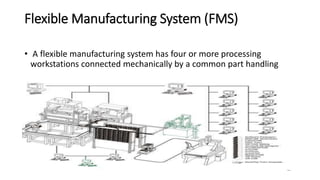
Flexible Manufacturing System (FMS)
• A flexible manufacturing system has four or more processing
workstations connected mechanically by a common part handling
THANK YOU

Flexible manufacturing system - Computer aided manufacturing

  • 1.
    COMPUTER AIDED MANUFACTURING(2171903) By:- Sajan Gohel (160123119010) Branch: - Mechanical Batch: - 7D1 Guided by: prof. himanshu barot Gandhinagar Institute of Technology Topic: - FLEXIBLE MANUFACTURING SYSTEM
  • 2.
    Content Component of FMS Typesof flexibility Flexible manufacturing system
  • 3.
    Component of flexiblemanufacturing system • Workstation • Material handling and storage system • Computer control system • Human resource
  • 4.
    Types of flexibility •Flexibility of product variety • flexibility of production volume • flexibility of delivery time • flexibility of material handling • flexibility of operations • flexibility of expansion • flexibility of market
  • 5.
    Flexible manufacturing system •The FMS was first conceptualized for machining, and it • required the prior development of NC. • This concept is credited to David Williamson, a British engineer during mid-1960s. • In late 1960s the first FMS machining system was installed at Ingersoll-Randcompany in Virginia. • Germany implemented its first FMS in 1969, in cooperation with the university of Stuttgart. • Russia and Japan implemented FMS in 1972.
  • 6.
    What is FMS??? • A flexible manufacturing system is An automated machine cell, consisting of a group of processing workstations, interconnected with automated material handling and storage system. • The FMS is most suited for the mid-variety, mid-volume production range
  • 7.
    Why FMS ? •External changes such as change in product design and production system. • Optimizing the manufacturing cycle time • Reduced production costs • Overcoming internal changes like breakdowns etc
  • 8.
    What makes itflexible??? • Three capabilities that a manufacturing system must possess to be a flexible. 1.The ability to identify and distinguish among the different part styles processed by the system. 2.Quick changeover of operating instructions, and 3.Quick changeover of physical setup.
  • 9.
    Classification of FMS •Flexible manufacturing systems can be distinguished according to the number of machines in the system. The following are typical categories: • Single machine cell • Flexible manufacturing cell • Flexible manufacturing system
  • 10.
    Single Machine Cell(SMC) • A single machine cell consists of one CNC machining centre combined with a parts storage system for unattended operation. • Completed parts are periodically unloaded from the parts storage unit, and raw work parts are loaded into it
  • 11.
    Flexible Manufacturing Cell(FMC) • A flexible manufacturing cell consists of two or three processing workstations (typically CNC machining centers) plus a part handling system. • The part handling system is connected to a load/unload station.
  • 12.
    Flexible Manufacturing System(FMS) • A flexible manufacturing system has four or more processing workstations connected mechanically by a common part handling
  • 13.