FLEXIBLE
MANUFACTURING
SYSTEM
Submitted by:
Gyanendra Meena
Mani Shankar
Irshad Hussain
CONTENTS
1. History of FMS
2. WHY FMS ?
3. Basic components of FMS
4. FMS equipment
5. Types of FMS
6. Flexibility in FMS & applications of FMS
7. advantages and disadvantage
8. Challenges with FMS
9. Conclusion & references
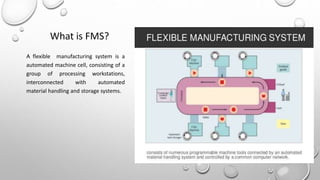
What is FMS?
A flexible manufacturing system is a
automated machine cell, consisting of a
group of processing workstations,
interconnected with automated
material handling and storage systems.
HISTORY OF FMS
The first fms was patented in 1965 by Theo Williamson who made numerically controlled
equipment.
Examples of numerically controlled equipment are like a CNC lathes or mills which is called varing
types of fms
Components of FMS systems
Robotics
Material handling/ transport
Machines
Manual/ automated assembly cells
Computers
Controllers
Software
Networks
WHY FMS ?
• External changes such as change in product design and production system.
• Optimizing the manufacturing cycle time
• Reduced production costs
• Overcoming internal changes like breakdowns etc.
BASIC COMPONENTS OF FMS
Workstations
Automated material handling and storage systems
Computer control system
WORKSTATION
Substations
1. load/unload stations
2. Machining stations
3. Other processing stations
4. assembly
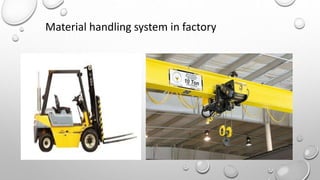
Material handling system in factory
Types of FMS
Sequential FMS
Random FMS
Dedicated FMS
Engineered FMS
Flexibility in FMS
Flexibility in manufacturing means the ability to deal with slightly or greatly
mixed parts, to allow variation in parts assembly and variations in process
sequence, change the production volume and change the design of certain
product being manufactured.
Identification of the different production units to perform the correct operation.
Quick changeover of operating instructions.
Quick changeover of physical setups of fixtures, tools and other working units.
Advantages of FMS
To reduce set up and queue times
Improve efficiency
Reduce time for product completion
Utilize human workers better
Improve product routing
Produce a variety of items under one roof
Improve product quality
Produce more product mare quickly
Disadvantages of FMS
Expensive
Substantial pre-planning activity
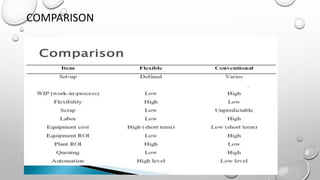
COMPARISON
Determining if fms the best production system for your company
Possible expansion costs associated with implementing fms
Challenges with FMS
Fms is a revolution in the field of manufacturing technology.
Fms can be designed to meet the specific demand of each company
Fms is used for multi task operation.
Fms requires substantial investment of time and resources.
CONCLUSION
Reference
Https://monroeengineering.Com/blog/what-is-a-flexible-manufacturing-system/
Https://www.Referenceforbusiness.Com/management/ex-gov/flexible-manufacturing.Html

Flexible manufacturing system ppt