Theory of Machine (2151902)
Mechanical Department
Sem.: 5th
D (D2)
• Prepared By: Sajan Gohel (160123119010)
Topic : Analysis of internal
expansion shoe break
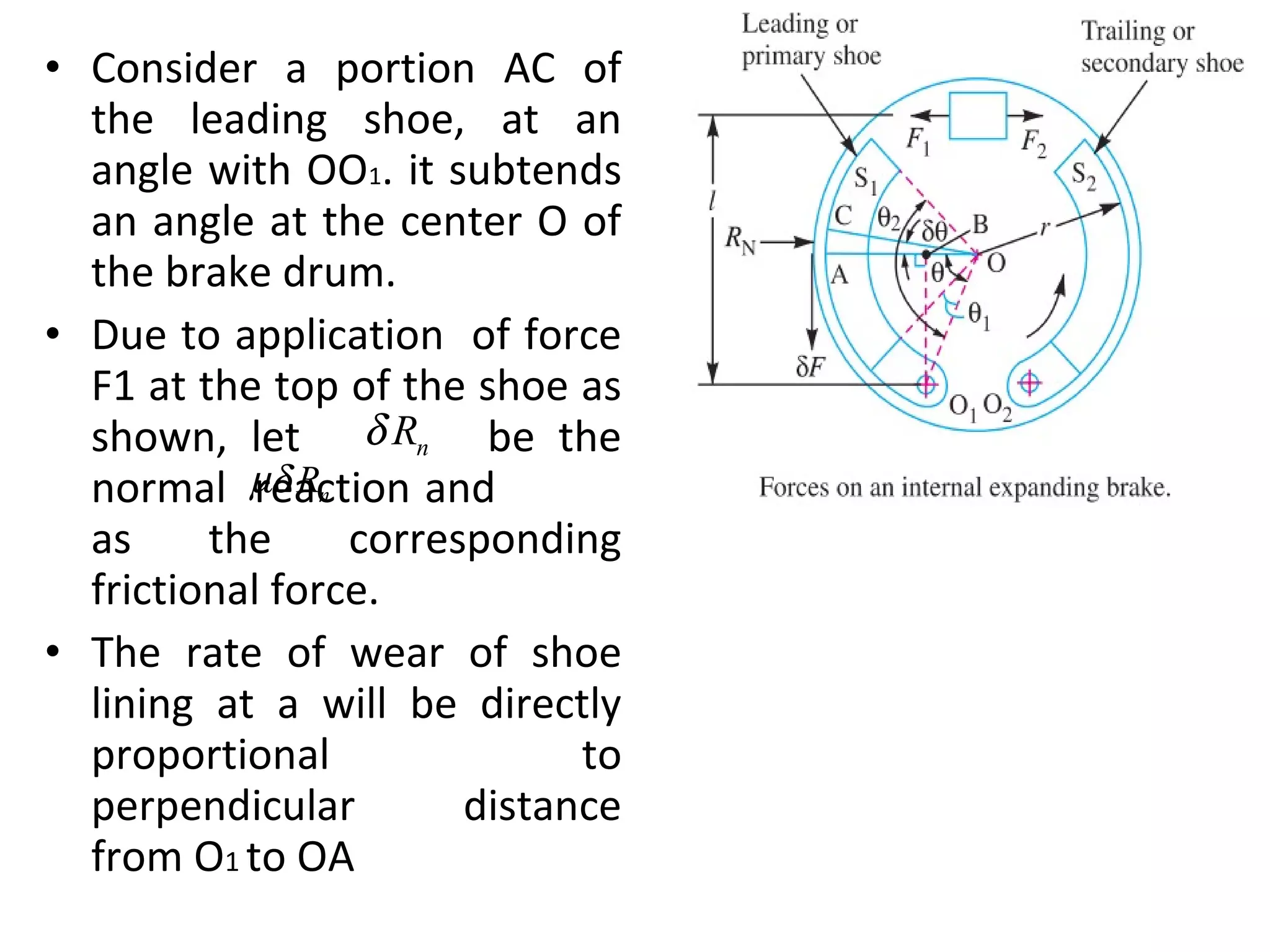
Internal Expanding shoe Brake
 An internal expanding
shoe brake consists of
two shoes S1 and S2.
 The outer surface of the
shoes are lined with some
friction material to increase
the coefficient of friction
and to prevent
wearing away of the metal.
Each shoe is pivoted at one end about a fixed fulcrum O1
and O2 and made to contact a cam at the other end.
 When the cam rotates,
the shoes are pushed
outwards against the
rim of the drum.
 The friction between the
shoes and the drum
produces the braking
torque and hence reduces
the speed of the drum.
 The shoes are normally held
in off position by a spring .
 The drum encloses the entire mechanism to keep out dust and moisture.
Working
 Now we consider the
forces acting on the
brake when the drum
rotates in the
anticlockwise direction :
It may be noted that for
the anticlockwise
direction, the left hand
shoe is known as leading or primary shoe
while the right hand shoe is known as trailing or
secondary shoe.
 r = Internal radius of
the wheel rim.
 b = Width of the
brake lining.
 F1 = Force exerted by
the cam on
the leading shoe.
 F2 = Force exerted by
the cam on the trailing shoe.
= coefficient of friction.
µ
µ
• Consider a portion AC of
the leading shoe, at an
angle with OO1. it subtends
an angle at the center O of
the brake drum.
• Due to application of force
F1 at the top of the shoe as
shown, let be the
normal reaction and
as the corresponding
frictional force.
• The rate of wear of shoe
lining at a will be directly
proportional to
perpendicular distance
from O1 to OA
nRδ
nRµδ
Analysis of Internal Expansion Shoe Break

Analysis of Internal Expansion Shoe Break

  • 1.
    Theory of Machine(2151902) Mechanical Department Sem.: 5th D (D2) • Prepared By: Sajan Gohel (160123119010) Topic : Analysis of internal expansion shoe break
  • 2.
    Internal Expanding shoeBrake  An internal expanding shoe brake consists of two shoes S1 and S2.  The outer surface of the shoes are lined with some friction material to increase the coefficient of friction and to prevent wearing away of the metal. Each shoe is pivoted at one end about a fixed fulcrum O1 and O2 and made to contact a cam at the other end.
  • 3.
     When thecam rotates, the shoes are pushed outwards against the rim of the drum.  The friction between the shoes and the drum produces the braking torque and hence reduces the speed of the drum.  The shoes are normally held in off position by a spring .  The drum encloses the entire mechanism to keep out dust and moisture.
  • 4.
    Working  Now weconsider the forces acting on the brake when the drum rotates in the anticlockwise direction : It may be noted that for the anticlockwise direction, the left hand shoe is known as leading or primary shoe while the right hand shoe is known as trailing or secondary shoe.
  • 5.
     r =Internal radius of the wheel rim.  b = Width of the brake lining.  F1 = Force exerted by the cam on the leading shoe.  F2 = Force exerted by the cam on the trailing shoe. = coefficient of friction. µ µ
  • 6.
    • Consider aportion AC of the leading shoe, at an angle with OO1. it subtends an angle at the center O of the brake drum. • Due to application of force F1 at the top of the shoe as shown, let be the normal reaction and as the corresponding frictional force. • The rate of wear of shoe lining at a will be directly proportional to perpendicular distance from O1 to OA nRδ nRµδ