Unit 4
Energy Storing elements and
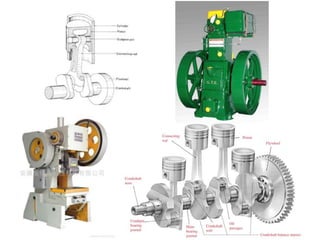
Engine components
Topics
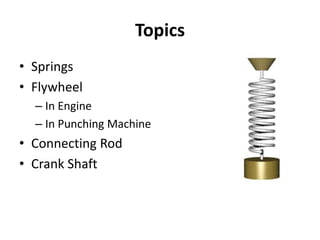
• Springs
• Flywheel
– In Engine
– In Punching Machine
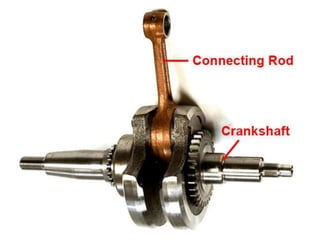
• Connecting Rod
• Crank Shaft
SPRINGS
• Spring is an elastic body whose function is to distort when loaded and to
recover its original shape when the load is removed.
APPLICATION OF SPRINGS
• To apply forces as in brakes, clutches and spring loaded valves.
• To store energy as in watches, toys.
• To measure forces as in spring balance and engine indicators.
• To cushion, absorb or control energy due to either shock or vibration as in
car.
TYPES OF SPRINGS:
Types of Springs
HELICAL SPRINGS
 The helical springs are made up of a wire coiled in the form of helix and is
primarily intended for tensile or compressive loads.
 The cross section of the wire from which the spring made may be circular,
square or rectangular.
 The two forms of helical springs are compression spring and helical
tension springs.
Compression
Helical Spring
Tension Helical Spring
MATERIAL FOR HELICAL SPRINGS
 The material of the spring should have
 high fatigue strength,
 high ductility,
 high resilience and
 creep resistant.
 It largely depends upon the size and service.
 The strength of the wires varies with size, smaller size wires have greater
strength and less ductility, due to the greater degree of cold working.
 Severe service means rapid continuous loading where the ratio of
minimum to maximum load (or stress) is one-half or less, as in automotive
valve springs.
 Average service includes the same stress range as in severe service but
with only intermittent operation, as in engine governor springs and
automobile suspension springs.
 Light service includes springs subjected to loads that are static or very
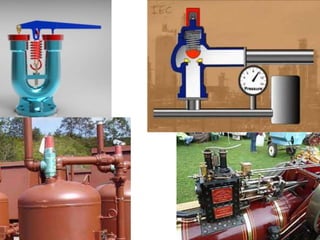
infrequently varied, as in safety valve springs.
 The springs are mostly made from oil-tempered carbon steel wires
containing 0.60 to 0.70 per cent carbon and 0.60 to 1.0 per cent
manganese.
Material for Helical Springs
 Music wire is used for small springs.
 Non-ferrous materials like phosphor bronze, beryllium copper, monel
metal, brass etc., may be used in special cases to increase fatigue
resistance, temperature resistance and corrosion resistance.
 Table PSGDB 7.105 shows the values of allowable shear stress for various
materials used for springs.
 The helical springs are either cold formed or hot formed depending upon
the size of the wire.
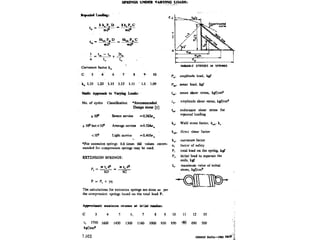
Static Approach to varying Loads
No. of cycles Classification
*Recommended
Design Stress [t]
> 106 Severe service 0.263su
>104 but <106 Average service 0.324su
<104 Light service 0.405su
Terms used in Compression Spring
Axially loaded helical spring
TERMS USED IN COMPRESSION SPRING
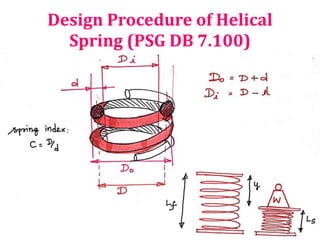
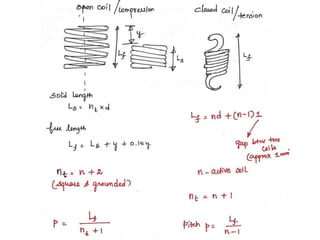
 SOLID LENGTH: When the compression spring is compressed until the
coils come in contact with each other the spring is said to be solid.
 The solid length of a spring is the product of total number of coils and the
diameter of the wire. Ls = n’.d, where n’ = total number of coils, d =
diameter of the wire
 FREE LENGTH: It is the length of the spring in the free or unloaded
condition. It is equal to the solid length plus the maximum deflection or
compression of the spring and the clearance between the adjacent coils.
 Free length of the spring, = Solid length + Max compression+Clearence
between adjacent coils, LF = n’d+ymax+0.15ymax
 SPRING INDEX: It is defined as the ratio of the mean diameter of the coil
to the diameter of the coil to the diameter of the wire. C=D/d, where
D- mean diameter of coil, d- diameter of wire
 SPRING RATE: It is defined as the load required per unit deflection of the
spring. q=P/y where P- applied load, y- deflection of the spring.
 PITCH: The pitch of the coil is defined as the axial distance between
adjacent coil in uncompressed state.
Pitch length=free length/(n’-1)
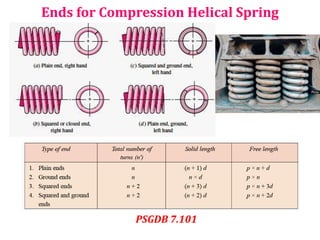
Ends for Compression Helical Spring
PSGDB 7.101
Ends for Tension Helical Spring
• The tensile springs are provided with hooks or loops as shown in
Fig.
• These loops may be made by turning whole coil or half of the coil.
• In a tension spring, large stress concentration is produced at the
loop or other attaching device of tension spring.
• The main disadvantage of tension spring is the failure of the spring
when the wire breaks.
• A compression spring used for carrying a tensile load is shown in
Fig.
• The total number of turns of a tension helical spring must be equal
to the number of turns (n) between the points where the loops start
plus the equivalent turns for the loops.
• It has been found experimentally that half turn should be added for
each loop. Thus for a spring having loops on both ends, the total
number of active turns, n' = n + 1
Ends for Tension Helical Spring
Stresses in Helical Spring
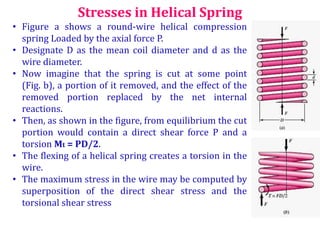
• Figure a shows a round-wire helical compression
spring Loaded by the axial force P.
• Designate D as the mean coil diameter and d as the
wire diameter.
• Now imagine that the spring is cut at some point
(Fig. b), a portion of it removed, and the effect of the
removed portion replaced by the net internal
reactions.
• Then, as shown in the figure, from equilibrium the cut
portion would contain a direct shear force P and a
torsion Mt = PD/2.
• The flexing of a helical spring creates a torsion in the
wire.
• The maximum stress in the wire may be computed by
superposition of the direct shear stress and the
torsional shear stress
Stresses in Helical Spring
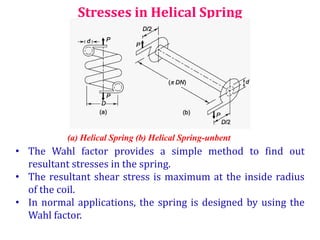
• The resultant stress consists of superimposition of torsional
shear stress, direct shear stress and additional stresses due to
the curvature of the coil.
• The stresses in the spring wire on account of these factors are
shown in Fig.
• When the bar is bent in the form of coil, the length of the
inside fibre is less than the length of the outside fibre. This
results in stress concentration at the inside fibre of the coil.
• AM Wahl1 derived the equation for resultant stress, which
includes torsional shear stress, direct shear stress and stress
concentration due to curvature.
• This equation is given by,
where K is called the stress factor or Wahl factor.
• The Wahl factor is given by,
Stresses in Helical Spring
(a) Helical Spring (b) Helical Spring-unbent
• The Wahl factor provides a simple method to find out
resultant stresses in the spring.
• The resultant shear stress is maximum at the inside radius
of the coil.
• In normal applications, the spring is designed by using the
Wahl factor.
Stresses in Helical Spring
• The load-deflection equation of the spring is given by
• The rate of spring (q) is given
by, q = P/y
• Then stiffness of the spring is
given by,
• Strain energy stored in the spring
• It has been found experimentally that when the free length of
the spring (LF) is more than three times the mean or pitch
diameter (D), then the spring behaves like a column and may
fail by buckling at a comparatively low load as shown in Fig
• The spring should be preferably designed as buckle-proof.
Compression springs, which cannot be designed buckle-proof,
must be guided in a sleeve or over an arbor.
• The thumb rules for provision of guide are as follows:
Buckling of compression springs
• Lf/D < 3,
• for Lf/D > 3 the spring must be
suitably guided
• When one end of a helical spring is resting on a rigid support
and the other end is loaded suddenly, then all the coils of
the spring will not suddenly deflect equally, because some
time is required for the propagation of stress along the spring
wire.
• In the beginning, the end coils of the spring in contact with the
applied load takes up whole of the deflection and then it
transmits a large part of its deflection to the adjacent coils.
• In this way, a wave of compression propagates through the
coils to the supported end from where it is reflected back to
the deflected end.
• This wave of compression travels along the spring indefinitely.
• If the applied load is of fluctuating type as in the case of valve
spring in internal combustion engines and if the time interval
between the load applications is equal to the time required for
the wave to travel from one end to the other end, then
resonance will occur.
Surge in springs
• This results in very large deflections of the coils and correspondingly very
high stresses.
• Under these conditions, it is just possible that the spring may fail. This
phenomenon is called surge.
• It has been found that the natural frequency of spring should be atleast
twelve times the frequency of application of a periodic load in order to
avoid resonance.
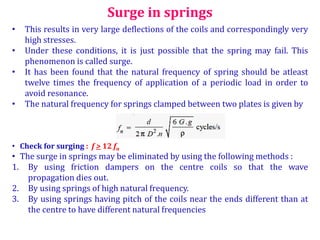
• The natural frequency for springs clamped between two plates is given by
Surge in springs
• Check for surging : f > 12 fn
• The surge in springs may be eliminated by using the following methods :
1. By using friction dampers on the centre coils so that the wave
propagation dies out.
2. By using springs of high natural frequency.
3. By using springs having pitch of the coils near the ends different than at
the centre to have different natural frequencies
Design against Fluctuating Load
• In many applications, the force acting on the spring is not
constant but varies in magnitude with time.
• The valve spring of an automotive engine is subjected to
millions of stress cycles during its lifetime.
• On the other hand, the springs in linkages and mechanisms
are subjected to comparatively less number of stress cycles.
• The springs subjected to fluctuating stresses are designed
on the basis of two criteria—design for infinite life and
design for finite life.
• Let us consider a spring subjected to an external fluctuating
force, which changes its magnitude from Pmax to Pmin in the
load cycle.
• The mean force Pm and the force amplitude Pa are given by,
Design against fluctuating load
• The mean stress (τm) is calculated from mean force (Pm) by using shear
stress correction factor (Ks). It is given by,
• Ksh is the correction factor for direct shear stress and it is applicable to
mean stress only. ks = ksh.kc
• kc - curvature factor
• For torsional stress amplitude (τa), it is necessary to also consider the
effect of stress concentration due to curvature (ks )in addition to direct
shear stress. Therefore,
• For Patented and cold-drawn steel wires (Grade-1 to 4), τ-1 = 0.21 σu
and τy = 0.42 σu
• For oil-hardened and tempered steel wires (SW and VW grade),
τ-1 = 0.22 σu and τy = 0.45 σu
Curvature factor kc
C 3 4 6 7 8 9 10
kc 1.35 1.25 1.15 1.13 1.11 1.1 1.09
Design against fluctuating load
• The helical springs subjected to fatigue loading are
designed by using the Soderberg line method.
• The spring materials are usually tested for torsional
endurance strength under a repeated stress that varies
from zero to a maximum.
• Since the springs are ordinarily loaded in one direction
only (the load in springs is never reversed in nature),
therefore a modified Soderberg line is used for springs,
Concentric or Composite Springs
• A concentric or composite spring is used for one of the
following purposes :
• To obtain greater spring force within a given space.
• To insure the operation of a mechanism in the event
of failure of one of the springs.
• Concentric spring is also called a ‘nested’ spring.
• The concentric springs for the above two purposes may
have two or more springs and have the same free lengths
as shown in Fig. and are compressed equally.
• Such springs are used in automobile clutches, valve
springs in aircraft, heavy duty diesel engines and
rail-road car suspension systems.
• The adjacent coils of the concentric spring are wound in
opposite directions to eliminate any tendency to bind.
• If the same material is used, the concentric springs are
designed for the same stress.
• In order to get the same stress factor (K), it is desirable
to have the same spring index (C ).
• Assuming that both the springs are made of same material, then
the maximum shear stress induced in both the springs is
approximately same, i.e. τ1 = τ2
• If both the springs are effective throughout their working range,
then their free length and deflection are equal, i.e. y1 =y2
• The following relations are used for designing Concentric
springs.
• τ1 = τ2 < [τ]
• D1/d1 = D2/d2 =C
• P1/P2 =2(C/(C-2))
• d1< (D1-D2)/2
Concentric or Composite Springs
• When extension springs are made with coils in contact with one another,
they are said to be close-wound.
• Spring manufacturers prefer some initial tension in close-wound springs
in order to hold the free length more accurately.
• The deflection y is the extension of the spring beyond the free length Lf
and Pi is the initial tension in the spring that must be exceeded before
the spring deflects.
• The load-deflection relation is then P = Pi + qy where q is the spring
rate.
Extension Springs
Helical Torsion Springs
• A helical torsion spring is a device used to transmit the torque to a
particular component of a machine or mechanism.
• It is widely used in door hinges, brush holders, automobile starters and
door locks.
• The ends are formed in such a way that the spring is loaded by a torque
about the axis of the coils.
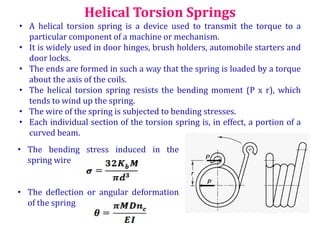
• The helical torsion spring resists the bending moment (P x r), which
tends to wind up the spring.
• The wire of the spring is subjected to bending stresses.
• Each individual section of the torsion spring is, in effect, a portion of a
curved beam.
• The bending stress induced in the
spring wire
• The deflection or angular deformation
of the spring
Leaf Spring
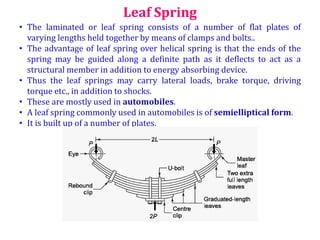
• The laminated or leaf spring consists of a number of flat plates of
varying lengths held together by means of clamps and bolts..
• The advantage of leaf spring over helical spring is that the ends of the
spring may be guided along a definite path as it deflects to act as a
structural member in addition to energy absorbing device.
• Thus the leaf springs may carry lateral loads, brake torque, driving
torque etc., in addition to shocks.
• These are mostly used in automobiles.
• A leaf spring commonly used in automobiles is of semielliptical form.
• It is built up of a number of plates.
Multi-leaf spring
• The leaves are usually given an initial curvature or cambered so that
they will tend to straighten under the load.
• The leaves are held together by means of a band shrunk around them
at the center or by a bolt passing through the center.
• Since the band exerts stiffening and strengthening effect, therefore the
effective length of the spring for bending will be overall length of spring
minus width of band.
• The spring is clamped to the axle housing by means of U bolts.
• The longest leaf known as main leaf or master leaf has its ends formed
in the shape of an eye through which the bolts are passed to secure the
spring to its support.
• Usually the eyes through which the spring is attached to the hanger or
shackle, are provided with bushings of some antifriction materials such
as bronze or rubber.
• The other leaves of the springs are known as graduated leaves.
• Rebound clips are located at intermediate positions in the length of the
spring so that the graduated leaves also share the stress induced in the
full length of leaves when the spring rebounds.
• A Belleville spring consists of a coned disk as shown in
Fig.
• This type of spring is also called ‘coned disk’ spring.
• It is called Belleville spring because it was invented by
Julian Belleville, who patented its design in France in
1867.
• In the Belleville spring, (h/t) ratio is reduced to 2.1 the
load is constant for this range of deflection.
• This is useful for engaging or disengaging the clutch, when
the Belleville spring is used as a clutch spring.
• The Belleville spring offers the following advantages:
• It is simple in construction and easy to manufacture.
• The Belleville spring is a compact spring unit.
• It is especially useful where very large force is desired
for small deflection of the spring.
• It provides a wide range of spring constants making it
versatile.
• It can provide any linear or non-linear load deflection
characteristic.
Belleville Springs
Belleville springs
Let
P = axial force on the spring (N)
y = deflection of spring (m)
t = thickness of disc or washer (m)
h = free height minus thickness (m)
E = modulus of elasticity (N/m2)
σ = stress at the inside circumference
(N/m2)
d0 = outer diameter of washer (m)
di = inner diameter of washer (m)
ν = Poisson’s ratio ( 0.3 for steel)
M, C1, C2 = Constants
• PSGDB 7.100
Design Procedure of Helical
Spring
• The basic procedure for the design of helical spring consists of
the following steps:
1) For the given application, estimate the maximum spring force
(P) and the corresponding required deflection (y) of the
spring. In some cases, maximum spring force (P) and stiffness
q, which is (P/d), are specified.
2) Select a suitable spring material and find out ultimate tensile
strength (σut) from the data.
3) Calculate the permissible shear stress for the spring wire by
following relationship: τ = 0.30 σut or 0.50 σut
4) Assume a suitable value for the spring index (C). For
industrial applications, the spring index varies from 8 to 10. A
spring index of 8 is considered as a good value. The spring
index for springs in valves and clutches is 5. The spring index
should never be less than 3.
5) Calculate the Wahl factor using the equation in PSGDB 7.100
Design Procedure of Helical Spring
6) Determine wire diameter (d) by using the stress Eq. PSGDB
7.100.
7) Determine mean coil diameter (D) by the following
relationship: D = Cd
8) Determine the number of active coils (n) by using deflection
Eq. PSGDB 7.100. The modulus of rigidity (G) for steel wires
is 81370 MPa.
9) Decide the style of ends for the spring depending upon the
configuration of the application. Determine the number of
inactive coils. Adding active and inactive coils, find out the
total number of coils (n').
10)Determine the solid length of the spring by the following
relationship: Solid length = n‘d
Design procedure of Helical Spring
11)Determine the maximum deflection of the spring by Eq.
PSGDB 7.100.
12)Assume a gap of 0.5 to 2 mm between adjacent coils, when
the spring is under the action of maximum load. The total
axial gap between coils is given by,
total gap = (n'–1) × gap between two adjacent coils
11)In some cases, the total axial gap is taken as 15% of the
maximum deflection:
12)Determine the free length of the spring by the following
relationship: Free length = Solid length + Total gap + ymax
13)Determine the pitch of the coil by using the equations in
PSGDB 7.101
14)Determine the rate of spring by stiffness Eq. PSGDB 7.100
15)Prepare a list of spring specifications.
Design procedure of Helical Spring
Design Procedure of Helical
Spring (PSG DB 7.100)
1. Max Permissible Shear stress ()
2. Deflection of Spring (y)
3. Stiffness of spring (q)
4. Spring Index (C = D/d)
5. Total no. of Coils (n)
6. Solid length of spring (Ls = (d x n) +(2+d))
7. Free length of the spring (Lf= Ls + y)
8. Inner and outer dia (Di & Do)
9. Pitch of the coil, P = (Lf – Ls / n t + d)
10. Helix angle
Dimensions to be found for a Spring
(Design of a Spring)
• Load
• Wire Dia (d & D)
• Spring index
• No of turns
• Free and Solid Length
• Pitch
• Stiffness (If req)
• Frequency (mass & sp weight given)
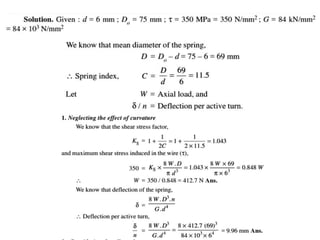
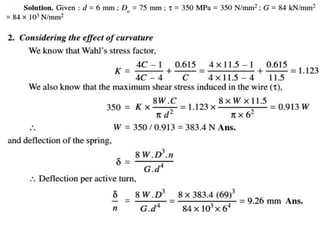
• Design a spring for a balance to measure 0 to
1000 N over a scale of length 80 mm. The
spring is to be enclosed in a casing of 25 mm
diameter. The approximate number of turns is
30. The modulus of rigidity is 85 kN/mm2.
Also calculate the maximum shear stress
induced. Assume d = 4 mm. initially.
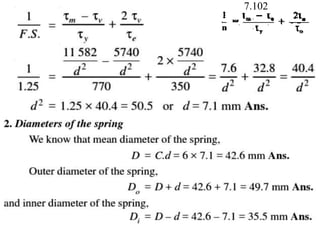
• A helical compression spring made of oil tempered
carbon steel, is subjected to a load which varies from
400 N to 1000 N. Thu spring index is 6 and the design
factor of safety is 1.25. If the yield stress in shear is 770
MPa and endurance stress in shear is 360 MPa, find
• 1) Size of the spring wire,
• 2) Diameters of the spring,
• 3) Number of turns of the spring, and
• 4) Free length of the spring.
• The compression of the spring at the maximum load is
30 mm. The modulus of rigidity for the spring material
may be taken as 80 kN/mm2.
Pm
Pa
7.102
PSG DB
7.100
Flywheel
The principle of flywheel in found before the many centuries ago
---- in the potter’s wheel
A potter’s wheel is a mechanism with a rotating turntable on top where the clay is
shaped.
A shaft from the turntable to the pedal has a flywheel attached. As the person
operating the potter’s wheel presses down and releases the pedal, the flywheel
keeps the turntable moving at a constant speed.
The operator could even stop pedaling and the turntable would keep moving due
to the energy stored in the flywheel.
A flywheel is a mechanical energy storage/delivery device that stores
energy in the form of kinetic energy.
If the source of the driving torque or load torque is fluctuating in
nature, then a flywheel is usually called for.
The main function of a fly wheel is to smoothen out variations in the
speed of a shaft caused by torque fluctuations.
Internal combustion engines with one or two cylinders are a typical
example. Piston compressors, punch presses, riveting machine,
rock crushers etc. are the other systems that have fly wheel.
In case of steam engines, internal combustion engines, reciprocating
compressors and pumps, the energy is developed during one stroke and
the engine is to run for the whole cycle on the energy produced during
this one ,stroke.
Flywheel absorbs mechanical energy by increasing its angular
velocity and delivers the stored energy by decreasing its velocity
Flywheels-Function need and Operation
Governor Vs Flywheel
Two following types of cases where reciprocating engine mechanism is used :
(a) -Variable torque is supplied where demand is a constant torque
Ex: An internal combustion engine or a steam engine which is used as a prime
mover to drive generators, centrifugal pumps, etc.
(b) -Demand is variable torque whereas constant torque is supplied.
Ex: A punching machine which is driven by a prime mover like electric motor.
In both these cases there is mismatch between the supply and demand.
This results in speed variation.
In case of generators, speed variation results in change in frequency and variation in
voltage.
On the other hand, punching machine requires energy at small interval only when
punching is done.
To supply such large energy at the time of punching, motor of high power shall be
required and also large variation in speed.
To smoothen these variations in torque, flywheel is used which works as a energy
storage. This results in usage of low power motor in punching machine.
Types of Fly Wheels
1. Disc type : Up to 600 mm diameter - One piece
2. Rim & Arm type : Diameters (600 to 2500 mm)
Hub is connected with 4,6 or 8 arms
3. Split Fly wheel: Larger size diameter above 2500mm
Fly wheel is spitted in 2 ,3 or more no. of components.
The turning moment diagram (also known as crank-effort diagram)
It is the graphical representation of the turning moment or crank-effort
for various positions of the crank. It is plotted on Cartesian coordinates,
in which the turning moment is taken as the ordinate and crank angle as
abscissa.
Let, Fp = Piston effort, r = Radius of crank,
n = Ratio of the connecting rod length and radius of crank, and
Ѳ = Angle turned by the crank from inner dead centre.
Turning Moment
Diagram
for a Single Cylinder
Double Acting Steam
Engine
The turning moment T is zero, when the crank angle Ѳ is zero. It is maximum
when the crank angle is 90 and again zero when the angle is 180.
This is shown by the curve abc represents the turning moment diagram for
outstroke. The curve cde is the turning moment diagram for instroke and is
somewhat similar to the curve abc.
Since the work done is the product of the turning moment and the angle turned,
therefore the area of the turning moment diagram represents the work done per
revolution.
In actual practice, the engine is assumed to work against the mean resisting
torque, as shown by a horizontal line AF.
1. When the turning moment is positive (i.e. when the engine torque is
more than the mean resisting torque) as shown between points B and C (or D and E)
in Fig. the crankshaft accelerates and the work is done by the
steam.
2. When the turning moment is negative (i.e. when the engine torque is
less than the mean resisting Torque) as shown between points C and D in
Fig., the crankshaft retards and the work is done on the steam.
3. If, T=Torque on crankshaft at any instant & Tmean = Mean resisting
torque.
Then accelerating torque on the rotating parts of the engine = T - T mean
4. If ( T - T mean) is positive flywheel accelerates and if (T- Tmean) is
negative, then the flywheel retards.
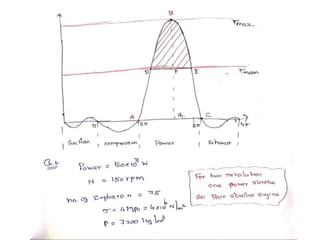
Turning moment diagram for a four stroke internal combustion engine
Only one cycle is powered directly by the combustion of gases in 4-S engine. The
movement of the piston in the other three steps is powered by the flywheel. As the
piston is pushed down by the combustion, its linear kinetic energy is transferred into
rotational kinetic energy in the flywheel. Because the flywheel has such a high moment
of inertia, it has a high amount of kinetic energy. This kinetic energy is in turn
transferred to the piston in the other three phases in order to move it down, up, down in
the cylinder. Were it not for the flywheel, the piston would be pushed down in the
cylinder once, and would have no way to return to the top.
TURNING MOMENT DIAGRAM TOR TRIPLE CYLINDER COMPOUND
STEAM ENGINE
Three cylinders double acting compound steam engine. the diagram for each
engine is drawn separately and After summation of all three, the resultant
diagram is drawn.
Here generally first cylinder is of high pressure second is of Medium and third is
low pressure.
The arrangement of cylinders are done in such a way that there is minimum
possible variation in turning moment. That’s why cranks arranger on the angle
of 120 degree.
Design Approach
There are two stages to the design of a flywheel.
The amount of energy required for the desired degree of smoothening
must be found and the (mass) moment of inertia needed to absorb that
energy determined.
Then flywheel geometry must be defined that caters the required
moment of inertia in a reasonably sized package and is safe against
failure at the designed speeds of operation.
The moment of inertia is the measure of resistance to torque applied on a
spinning object (i.e. the higher the Moment of Inertia, the slower it will
spin after being applied a given torque).
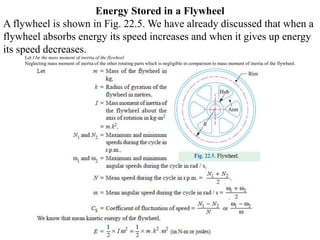
Energy Stored in a Flywheel
A flywheel is shown in Fig. 22.5. We have already discussed that when a
flywheel absorbs energy its speed increases and when it gives up energy
its speed decreases.
Let I be the mass moment of inertia of the flywheel.
Neglecting mass moment of inertia of the other rotating parts which is negligible in comparison to mass moment of inertia of the flywheel.
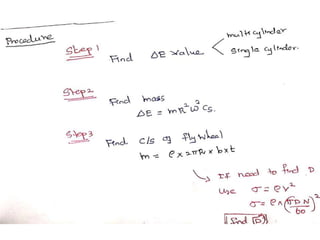
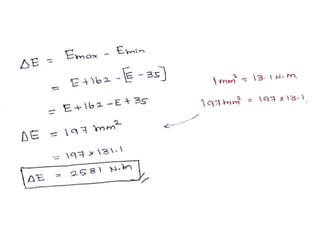
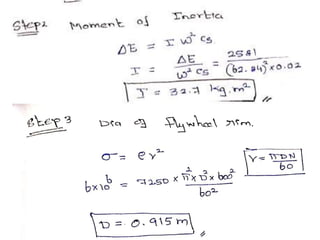
Formula for Flywheel
Circumferential stress
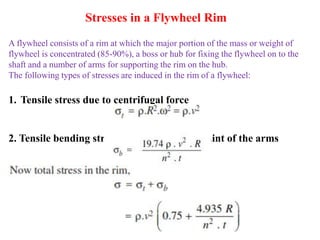
A flywheel consists of a rim at which the major portion of the mass or weight of
flywheel is concentrated (85-90%), a boss or hub for fixing the flywheel on to the
shaft and a number of arms for supporting the rim on the hub.
The following types of stresses are induced in the rim of a flywheel:
1. Tensile stress due to centrifugal force
2. Tensile bending stress caused by the restraint of the arms
Stresses in a Flywheel Rim
[PSG (p.7.120)]
w = width of the key
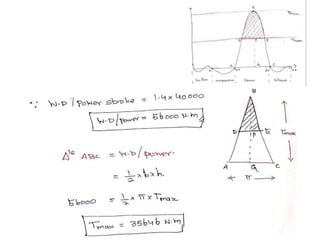
Area of Triangle = ½ b h
(PSG D.B.p-5.16)
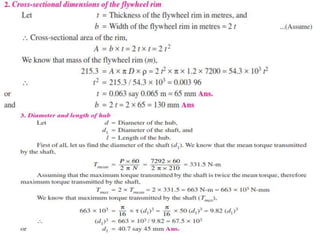
Unless a flywheel is used, the speed of the crank shaft will be very high when
resisting torque is very small and substantial decrease in speed shall take place
when punching operation is done.
If flywheel is provided, the excess energy shall be absorbed in the flywheel and it
will be available when punching operation is being done where energy is deficient.
It will result in reduction of the power of motor required if a suitable flywheel is
used.
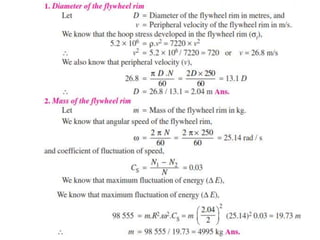
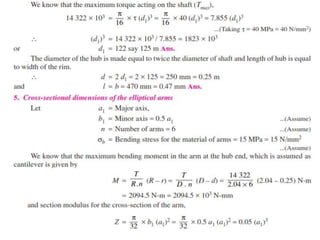
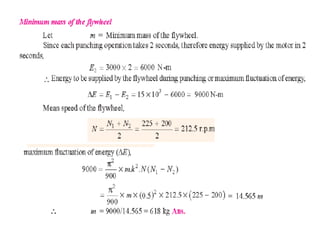
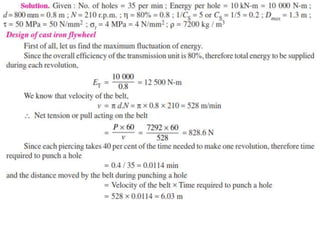
Approach to Punching machine
Flywheel Problems
• Prilim Data
– Power
– Energy
– Belt velocity
– Total force
– Time taken to punch one hole
– Linear distance
– Energy supplied
– Max fluctuation of energy
1. Mass of flywheel
2. Flywheel CS
3. Dia of hub and length of hub
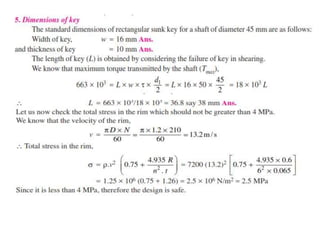
4. Dimensions of Key (PSG DB 5.16)
5. Checking total stress (PSG DB 7.120)
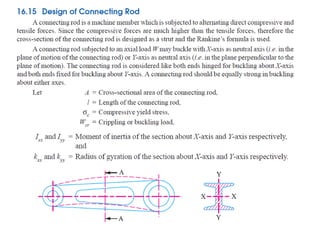
Connecting rod
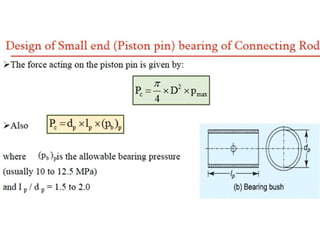
Forces on Connecting Rod
• Force due to Gas or steam pressure and
• Inertia force of reciprocating parts
r – radius of crank
θ- angle between connecting rod and crank
n1 – ratio of c.r length and crank radius = l/r
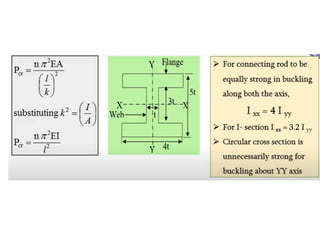
Buckling
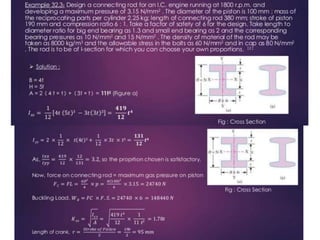
• Given Data:
– N = 1200 rpm
– P =3.15 N/mm2
– D = 100mm
– M = 2.25 kg
– L = 380 mm
– l = 190 mm
– h = 6:1
– FOS = 6
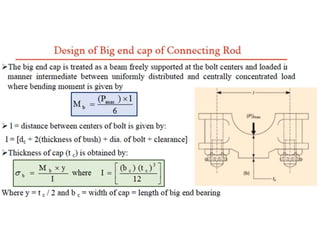
• Big crank pin
– lc = 1.3 dc
– Pc = 10 N/mm2
• Small end piston
pin
– lp = 2 dp
– Pp = 10 N/mm2
–  = 2000 kg/m3
– a = 1/7500
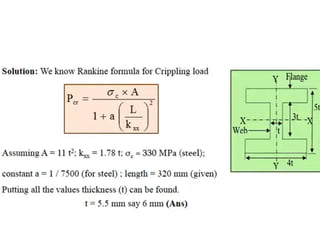
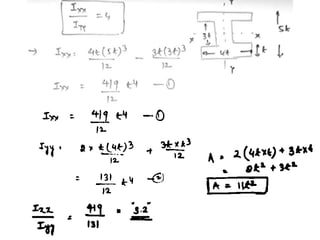
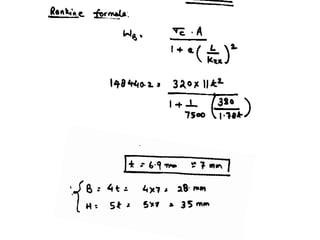
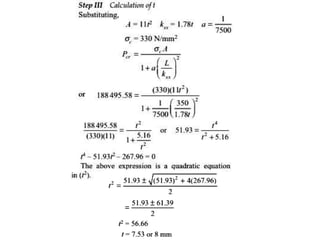
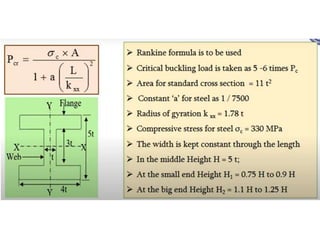
• Determine the dimensions of cross section of
the connecting rod for a diesel engine with
the following data: cylinder bore = 100 mm,
length of connecting rod = 350 mm, Maximum
gas pressure = 4 MPa and factor of safety = 6
Unit 4
Energy Storing
elements and
Engine components
Spring
Connecting
Rod
Flywheel
In engine
(Single cyl
Multi cyl)
In punching
machine

UNIT 4 Energy storing elements and Engine components.pptx

  • 1.
    Unit 4 Energy Storingelements and Engine components
  • 3.
    Topics • Springs • Flywheel –In Engine – In Punching Machine • Connecting Rod • Crank Shaft
  • 4.
    SPRINGS • Spring isan elastic body whose function is to distort when loaded and to recover its original shape when the load is removed. APPLICATION OF SPRINGS • To apply forces as in brakes, clutches and spring loaded valves. • To store energy as in watches, toys. • To measure forces as in spring balance and engine indicators. • To cushion, absorb or control energy due to either shock or vibration as in car. TYPES OF SPRINGS:
  • 5.
  • 6.
    HELICAL SPRINGS  Thehelical springs are made up of a wire coiled in the form of helix and is primarily intended for tensile or compressive loads.  The cross section of the wire from which the spring made may be circular, square or rectangular.  The two forms of helical springs are compression spring and helical tension springs. Compression Helical Spring Tension Helical Spring
  • 7.
    MATERIAL FOR HELICALSPRINGS  The material of the spring should have  high fatigue strength,  high ductility,  high resilience and  creep resistant.  It largely depends upon the size and service.  The strength of the wires varies with size, smaller size wires have greater strength and less ductility, due to the greater degree of cold working.  Severe service means rapid continuous loading where the ratio of minimum to maximum load (or stress) is one-half or less, as in automotive valve springs.  Average service includes the same stress range as in severe service but with only intermittent operation, as in engine governor springs and automobile suspension springs.  Light service includes springs subjected to loads that are static or very infrequently varied, as in safety valve springs.  The springs are mostly made from oil-tempered carbon steel wires containing 0.60 to 0.70 per cent carbon and 0.60 to 1.0 per cent manganese.
  • 8.
    Material for HelicalSprings  Music wire is used for small springs.  Non-ferrous materials like phosphor bronze, beryllium copper, monel metal, brass etc., may be used in special cases to increase fatigue resistance, temperature resistance and corrosion resistance.  Table PSGDB 7.105 shows the values of allowable shear stress for various materials used for springs.  The helical springs are either cold formed or hot formed depending upon the size of the wire. Static Approach to varying Loads No. of cycles Classification *Recommended Design Stress [t] > 106 Severe service 0.263su >104 but <106 Average service 0.324su <104 Light service 0.405su
  • 9.
    Terms used inCompression Spring Axially loaded helical spring
  • 10.
    TERMS USED INCOMPRESSION SPRING  SOLID LENGTH: When the compression spring is compressed until the coils come in contact with each other the spring is said to be solid.  The solid length of a spring is the product of total number of coils and the diameter of the wire. Ls = n’.d, where n’ = total number of coils, d = diameter of the wire  FREE LENGTH: It is the length of the spring in the free or unloaded condition. It is equal to the solid length plus the maximum deflection or compression of the spring and the clearance between the adjacent coils.  Free length of the spring, = Solid length + Max compression+Clearence between adjacent coils, LF = n’d+ymax+0.15ymax  SPRING INDEX: It is defined as the ratio of the mean diameter of the coil to the diameter of the coil to the diameter of the wire. C=D/d, where D- mean diameter of coil, d- diameter of wire  SPRING RATE: It is defined as the load required per unit deflection of the spring. q=P/y where P- applied load, y- deflection of the spring.  PITCH: The pitch of the coil is defined as the axial distance between adjacent coil in uncompressed state. Pitch length=free length/(n’-1)
  • 11.
    Ends for CompressionHelical Spring PSGDB 7.101
  • 12.
    Ends for TensionHelical Spring • The tensile springs are provided with hooks or loops as shown in Fig. • These loops may be made by turning whole coil or half of the coil. • In a tension spring, large stress concentration is produced at the loop or other attaching device of tension spring. • The main disadvantage of tension spring is the failure of the spring when the wire breaks. • A compression spring used for carrying a tensile load is shown in Fig. • The total number of turns of a tension helical spring must be equal to the number of turns (n) between the points where the loops start plus the equivalent turns for the loops. • It has been found experimentally that half turn should be added for each loop. Thus for a spring having loops on both ends, the total number of active turns, n' = n + 1
  • 13.
    Ends for TensionHelical Spring
  • 14.
    Stresses in HelicalSpring • Figure a shows a round-wire helical compression spring Loaded by the axial force P. • Designate D as the mean coil diameter and d as the wire diameter. • Now imagine that the spring is cut at some point (Fig. b), a portion of it removed, and the effect of the removed portion replaced by the net internal reactions. • Then, as shown in the figure, from equilibrium the cut portion would contain a direct shear force P and a torsion Mt = PD/2. • The flexing of a helical spring creates a torsion in the wire. • The maximum stress in the wire may be computed by superposition of the direct shear stress and the torsional shear stress
  • 15.
    Stresses in HelicalSpring • The resultant stress consists of superimposition of torsional shear stress, direct shear stress and additional stresses due to the curvature of the coil. • The stresses in the spring wire on account of these factors are shown in Fig. • When the bar is bent in the form of coil, the length of the inside fibre is less than the length of the outside fibre. This results in stress concentration at the inside fibre of the coil. • AM Wahl1 derived the equation for resultant stress, which includes torsional shear stress, direct shear stress and stress concentration due to curvature. • This equation is given by, where K is called the stress factor or Wahl factor. • The Wahl factor is given by,
  • 16.
  • 17.
    Stresses in HelicalSpring (a) Helical Spring (b) Helical Spring-unbent • The Wahl factor provides a simple method to find out resultant stresses in the spring. • The resultant shear stress is maximum at the inside radius of the coil. • In normal applications, the spring is designed by using the Wahl factor.
  • 18.
    Stresses in HelicalSpring • The load-deflection equation of the spring is given by • The rate of spring (q) is given by, q = P/y • Then stiffness of the spring is given by, • Strain energy stored in the spring
  • 19.
    • It hasbeen found experimentally that when the free length of the spring (LF) is more than three times the mean or pitch diameter (D), then the spring behaves like a column and may fail by buckling at a comparatively low load as shown in Fig • The spring should be preferably designed as buckle-proof. Compression springs, which cannot be designed buckle-proof, must be guided in a sleeve or over an arbor. • The thumb rules for provision of guide are as follows: Buckling of compression springs • Lf/D < 3, • for Lf/D > 3 the spring must be suitably guided
  • 20.
    • When oneend of a helical spring is resting on a rigid support and the other end is loaded suddenly, then all the coils of the spring will not suddenly deflect equally, because some time is required for the propagation of stress along the spring wire. • In the beginning, the end coils of the spring in contact with the applied load takes up whole of the deflection and then it transmits a large part of its deflection to the adjacent coils. • In this way, a wave of compression propagates through the coils to the supported end from where it is reflected back to the deflected end. • This wave of compression travels along the spring indefinitely. • If the applied load is of fluctuating type as in the case of valve spring in internal combustion engines and if the time interval between the load applications is equal to the time required for the wave to travel from one end to the other end, then resonance will occur. Surge in springs
  • 21.
    • This resultsin very large deflections of the coils and correspondingly very high stresses. • Under these conditions, it is just possible that the spring may fail. This phenomenon is called surge. • It has been found that the natural frequency of spring should be atleast twelve times the frequency of application of a periodic load in order to avoid resonance. • The natural frequency for springs clamped between two plates is given by Surge in springs • Check for surging : f > 12 fn • The surge in springs may be eliminated by using the following methods : 1. By using friction dampers on the centre coils so that the wave propagation dies out. 2. By using springs of high natural frequency. 3. By using springs having pitch of the coils near the ends different than at the centre to have different natural frequencies
  • 22.
    Design against FluctuatingLoad • In many applications, the force acting on the spring is not constant but varies in magnitude with time. • The valve spring of an automotive engine is subjected to millions of stress cycles during its lifetime. • On the other hand, the springs in linkages and mechanisms are subjected to comparatively less number of stress cycles. • The springs subjected to fluctuating stresses are designed on the basis of two criteria—design for infinite life and design for finite life. • Let us consider a spring subjected to an external fluctuating force, which changes its magnitude from Pmax to Pmin in the load cycle. • The mean force Pm and the force amplitude Pa are given by,
  • 23.
    Design against fluctuatingload • The mean stress (τm) is calculated from mean force (Pm) by using shear stress correction factor (Ks). It is given by, • Ksh is the correction factor for direct shear stress and it is applicable to mean stress only. ks = ksh.kc • kc - curvature factor • For torsional stress amplitude (τa), it is necessary to also consider the effect of stress concentration due to curvature (ks )in addition to direct shear stress. Therefore, • For Patented and cold-drawn steel wires (Grade-1 to 4), τ-1 = 0.21 σu and τy = 0.42 σu • For oil-hardened and tempered steel wires (SW and VW grade), τ-1 = 0.22 σu and τy = 0.45 σu Curvature factor kc C 3 4 6 7 8 9 10 kc 1.35 1.25 1.15 1.13 1.11 1.1 1.09
  • 24.
    Design against fluctuatingload • The helical springs subjected to fatigue loading are designed by using the Soderberg line method. • The spring materials are usually tested for torsional endurance strength under a repeated stress that varies from zero to a maximum. • Since the springs are ordinarily loaded in one direction only (the load in springs is never reversed in nature), therefore a modified Soderberg line is used for springs,
  • 25.
    Concentric or CompositeSprings • A concentric or composite spring is used for one of the following purposes : • To obtain greater spring force within a given space. • To insure the operation of a mechanism in the event of failure of one of the springs. • Concentric spring is also called a ‘nested’ spring. • The concentric springs for the above two purposes may have two or more springs and have the same free lengths as shown in Fig. and are compressed equally. • Such springs are used in automobile clutches, valve springs in aircraft, heavy duty diesel engines and rail-road car suspension systems. • The adjacent coils of the concentric spring are wound in opposite directions to eliminate any tendency to bind. • If the same material is used, the concentric springs are designed for the same stress. • In order to get the same stress factor (K), it is desirable to have the same spring index (C ).
  • 26.
    • Assuming thatboth the springs are made of same material, then the maximum shear stress induced in both the springs is approximately same, i.e. τ1 = τ2 • If both the springs are effective throughout their working range, then their free length and deflection are equal, i.e. y1 =y2 • The following relations are used for designing Concentric springs. • τ1 = τ2 < [τ] • D1/d1 = D2/d2 =C • P1/P2 =2(C/(C-2)) • d1< (D1-D2)/2 Concentric or Composite Springs
  • 27.
    • When extensionsprings are made with coils in contact with one another, they are said to be close-wound. • Spring manufacturers prefer some initial tension in close-wound springs in order to hold the free length more accurately. • The deflection y is the extension of the spring beyond the free length Lf and Pi is the initial tension in the spring that must be exceeded before the spring deflects. • The load-deflection relation is then P = Pi + qy where q is the spring rate. Extension Springs
  • 28.
    Helical Torsion Springs •A helical torsion spring is a device used to transmit the torque to a particular component of a machine or mechanism. • It is widely used in door hinges, brush holders, automobile starters and door locks. • The ends are formed in such a way that the spring is loaded by a torque about the axis of the coils. • The helical torsion spring resists the bending moment (P x r), which tends to wind up the spring. • The wire of the spring is subjected to bending stresses. • Each individual section of the torsion spring is, in effect, a portion of a curved beam. • The bending stress induced in the spring wire • The deflection or angular deformation of the spring
  • 29.
    Leaf Spring • Thelaminated or leaf spring consists of a number of flat plates of varying lengths held together by means of clamps and bolts.. • The advantage of leaf spring over helical spring is that the ends of the spring may be guided along a definite path as it deflects to act as a structural member in addition to energy absorbing device. • Thus the leaf springs may carry lateral loads, brake torque, driving torque etc., in addition to shocks. • These are mostly used in automobiles. • A leaf spring commonly used in automobiles is of semielliptical form. • It is built up of a number of plates.
  • 30.
    Multi-leaf spring • Theleaves are usually given an initial curvature or cambered so that they will tend to straighten under the load. • The leaves are held together by means of a band shrunk around them at the center or by a bolt passing through the center. • Since the band exerts stiffening and strengthening effect, therefore the effective length of the spring for bending will be overall length of spring minus width of band. • The spring is clamped to the axle housing by means of U bolts. • The longest leaf known as main leaf or master leaf has its ends formed in the shape of an eye through which the bolts are passed to secure the spring to its support. • Usually the eyes through which the spring is attached to the hanger or shackle, are provided with bushings of some antifriction materials such as bronze or rubber. • The other leaves of the springs are known as graduated leaves. • Rebound clips are located at intermediate positions in the length of the spring so that the graduated leaves also share the stress induced in the full length of leaves when the spring rebounds.
  • 31.
    • A Bellevillespring consists of a coned disk as shown in Fig. • This type of spring is also called ‘coned disk’ spring. • It is called Belleville spring because it was invented by Julian Belleville, who patented its design in France in 1867. • In the Belleville spring, (h/t) ratio is reduced to 2.1 the load is constant for this range of deflection. • This is useful for engaging or disengaging the clutch, when the Belleville spring is used as a clutch spring. • The Belleville spring offers the following advantages: • It is simple in construction and easy to manufacture. • The Belleville spring is a compact spring unit. • It is especially useful where very large force is desired for small deflection of the spring. • It provides a wide range of spring constants making it versatile. • It can provide any linear or non-linear load deflection characteristic. Belleville Springs
  • 32.
    Belleville springs Let P =axial force on the spring (N) y = deflection of spring (m) t = thickness of disc or washer (m) h = free height minus thickness (m) E = modulus of elasticity (N/m2) σ = stress at the inside circumference (N/m2) d0 = outer diameter of washer (m) di = inner diameter of washer (m) ν = Poisson’s ratio ( 0.3 for steel) M, C1, C2 = Constants
  • 33.
    • PSGDB 7.100 DesignProcedure of Helical Spring
  • 34.
    • The basicprocedure for the design of helical spring consists of the following steps: 1) For the given application, estimate the maximum spring force (P) and the corresponding required deflection (y) of the spring. In some cases, maximum spring force (P) and stiffness q, which is (P/d), are specified. 2) Select a suitable spring material and find out ultimate tensile strength (σut) from the data. 3) Calculate the permissible shear stress for the spring wire by following relationship: τ = 0.30 σut or 0.50 σut 4) Assume a suitable value for the spring index (C). For industrial applications, the spring index varies from 8 to 10. A spring index of 8 is considered as a good value. The spring index for springs in valves and clutches is 5. The spring index should never be less than 3. 5) Calculate the Wahl factor using the equation in PSGDB 7.100 Design Procedure of Helical Spring
  • 35.
    6) Determine wirediameter (d) by using the stress Eq. PSGDB 7.100. 7) Determine mean coil diameter (D) by the following relationship: D = Cd 8) Determine the number of active coils (n) by using deflection Eq. PSGDB 7.100. The modulus of rigidity (G) for steel wires is 81370 MPa. 9) Decide the style of ends for the spring depending upon the configuration of the application. Determine the number of inactive coils. Adding active and inactive coils, find out the total number of coils (n'). 10)Determine the solid length of the spring by the following relationship: Solid length = n‘d Design procedure of Helical Spring
  • 36.
    11)Determine the maximumdeflection of the spring by Eq. PSGDB 7.100. 12)Assume a gap of 0.5 to 2 mm between adjacent coils, when the spring is under the action of maximum load. The total axial gap between coils is given by, total gap = (n'–1) × gap between two adjacent coils 11)In some cases, the total axial gap is taken as 15% of the maximum deflection: 12)Determine the free length of the spring by the following relationship: Free length = Solid length + Total gap + ymax 13)Determine the pitch of the coil by using the equations in PSGDB 7.101 14)Determine the rate of spring by stiffness Eq. PSGDB 7.100 15)Prepare a list of spring specifications. Design procedure of Helical Spring
  • 37.
    Design Procedure ofHelical Spring (PSG DB 7.100) 1. Max Permissible Shear stress () 2. Deflection of Spring (y) 3. Stiffness of spring (q) 4. Spring Index (C = D/d) 5. Total no. of Coils (n) 6. Solid length of spring (Ls = (d x n) +(2+d)) 7. Free length of the spring (Lf= Ls + y) 8. Inner and outer dia (Di & Do) 9. Pitch of the coil, P = (Lf – Ls / n t + d) 10. Helix angle
  • 42.
    Dimensions to befound for a Spring (Design of a Spring) • Load • Wire Dia (d & D) • Spring index • No of turns • Free and Solid Length • Pitch • Stiffness (If req) • Frequency (mass & sp weight given)
  • 49.
    • Design aspring for a balance to measure 0 to 1000 N over a scale of length 80 mm. The spring is to be enclosed in a casing of 25 mm diameter. The approximate number of turns is 30. The modulus of rigidity is 85 kN/mm2. Also calculate the maximum shear stress induced. Assume d = 4 mm. initially.
  • 54.
    • A helicalcompression spring made of oil tempered carbon steel, is subjected to a load which varies from 400 N to 1000 N. Thu spring index is 6 and the design factor of safety is 1.25. If the yield stress in shear is 770 MPa and endurance stress in shear is 360 MPa, find • 1) Size of the spring wire, • 2) Diameters of the spring, • 3) Number of turns of the spring, and • 4) Free length of the spring. • The compression of the spring at the maximum load is 30 mm. The modulus of rigidity for the spring material may be taken as 80 kN/mm2.
  • 56.
  • 57.
  • 58.
  • 59.
  • 60.
    The principle offlywheel in found before the many centuries ago ---- in the potter’s wheel A potter’s wheel is a mechanism with a rotating turntable on top where the clay is shaped. A shaft from the turntable to the pedal has a flywheel attached. As the person operating the potter’s wheel presses down and releases the pedal, the flywheel keeps the turntable moving at a constant speed. The operator could even stop pedaling and the turntable would keep moving due to the energy stored in the flywheel.
  • 65.
    A flywheel isa mechanical energy storage/delivery device that stores energy in the form of kinetic energy. If the source of the driving torque or load torque is fluctuating in nature, then a flywheel is usually called for. The main function of a fly wheel is to smoothen out variations in the speed of a shaft caused by torque fluctuations. Internal combustion engines with one or two cylinders are a typical example. Piston compressors, punch presses, riveting machine, rock crushers etc. are the other systems that have fly wheel. In case of steam engines, internal combustion engines, reciprocating compressors and pumps, the energy is developed during one stroke and the engine is to run for the whole cycle on the energy produced during this one ,stroke. Flywheel absorbs mechanical energy by increasing its angular velocity and delivers the stored energy by decreasing its velocity Flywheels-Function need and Operation
  • 66.
  • 67.
    Two following typesof cases where reciprocating engine mechanism is used : (a) -Variable torque is supplied where demand is a constant torque Ex: An internal combustion engine or a steam engine which is used as a prime mover to drive generators, centrifugal pumps, etc. (b) -Demand is variable torque whereas constant torque is supplied. Ex: A punching machine which is driven by a prime mover like electric motor. In both these cases there is mismatch between the supply and demand. This results in speed variation. In case of generators, speed variation results in change in frequency and variation in voltage. On the other hand, punching machine requires energy at small interval only when punching is done. To supply such large energy at the time of punching, motor of high power shall be required and also large variation in speed. To smoothen these variations in torque, flywheel is used which works as a energy storage. This results in usage of low power motor in punching machine.
  • 68.
    Types of FlyWheels 1. Disc type : Up to 600 mm diameter - One piece 2. Rim & Arm type : Diameters (600 to 2500 mm) Hub is connected with 4,6 or 8 arms 3. Split Fly wheel: Larger size diameter above 2500mm Fly wheel is spitted in 2 ,3 or more no. of components.
  • 69.
    The turning momentdiagram (also known as crank-effort diagram) It is the graphical representation of the turning moment or crank-effort for various positions of the crank. It is plotted on Cartesian coordinates, in which the turning moment is taken as the ordinate and crank angle as abscissa. Let, Fp = Piston effort, r = Radius of crank, n = Ratio of the connecting rod length and radius of crank, and Ѳ = Angle turned by the crank from inner dead centre.
  • 70.
    Turning Moment Diagram for aSingle Cylinder Double Acting Steam Engine The turning moment T is zero, when the crank angle Ѳ is zero. It is maximum when the crank angle is 90 and again zero when the angle is 180. This is shown by the curve abc represents the turning moment diagram for outstroke. The curve cde is the turning moment diagram for instroke and is somewhat similar to the curve abc.
  • 71.
    Since the workdone is the product of the turning moment and the angle turned, therefore the area of the turning moment diagram represents the work done per revolution. In actual practice, the engine is assumed to work against the mean resisting torque, as shown by a horizontal line AF. 1. When the turning moment is positive (i.e. when the engine torque is more than the mean resisting torque) as shown between points B and C (or D and E) in Fig. the crankshaft accelerates and the work is done by the steam. 2. When the turning moment is negative (i.e. when the engine torque is less than the mean resisting Torque) as shown between points C and D in Fig., the crankshaft retards and the work is done on the steam. 3. If, T=Torque on crankshaft at any instant & Tmean = Mean resisting torque. Then accelerating torque on the rotating parts of the engine = T - T mean 4. If ( T - T mean) is positive flywheel accelerates and if (T- Tmean) is negative, then the flywheel retards.
  • 72.
    Turning moment diagramfor a four stroke internal combustion engine Only one cycle is powered directly by the combustion of gases in 4-S engine. The movement of the piston in the other three steps is powered by the flywheel. As the piston is pushed down by the combustion, its linear kinetic energy is transferred into rotational kinetic energy in the flywheel. Because the flywheel has such a high moment of inertia, it has a high amount of kinetic energy. This kinetic energy is in turn transferred to the piston in the other three phases in order to move it down, up, down in the cylinder. Were it not for the flywheel, the piston would be pushed down in the cylinder once, and would have no way to return to the top.
  • 73.
    TURNING MOMENT DIAGRAMTOR TRIPLE CYLINDER COMPOUND STEAM ENGINE Three cylinders double acting compound steam engine. the diagram for each engine is drawn separately and After summation of all three, the resultant diagram is drawn. Here generally first cylinder is of high pressure second is of Medium and third is low pressure. The arrangement of cylinders are done in such a way that there is minimum possible variation in turning moment. That’s why cranks arranger on the angle of 120 degree.
  • 74.
    Design Approach There aretwo stages to the design of a flywheel. The amount of energy required for the desired degree of smoothening must be found and the (mass) moment of inertia needed to absorb that energy determined. Then flywheel geometry must be defined that caters the required moment of inertia in a reasonably sized package and is safe against failure at the designed speeds of operation. The moment of inertia is the measure of resistance to torque applied on a spinning object (i.e. the higher the Moment of Inertia, the slower it will spin after being applied a given torque).
  • 75.
    Energy Stored ina Flywheel A flywheel is shown in Fig. 22.5. We have already discussed that when a flywheel absorbs energy its speed increases and when it gives up energy its speed decreases. Let I be the mass moment of inertia of the flywheel. Neglecting mass moment of inertia of the other rotating parts which is negligible in comparison to mass moment of inertia of the flywheel.
  • 80.
  • 82.
  • 94.
    A flywheel consistsof a rim at which the major portion of the mass or weight of flywheel is concentrated (85-90%), a boss or hub for fixing the flywheel on to the shaft and a number of arms for supporting the rim on the hub. The following types of stresses are induced in the rim of a flywheel: 1. Tensile stress due to centrifugal force 2. Tensile bending stress caused by the restraint of the arms Stresses in a Flywheel Rim
  • 95.
  • 96.
    w = widthof the key
  • 106.
  • 110.
  • 111.
    Unless a flywheelis used, the speed of the crank shaft will be very high when resisting torque is very small and substantial decrease in speed shall take place when punching operation is done. If flywheel is provided, the excess energy shall be absorbed in the flywheel and it will be available when punching operation is being done where energy is deficient. It will result in reduction of the power of motor required if a suitable flywheel is used.
  • 116.
    Approach to Punchingmachine Flywheel Problems • Prilim Data – Power – Energy – Belt velocity – Total force – Time taken to punch one hole – Linear distance – Energy supplied – Max fluctuation of energy 1. Mass of flywheel 2. Flywheel CS 3. Dia of hub and length of hub 4. Dimensions of Key (PSG DB 5.16) 5. Checking total stress (PSG DB 7.120)
  • 123.
  • 129.
    Forces on ConnectingRod • Force due to Gas or steam pressure and • Inertia force of reciprocating parts r – radius of crank θ- angle between connecting rod and crank n1 – ratio of c.r length and crank radius = l/r
  • 130.
  • 144.
    • Given Data: –N = 1200 rpm – P =3.15 N/mm2 – D = 100mm – M = 2.25 kg – L = 380 mm – l = 190 mm – h = 6:1 – FOS = 6 • Big crank pin – lc = 1.3 dc – Pc = 10 N/mm2 • Small end piston pin – lp = 2 dp – Pp = 10 N/mm2 –  = 2000 kg/m3 – a = 1/7500
  • 151.
    • Determine thedimensions of cross section of the connecting rod for a diesel engine with the following data: cylinder bore = 100 mm, length of connecting rod = 350 mm, Maximum gas pressure = 4 MPa and factor of safety = 6
  • 155.
    Unit 4 Energy Storing elementsand Engine components Spring Connecting Rod Flywheel In engine (Single cyl Multi cyl) In punching machine