Fluid Power Engineering (2151903)
Mechanical Department
Sem.: 5th
D (D2)
• Priming of Centrifugal Pump
• Prepared By: Sajan Gohel(160123119010)
•
•
Content
• What is priming?
• Why required of priming?
• Methods of priming.
What is priming?
• Priming of a pump is very essential step in start up
of a centrifugal pump. Fact is that centrifugal pump
are not capable of pumping air or vapours.
• Priming is the process in which the impeller of a
centrifugal pump will get fully sub merged in liquid
without any air trap inside. This is especially
required when there is a first start up.
Why required of priming?
• The priming of positive displacement pumps is
required only at the time of first starting.
• In this case priming means filling liquid in casing
and aim to diminish the clearance volume.
• It can be removed the air by their own pumping
action. This is called self priming.
• Priming is not required in reciprocating pumps. But
a centrifugal pump is not self priming, thus priming
is required.
Methods of priming.
• The pumps can be primed by any of the following
methods.
1.Manually
2.With vacuum pump
3.With jet pump
4.With seperator
Manually
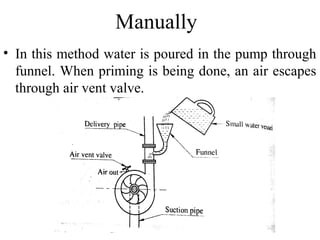
• In this method water is poured in the pump through
funnel. When priming is being done, an air escapes
through air vent valve.
With Vacuum Pump
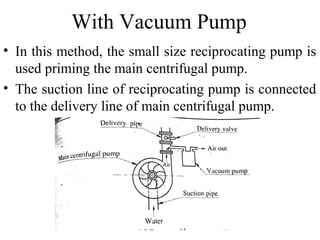
• In this method, the small size reciprocating pump is
used priming the main centrifugal pump.
• The suction line of reciprocating pump is connected
to the delivery line of main centrifugal pump.
With jet pump
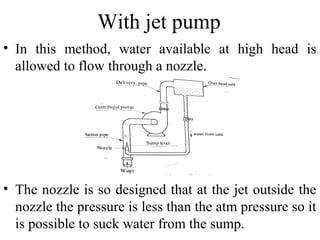
• In this method, water available at high head is
allowed to flow through a nozzle.
• The nozzle is so designed that at the jet outside the
nozzle the pressure is less than the atm pressure so it
is possible to suck water from the sump.
With Seperator
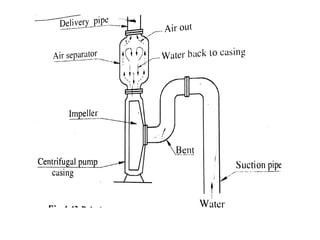
• In this method, air seperator is provided on the
delivery side of pump and bent suction pipe portion
is provided at the inlet of the pump.
• Bent suction pipe portion always contain some
liquid.
• The liquid heavier than air, so it falls back into
seperator and air moves in upward direction.
• Therefore the liquid and air are seperated in
seperator.
Priming of Centrifugal Pump

Priming of Centrifugal Pump

  • 1.
    Fluid Power Engineering(2151903) Mechanical Department Sem.: 5th D (D2) • Priming of Centrifugal Pump • Prepared By: Sajan Gohel(160123119010) • •
  • 2.
    Content • What ispriming? • Why required of priming? • Methods of priming.
  • 3.
    What is priming? •Priming of a pump is very essential step in start up of a centrifugal pump. Fact is that centrifugal pump are not capable of pumping air or vapours. • Priming is the process in which the impeller of a centrifugal pump will get fully sub merged in liquid without any air trap inside. This is especially required when there is a first start up.
  • 4.
    Why required ofpriming? • The priming of positive displacement pumps is required only at the time of first starting. • In this case priming means filling liquid in casing and aim to diminish the clearance volume. • It can be removed the air by their own pumping action. This is called self priming. • Priming is not required in reciprocating pumps. But a centrifugal pump is not self priming, thus priming is required.
  • 5.
    Methods of priming. •The pumps can be primed by any of the following methods. 1.Manually 2.With vacuum pump 3.With jet pump 4.With seperator
  • 6.
    Manually • In thismethod water is poured in the pump through funnel. When priming is being done, an air escapes through air vent valve.
  • 7.
    With Vacuum Pump •In this method, the small size reciprocating pump is used priming the main centrifugal pump. • The suction line of reciprocating pump is connected to the delivery line of main centrifugal pump.
  • 8.
    With jet pump •In this method, water available at high head is allowed to flow through a nozzle. • The nozzle is so designed that at the jet outside the nozzle the pressure is less than the atm pressure so it is possible to suck water from the sump.
  • 9.
    With Seperator • Inthis method, air seperator is provided on the delivery side of pump and bent suction pipe portion is provided at the inlet of the pump. • Bent suction pipe portion always contain some liquid. • The liquid heavier than air, so it falls back into seperator and air moves in upward direction. • Therefore the liquid and air are seperated in seperator.