
Flame photometry
Dr. Ayesha shafi
OBJECTVES
• INTRODUCTION
• PRINCIPLE
• THEORY
• INSTRUMENTATION
• APPLICATIONS
Introduction
• Flame photometry (more accurately called Flame Atomic Emission
Spectrometry)is a branch of spectroscopy in which the species examined in
the spectrometer are in the form of atoms.
• A photoelectric flame photometer is an instrument used in inorganic
chemical analysis to determine the concentration of certain metal ions
among them sodium, potassium, calcium and lithium.
• Flame Photometry is based on measurement of intensity of the light
emitted when a metal is introduced into flame.
• The wavelength of colour tells what the element is (qualitative)
• The colour's intensity tells us how much of the element present (quantitative)
Principle and theory
• The basic principle upon which Atomic Spectroscopy works is based
on the fact that "Matter absorbs light at the same wavelength at
which it emits light".
• Atoms of elements  subjected to hot flame  specific quantum of
thermal energy absorbed by orbital electrons  become unstable at
high energy level  release energy as photons of particular
wavelength  change back to ground state.
• When a metal salt solution is burned, the metal provides a colored
flame and each metal ion gives a different colored flame.
• Flame tests, therefore, can be used to test for the absence or
presence of a metal ion
Basic concept
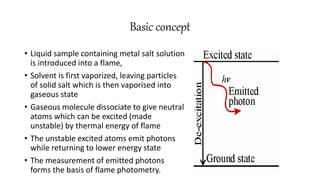
• Liquid sample containing metal salt solution
is introduced into a flame,
• Solvent is first vaporized, leaving particles
of solid salt which is then vaporised into
gaseous state
• Gaseous molecule dissociate to give neutral
atoms which can be excited (made
unstable) by thermal energy of flame
• The unstable excited atoms emit photons
while returning to lower energy state
• The measurement of emitted photons
forms the basis of flame photometry.
Continue….
• Under constant and controlled conditions, the light intensity of the
characteristic wavelength produced by each of the atoms is directly
proportional to the number of atoms that are emitting energy, which
in turn is directly proportional to the concentration of the substance
of interest in the sample.
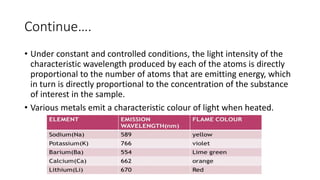
• Various metals emit a characteristic colour of light when heated.
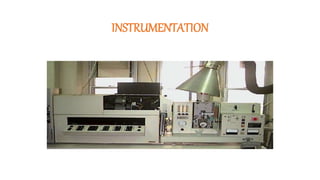
INSTRUMENTATION
8
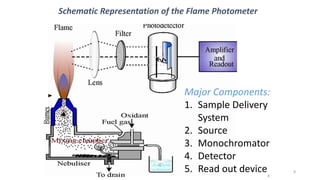
Major Components:
1. Sample Delivery
System
2. Source
3. Monochromator
4. Detector
5. Read out device8
Schematic Representation of the Flame Photometer
Sample Delivery System
There are three components for introducing liquid sample:
• Nebulizer – it breaks up the liquid into small droplets.
• Nebulization the is conversion of a sample to a mist of finely divided droplets
using a jet of compressed gas.
• The flow carries the sample into the atomization region.
• Pneumatic Nebulizers: (most common)
• Aerosol modifier – it removes large droplets from the stream and
allow only smaller droplets than a certain size to pass
• Flame or Atomizer – it converts the analyte into free atoms
Source
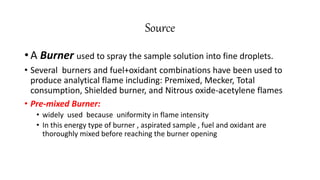
• A Burner used to spray the sample solution into fine droplets.
• Several burners and fuel+oxidant combinations have been used to
produce analytical flame including: Premixed, Mecker, Total
consumption, Shielded burner, and Nitrous oxide-acetylene flames
• Pre-mixed Burner:
• widely used because uniformity in flame intensity
• In this energy type of burner , aspirated sample , fuel and oxidant are
thoroughly mixed before reaching the burner opening
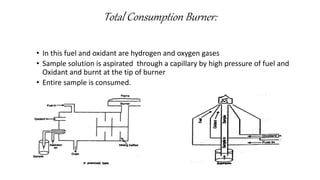
Total Consumption Burner:
• In this fuel and oxidant are hydrogen and oxygen gases
• Sample solution is aspirated through a capillary by high pressure of fuel and
Oxidant and burnt at the tip of burner
• Entire sample is consumed.
Monochromator:
• Prism: Quartz material is used for making prism, as quartz is
transparent over entire region
• Grating: it employs a grating which is essentially a series of parallel
straight lines cut into a plane surface
Detectors:
• Photomultiplier tubes
• Photo emissive cell
• Photo voltaic cell
Photovoltaic cell:
• It has a thin metallic layer coated with silver or gold which act
as electrode, also has metal base plate which act as another
electrode
• Two layers are separated by semiconductor layer of selenium,
when light radiation falls on selenium layer.
• This creates potential diff. between the two electrode and
cause flow of current.
12
Read-out Device:
• It is capable of displaying the absorption spectrum as well
absorbance at specific wavelength
• Nowadays the instruments have microprocessor controlled
electronics that provides outputs compatible with the printers
and computers
• Thereby minimizing the possibility of operator error in
transferring data.
13
Element wavelength Detection
limit
Element wavelength Detection
limit
Al 396 0.5 Pb 406 14
Ba 455 3 Li 461 0.067
Ca 423 0.07 Mg 285 1
Cu 325 0.6 Ni 355 1.6
Fe 372 2.5 Hg 254 2.5
Elements, their characteristic emission wavelengths and detection limits
APPLICATIONS:
• To estimate sodium, potassium, calcium, lithium etc. level
in sample of serum, urine, CSF and other body fluids.
• Flame photometry is useful for the determination of alkali
and alkaline earth metals.
• Used in determination of lead in petrol.
• Used in the study of equilibrium constants involving in ion
exchange resins.
• Used in determination of calcium and magnesium in
cement.
14

Flame photometry

  • 1.
  • 2.
    OBJECTVES • INTRODUCTION • PRINCIPLE •THEORY • INSTRUMENTATION • APPLICATIONS
  • 3.
    Introduction • Flame photometry(more accurately called Flame Atomic Emission Spectrometry)is a branch of spectroscopy in which the species examined in the spectrometer are in the form of atoms. • A photoelectric flame photometer is an instrument used in inorganic chemical analysis to determine the concentration of certain metal ions among them sodium, potassium, calcium and lithium. • Flame Photometry is based on measurement of intensity of the light emitted when a metal is introduced into flame. • The wavelength of colour tells what the element is (qualitative) • The colour's intensity tells us how much of the element present (quantitative)
  • 4.
    Principle and theory •The basic principle upon which Atomic Spectroscopy works is based on the fact that "Matter absorbs light at the same wavelength at which it emits light". • Atoms of elements  subjected to hot flame  specific quantum of thermal energy absorbed by orbital electrons  become unstable at high energy level  release energy as photons of particular wavelength  change back to ground state. • When a metal salt solution is burned, the metal provides a colored flame and each metal ion gives a different colored flame. • Flame tests, therefore, can be used to test for the absence or presence of a metal ion
  • 5.
    Basic concept • Liquidsample containing metal salt solution is introduced into a flame, • Solvent is first vaporized, leaving particles of solid salt which is then vaporised into gaseous state • Gaseous molecule dissociate to give neutral atoms which can be excited (made unstable) by thermal energy of flame • The unstable excited atoms emit photons while returning to lower energy state • The measurement of emitted photons forms the basis of flame photometry.
  • 6.
    Continue…. • Under constantand controlled conditions, the light intensity of the characteristic wavelength produced by each of the atoms is directly proportional to the number of atoms that are emitting energy, which in turn is directly proportional to the concentration of the substance of interest in the sample. • Various metals emit a characteristic colour of light when heated.
  • 7.
  • 8.
    8 Major Components: 1. SampleDelivery System 2. Source 3. Monochromator 4. Detector 5. Read out device8 Schematic Representation of the Flame Photometer
  • 9.
    Sample Delivery System Thereare three components for introducing liquid sample: • Nebulizer – it breaks up the liquid into small droplets. • Nebulization the is conversion of a sample to a mist of finely divided droplets using a jet of compressed gas. • The flow carries the sample into the atomization region. • Pneumatic Nebulizers: (most common) • Aerosol modifier – it removes large droplets from the stream and allow only smaller droplets than a certain size to pass • Flame or Atomizer – it converts the analyte into free atoms
  • 10.
    Source • A Burnerused to spray the sample solution into fine droplets. • Several burners and fuel+oxidant combinations have been used to produce analytical flame including: Premixed, Mecker, Total consumption, Shielded burner, and Nitrous oxide-acetylene flames • Pre-mixed Burner: • widely used because uniformity in flame intensity • In this energy type of burner , aspirated sample , fuel and oxidant are thoroughly mixed before reaching the burner opening
  • 11.
    Total Consumption Burner: •In this fuel and oxidant are hydrogen and oxygen gases • Sample solution is aspirated through a capillary by high pressure of fuel and Oxidant and burnt at the tip of burner • Entire sample is consumed.
  • 12.
    Monochromator: • Prism: Quartzmaterial is used for making prism, as quartz is transparent over entire region • Grating: it employs a grating which is essentially a series of parallel straight lines cut into a plane surface Detectors: • Photomultiplier tubes • Photo emissive cell • Photo voltaic cell Photovoltaic cell: • It has a thin metallic layer coated with silver or gold which act as electrode, also has metal base plate which act as another electrode • Two layers are separated by semiconductor layer of selenium, when light radiation falls on selenium layer. • This creates potential diff. between the two electrode and cause flow of current. 12
  • 13.
    Read-out Device: • Itis capable of displaying the absorption spectrum as well absorbance at specific wavelength • Nowadays the instruments have microprocessor controlled electronics that provides outputs compatible with the printers and computers • Thereby minimizing the possibility of operator error in transferring data. 13 Element wavelength Detection limit Element wavelength Detection limit Al 396 0.5 Pb 406 14 Ba 455 3 Li 461 0.067 Ca 423 0.07 Mg 285 1 Cu 325 0.6 Ni 355 1.6 Fe 372 2.5 Hg 254 2.5 Elements, their characteristic emission wavelengths and detection limits
  • 14.
    APPLICATIONS: • To estimatesodium, potassium, calcium, lithium etc. level in sample of serum, urine, CSF and other body fluids. • Flame photometry is useful for the determination of alkali and alkaline earth metals. • Used in determination of lead in petrol. • Used in the study of equilibrium constants involving in ion exchange resins. • Used in determination of calcium and magnesium in cement. 14