MRS. T. A. MANDHARE
NAVSAHYADRI INSTITUTE OF PHARMACY, NASRAPUR, PUNE.
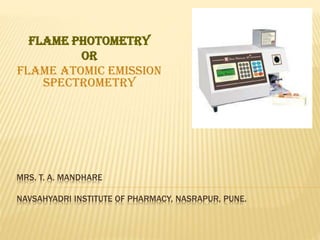
Flame Photometry
Or
Flame Atomic Emission
Spectrometry
CONTENT
 Introduction
 Principle
 Interferences
 Instrumentation
 Applications
Navsahyadri Pharmacy, Naigaon, Pune.
2
INTRODUCTION
 Flame Photometry or Flame Atomic Emission Spectrometry is a
branch of spectroscopy in which the species examined in the
spectrometer are in the form of atoms.
 Flame Photometer: “An instrument used in inorganic chemical
analysis to determine the concentration of certain metal ions,”
among them sodium, potassium, calcium and lithium.
 Flame Photometry is based on measurement of intensity of the light
emitted when a metal is introduced into flame.
 The wavelength of color tells us what the element is (qualitative).
 The color's intensity tells us how much of the element present
(quantitative).
Navsahyadri Pharmacy, Naigaon, Pune.
3
FLAME ATOMIC EMISSION SPECTROMETRY
 Flame photometry is also named as Flame Atomic Emission
Spectrometry because of the use of a flame to provide the
energy of excitation to atoms introduced into the flame.
 Flame photometry is simple, rapid method for the routine
determination of elements that can be easily excited.
Navsahyadri Pharmacy, Naigaon, Pune.
4
PRINCIPLE
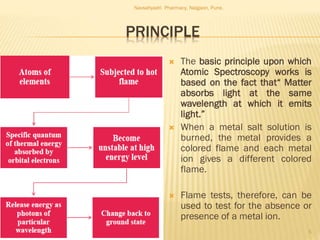
 The basic principle upon which
Atomic Spectroscopy works is
based on the fact that“ Matter
absorbs light at the same
wavelength at which it emits
light.”
 When a metal salt solution is
burned, the metal provides a
colored flame and each metal
ion gives a different colored
flame.
 Flame tests, therefore, can be
used to test for the absence or
presence of a metal ion.
Navsahyadri Pharmacy, Naigaon, Pune.
5
BASIC CONCEPT:
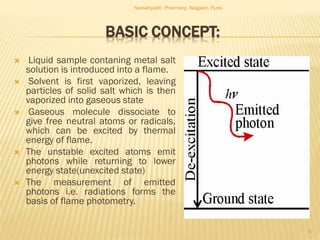
 Liquid sample contaning metal salt
solution is introduced into a flame.
 Solvent is first vaporized, leaving
particles of solid salt which is then
vaporized into gaseous state
 Gaseous molecule dissociate to
give free neutral atoms or radicals,
which can be excited by thermal
energy of flame.
 The unstable excited atoms emit
photons while returning to lower
energy state(unexcited state)
 The measurement of emitted
photons i.e. radiations forms the
basis of flame photometry.
Navsahyadri Pharmacy, Naigaon, Pune.
6
 Under constant and controlled conditions, the light intensity of
the characteristic wavelength produced by each of the atoms is
directly proportional to the number of atoms that are emitting
energy, which in turn is directly proportional to the
concentration of the substance of interest in the sample.
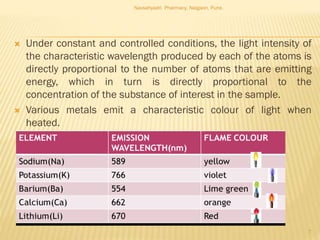
 Various metals emit a characteristic colour of light when
heated.
Navsahyadri Pharmacy, Naigaon, Pune.
7
BOLTZMANN LAW
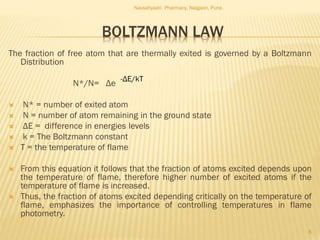
The fraction of free atom that are thermally exited is governed by a Boltzmann
Distribution
N*/N= Δe
 N* = number of exited atom
 N = number of atom remaining in the ground state
 ΔE = difference in energies levels
 k = The Boltzmann constant
 T = the temperature of flame
 From this equation it follows that the fraction of atoms excited depends upon
the temperature of flame, therefore higher number of excited atoms if the
temperature of flame is increased.
 Thus, the fraction of atoms excited depending critically on the temperature of
flame, emphasizes the importance of controlling temperatures in flame
photometry.
Navsahyadri Pharmacy, Naigaon, Pune.
8
-ΔE/kT
SCHEIBE-LOMAKIN EQUATION
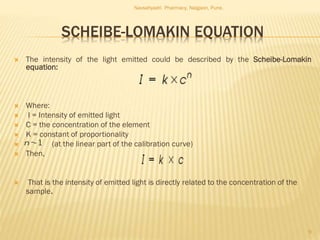
 The intensity of the light emitted could be described by the Scheibe-Lomakin
equation:
 Where:
 I = Intensity of emitted light
 C = the concentration of the element
 K = constant of proportionality
 (at the linear part of the calibration curve)
 Then,
 That is the intensity of emitted light is directly related to the concentration of the
sample.
Navsahyadri Pharmacy, Naigaon, Pune.
9
INTERFERENCES
Navsahyadri Pharmacy, Naigaon, Pune.
10
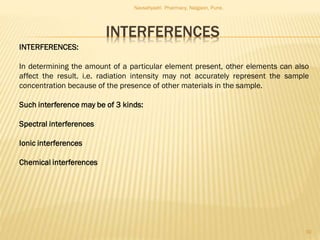
INTERFERENCES:
In determining the amount of a particular element present, other elements can also
affect the result. i.e. radiation intensity may not accurately represent the sample
concentration because of the presence of other materials in the sample.
Such interference may be of 3 kinds:
Spectral interferences
Ionic interferences
Chemical interferences
SPECTRAL INTERFERENCES
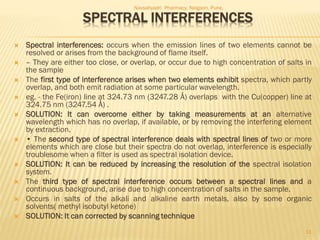
 Spectral interferences: occurs when the emission lines of two elements cannot be
resolved or arises from the background of flame itself.
 – They are either too close, or overlap, or occur due to high concentration of salts in
the sample
 The first type of interference arises when two elements exhibit spectra, which partly
overlap, and both emit radiation at some particular wavelength.
 eg. - the Fe(iron) line at 324.73 nm (3247.28 Å) overlaps with the Cu(copper) line at
324.75 nm (3247.54 Å) .
 SOLUTION: It can overcome either by taking measurements at an alternative
wavelength which has no overlap, if available, or by removing the interfering element
by extraction.
 • The second type of spectral interference deals with spectral lines of two or more
elements which are close but their spectra do not overlap, interference is especially
troublesome when a filter is used as spectral isolation device.
 SOLUTION: It can be reduced by increasing the resolution of the spectral isolation
system.
 The third type of spectral interference occurs between a spectral lines and a
continuous background, arise due to high concentration of salts in the sample.
 Occurs in salts of the alkali and alkaline earth metals, also by some organic
solvents( methyl isobutyl ketone)
 SOLUTION: It can corrected by scanning technique
Navsahyadri Pharmacy, Naigaon, Pune.
11
IONIC INTERFERENCES
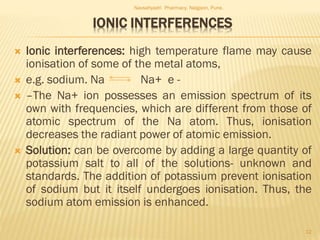
 Ionic interferences: high temperature flame may cause
ionisation of some of the metal atoms,
 e.g. sodium. Na Na+ e -
 –The Na+ ion possesses an emission spectrum of its
own with frequencies, which are different from those of
atomic spectrum of the Na atom. Thus, ionisation
decreases the radiant power of atomic emission.
 Solution: can be overcome by adding a large quantity of
potassium salt to all of the solutions- unknown and
standards. The addition of potassium prevent ionisation
of sodium but it itself undergoes ionisation. Thus, the
sodium atom emission is enhanced.
Navsahyadri Pharmacy, Naigaon, Pune.
12
 Chemical interferences: The chemical interferences arise out of the reaction
between different interferents and the analyte.
Includes:
 • Cation-anaion interference:
 – The presence of certain anions, such as oxalate, phosphate, sulfate, in a
solution may affect the intensity of radiation emitted by an element.
 E.g.,– calcium + phosphate ion forms a stable substance, as Ca3(PO4)2 which
does not decompose easily, resulting in the production of lesser atoms.
 • Cation-cation interference:
 – These interferences are neither spectral nor ionic in nature
 – Eg. aluminum interferes with calcium and magnesium.
 • Oxide formation interference:
 - Arises due to the formation of stable oxides with free metal atoms if the oxygen
is present in the flame, thus the emission intensity is lowered because a large
percentage of free metal atom have been removed from the flame.
 - All alkaline earth elements form oxides.
Navsahyadri Pharmacy, Naigaon, Pune.
13
CHEMICAL INTERFERENCES
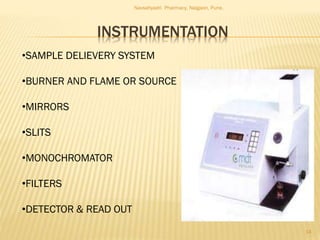
INSTRUMENTATION
Navsahyadri Pharmacy, Naigaon, Pune.
14
•SAMPLE DELIEVERY SYSTEM
•BURNER AND FLAME OR SOURCE
•MIRRORS
•SLITS
•MONOCHROMATOR
•FILTERS
•DETECTOR & READ OUT
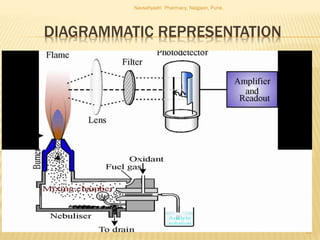
DIAGRAMMATIC REPRESENTATION
Navsahyadri Pharmacy, Naigaon, Pune.
15
SAMPLE DELIVERY SYSTEM
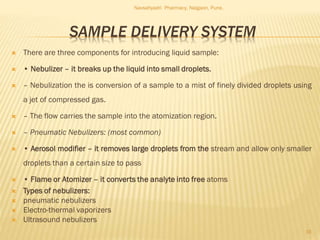
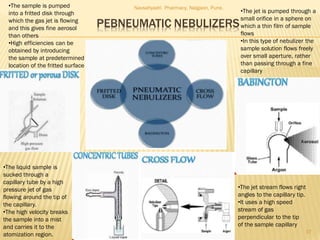
 There are three components for introducing liquid sample:
 • Nebulizer – it breaks up the liquid into small droplets.
 – Nebulization the is conversion of a sample to a mist of finely divided droplets using
a jet of compressed gas.
 – The flow carries the sample into the atomization region.
 – Pneumatic Nebulizers: (most common)
 • Aerosol modifier – it removes large droplets from the stream and allow only smaller
droplets than a certain size to pass
 • Flame or Atomizer – it converts the analyte into free atoms
 Types of nebulizers:
 pneumatic nebulizers
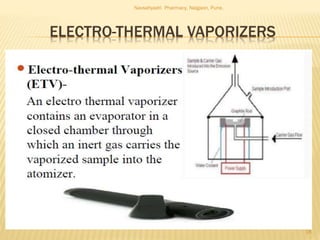
 Electro-thermal vaporizers
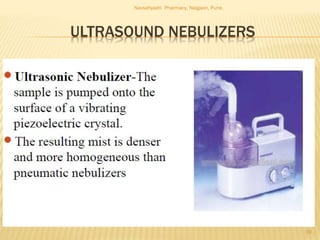
 Ultrasound nebulizers
Navsahyadri Pharmacy, Naigaon, Pune.
16
PEBNEUMATIC NEBULIZERS
Navsahyadri Pharmacy, Naigaon, Pune.
17
•The liquid sample is
sucked through a
capillary tube by a high
pressure jet of gas
flowing around the tip of
the capillary.
•The high velocity breaks
the sample into a mist
and carries it to the
atomization region.
•The jet stream flows right
angles to the capillary tip.
•It uses a high speed
stream of gas
perpendicular to the tip
of the sample capillary
•The jet is pumped through a
small orifice in a sphere on
which a thin film of sample
flows
•In this type of nebulizer the
sample solution flows freely
over small aperture, rather
than passing through a fine
capillary
•The sample is pumped
into a fritted disk through
which the gas jet is flowing
and this gives fine aerosol
than others
•High efficiencies can be
obtained by introducing
the sample at predetermined
location of the fritted surface
ELECTRO-THERMAL VAPORIZERS
Navsahyadri Pharmacy, Naigaon, Pune.
18
ULTRASOUND NEBULIZERS
Navsahyadri Pharmacy, Naigaon, Pune.
19
SOURCE: BURNER
 The flame used in flame photometer must possess
following functions-
 The flame should possess the ability to evaporate the liquid
droplets from the sample solution, resulting in the
formation of solid residues.
 The flame should decompose the compounds in the solid
residue formed above, resulting in the formation of atoms.
 The flame must have capacity to excite the atoms form in
above step and cause them to emit radiant energy.
 For analytical purposes, it becomes essential that emission
intensity should be steady over reasonable periods of
time(1-2 min).
Navsahyadri Pharmacy, Naigaon, Pune.
20
 The temperature of the flame, which is primarily
responsible for the occurrence of the above
mentioned processes is controlled by several factors
which are summarized as follows:
 Type of fuel and oxidant and fuel-to-oxidant ratio
 Type of solvent for preparing the sample solution
 Amount of solvent which is entering into the flame
 Type of burner employed in flame photometer
 The particular region in flame which is to be focused
into the entrance slit of the spectral isolation unit
Navsahyadri Pharmacy, Naigaon, Pune.
21
 Several burners and fuel+oxidant combinations have been
used to produce analytical flame including:
 Mecker burner,
 Total consumption burner,
 Premix of laminar- flow burner,
 Lundergardh burner,
 Shielded burner,
 Nitrous oxide-acetylene flames
Navsahyadri Pharmacy, Naigaon, Pune.
22
MECKER BURNER:
 This burner was used earlier and employed natural gas and
oxygen. As this burner produced relatively low temperatures and
low excitation energies, this was generally used for the study of
alkali metals only.
 Flame produced by Mecker burner is not homogeneous
chemically.
 It means that there are different regions in the flame that is an
oxidizing region and a reducing region appear in the flame. As
the processes leading to atomic excitation in the flame differ in
the oxidizing and reducing regions in flame, different
concentrations of excited atoms are obtained in these regions.
 These days mecker burner is not used.
Navsahyadri Pharmacy, Naigaon, Pune.
23
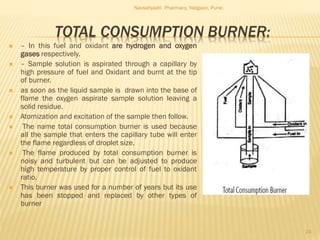
TOTAL CONSUMPTION BURNER:
 – In this fuel and oxidant are hydrogen and oxygen
gases respectively.
 – Sample solution is aspirated through a capillary by
high pressure of fuel and Oxidant and burnt at the tip
of burner.
 as soon as the liquid sample is drawn into the base of
flame the oxygen aspirate sample solution leaving a
solid residue.
 Atomization and excitation of the sample then follow.
 The name total consumption burner is used because
all the sample that enters the capillary tube will enter
the flame regardless of droplet size.
 The flame produced by total consumption burner is
noisy and turbulent but can be adjusted to produce
high temperature by proper control of fuel to oxidant
ratio.
 This burner was used for a number of years but its use
has been stopped and replaced by other types of
burner
Navsahyadri Pharmacy, Naigaon, Pune.
24
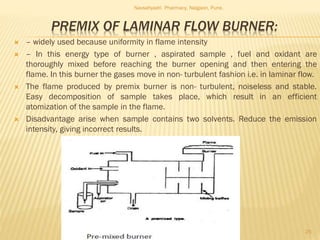
PREMIX OF LAMINAR FLOW BURNER:
 – widely used because uniformity in flame intensity
 – In this energy type of burner , aspirated sample , fuel and oxidant are
thoroughly mixed before reaching the burner opening and then entering the
flame. In this burner the gases move in non- turbulent fashion i.e. in laminar flow.
 The flame produced by premix burner is non- turbulent, noiseless and stable.
Easy decomposition of sample takes place, which result in an efficient
atomization of the sample in the flame.
 Disadvantage arise when sample contains two solvents. Reduce the emission
intensity, giving incorrect results.
Navsahyadri Pharmacy, Naigaon, Pune.
25
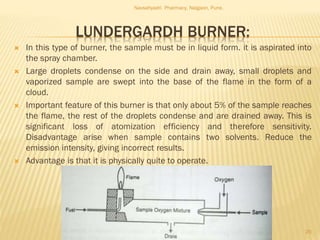
LUNDERGARDH BURNER:
 In this type of burner, the sample must be in liquid form. it is aspirated into
the spray chamber.
 Large droplets condense on the side and drain away, small droplets and
vaporized sample are swept into the base of the flame in the form of a
cloud.
 Important feature of this burner is that only about 5% of the sample reaches
the flame, the rest of the droplets condense and are drained away. This is
significant loss of atomization efficiency and therefore sensitivity.
Disadvantage arise when sample contains two solvents. Reduce the
emission intensity, giving incorrect results.
 Advantage is that it is physically quite to operate.
Navsahyadri Pharmacy, Naigaon, Pune.
26
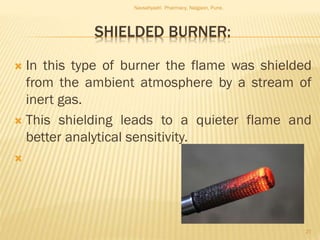
SHIELDED BURNER:
 In this type of burner the flame was shielded
from the ambient atmosphere by a stream of
inert gas.
 This shielding leads to a quieter flame and
better analytical sensitivity.

Navsahyadri Pharmacy, Naigaon, Pune.
27
NITROUS OXIDE-ACETYLENE FLAMES:
 During research in atomic absorption spectroscopy , J, Willis and M. Amos
independently found that nitrous oxide- acetylene flames were superior to
other flames for efficiently producing free atoms, particularly for metals with
very reflective oxides, such as aluminium and titanium.
 Disadvantage is that high temperature reduces its usefulness for the
determination of alkali metals because they are easily ionized.
 One problem encountered was the intense background emission, which
makes measurement of the metal emission very difficult.
 However, the “wobbler” designed by Rains for background correction and
the commercial nitrous oxide- acetylene burners developed provide
equipment capable of high sensitivity and accuracy.
Navsahyadri Pharmacy, Naigaon, Pune.
28
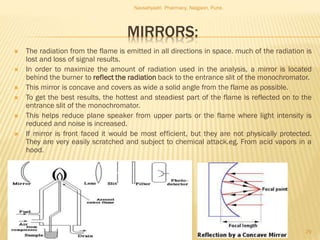
MIRRORS:
 The radiation from the flame is emitted in all directions in space. much of the radiation is
lost and loss of signal results.
 In order to maximize the amount of radiation used in the analysis, a mirror is located
behind the burner to reflect the radiation back to the entrance slit of the monochromator.
 This mirror is concave and covers as wide a solid angle from the flame as possible.
 To get the best results, the hottest and steadiest part of the flame is reflected on to the
entrance slit of the monochromator.
 This helps reduce plane speaker from upper parts or the flame where light intensity is
reduced and noise is increased.
 If mirror is front faced it would be most efficient, but they are not physically protected.
They are very easily scratched and subject to chemical attack.eg. From acid vapors in a
hood.
Navsahyadri Pharmacy, Naigaon, Pune.
29
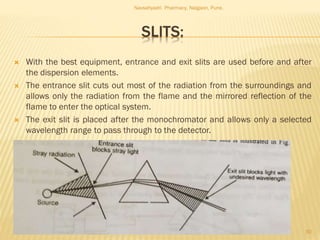
SLITS:
 With the best equipment, entrance and exit slits are used before and after
the dispersion elements.
 The entrance slit cuts out most of the radiation from the surroundings and
allows only the radiation from the flame and the mirrored reflection of the
flame to enter the optical system.
 The exit slit is placed after the monochromator and allows only a selected
wavelength range to pass through to the detector.
Navsahyadri Pharmacy, Naigaon, Pune.
30
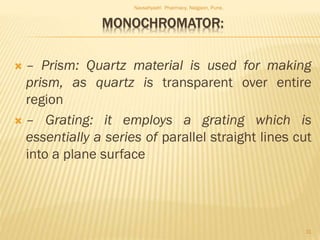
MONOCHROMATOR:
 – Prism: Quartz material is used for making
prism, as quartz is transparent over entire
region
 – Grating: it employs a grating which is
essentially a series of parallel straight lines cut
into a plane surface
Navsahyadri Pharmacy, Naigaon, Pune.
31
FILTERS:
 In some elements, the emission spectrum contains a few lines.
In such cases wide wavelength ranges will be allowed to enter
the detector causing any serious error.
 In such situation, an optical filter may be used in place of slit
and monochromator system.
Navsahyadri Pharmacy, Naigaon, Pune.
32
DETECTORS:
 The radiation coming from the optical system is
allowed to fall on the detector which measure the
intensity of radiation fallowing on it.
 – Photomultiplier tubes
 – Photo emissive cell
 – Photo voltaic cell
Navsahyadri Pharmacy, Naigaon, Pune.
33
READ-OUT DEVICE
 • It is capable of displaying the absorption spectrum as well absorbance at
specific wavelength
 • Nowadays the instruments have microprocessor controlled electronics
that provides outputs compatible with the printers and computers
 • Thereby minimizing the possibility of operator error in transferring data.
Navsahyadri Pharmacy, Naigaon, Pune.
34
APPLICATIONS
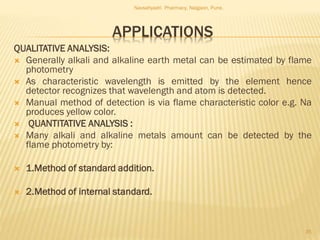
QUALITATIVE ANALYSIS:
 Generally alkali and alkaline earth metal can be estimated by flame
photometry
 As characteristic wavelength is emitted by the element hence
detector recognizes that wavelength and atom is detected.
 Manual method of detection is via flame characteristic color e.g. Na
produces yellow color.
 QUANTITATIVE ANALYSIS :
 Many alkali and alkaline metals amount can be detected by the
flame photometry by:
 1.Method of standard addition.
 2.Method of internal standard.
Navsahyadri Pharmacy, Naigaon, Pune.
35
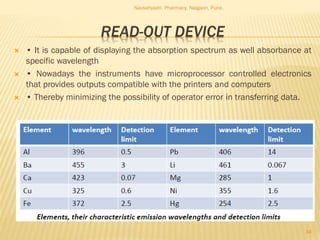
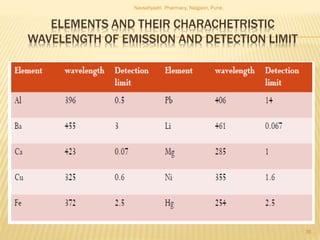
ELEMENTS AND THEIR CHARACHETRISTIC
WAVELENGTH OF EMISSION AND DETECTION LIMIT
Navsahyadri Pharmacy, Naigaon, Pune.
36
OTHER APPLICATIONS:
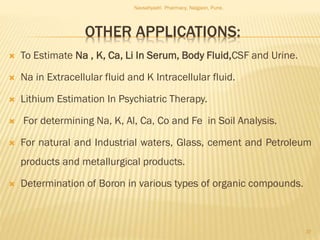
 To Estimate Na , K, Ca, Li In Serum, Body Fluid,CSF and Urine.
 Na in Extracellular fluid and K Intracellular fluid.
 Lithium Estimation In Psychiatric Therapy.
 For determining Na, K, Al, Ca, Co and Fe in Soil Analysis.
 For natural and Industrial waters, Glass, cement and Petroleum
products and metallurgical products.
 Determination of Boron in various types of organic compounds.
Navsahyadri Pharmacy, Naigaon, Pune.
37
REFERENCES
 Practical Biochemistry, Principles & Techniques,
Cambridge low-price editions, 5th Edition, Edited By Keith
Wilson & John Walker, Chapter: Spectroscopic Techniques,
Pages : 486-490.
 Chatwal & Anand; Instrumental Methods of Chemical
Analysis, 5/e 2013, page no- 2.370 to 2.375, Himalaya
Publishing House.
 B.K Sharma; Instrumental Methods of Chemical Analysis,
26/e 2007, page no- 430 to 437, GOEL Publishing House.
Navsahyadri Pharmacy, Naigaon, Pune.
38
Navsahyadri Pharmacy, Naigaon, Pune.
39

Flame photometry

  • 1.
    MRS. T. A.MANDHARE NAVSAHYADRI INSTITUTE OF PHARMACY, NASRAPUR, PUNE. Flame Photometry Or Flame Atomic Emission Spectrometry
  • 2.
    CONTENT  Introduction  Principle Interferences  Instrumentation  Applications Navsahyadri Pharmacy, Naigaon, Pune. 2
  • 3.
    INTRODUCTION  Flame Photometryor Flame Atomic Emission Spectrometry is a branch of spectroscopy in which the species examined in the spectrometer are in the form of atoms.  Flame Photometer: “An instrument used in inorganic chemical analysis to determine the concentration of certain metal ions,” among them sodium, potassium, calcium and lithium.  Flame Photometry is based on measurement of intensity of the light emitted when a metal is introduced into flame.  The wavelength of color tells us what the element is (qualitative).  The color's intensity tells us how much of the element present (quantitative). Navsahyadri Pharmacy, Naigaon, Pune. 3
  • 4.
    FLAME ATOMIC EMISSIONSPECTROMETRY  Flame photometry is also named as Flame Atomic Emission Spectrometry because of the use of a flame to provide the energy of excitation to atoms introduced into the flame.  Flame photometry is simple, rapid method for the routine determination of elements that can be easily excited. Navsahyadri Pharmacy, Naigaon, Pune. 4
  • 5.
    PRINCIPLE  The basicprinciple upon which Atomic Spectroscopy works is based on the fact that“ Matter absorbs light at the same wavelength at which it emits light.”  When a metal salt solution is burned, the metal provides a colored flame and each metal ion gives a different colored flame.  Flame tests, therefore, can be used to test for the absence or presence of a metal ion. Navsahyadri Pharmacy, Naigaon, Pune. 5
  • 6.
    BASIC CONCEPT:  Liquidsample contaning metal salt solution is introduced into a flame.  Solvent is first vaporized, leaving particles of solid salt which is then vaporized into gaseous state  Gaseous molecule dissociate to give free neutral atoms or radicals, which can be excited by thermal energy of flame.  The unstable excited atoms emit photons while returning to lower energy state(unexcited state)  The measurement of emitted photons i.e. radiations forms the basis of flame photometry. Navsahyadri Pharmacy, Naigaon, Pune. 6
  • 7.
     Under constantand controlled conditions, the light intensity of the characteristic wavelength produced by each of the atoms is directly proportional to the number of atoms that are emitting energy, which in turn is directly proportional to the concentration of the substance of interest in the sample.  Various metals emit a characteristic colour of light when heated. Navsahyadri Pharmacy, Naigaon, Pune. 7
  • 8.
    BOLTZMANN LAW The fractionof free atom that are thermally exited is governed by a Boltzmann Distribution N*/N= Δe  N* = number of exited atom  N = number of atom remaining in the ground state  ΔE = difference in energies levels  k = The Boltzmann constant  T = the temperature of flame  From this equation it follows that the fraction of atoms excited depends upon the temperature of flame, therefore higher number of excited atoms if the temperature of flame is increased.  Thus, the fraction of atoms excited depending critically on the temperature of flame, emphasizes the importance of controlling temperatures in flame photometry. Navsahyadri Pharmacy, Naigaon, Pune. 8 -ΔE/kT
  • 9.
    SCHEIBE-LOMAKIN EQUATION  Theintensity of the light emitted could be described by the Scheibe-Lomakin equation:  Where:  I = Intensity of emitted light  C = the concentration of the element  K = constant of proportionality  (at the linear part of the calibration curve)  Then,  That is the intensity of emitted light is directly related to the concentration of the sample. Navsahyadri Pharmacy, Naigaon, Pune. 9
  • 10.
    INTERFERENCES Navsahyadri Pharmacy, Naigaon,Pune. 10 INTERFERENCES: In determining the amount of a particular element present, other elements can also affect the result. i.e. radiation intensity may not accurately represent the sample concentration because of the presence of other materials in the sample. Such interference may be of 3 kinds: Spectral interferences Ionic interferences Chemical interferences
  • 11.
    SPECTRAL INTERFERENCES  Spectralinterferences: occurs when the emission lines of two elements cannot be resolved or arises from the background of flame itself.  – They are either too close, or overlap, or occur due to high concentration of salts in the sample  The first type of interference arises when two elements exhibit spectra, which partly overlap, and both emit radiation at some particular wavelength.  eg. - the Fe(iron) line at 324.73 nm (3247.28 Å) overlaps with the Cu(copper) line at 324.75 nm (3247.54 Å) .  SOLUTION: It can overcome either by taking measurements at an alternative wavelength which has no overlap, if available, or by removing the interfering element by extraction.  • The second type of spectral interference deals with spectral lines of two or more elements which are close but their spectra do not overlap, interference is especially troublesome when a filter is used as spectral isolation device.  SOLUTION: It can be reduced by increasing the resolution of the spectral isolation system.  The third type of spectral interference occurs between a spectral lines and a continuous background, arise due to high concentration of salts in the sample.  Occurs in salts of the alkali and alkaline earth metals, also by some organic solvents( methyl isobutyl ketone)  SOLUTION: It can corrected by scanning technique Navsahyadri Pharmacy, Naigaon, Pune. 11
  • 12.
    IONIC INTERFERENCES  Ionicinterferences: high temperature flame may cause ionisation of some of the metal atoms,  e.g. sodium. Na Na+ e -  –The Na+ ion possesses an emission spectrum of its own with frequencies, which are different from those of atomic spectrum of the Na atom. Thus, ionisation decreases the radiant power of atomic emission.  Solution: can be overcome by adding a large quantity of potassium salt to all of the solutions- unknown and standards. The addition of potassium prevent ionisation of sodium but it itself undergoes ionisation. Thus, the sodium atom emission is enhanced. Navsahyadri Pharmacy, Naigaon, Pune. 12
  • 13.
     Chemical interferences:The chemical interferences arise out of the reaction between different interferents and the analyte. Includes:  • Cation-anaion interference:  – The presence of certain anions, such as oxalate, phosphate, sulfate, in a solution may affect the intensity of radiation emitted by an element.  E.g.,– calcium + phosphate ion forms a stable substance, as Ca3(PO4)2 which does not decompose easily, resulting in the production of lesser atoms.  • Cation-cation interference:  – These interferences are neither spectral nor ionic in nature  – Eg. aluminum interferes with calcium and magnesium.  • Oxide formation interference:  - Arises due to the formation of stable oxides with free metal atoms if the oxygen is present in the flame, thus the emission intensity is lowered because a large percentage of free metal atom have been removed from the flame.  - All alkaline earth elements form oxides. Navsahyadri Pharmacy, Naigaon, Pune. 13 CHEMICAL INTERFERENCES
  • 14.
    INSTRUMENTATION Navsahyadri Pharmacy, Naigaon,Pune. 14 •SAMPLE DELIEVERY SYSTEM •BURNER AND FLAME OR SOURCE •MIRRORS •SLITS •MONOCHROMATOR •FILTERS •DETECTOR & READ OUT
  • 15.
  • 16.
    SAMPLE DELIVERY SYSTEM There are three components for introducing liquid sample:  • Nebulizer – it breaks up the liquid into small droplets.  – Nebulization the is conversion of a sample to a mist of finely divided droplets using a jet of compressed gas.  – The flow carries the sample into the atomization region.  – Pneumatic Nebulizers: (most common)  • Aerosol modifier – it removes large droplets from the stream and allow only smaller droplets than a certain size to pass  • Flame or Atomizer – it converts the analyte into free atoms  Types of nebulizers:  pneumatic nebulizers  Electro-thermal vaporizers  Ultrasound nebulizers Navsahyadri Pharmacy, Naigaon, Pune. 16
  • 17.
    PEBNEUMATIC NEBULIZERS Navsahyadri Pharmacy,Naigaon, Pune. 17 •The liquid sample is sucked through a capillary tube by a high pressure jet of gas flowing around the tip of the capillary. •The high velocity breaks the sample into a mist and carries it to the atomization region. •The jet stream flows right angles to the capillary tip. •It uses a high speed stream of gas perpendicular to the tip of the sample capillary •The jet is pumped through a small orifice in a sphere on which a thin film of sample flows •In this type of nebulizer the sample solution flows freely over small aperture, rather than passing through a fine capillary •The sample is pumped into a fritted disk through which the gas jet is flowing and this gives fine aerosol than others •High efficiencies can be obtained by introducing the sample at predetermined location of the fritted surface
  • 18.
  • 19.
  • 20.
    SOURCE: BURNER  Theflame used in flame photometer must possess following functions-  The flame should possess the ability to evaporate the liquid droplets from the sample solution, resulting in the formation of solid residues.  The flame should decompose the compounds in the solid residue formed above, resulting in the formation of atoms.  The flame must have capacity to excite the atoms form in above step and cause them to emit radiant energy.  For analytical purposes, it becomes essential that emission intensity should be steady over reasonable periods of time(1-2 min). Navsahyadri Pharmacy, Naigaon, Pune. 20
  • 21.
     The temperatureof the flame, which is primarily responsible for the occurrence of the above mentioned processes is controlled by several factors which are summarized as follows:  Type of fuel and oxidant and fuel-to-oxidant ratio  Type of solvent for preparing the sample solution  Amount of solvent which is entering into the flame  Type of burner employed in flame photometer  The particular region in flame which is to be focused into the entrance slit of the spectral isolation unit Navsahyadri Pharmacy, Naigaon, Pune. 21
  • 22.
     Several burnersand fuel+oxidant combinations have been used to produce analytical flame including:  Mecker burner,  Total consumption burner,  Premix of laminar- flow burner,  Lundergardh burner,  Shielded burner,  Nitrous oxide-acetylene flames Navsahyadri Pharmacy, Naigaon, Pune. 22
  • 23.
    MECKER BURNER:  Thisburner was used earlier and employed natural gas and oxygen. As this burner produced relatively low temperatures and low excitation energies, this was generally used for the study of alkali metals only.  Flame produced by Mecker burner is not homogeneous chemically.  It means that there are different regions in the flame that is an oxidizing region and a reducing region appear in the flame. As the processes leading to atomic excitation in the flame differ in the oxidizing and reducing regions in flame, different concentrations of excited atoms are obtained in these regions.  These days mecker burner is not used. Navsahyadri Pharmacy, Naigaon, Pune. 23
  • 24.
    TOTAL CONSUMPTION BURNER: – In this fuel and oxidant are hydrogen and oxygen gases respectively.  – Sample solution is aspirated through a capillary by high pressure of fuel and Oxidant and burnt at the tip of burner.  as soon as the liquid sample is drawn into the base of flame the oxygen aspirate sample solution leaving a solid residue.  Atomization and excitation of the sample then follow.  The name total consumption burner is used because all the sample that enters the capillary tube will enter the flame regardless of droplet size.  The flame produced by total consumption burner is noisy and turbulent but can be adjusted to produce high temperature by proper control of fuel to oxidant ratio.  This burner was used for a number of years but its use has been stopped and replaced by other types of burner Navsahyadri Pharmacy, Naigaon, Pune. 24
  • 25.
    PREMIX OF LAMINARFLOW BURNER:  – widely used because uniformity in flame intensity  – In this energy type of burner , aspirated sample , fuel and oxidant are thoroughly mixed before reaching the burner opening and then entering the flame. In this burner the gases move in non- turbulent fashion i.e. in laminar flow.  The flame produced by premix burner is non- turbulent, noiseless and stable. Easy decomposition of sample takes place, which result in an efficient atomization of the sample in the flame.  Disadvantage arise when sample contains two solvents. Reduce the emission intensity, giving incorrect results. Navsahyadri Pharmacy, Naigaon, Pune. 25
  • 26.
    LUNDERGARDH BURNER:  Inthis type of burner, the sample must be in liquid form. it is aspirated into the spray chamber.  Large droplets condense on the side and drain away, small droplets and vaporized sample are swept into the base of the flame in the form of a cloud.  Important feature of this burner is that only about 5% of the sample reaches the flame, the rest of the droplets condense and are drained away. This is significant loss of atomization efficiency and therefore sensitivity. Disadvantage arise when sample contains two solvents. Reduce the emission intensity, giving incorrect results.  Advantage is that it is physically quite to operate. Navsahyadri Pharmacy, Naigaon, Pune. 26
  • 27.
    SHIELDED BURNER:  Inthis type of burner the flame was shielded from the ambient atmosphere by a stream of inert gas.  This shielding leads to a quieter flame and better analytical sensitivity.  Navsahyadri Pharmacy, Naigaon, Pune. 27
  • 28.
    NITROUS OXIDE-ACETYLENE FLAMES: During research in atomic absorption spectroscopy , J, Willis and M. Amos independently found that nitrous oxide- acetylene flames were superior to other flames for efficiently producing free atoms, particularly for metals with very reflective oxides, such as aluminium and titanium.  Disadvantage is that high temperature reduces its usefulness for the determination of alkali metals because they are easily ionized.  One problem encountered was the intense background emission, which makes measurement of the metal emission very difficult.  However, the “wobbler” designed by Rains for background correction and the commercial nitrous oxide- acetylene burners developed provide equipment capable of high sensitivity and accuracy. Navsahyadri Pharmacy, Naigaon, Pune. 28
  • 29.
    MIRRORS:  The radiationfrom the flame is emitted in all directions in space. much of the radiation is lost and loss of signal results.  In order to maximize the amount of radiation used in the analysis, a mirror is located behind the burner to reflect the radiation back to the entrance slit of the monochromator.  This mirror is concave and covers as wide a solid angle from the flame as possible.  To get the best results, the hottest and steadiest part of the flame is reflected on to the entrance slit of the monochromator.  This helps reduce plane speaker from upper parts or the flame where light intensity is reduced and noise is increased.  If mirror is front faced it would be most efficient, but they are not physically protected. They are very easily scratched and subject to chemical attack.eg. From acid vapors in a hood. Navsahyadri Pharmacy, Naigaon, Pune. 29
  • 30.
    SLITS:  With thebest equipment, entrance and exit slits are used before and after the dispersion elements.  The entrance slit cuts out most of the radiation from the surroundings and allows only the radiation from the flame and the mirrored reflection of the flame to enter the optical system.  The exit slit is placed after the monochromator and allows only a selected wavelength range to pass through to the detector. Navsahyadri Pharmacy, Naigaon, Pune. 30
  • 31.
    MONOCHROMATOR:  – Prism:Quartz material is used for making prism, as quartz is transparent over entire region  – Grating: it employs a grating which is essentially a series of parallel straight lines cut into a plane surface Navsahyadri Pharmacy, Naigaon, Pune. 31
  • 32.
    FILTERS:  In someelements, the emission spectrum contains a few lines. In such cases wide wavelength ranges will be allowed to enter the detector causing any serious error.  In such situation, an optical filter may be used in place of slit and monochromator system. Navsahyadri Pharmacy, Naigaon, Pune. 32
  • 33.
    DETECTORS:  The radiationcoming from the optical system is allowed to fall on the detector which measure the intensity of radiation fallowing on it.  – Photomultiplier tubes  – Photo emissive cell  – Photo voltaic cell Navsahyadri Pharmacy, Naigaon, Pune. 33

  • 34.
    READ-OUT DEVICE  •It is capable of displaying the absorption spectrum as well absorbance at specific wavelength  • Nowadays the instruments have microprocessor controlled electronics that provides outputs compatible with the printers and computers  • Thereby minimizing the possibility of operator error in transferring data. Navsahyadri Pharmacy, Naigaon, Pune. 34
  • 35.
    APPLICATIONS QUALITATIVE ANALYSIS:  Generallyalkali and alkaline earth metal can be estimated by flame photometry  As characteristic wavelength is emitted by the element hence detector recognizes that wavelength and atom is detected.  Manual method of detection is via flame characteristic color e.g. Na produces yellow color.  QUANTITATIVE ANALYSIS :  Many alkali and alkaline metals amount can be detected by the flame photometry by:  1.Method of standard addition.  2.Method of internal standard. Navsahyadri Pharmacy, Naigaon, Pune. 35
  • 36.
    ELEMENTS AND THEIRCHARACHETRISTIC WAVELENGTH OF EMISSION AND DETECTION LIMIT Navsahyadri Pharmacy, Naigaon, Pune. 36
  • 37.
    OTHER APPLICATIONS:  ToEstimate Na , K, Ca, Li In Serum, Body Fluid,CSF and Urine.  Na in Extracellular fluid and K Intracellular fluid.  Lithium Estimation In Psychiatric Therapy.  For determining Na, K, Al, Ca, Co and Fe in Soil Analysis.  For natural and Industrial waters, Glass, cement and Petroleum products and metallurgical products.  Determination of Boron in various types of organic compounds. Navsahyadri Pharmacy, Naigaon, Pune. 37
  • 38.
    REFERENCES  Practical Biochemistry,Principles & Techniques, Cambridge low-price editions, 5th Edition, Edited By Keith Wilson & John Walker, Chapter: Spectroscopic Techniques, Pages : 486-490.  Chatwal & Anand; Instrumental Methods of Chemical Analysis, 5/e 2013, page no- 2.370 to 2.375, Himalaya Publishing House.  B.K Sharma; Instrumental Methods of Chemical Analysis, 26/e 2007, page no- 430 to 437, GOEL Publishing House. Navsahyadri Pharmacy, Naigaon, Pune. 38
  • 39.