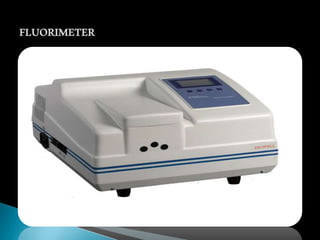
Presentation on “ Fluorimetry and
its Application
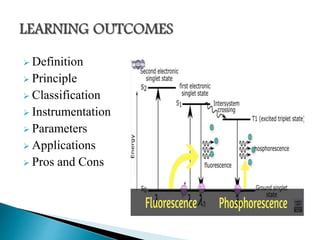
 Definition
 Principle
 Classification
 Instrumentation
 Parameters
 Applications
 Pros and Cons
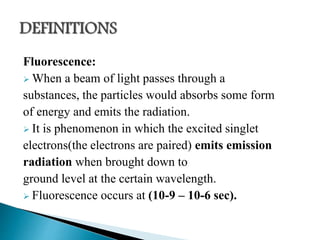
Fluorescence:
 When a beam of light passes through a
substances, the particles would absorbs some form
of energy and emits the radiation.
 It is phenomenon in which the excited singlet
electrons(the electrons are paired) emits emission
radiation when brought down to
ground level at the certain wavelength.
 Fluorescence occurs at (10-9 – 10-6 sec).
 It is a type of electromagnetic spectroscopy that
analyses the fluorescence from the sample.
 It involves the use of beam of light, usually ultra
violet light that excites the electrons in the molecules
of certain compounds (fluorescence substances) and
that produces a light of lower energy
 The principle involved is Vibrational relaxation.
 Molecules have bonding (σ) electrons and
(π)electrons and n non bonding electrons.
 When the excited electrons absorbs the radiant
energy, the bonding electrons gets down to anti
bonding orbital.
 Has high energy but less stable.
 it is a instantenous process
The factors effecting fluorescence intensity are
 Concentration
 Quantum yield of fluorescence
 Intensity of incident light
 Adsorption
 Oxygen
 pH
 Temperature & Viscosity
 Photodecomposition
 Quenchers
 Scatter
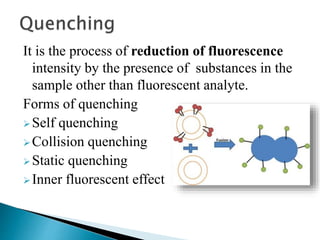
It is the process of reduction of fluorescence
intensity by the presence of substances in the
sample other than fluorescent analyte.
Forms of quenching
Self quenching
Collision quenching
Static quenching
Inner fluorescent effect
Contd.,
Self quenching:
Fluorescence intensity with
concentration.
Static quenching:
Due to complex formation between fluorescent
analyte and substances.
Collision quenching:
Collision between fluorescent substances and
halide ions.
Inner fluorescent effect:
Absorption of incident light by filters
decreases the fluorescent intensity.
 Test solutions prepared for fluorescence
spectrophotometer are usually 10 times to 100 times
less concentrated than those used in absorption
spectrophotometer.
 Concentrations of 10-5-10-7 mol/l are frequently
used.
 Blank should be not less than 0.40 and not more than
2.50.
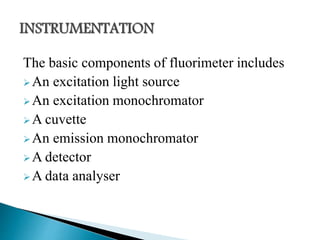
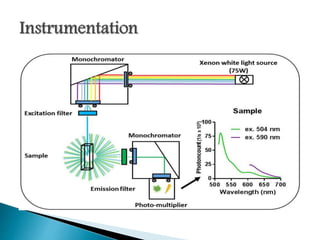
The basic components of fluorimeter includes
An excitation light source
An excitation monochromator
A cuvette
An emission monochromator
A detector
A data analyser
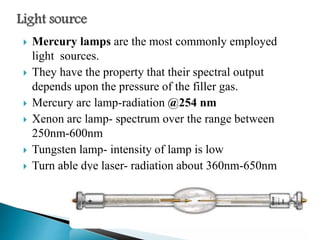
 Mercury lamps are the most commonly employed
light sources.
 They have the property that their spectral output
depends upon the pressure of the filler gas.
 Mercury arc lamp-radiation @254 nm
 Xenon arc lamp- spectrum over the range between
250nm-600nm
 Tungsten lamp- intensity of lamp is low
 Turn able dye laser- radiation about 360nm-650nm
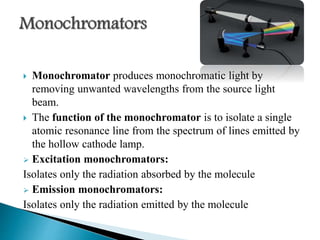
 Monochromator produces monochromatic light by
removing unwanted wavelengths from the source light
beam.
 The function of the monochromator is to isolate a single
atomic resonance line from the spectrum of lines emitted by
the hollow cathode lamp.
 Excitation monochromators:
Isolates only the radiation absorbed by the molecule
 Emission monochromators:
Isolates only the radiation emitted by the molecule
The proper selection of filters requires
familiarity with the emission spectrum and
the excitation spectrum.
Primary filter:
It absorbs the visible light and transmits UV light.
Secondary filter:
It absorbs the UV light and transmits visible light.
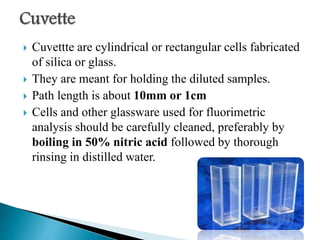
 Cuvettte are cylindrical or rectangular cells fabricated
of silica or glass.
 They are meant for holding the diluted samples.
 Path length is about 10mm or 1cm
 Cells and other glassware used for fluorimetric
analysis should be carefully cleaned, preferably by
boiling in 50% nitric acid followed by thorough
rinsing in distilled water.
Detectors are device or instrument designed to
detect the presence of a particular object or
substance.
Three forms of detectors are
 Photovoltaic cell
 Phototube
 Photomultiplier tube.
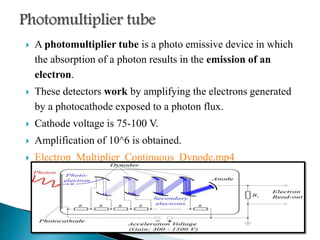
 A photomultiplier tube is a photo emissive device in which
the absorption of a photon results in the emission of an
electron.
 These detectors work by amplifying the electrons generated
by a photocathode exposed to a photon flux.
 Cathode voltage is 75-100 V.
 Amplification of 10^6 is obtained.
 Electron_Multiplier_Continuous_Dynode.mp4
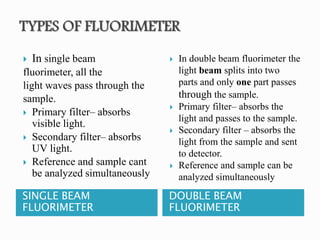
SINGLE BEAM
FLUORIMETER
DOUBLE BEAM
FLUORIMETER
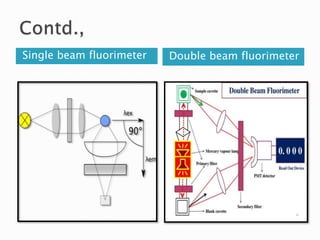
 In single beam
fluorimeter, all the
light waves pass through the
sample.
 Primary filter– absorbs
visible light.
 Secondary filter– absorbs
UV light.
 Reference and sample cant
be analyzed simultaneously
 In double beam fluorimeter the
light beam splits into two
parts and only one part passes
through the sample.
 Primary filter– absorbs the
light and passes to the sample.
 Secondary filter – absorbs the
light from the sample and sent
to detector.
 Reference and sample can be
analyzed simultaneously
Single beam fluorimeter Double beam fluorimeter
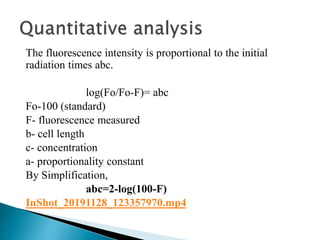
The fluorescence intensity is proportional to the initial
radiation times abc.
log(Fo/Fo-F)= abc
Fo-100 (standard)
F- fluorescence measured
b- cell length
c- concentration
a- proportionality constant
By Simplification,
abc=2-log(100-F)
InShot_20191128_123357970.mp4
 Determination of inorganic substances;
 Determination of thiamine
 Determination of indoles, phenols, phenothiazines.
 Napthols ,proteins ,plant pigment and steroids can be
determined.
 Detection of impurities at nanogram quantities.
 Detection of respiratory tract infection.
 Determines phenyltoin.
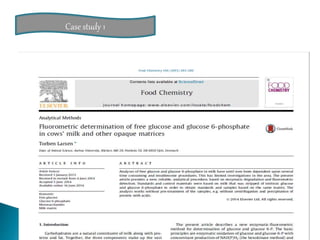
Case study 1
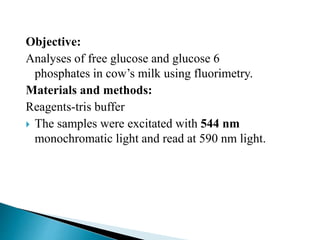
Objective:
Analyses of free glucose and glucose 6
phosphates in cow’s milk using fluorimetry.
Materials and methods:
Reagents-tris buffer
 The samples were excitated with 544 nm
monochromatic light and read at 590 nm light.
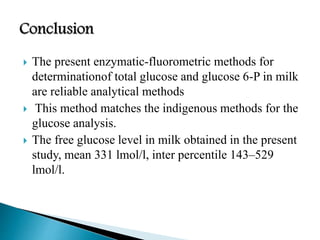
 The present enzymatic-fluorometric methods for
determinationof total glucose and glucose 6-P in milk
are reliable analytical methods
 This method matches the indigenous methods for the
glucose analysis.
 The free glucose level in milk obtained in the present
study, mean 331 lmol/l, inter percentile 143–529
lmol/l.
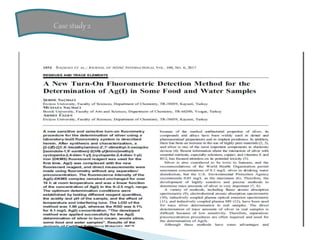
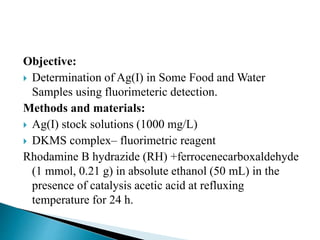
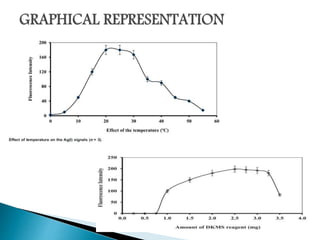
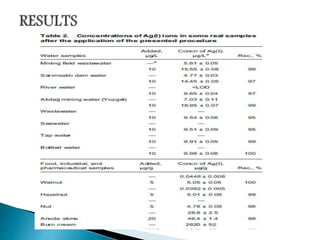
Objective:
 Determination of Ag(I) in Some Food and Water
Samples using fluorimeteric detection.
Methods and materials:
 Ag(I) stock solutions (1000 mg/L)
 DKMS complex– fluorimetric reagent
Rhodamine B hydrazide (RH) +ferrocenecarboxaldehyde
(1 mmol, 0.21 g) in absolute ethanol (50 mL) in the
presence of catalysis acetic acid at refluxing
temperature for 24 h.
 The procedure is highly sensitive, as well as selective,
because it does not require the preparation of samples.
 Rapid response and high specificity
 The new sensitive system is inexpensive
 Has a low LOD (micrograms per liter).
 Easy in construction.
 Allows wide sample variation because it is
interference-free.
 This system minimizes analysis time and the manpower
needed
Fifield&kealey., principlkes and practice of analytical chemistry
(2000)
Syed&haddad ., textbook of analytical chemistry,(2011)
https://www.slideshare.net/sreevidyavemuri/fluorimetry-45064390
http://www.authorstream.com/Presentation/nalinisahoo-
2331005-fluorimetry/
https://www.chem.uci.edu/~dmitryf/manuals/Fundamentals/Fl
uorescence%20Spectroscopy.pdf
http://srmbiotech25.yolasite.com/resources/Applications_of_Fl
uorimetry_and_Phosphorimetry.pdf
https://www.nature.com/subjects/fluorescence-spectrometry
https://link.springer.com/journal/10895
https://www.ncbi.nlm.nih.gov/pmc/articles/PMC2662353/
Fluorimetry presentation

Fluorimetry presentation

  • 2.
    Presentation on “Fluorimetry and its Application
  • 3.
     Definition  Principle Classification  Instrumentation  Parameters  Applications  Pros and Cons
  • 4.
    Fluorescence:  When abeam of light passes through a substances, the particles would absorbs some form of energy and emits the radiation.  It is phenomenon in which the excited singlet electrons(the electrons are paired) emits emission radiation when brought down to ground level at the certain wavelength.  Fluorescence occurs at (10-9 – 10-6 sec).
  • 5.
     It isa type of electromagnetic spectroscopy that analyses the fluorescence from the sample.  It involves the use of beam of light, usually ultra violet light that excites the electrons in the molecules of certain compounds (fluorescence substances) and that produces a light of lower energy
  • 6.
     The principleinvolved is Vibrational relaxation.  Molecules have bonding (σ) electrons and (π)electrons and n non bonding electrons.  When the excited electrons absorbs the radiant energy, the bonding electrons gets down to anti bonding orbital.  Has high energy but less stable.  it is a instantenous process
  • 7.
    The factors effectingfluorescence intensity are  Concentration  Quantum yield of fluorescence  Intensity of incident light  Adsorption  Oxygen  pH  Temperature & Viscosity  Photodecomposition  Quenchers  Scatter
  • 8.
    It is theprocess of reduction of fluorescence intensity by the presence of substances in the sample other than fluorescent analyte. Forms of quenching Self quenching Collision quenching Static quenching Inner fluorescent effect
  • 9.
    Contd., Self quenching: Fluorescence intensitywith concentration. Static quenching: Due to complex formation between fluorescent analyte and substances. Collision quenching: Collision between fluorescent substances and halide ions. Inner fluorescent effect: Absorption of incident light by filters decreases the fluorescent intensity.
  • 10.
     Test solutionsprepared for fluorescence spectrophotometer are usually 10 times to 100 times less concentrated than those used in absorption spectrophotometer.  Concentrations of 10-5-10-7 mol/l are frequently used.  Blank should be not less than 0.40 and not more than 2.50.
  • 12.
    The basic componentsof fluorimeter includes An excitation light source An excitation monochromator A cuvette An emission monochromator A detector A data analyser
  • 14.
     Mercury lampsare the most commonly employed light sources.  They have the property that their spectral output depends upon the pressure of the filler gas.  Mercury arc lamp-radiation @254 nm  Xenon arc lamp- spectrum over the range between 250nm-600nm  Tungsten lamp- intensity of lamp is low  Turn able dye laser- radiation about 360nm-650nm
  • 15.
     Monochromator producesmonochromatic light by removing unwanted wavelengths from the source light beam.  The function of the monochromator is to isolate a single atomic resonance line from the spectrum of lines emitted by the hollow cathode lamp.  Excitation monochromators: Isolates only the radiation absorbed by the molecule  Emission monochromators: Isolates only the radiation emitted by the molecule
  • 16.
    The proper selectionof filters requires familiarity with the emission spectrum and the excitation spectrum. Primary filter: It absorbs the visible light and transmits UV light. Secondary filter: It absorbs the UV light and transmits visible light.
  • 17.
     Cuvettte arecylindrical or rectangular cells fabricated of silica or glass.  They are meant for holding the diluted samples.  Path length is about 10mm or 1cm  Cells and other glassware used for fluorimetric analysis should be carefully cleaned, preferably by boiling in 50% nitric acid followed by thorough rinsing in distilled water.
  • 18.
    Detectors are deviceor instrument designed to detect the presence of a particular object or substance. Three forms of detectors are  Photovoltaic cell  Phototube  Photomultiplier tube.
  • 19.
     A photomultipliertube is a photo emissive device in which the absorption of a photon results in the emission of an electron.  These detectors work by amplifying the electrons generated by a photocathode exposed to a photon flux.  Cathode voltage is 75-100 V.  Amplification of 10^6 is obtained.  Electron_Multiplier_Continuous_Dynode.mp4
  • 20.
    SINGLE BEAM FLUORIMETER DOUBLE BEAM FLUORIMETER In single beam fluorimeter, all the light waves pass through the sample.  Primary filter– absorbs visible light.  Secondary filter– absorbs UV light.  Reference and sample cant be analyzed simultaneously  In double beam fluorimeter the light beam splits into two parts and only one part passes through the sample.  Primary filter– absorbs the light and passes to the sample.  Secondary filter – absorbs the light from the sample and sent to detector.  Reference and sample can be analyzed simultaneously
  • 21.
    Single beam fluorimeterDouble beam fluorimeter
  • 22.
    The fluorescence intensityis proportional to the initial radiation times abc. log(Fo/Fo-F)= abc Fo-100 (standard) F- fluorescence measured b- cell length c- concentration a- proportionality constant By Simplification, abc=2-log(100-F) InShot_20191128_123357970.mp4
  • 23.
     Determination ofinorganic substances;  Determination of thiamine  Determination of indoles, phenols, phenothiazines.  Napthols ,proteins ,plant pigment and steroids can be determined.  Detection of impurities at nanogram quantities.  Detection of respiratory tract infection.  Determines phenyltoin.
  • 24.
  • 25.
    Objective: Analyses of freeglucose and glucose 6 phosphates in cow’s milk using fluorimetry. Materials and methods: Reagents-tris buffer  The samples were excitated with 544 nm monochromatic light and read at 590 nm light.
  • 26.
     The presentenzymatic-fluorometric methods for determinationof total glucose and glucose 6-P in milk are reliable analytical methods  This method matches the indigenous methods for the glucose analysis.  The free glucose level in milk obtained in the present study, mean 331 lmol/l, inter percentile 143–529 lmol/l.
  • 28.
    Objective:  Determination ofAg(I) in Some Food and Water Samples using fluorimeteric detection. Methods and materials:  Ag(I) stock solutions (1000 mg/L)  DKMS complex– fluorimetric reagent Rhodamine B hydrazide (RH) +ferrocenecarboxaldehyde (1 mmol, 0.21 g) in absolute ethanol (50 mL) in the presence of catalysis acetic acid at refluxing temperature for 24 h.
  • 31.
     The procedureis highly sensitive, as well as selective, because it does not require the preparation of samples.  Rapid response and high specificity  The new sensitive system is inexpensive  Has a low LOD (micrograms per liter).  Easy in construction.  Allows wide sample variation because it is interference-free.  This system minimizes analysis time and the manpower needed
  • 32.
    Fifield&kealey., principlkes andpractice of analytical chemistry (2000) Syed&haddad ., textbook of analytical chemistry,(2011) https://www.slideshare.net/sreevidyavemuri/fluorimetry-45064390 http://www.authorstream.com/Presentation/nalinisahoo- 2331005-fluorimetry/ https://www.chem.uci.edu/~dmitryf/manuals/Fundamentals/Fl uorescence%20Spectroscopy.pdf http://srmbiotech25.yolasite.com/resources/Applications_of_Fl uorimetry_and_Phosphorimetry.pdf https://www.nature.com/subjects/fluorescence-spectrometry https://link.springer.com/journal/10895 https://www.ncbi.nlm.nih.gov/pmc/articles/PMC2662353/