z
Flame photometry
Flame atomic emission spectroscopy
School of pharmacy and paramedical
sciences
K.K.UNIVERSITY
Bihar sharif nalanda (Bihar) - 803115
Presented by:
RAJY GOPAL PATHAK
EN. NO.- 21080100057
Sem/year’s – 7th
/4th
Bachelor’s of pharmacy
Session- 2021-25
z
Introduction:
• During 1980s Bowling Barnes, David Richardson, John Berry and Robert Hood
developed an instrument to measure the low concentrations of sodium and
potassium in a solution.
• They named this instrument as Flame photometer.
• The principle of flame photometer is based on the measurement of the emitted
light intensity when a metal is introduced into the flame.
• The wavelength of the colour gives information about the element and the colour of
the flame gives information about the amount of the element present in the sample.
• Flame photometry is one of the branches of atomic absorption
spectroscopy.
• It is also known as flame emission spectroscopy.
• Currently, it has become a necessary tool in the field of analytical
chemistry.
• Flame photometer can be used to determine the concentration of certain metal
ions like sodium, potassium, lithium, calcium and cesium etc.
• In flame photometer spectra the metal ions are used in the form of atoms.
z
Principle of Flame photometer
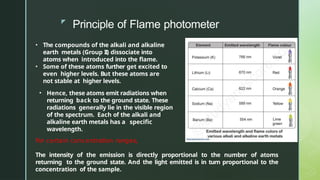
• The compounds of the alkali and alkaline
earth metals (Group II) dissociate into
atoms when introduced into the flame.
• Some of these atoms further get excited to
even higher levels. But these atoms are
not stable at higher levels.
• Hence, these atoms emit radiations when
returning back to the ground state. These
radiations generally lie in the visible region
of the spectrum. Each of the alkali and
alkaline earth metals has a specific
wavelength.
For certain concentration ranges,
The intensity of the emission is directly proportional to the number of atoms
returning to the ground state. And the light emitted is in turn proportional to the
concentration of the sample.
z
Parts of flame photometer
A simple flame photometer consists of the following basic components:
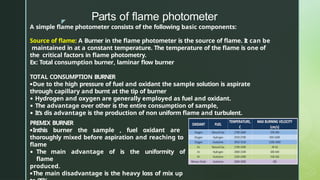
Source of flame: A Burner in the flame photometer is the source of flame. It can be
maintained in at a constant temperature. The temperature of the flame is one of
the critical factors in flame photometry.
Ex: Total consumption burner, laminar flow burner
TOTAL CONSUMPTION BURNER
•Due to the high pressure of fuel and oxidant the sample solution is aspirate
through capillary and burnt at the tip of burner
• Hydrogen and oxygen are generally employed as fuel and oxidant.
• The advantage over other is the entire consumption of sample,
• It’s dis advantage is the production of non uniform flame and turbulent.
PREMIX BURNER
•Inthis burner the sample , fuel oxidant are
thoroughly mixed before aspiration and reaching to
flame
• The main advantage of is the uniformity of
flame
produced.
•The main disadvantage is the heavy loss of mix up
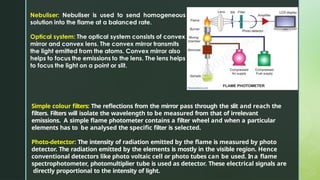
Simple colour filters: The reflections from the mirror pass through the slit and reach the
filters. Filters will isolate the wavelength to be measured from that of irrelevant
emissions. A simple flame photometer contains a filter wheel and when a particular
elements has to be analysed the specific filter is selected.
Photo-detector: The intensity of radiation emitted by the flame is measured by photo
detector. The radiation emitted by the elements is mostly in the visible region. Hence
conventional detectors like photo voltaic cell or photo tubes can be used. Ina flame
spectrophotometer, photomultiplier tube is used as detector. These electrical signals are
directly proportional to the intensity of light.
z Working procedure:
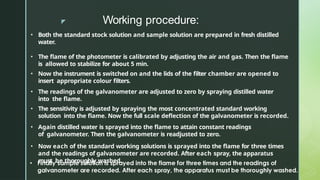
• Both the standard stock solution and sample solution are prepared in fresh distilled
water.
• The flame of the photometer is calibrated by adjusting the air and gas. Then the flame
is allowed to stabilize for about 5 min.
• Now the instrument is switched on and the lids of the filter chamber are opened to
insert appropriate colour filters.
• The readings of the galvanometer are adjusted to zero by spraying distilled water
into the flame.
• The sensitivity is adjusted by spraying the most concentrated standard working
solution into the flame. Now the full scale deflection of the galvanometer is recorded.
• Again distilled water is sprayed into the flame to attain constant readings
of galvanometer. Then the galvanometer is readjusted to zero.
• Now each of the standard working solutions is sprayed into the flame for three times
and the readings of galvanometer are recorded. After each spray, the apparatus
must be thoroughly washed.
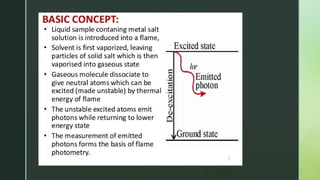
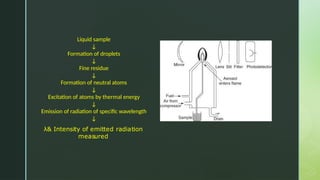
Liquid sample
↓
Formation of droplets
↓
Fine residue
↓
Formation of neutral atoms
↓
Excitation of atoms by thermal energy
↓
Emission of radiation of specific wavelength
↓
λ& Intensity of emitted radiation
measured
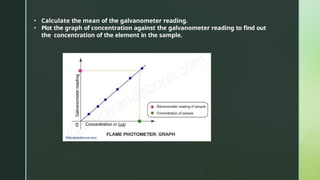
• Calculate the mean of the galvanometer reading.
• Plot the graph of concentration against the galvanometer reading to find out
the concentration of the element in the sample.
The oxidants in flame photometer are mainly air, oxygen or nitrous oxide. The
temperature of the flame depends on the ratio of fuel and oxidant.
The processes occurring during flame photometer analysis are summarized below:
Desolvation: Desolvation involves drying a sample in a solution. The metal particles
in the solvent are dehydrated by the flame and thus solvent is evaporated.
Vaporization: The metal particles in the sample are also dehydrated. This also led to
the evaporation of the solvent.
Atomization: Atomization is the separation of all atoms in a chemical substance. The
metal ions in the sample are reduced to metal atoms by the flame.
Excitation: The electrostatic force of attraction between the electrons and nucleus of the
atom helps them to absorb a particular amount of energy. The atoms then jump to the
higher energy state when excited.
Emission: Since the higher energy state is unstable the atoms jump back to the ground
state or low energy state to gain stability. This jumping of atoms emits radiation with
characteristic wavelength. The radiation is measured by the photo detector.
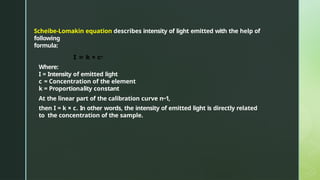
Scheibe-Lomakin equation describes intensity of light emitted with the help of
following
formula:
I = k × cn
Where:
I = Intensity of emitted light
c = Concentration of the element
k = Proportionality constant
At the linear part of the calibration curve n~1,
then I = k × c. In other words, the intensity of emitted light is directly related
to the concentration of the sample.
z
Applications of flame photometer
• Flame photometer can be applied both for quantitative and qualitative analysis of
elements. The radiations emitted by the flame photometer are characteristic to particular
metal. Hence with the help of Flame photometer we can detect the presence of any
specific element in the given sample.
• The presence of some group I
I elements is critical for soil health. We can determine the
presence of various alkali and alkaline earth metals in soil sample by conducting flame
test and then the soil can be supplied with specific fertiliser.
• The concentrations of Na+ and K+ ions are very important in the human body for
conducting various metabolic functions. Their concentrations can be determined by
diluting and aspirating blood serum sample into the flame.
• Soft drinks, fruit juices and alcoholic beverages can also be analysed by using flame
photometry to determine the concentrations of various metals and elements.
• Used in determination of calcium and magnesium in cement.
• Used in determination of lead in petrol.
z
Advantages of flame photometer
• The method of analysis is very simple and economical.
• It is quick, convenient, selective and sensitive analysis.
• It is both and qualitative and quantitative in nature.
• Even very low concentrations (parts per million/ppm to parts per billion/ppb
range) of metals in the sample can be determined.
• This method compensates for any unexpected interfering material present in
the sample solution.
• This method can be used to estimate elements which are rarely analysed.
z
Disadvantages of flame photometer
In spite of many advantages, this analysis technique has quite a few disadvantages:
• The accurate concentration of the metal ion in the solution cannot be measured.
• It cannot directly detect and determine the presence of inert gases.
• Though this technique measures the total metal content present in the sample, it does
not
provide the information about the molecular structure of the metal present in the sample.
• Only liquid samples may be used. Also sample preparation becomes lengthy in
some cases.
• Flame photometry cannot be used for the direct determination of each and every
metal atom. A number of metal atoms cannot be analysed by this method. The
elements such as carbon, hydrogen and halides cannot be detected due to their
non-radiating nature.
z
Thank you

flame photometry, principles,Application .pptx

  • 1.
    z Flame photometry Flame atomicemission spectroscopy School of pharmacy and paramedical sciences K.K.UNIVERSITY Bihar sharif nalanda (Bihar) - 803115 Presented by: RAJY GOPAL PATHAK EN. NO.- 21080100057 Sem/year’s – 7th /4th Bachelor’s of pharmacy Session- 2021-25
  • 2.
    z Introduction: • During 1980sBowling Barnes, David Richardson, John Berry and Robert Hood developed an instrument to measure the low concentrations of sodium and potassium in a solution. • They named this instrument as Flame photometer. • The principle of flame photometer is based on the measurement of the emitted light intensity when a metal is introduced into the flame. • The wavelength of the colour gives information about the element and the colour of the flame gives information about the amount of the element present in the sample. • Flame photometry is one of the branches of atomic absorption spectroscopy. • It is also known as flame emission spectroscopy. • Currently, it has become a necessary tool in the field of analytical chemistry. • Flame photometer can be used to determine the concentration of certain metal ions like sodium, potassium, lithium, calcium and cesium etc. • In flame photometer spectra the metal ions are used in the form of atoms.
  • 3.
    z Principle of Flamephotometer • The compounds of the alkali and alkaline earth metals (Group II) dissociate into atoms when introduced into the flame. • Some of these atoms further get excited to even higher levels. But these atoms are not stable at higher levels. • Hence, these atoms emit radiations when returning back to the ground state. These radiations generally lie in the visible region of the spectrum. Each of the alkali and alkaline earth metals has a specific wavelength. For certain concentration ranges, The intensity of the emission is directly proportional to the number of atoms returning to the ground state. And the light emitted is in turn proportional to the concentration of the sample.
  • 5.
    z Parts of flamephotometer A simple flame photometer consists of the following basic components: Source of flame: A Burner in the flame photometer is the source of flame. It can be maintained in at a constant temperature. The temperature of the flame is one of the critical factors in flame photometry. Ex: Total consumption burner, laminar flow burner TOTAL CONSUMPTION BURNER •Due to the high pressure of fuel and oxidant the sample solution is aspirate through capillary and burnt at the tip of burner • Hydrogen and oxygen are generally employed as fuel and oxidant. • The advantage over other is the entire consumption of sample, • It’s dis advantage is the production of non uniform flame and turbulent. PREMIX BURNER •Inthis burner the sample , fuel oxidant are thoroughly mixed before aspiration and reaching to flame • The main advantage of is the uniformity of flame produced. •The main disadvantage is the heavy loss of mix up
  • 6.
    Simple colour filters:The reflections from the mirror pass through the slit and reach the filters. Filters will isolate the wavelength to be measured from that of irrelevant emissions. A simple flame photometer contains a filter wheel and when a particular elements has to be analysed the specific filter is selected. Photo-detector: The intensity of radiation emitted by the flame is measured by photo detector. The radiation emitted by the elements is mostly in the visible region. Hence conventional detectors like photo voltaic cell or photo tubes can be used. Ina flame spectrophotometer, photomultiplier tube is used as detector. These electrical signals are directly proportional to the intensity of light.
  • 7.
    z Working procedure: •Both the standard stock solution and sample solution are prepared in fresh distilled water. • The flame of the photometer is calibrated by adjusting the air and gas. Then the flame is allowed to stabilize for about 5 min. • Now the instrument is switched on and the lids of the filter chamber are opened to insert appropriate colour filters. • The readings of the galvanometer are adjusted to zero by spraying distilled water into the flame. • The sensitivity is adjusted by spraying the most concentrated standard working solution into the flame. Now the full scale deflection of the galvanometer is recorded. • Again distilled water is sprayed into the flame to attain constant readings of galvanometer. Then the galvanometer is readjusted to zero. • Now each of the standard working solutions is sprayed into the flame for three times and the readings of galvanometer are recorded. After each spray, the apparatus must be thoroughly washed.
  • 8.
    Liquid sample ↓ Formation ofdroplets ↓ Fine residue ↓ Formation of neutral atoms ↓ Excitation of atoms by thermal energy ↓ Emission of radiation of specific wavelength ↓ λ& Intensity of emitted radiation measured
  • 9.
    • Calculate themean of the galvanometer reading. • Plot the graph of concentration against the galvanometer reading to find out the concentration of the element in the sample.
  • 10.
    The oxidants inflame photometer are mainly air, oxygen or nitrous oxide. The temperature of the flame depends on the ratio of fuel and oxidant. The processes occurring during flame photometer analysis are summarized below: Desolvation: Desolvation involves drying a sample in a solution. The metal particles in the solvent are dehydrated by the flame and thus solvent is evaporated. Vaporization: The metal particles in the sample are also dehydrated. This also led to the evaporation of the solvent. Atomization: Atomization is the separation of all atoms in a chemical substance. The metal ions in the sample are reduced to metal atoms by the flame. Excitation: The electrostatic force of attraction between the electrons and nucleus of the atom helps them to absorb a particular amount of energy. The atoms then jump to the higher energy state when excited. Emission: Since the higher energy state is unstable the atoms jump back to the ground state or low energy state to gain stability. This jumping of atoms emits radiation with characteristic wavelength. The radiation is measured by the photo detector.
  • 11.
    Scheibe-Lomakin equation describesintensity of light emitted with the help of following formula: I = k × cn Where: I = Intensity of emitted light c = Concentration of the element k = Proportionality constant At the linear part of the calibration curve n~1, then I = k × c. In other words, the intensity of emitted light is directly related to the concentration of the sample.
  • 12.
    z Applications of flamephotometer • Flame photometer can be applied both for quantitative and qualitative analysis of elements. The radiations emitted by the flame photometer are characteristic to particular metal. Hence with the help of Flame photometer we can detect the presence of any specific element in the given sample. • The presence of some group I I elements is critical for soil health. We can determine the presence of various alkali and alkaline earth metals in soil sample by conducting flame test and then the soil can be supplied with specific fertiliser. • The concentrations of Na+ and K+ ions are very important in the human body for conducting various metabolic functions. Their concentrations can be determined by diluting and aspirating blood serum sample into the flame. • Soft drinks, fruit juices and alcoholic beverages can also be analysed by using flame photometry to determine the concentrations of various metals and elements. • Used in determination of calcium and magnesium in cement. • Used in determination of lead in petrol.
  • 13.
    z Advantages of flamephotometer • The method of analysis is very simple and economical. • It is quick, convenient, selective and sensitive analysis. • It is both and qualitative and quantitative in nature. • Even very low concentrations (parts per million/ppm to parts per billion/ppb range) of metals in the sample can be determined. • This method compensates for any unexpected interfering material present in the sample solution. • This method can be used to estimate elements which are rarely analysed.
  • 14.
    z Disadvantages of flamephotometer In spite of many advantages, this analysis technique has quite a few disadvantages: • The accurate concentration of the metal ion in the solution cannot be measured. • It cannot directly detect and determine the presence of inert gases. • Though this technique measures the total metal content present in the sample, it does not provide the information about the molecular structure of the metal present in the sample. • Only liquid samples may be used. Also sample preparation becomes lengthy in some cases. • Flame photometry cannot be used for the direct determination of each and every metal atom. A number of metal atoms cannot be analysed by this method. The elements such as carbon, hydrogen and halides cannot be detected due to their non-radiating nature.
  • 15.