DIGESTION,
ABSORPTION &
TRANSPORT OF
DIETARY LIPIDS
Dr.UsmanSaleem
Overview
Digestion of
Dietary
Lipids
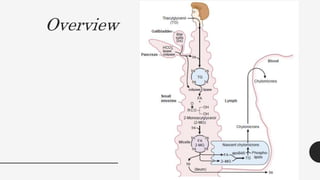
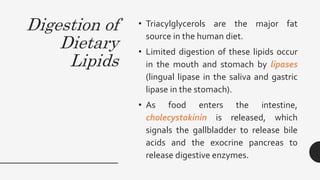
• Triacylglycerols are the major fat
source in the human diet.
• Limited digestion of these lipids occur
in the mouth and stomach by lipases
(lingual lipase in the saliva and gastric
lipase in the stomach).
• As food enters the intestine,
cholecystokinin is released, which
signals the gallbladder to release bile
acids and the exocrine pancreas to
release digestive enzymes.
Digestion of
Dietary
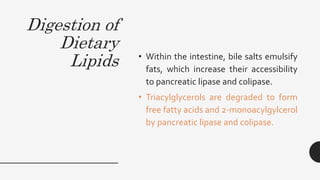
Lipids • Within the intestine, bile salts emulsify
fats, which increase their accessibility
to pancreatic lipase and colipase.
• Triacylglycerols are degraded to form
free fatty acids and 2-monoacylgylcerol
by pancreatic lipase and colipase.
Digestion of
Dietary
Lipids
• Dietary phospholipids are hydrolyzed
by pancreatic phospholipase A2 in the
intestine.
• Dietary cholesterol esters (cholesterol
esterified to a fatty acid) are
hydrolyzed by pancreatic cholesterol
esterase in the intestine.
Absorption
of Dietary
Lipids
• Micelles, consisting of bile acids and
the products of fat digestion, form
within the intestinal lumen and interact
with the enterocyte membrane.
• Lipid-soluble components diffuse from
the micelle into the intestinal epithelial
cell.
• Bile salts are resorbed farther down the
intestinal tract and returned to the liver
by the enterohepatic circulation.
Transport of
Dietary
Lipids in
the Blood
• The intestinal epithelial cells
resynthesize triacylglycerol and
package them into nascent (newborn)
chylomicrons for release into the
circulation.
• Once they are in the circulation, the
nascent chylomicrons interact with
HDL particles and acquire two
additional protein components:
 apoCII and
 apoE.
Transport of
Dietary
Lipids in
the Blood
• ApoCII activates lipoprotein lipase on
capillary endothelium of muscle and
adipose tissue, which digests the
triglycerides in the chylomicron.
Fate of
Chylomicrons
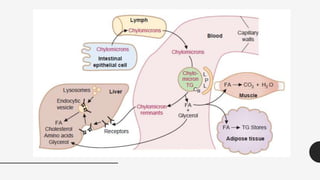
• The fatty acids released from the
chylomicron enter the muscle for
energy production or the fat cell for
storage.
• The glycerol released is metabolized
only in the liver.
• As the chylomicron loses triglyceride,
its density increases, and it becomes a
chylomicron remnant.
Fate of
Chylomicrons
• Chylomicron remnants are removed
from circulation by the liver through
specific binding of the remnant to apoE
receptors on the liver membrane.
• Once it is in the liver, the remnant is
degraded, and the lipids are recycled.
Lipids digestion

Lipids digestion

  • 1.
  • 2.
  • 3.
    Digestion of Dietary Lipids • Triacylglycerolsare the major fat source in the human diet. • Limited digestion of these lipids occur in the mouth and stomach by lipases (lingual lipase in the saliva and gastric lipase in the stomach). • As food enters the intestine, cholecystokinin is released, which signals the gallbladder to release bile acids and the exocrine pancreas to release digestive enzymes.
  • 4.
    Digestion of Dietary Lipids •Within the intestine, bile salts emulsify fats, which increase their accessibility to pancreatic lipase and colipase. • Triacylglycerols are degraded to form free fatty acids and 2-monoacylgylcerol by pancreatic lipase and colipase.
  • 5.
    Digestion of Dietary Lipids • Dietaryphospholipids are hydrolyzed by pancreatic phospholipase A2 in the intestine. • Dietary cholesterol esters (cholesterol esterified to a fatty acid) are hydrolyzed by pancreatic cholesterol esterase in the intestine.
  • 6.
    Absorption of Dietary Lipids • Micelles,consisting of bile acids and the products of fat digestion, form within the intestinal lumen and interact with the enterocyte membrane. • Lipid-soluble components diffuse from the micelle into the intestinal epithelial cell. • Bile salts are resorbed farther down the intestinal tract and returned to the liver by the enterohepatic circulation.
  • 7.
    Transport of Dietary Lipids in theBlood • The intestinal epithelial cells resynthesize triacylglycerol and package them into nascent (newborn) chylomicrons for release into the circulation. • Once they are in the circulation, the nascent chylomicrons interact with HDL particles and acquire two additional protein components:  apoCII and  apoE.
  • 8.
    Transport of Dietary Lipids in theBlood • ApoCII activates lipoprotein lipase on capillary endothelium of muscle and adipose tissue, which digests the triglycerides in the chylomicron.
  • 9.
    Fate of Chylomicrons • Thefatty acids released from the chylomicron enter the muscle for energy production or the fat cell for storage. • The glycerol released is metabolized only in the liver. • As the chylomicron loses triglyceride, its density increases, and it becomes a chylomicron remnant.
  • 10.
    Fate of Chylomicrons • Chylomicronremnants are removed from circulation by the liver through specific binding of the remnant to apoE receptors on the liver membrane. • Once it is in the liver, the remnant is degraded, and the lipids are recycled.