Fluorescence in situ
Hybridization {FISH}
Fluorescence in situ
Hybridization (FISH)
FISH - a process which vividly
paints chromosomes or portions
of chromosomes with
fluorescent molecules
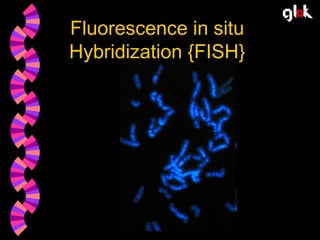
Opening picture - Human Mphase spread using DAPI stain
Fluorescence in situ
Hybridization (FISH)
Identifies chromosomal
abnormalities
Aids in gene mapping,
toxicological studies, analysis of
chromosome structural
aberrations, and ploidy
determination
Fluorescence in situ
Hybridization (FISH)
Used to identify the presence
and location of a region of DNA
or RNA within morphologically
preserved chromosome
preparations, fixed cells or
tissue sections
Fluorescence in situ
Hybridization (FISH)
This means you can view a
segment or entire chromosome
with your own eyes
Was often used during M phase
but is now used on I phase
chromosomes as well
Fluorescence in situ
Hybridization (FISH)
Advantage: less labor-intensive
method for confirming the
presence of a DNA segment
within an entire genome than
other conventional methods like
Southern blotting
FISH Procedure
Denature the chromosomes
Denature the probe
Hybridization
Fluorescence staining
Examine slides or store in the
dark
FISH Procedure
FISH Uses
Detection of high
concentrations of base pairs
e.g.: Mouse metaphase
preparation stained with DAPI
(a non-specific DNA binding
dye with high affinity for A-T
bonds)
FISH Uses
FISH Uses
Centromere regions stained
brighter - means they are rich in
A-T bonds
Also used in germ cell or
prenatal diagnosis of conditions
such as aneuploidies
FISH and Telomeres
Telomeric probes define the
terminal boundaries of
chromosomes (5’ and 3’ ends)
Used in research of
chromosomal rearrangements
and deletions related to cell
aging or other genetic
abnormalities
FISH and Telomeres
Special telomeric probes
specific to individual
chromosomes have been
designed
Probe is based on the TTAGGG
repeat present on all human
telomeres
FISH and Telomeres
FISH and Telomeres
Application in cytogenetic - can
detect submicroscopic deletions
and cryptic translocations of
genes associated with
unexplained mental retardation
and miscarriages
FISH - Medical
FISH can be used in the study
of transgenic animals (eg: Polly)
Selective markers show if the
human DNA was inserted
successfully and pinpoint where
the human DNA is
Transgenic Mouse
FISH - Medical
PRODUCTIONS

Fluorescence in situ Hybridization FISH #glok92

  • 1.
  • 2.
    Fluorescence in situ Hybridization(FISH) FISH - a process which vividly paints chromosomes or portions of chromosomes with fluorescent molecules Opening picture - Human Mphase spread using DAPI stain
  • 3.
    Fluorescence in situ Hybridization(FISH) Identifies chromosomal abnormalities Aids in gene mapping, toxicological studies, analysis of chromosome structural aberrations, and ploidy determination
  • 4.
    Fluorescence in situ Hybridization(FISH) Used to identify the presence and location of a region of DNA or RNA within morphologically preserved chromosome preparations, fixed cells or tissue sections
  • 5.
    Fluorescence in situ Hybridization(FISH) This means you can view a segment or entire chromosome with your own eyes Was often used during M phase but is now used on I phase chromosomes as well
  • 6.
    Fluorescence in situ Hybridization(FISH) Advantage: less labor-intensive method for confirming the presence of a DNA segment within an entire genome than other conventional methods like Southern blotting
  • 7.
    FISH Procedure Denature thechromosomes Denature the probe Hybridization Fluorescence staining Examine slides or store in the dark
  • 8.
  • 9.
    FISH Uses Detection ofhigh concentrations of base pairs e.g.: Mouse metaphase preparation stained with DAPI (a non-specific DNA binding dye with high affinity for A-T bonds)
  • 10.
  • 11.
    FISH Uses Centromere regionsstained brighter - means they are rich in A-T bonds Also used in germ cell or prenatal diagnosis of conditions such as aneuploidies
  • 12.
    FISH and Telomeres Telomericprobes define the terminal boundaries of chromosomes (5’ and 3’ ends) Used in research of chromosomal rearrangements and deletions related to cell aging or other genetic abnormalities
  • 13.
    FISH and Telomeres Specialtelomeric probes specific to individual chromosomes have been designed Probe is based on the TTAGGG repeat present on all human telomeres
  • 14.
  • 15.
    FISH and Telomeres Applicationin cytogenetic - can detect submicroscopic deletions and cryptic translocations of genes associated with unexplained mental retardation and miscarriages
  • 16.
    FISH - Medical FISHcan be used in the study of transgenic animals (eg: Polly) Selective markers show if the human DNA was inserted successfully and pinpoint where the human DNA is Transgenic Mouse
  • 17.
  • 18.